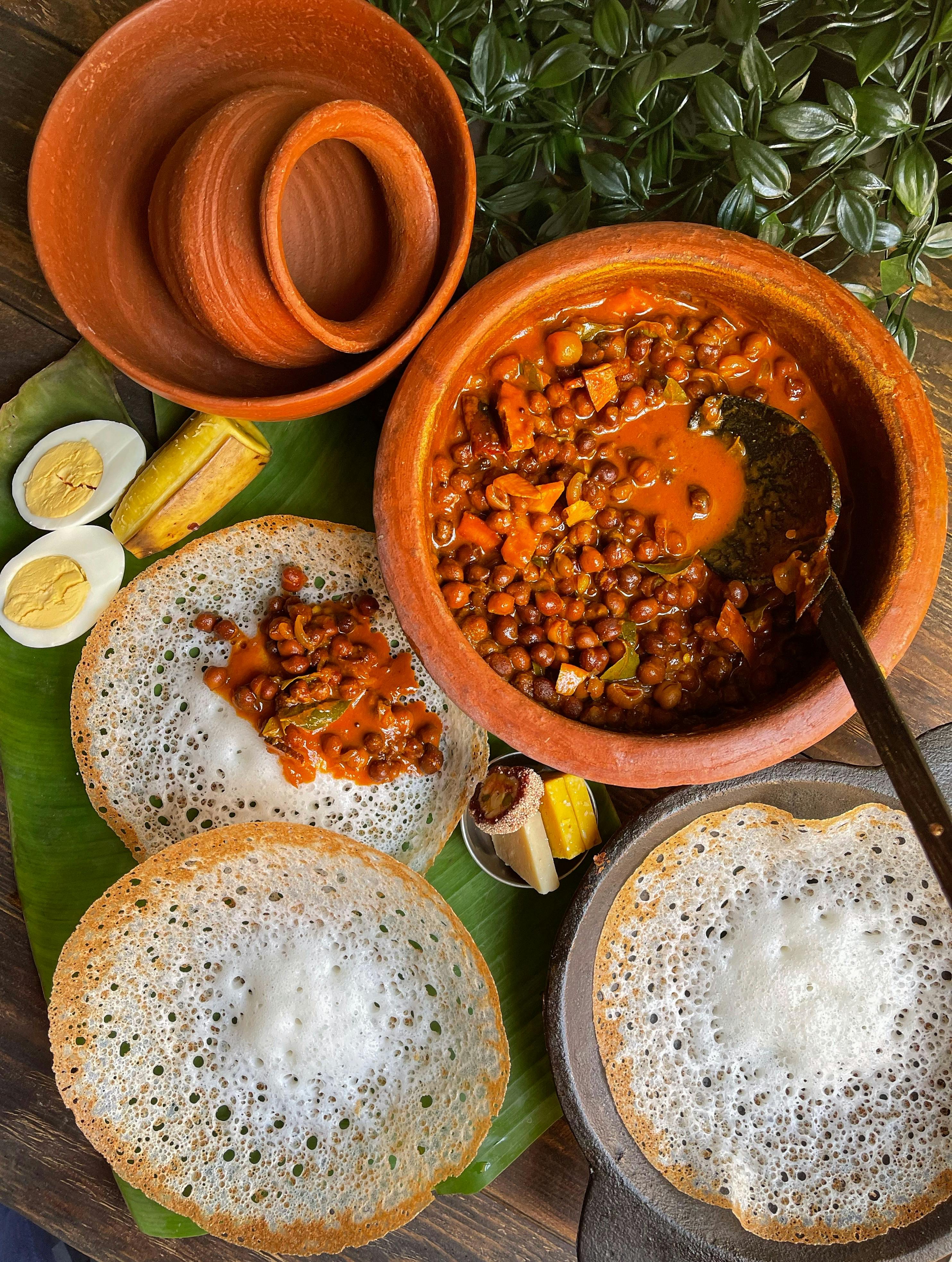
Photo: Saveurs Secretes / Pexels
Sri-Lankan
Hoppers
The diets react (see scores below)
Common Ingredients
- rice flour
- coconut milk
- yeast
- sugar
- salt
Specific recipes may vary.
Incompatible with 4 of 11 diets
Diet Ratings
Hoppers are Sri Lankan bowl-shaped pancakes made primarily from rice flour, which is a high-glycemic refined grain product with very high net carbs. A single hopper contains approximately 20-30g of net carbs from rice flour alone, easily exceeding or consuming the entire daily keto carb allowance in one serving. The addition of sugar further disqualifies this dish. While coconut milk is keto-friendly, it cannot offset the fundamentally incompatible carbohydrate load from the rice flour base. This dish is structurally built around a grain-based batter and is entirely incompatible with ketosis.
Hoppers (appa) are a traditional Sri Lankan fermented rice flour pancake made entirely from plant-based ingredients. All five components — rice flour, coconut milk, yeast, sugar, and salt — are fully vegan. Coconut milk is a plant-derived fat source, yeast is a fungus (not an animal product), and the remaining ingredients are standard pantry staples with no animal derivation. The dish is naturally gluten-free and represents a minimally processed whole-food preparation. Note that a common Sri Lankan variation, egg hoppers (bittara appa), includes a cracked egg in the centre — that variant would not be vegan — but the plain hopper as listed here contains no animal products whatsoever.
Hoppers are a Sri Lankan fermented rice flour crepe. The base ingredient is rice flour, which is a grain product and strictly excluded from the paleo diet. Additionally, the recipe includes added salt and refined sugar, both of which are non-paleo. Coconut milk is paleo-approved, and yeast in small amounts is generally tolerated, but these cannot redeem a dish fundamentally built on a grain-based flour. There is no meaningful substitution that would make this dish paleo in its traditional form.
Hoppers are a Sri Lankan fermented rice flour and coconut milk bowl-shaped pancake. From a Mediterranean diet perspective, they present a mixed profile. Rice flour is a refined grain, which is not ideal compared to whole grains, though fermentation via yeast may improve digestibility and glycemic impact somewhat. Coconut milk is a plant-based fat but is high in saturated fat, which is not the Mediterranean diet's preferred fat source (extra virgin olive oil is canonical). The small amount of sugar is minimal and not a primary concern. The dish is whole-food, minimally processed, and plant-based with no red meat or highly refined additives, which is positive. Overall, this falls into a moderate 'caution' category — acceptable occasionally but not a Mediterranean staple due to the refined rice flour base and coconut milk fat profile.
Some modern Mediterranean diet interpretations are more permissive about coconut milk as a plant-based fat, and fermented grain preparations are recognized in several traditional Mediterranean cultures (e.g., sourdough in Levantine and North African cuisines), which could push this dish toward a mild approval for occasional consumption.
Hoppers are a Sri Lankan fermented rice flour pancake made entirely from plant-based ingredients: rice flour (a grain), coconut milk (plant fat), yeast, sugar, and salt. There is not a single animal-derived ingredient in this dish. It is 100% plant-based, contains a grain (rice flour), added sugar, and plant oils (coconut). This is completely incompatible with the carnivore diet at every tier, including the most lenient 'animal-based' interpretations.
Hoppers contain two excluded ingredients: rice flour (a grain product — rice is explicitly excluded on Whole30) and sugar (added sugar is excluded). Even setting aside the sugar issue, rice flour alone disqualifies this dish. Furthermore, hoppers are a bowl-shaped fermented crepe/pancake, which falls squarely into the 'no recreating baked goods or junk food' rule — the Whole30 program explicitly lists crepes, pancakes, and wraps as prohibited food forms even when made with compliant ingredients. All three strikes apply here: excluded grain (rice flour), added sugar, and a prohibited food form (crepe/hopper shape).
Hoppers (appa) are a traditional Sri Lankan fermented rice flour and coconut milk pancake/bowl. Analyzing each ingredient: rice flour is low-FODMAP and well-tolerated; yeast used in fermentation is low-FODMAP in the amounts present in baked/cooked goods; sugar in small culinary quantities is low-FODMAP (sucrose is not a FODMAP); salt is FODMAP-free. The main consideration is coconut milk — Monash rates coconut milk as low-FODMAP at 1/2 cup (125ml) per serve, but high-FODMAP at larger quantities due to polyols (sorbitol). In a typical hopper, the coconut milk is distributed across multiple servings and diluted with rice flour, making the per-serving coconut milk content likely within safe limits. The fermentation process using yeast may further reduce any residual fermentable carbohydrates. Overall, hoppers at a standard 2-3 piece serving should be low-FODMAP for most individuals in the elimination phase.
Monash University has not specifically tested hoppers as a dish, so the assessment relies on individual ingredient analysis. Clinical FODMAP practitioners may advise caution around coconut milk quantity — if the recipe is coconut-milk-heavy or servings are large, total coconut milk intake could approach or exceed the 1/2 cup threshold per serve, risking polyol accumulation.
Hoppers are Sri Lankan bowl-shaped crepes made from fermented rice flour and coconut milk. While rice flour is a gluten-free grain and fermentation adds some probiotic benefit, the primary concern for DASH compatibility is the coconut milk, which is high in saturated fat from a tropical oil source — a category DASH explicitly limits. Coconut milk provides significant saturated fat (predominantly lauric acid), and DASH guidelines recommend limiting saturated fat and tropical oils including coconut. The dish also contains salt and sugar, though in modest amounts typical of a breakfast crepe. On the positive side, hoppers are not heavily processed, contain no red meat or trans fats, and are relatively low in sodium when prepared at home. Rice flour provides some carbohydrate energy but lacks the fiber of whole grains. Overall, hoppers can be consumed occasionally in moderation on a DASH diet, but the coconut milk saturated fat content prevents a full approval.
NIH DASH guidelines explicitly restrict saturated fat and tropical oils including coconut, making coconut milk-based dishes a concern. However, some updated clinical interpretations note that the saturated fat in coconut milk (rich in medium-chain triglycerides like lauric acid) may have a more neutral or complex effect on cardiovascular risk markers compared to long-chain saturated fats — some DASH-oriented dietitians may allow coconut milk in moderate culinary quantities rather than categorically excluding it.
Hoppers are a Sri Lankan fermented rice flour and coconut milk pancake/bowl. From a Zone perspective, they present several challenges. The primary carbohydrate source is rice flour, which is high-glycemic and refined — exactly the type of carbohydrate Dr. Sears classifies as 'unfavorable' in Zone terminology. Sugar is added, further spiking the glycemic load. Coconut milk contributes saturated fat rather than the preferred monounsaturated fat (olive oil, avocado, almonds). Crucially, there is no protein component — hoppers are essentially a pure carbohydrate delivery vehicle with saturated fat, making the 40/30/30 macro ratio structurally impossible to achieve within the dish itself. There are no vegetables, no lean protein, and no monounsaturated fat. While technically one could pair hoppers with a lean protein side (egg, fish curry) to approach Zone balance, the hopper itself scores poorly. The fermentation from yeast may marginally reduce glycemic impact, but not enough to offset the refined rice flour base. This sits at the low end of 'caution' bordering on 'avoid' specifically because the macro profile is so skewed — pure refined carbs plus saturated fat with zero protein.
Hoppers are traditional Sri Lankan bowl-shaped crepes made from fermented rice flour and coconut milk. The fermentation process (via yeast) is a mild positive — it slightly improves digestibility and may introduce modest probiotic-adjacent benefits. Coconut milk contains medium-chain triglycerides (MCTs), particularly lauric acid, which has a complex and debated relationship with inflammation — some research suggests it may support immune function, while others flag saturated fat content as a concern. Rice flour is a refined carbohydrate with a moderate-to-high glycemic index, lacking the fiber and micronutrients of whole grains, which is a mild negative. The small amount of sugar used in the batter is not significant at typical serving quantities. Salt is neutral at normal culinary levels. Overall, hoppers have no strongly pro-inflammatory ingredients (no seed oils, no trans fats, no HFCS, no processed additives), but they also lack notable anti-inflammatory properties — no omega-3s, antioxidants, or polyphenols. They occupy a neutral-to-mildly-caution zone: fine as an occasional part of a varied anti-inflammatory diet, especially when paired with anti-inflammatory accompaniments like coconut sambol, turmeric-spiced curries, or vegetables.
Coconut milk is the central contested ingredient here. Dr. Andrew Weil's anti-inflammatory guidelines caution against high saturated fat intake including from coconut products, while a growing number of functional medicine practitioners (including those following Paleo and ancestral diet frameworks) consider lauric acid in coconut milk to be neutral or even beneficial for inflammation, citing its antimicrobial and immune-modulating properties. The refined rice flour base would be flagged more strongly by low-glycemic anti-inflammatory advocates (such as those following The Zone or Blood Sugar Solution protocols) compared to the broader Weil-style framework, which is less glycemic-index focused.
Hoppers are fermented rice flour crepes made with coconut milk, yielding a light, lacy bowl-shaped pancake. They are relatively easy to digest (fermentation breaks down some starches), low in saturated fat compared to heavier coconut-milk dishes, and moderate in portion size — all mildly positive for GLP-1 patients. However, they score poorly on the two top priorities: they provide virtually no protein (no eggs, legumes, or animal protein listed) and minimal fiber (white rice flour is refined). The coconut milk adds saturated fat, and the small amount of sugar, while not excessive, adds empty calories. On a GLP-1 diet where every calorie must earn its nutritional keep, a dish that is primarily refined starch with moderate saturated fat and negligible protein or fiber is a poor standalone choice. It is not actively harmful in the way fried or very high-fat foods are, but it fails to support the core dietary goals. It becomes more acceptable if paired with a high-protein accompaniment (e.g., a poached egg inside — egg hoppers — or a lentil dhal), which is traditional in Sri Lankan cuisine. Evaluated as listed with no protein add-in, it earns a caution rating.
Some GLP-1-focused dietitians may be more permissive with hoppers than other refined-starch foods because the fermentation process lowers the glycemic impact somewhat and the portion is naturally small; they would argue the cultural context and palatability on low-appetite days makes it a reasonable vehicle food if paired correctly. Others would flag the saturated fat from coconut milk as a compounding concern given GLP-1-related slowed gastric emptying and nausea risk.
*See how scores were generated at our methodology page.
Nutritional profile
Six traits that cut across every diet.
Fiber & Plants
How much whole-plant food and fiber it delivers.
Healthy Fats
The quality of its fats (unsaturated, omega-3).
Whole / Unprocessed
How close it is to its natural, unprocessed form.
Gut Gentle
How easy it is on digestion (low FODMAP, few irritants).
Low Glycemic
How little it spikes your blood sugar.
Protein Density
How much protein it packs per calorie.
Controversy Index
Higher controversy = more disagreement between diets.
Diet-Specific Tips
 Vegan — 9/10
View tips
- Rice flour is 100% plant-based
- Coconut milk is a plant-derived ingredient with no animal components
- Yeast is a fungus, not an animal product — universally accepted as vegan
- Sugar and salt are vegan staples
- No animal products, by-products, or animal-derived additives present
- Plain hoppers are distinct from egg hoppers, which are non-vegan
- Fermented preparation is minimally processed, scoring highly under whole-food criteria
 Mediterranean — 5/10
View tips
- Rice flour is a refined grain, not a whole grain — not ideal for Mediterranean guidelines
- Coconut milk is high in saturated fat, diverging from olive oil as the preferred fat
- Fermentation via yeast is a positive factor, potentially improving glycemic and gut health profile
- No animal products, red meat, or highly processed ingredients — plant-based and whole-food
- Small amount of added sugar is minimal and not a primary concern
- Not a traditional Mediterranean food, so compatibility is interpreted rather than direct
 Low-FODMAP — 8/10
View tips
- Rice flour is inherently low-FODMAP and the primary ingredient
- Coconut milk is low-FODMAP at ≤1/2 cup (125ml) per serve — portion of coconut milk per hopper is the key variable
- Yeast in fermentation does not contribute meaningful FODMAPs in the final cooked product
- Sugar (sucrose) in small culinary amounts is not a FODMAP
- Fermentation process may further reduce fermentable carbohydrates
- No high-FODMAP ingredients (no wheat, garlic, onion, legumes, or lactose) present
- Standard 2-3 hopper serving likely keeps coconut milk within safe Monash thresholds
 DASH — 5/10
View tips
- Coconut milk is high in saturated fat from a tropical oil — explicitly limited by DASH guidelines
- Rice flour is refined and lacks the fiber benefit of whole grains
- Small amounts of added sugar and salt present but not excessive in typical preparation
- No lean protein, limiting nutritional density for a breakfast item
- Fermentation via yeast provides modest digestive benefit
- Portion size matters — a single hopper is relatively small, limiting overall saturated fat load
- Low-fat dairy or nut-based milk substitutes could improve DASH compatibility
 Zone — 5/10
View tips
- Rice flour is a refined, high-glycemic carbohydrate — classified as 'unfavorable' in Zone methodology
- Added sugar further elevates glycemic load
- Zero protein content makes 40/30/30 ratio impossible within the dish itself
- Coconut milk provides saturated fat, not the preferred monounsaturated fat
- No vegetables or low-glycemic carbohydrates present
- Fermentation from yeast may slightly moderate glycemic impact but does not fundamentally change the classification
- Could theoretically be paired with lean protein and vegetables to partially compensate, but the dish itself is deeply imbalanced
 Anti-Inflammatory — 5/10
View tips
- Rice flour is a refined carbohydrate with moderate-to-high glycemic index and low fiber — a mild negative
- Coconut milk provides saturated fat (lauric acid) with debated inflammatory profile
- Yeast fermentation is a modest positive for digestibility
- Small amount of sugar is not significant at typical culinary quantities
- No strongly pro-inflammatory ingredients (no seed oils, trans fats, HFCS, or artificial additives)
- No meaningful anti-inflammatory nutrients present (no omega-3s, polyphenols, antioxidants)
- Anti-inflammatory value depends heavily on accompaniments and overall dietary context
 GLP-1 Friendly — 4/10
View tips
- Negligible protein content — fails the #1 GLP-1 dietary priority
- Minimal fiber — refined rice flour provides little digestive support
- Coconut milk contributes saturated fat, which can worsen GLP-1 GI side effects
- Fermentation slightly reduces glycemic load compared to plain white rice flour preparations
- Naturally small portion size is a mild positive
- Significantly improved if paired with egg or legume-based accompaniment (not listed in ingredients)
- Empty-calorie risk on a reduced-appetite diet