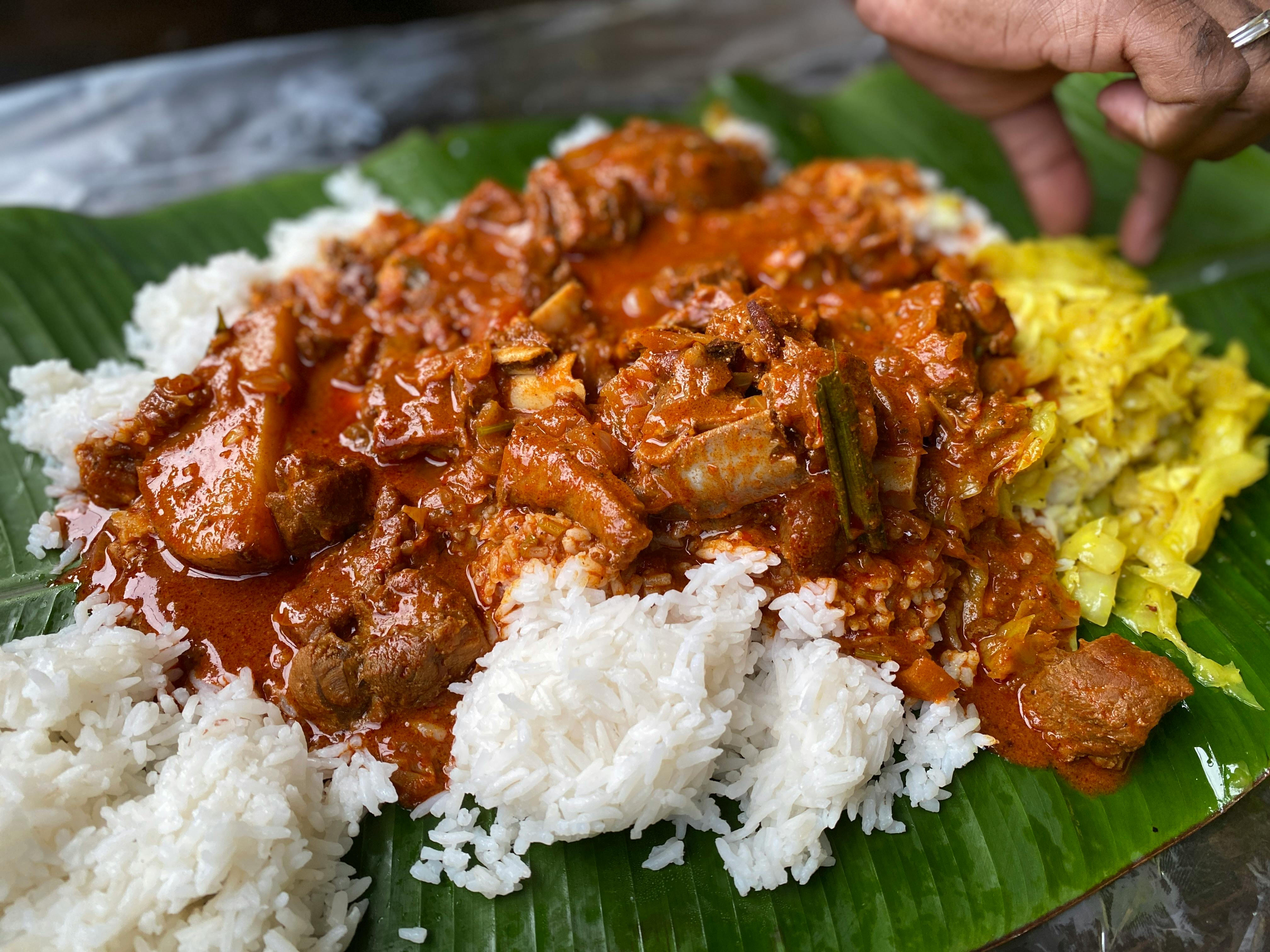
Photo: Rich Vijay / Pexels
Sri-Lankan
Rice and Curry
The diets react (see scores below)
Common Ingredients
- rice
- dhal
- coconut milk
- curry leaves
- pandan
- green chili
- onion
- turmeric
- mustard seeds
Specific recipes may vary.
Incompatible with 5 of 11 diets
Diet Ratings
Rice and Curry (Sri Lankan style) is fundamentally incompatible with a ketogenic diet. White rice is one of the highest net-carb foods available, with a single cup of cooked rice containing approximately 45g of net carbs — enough to exceed or nearly exhaust an entire day's keto carb budget in one serving. Dhal (lentils) adds another significant carb load, typically 20-25g net carbs per half-cup cooked. Together, these two staple ingredients make this dish an immediate disqualifier for ketosis. While several other ingredients (coconut milk, curry leaves, pandan, green chili, onion, turmeric, mustard seeds) are individually keto-friendly or neutral, they cannot offset the dominant carbohydrate content of the rice and lentils. This is not a portion-control situation — even a small serving of rice and dhal would likely push net carbs beyond the daily keto threshold.
This Sri Lankan rice and curry is entirely plant-based. Every ingredient — rice, dhal (lentils), coconut milk, curry leaves, pandan leaf, green chili, onion, turmeric, and mustard seeds — is derived from plants. Coconut milk is a whole-food plant ingredient standard in South and Southeast Asian cooking, not a dairy product. The dish is nutritionally strong, providing complex carbohydrates from rice, protein and fiber from dhal, and healthy fats from coconut milk, alongside anti-inflammatory compounds from turmeric and mustard seeds. This is a naturally vegan dish from a cuisine tradition that features abundant plant-based cooking.
Rice and Curry as prepared here contains two major paleo exclusions: rice (a grain) and dhal (a legume). These are foundational violations of paleo principles — grains and legumes are consistently excluded across all mainstream paleo frameworks due to their anti-nutrient content (lectins, phytates, saponins) and their absence from the Paleolithic diet. The remaining ingredients — coconut milk, curry leaves, pandan, green chili, onion, turmeric, and mustard seeds — are all paleo-compliant and nutritionally valuable. However, the two core non-compliant ingredients (rice and dhal) are structural to the dish and cannot simply be removed without fundamentally changing it. This is not a borderline case; both offending ingredients are clearly and consistently on the avoid list across Cordain, Sisson, Wolf, and The Paleo Foundation.
This Sri Lankan rice and dhal curry has several Mediterranean-compatible elements: dhal (lentils) is an excellent legume protein source strongly aligned with Mediterranean principles, and the aromatics (onion, green chili, turmeric, mustard seeds, curry leaves, pandan) are whole plant-based ingredients. However, two factors pull it toward caution. First, the base is white rice — a refined grain that lacks the fiber of Mediterranean-preferred whole grains like farro, barley, or bulgur. Second, coconut milk is the primary fat source, replacing olive oil entirely. Coconut milk is high in saturated fat, which contrasts with the Mediterranean diet's emphasis on monounsaturated fat from extra virgin olive oil. The dish is still whole-food, plant-forward, and minimally processed, so it is not an 'avoid,' but the coconut milk and white rice prevent a full approval.
Some modern Mediterranean diet researchers take a broader 'dietary pattern' view, noting that legume-based dishes with anti-inflammatory spices like turmeric are functionally compatible regardless of cooking fat origin. Additionally, white rice is common in traditional Cretan and other Eastern Mediterranean cuisines, and some practitioners accept it in moderate portions, particularly alongside high-fiber legumes that blunt its glycemic impact.
Rice and Curry is entirely plant-based with zero animal-derived ingredients. Every component — rice (grain), dhal (legume), coconut milk (plant fat), curry leaves, pandan, green chili, onion, turmeric, and mustard seeds (all plants/spices) — is explicitly excluded from the carnivore diet. This dish represents the antithesis of carnivore eating: it is high in carbohydrates, rich in plant antinutrients (lectins in dhal, oxalates, phytates), contains no animal protein, and no animal fat. There is no component that can be salvaged or modified to make this dish carnivore-compatible.
This dish contains two excluded ingredients: rice (a grain, explicitly banned on Whole30) and dhal (lentils, a legume, also explicitly banned). The remaining ingredients — coconut milk, curry leaves, pandan, green chili, onion, turmeric, and mustard seeds — are all Whole30-compliant, but the foundational components of the dish (rice and dhal) are both on the excluded list. There is no exception for rice or lentils under the Whole30 program, making this dish incompatible regardless of how it is prepared.
This dish contains multiple high-FODMAP ingredients that make it unsuitable during the elimination phase. The two most problematic ingredients are dhal (lentils/red lentils) and onion. Dhal is high in GOS (galacto-oligosaccharides), a key FODMAP, and is high-FODMAP at any standard curry serving size. Onion is one of the highest fructan-containing foods and is a clear 'avoid' during elimination at virtually any culinary quantity. While rice is low-FODMAP and safe, coconut milk is low-FODMAP only at small servings (up to 1/2 cup), curry leaves and pandan are generally considered low-FODMAP, green chili is low-FODMAP, turmeric is low-FODMAP, and mustard seeds are low-FODMAP — the combination of dhal and onion as core structural ingredients makes this dish high-FODMAP overall. Even if onion were omitted, the dhal alone would render the dish problematic during strict elimination.
Sri Lankan Rice and Curry with dhal (lentils) features several DASH-friendly ingredients — lentils are excellent sources of potassium, magnesium, fiber, and plant protein, all core DASH nutrients. Turmeric, curry leaves, pandan, green chili, mustard seeds, and onion are low-sodium, anti-inflammatory aromatics that align well with DASH principles. However, coconut milk is the significant concern: it is a tropical oil-based ingredient high in saturated fat, which DASH explicitly limits. Depending on the quantity of coconut milk used (full-fat coconut milk is ~24g saturated fat per 100ml), this dish can substantially exceed DASH's saturated fat targets. White rice, while not forbidden, is a refined grain that DASH de-emphasizes in favor of whole grains like brown rice. The dish is generally low in sodium if prepared without added salt, which is a positive factor. Overall, this is a borderline dish — the dhal base is DASH-positive, but the coconut milk quantity and white rice base pull it into caution territory.
NIH DASH guidelines explicitly classify coconut milk as a tropical oil high in saturated fat to be limited, consistent with AHA recommendations. However, some updated clinical interpretations note that the saturated fat in coconut milk (primarily lauric acid) may not carry the same cardiovascular risk as long-chain saturated fats found in animal products, and some DASH-aligned practitioners accept small amounts of coconut milk in mixed dishes — particularly when the overall dietary pattern is otherwise sound.
Sri Lankan Rice and Curry presents significant Zone Diet challenges, primarily due to the high-glycemic white rice base and the absence of lean protein. White rice is explicitly classified as an 'unfavorable' carbohydrate in Zone methodology — it has a high glycemic index, spikes insulin rapidly, and provides little fiber to slow absorption. The dhal (lentils) is the best Zone component here: lentils are a favorable carbohydrate source with meaningful protein and fiber, but they count primarily as a carbohydrate block in Zone because their protein is incomplete and the carb load dominates. Coconut milk is the other major concern — it is high in saturated fat rather than the monounsaturated fats Sears favors, and contributes significant calories with minimal Zone-friendly macros. The aromatics (curry leaves, pandan, green chili, onion, turmeric, mustard seeds) are Zone-positive due to polyphenol and anti-inflammatory content. The structural problem is macro imbalance: this dish is predominantly carbohydrate-heavy (rice + dhal) with saturated fat (coconut milk) and virtually no lean protein source listed. To make this Zone-compatible, a practitioner would need to dramatically reduce the rice portion (treating it as a small carb block), add a lean protein (grilled fish, chicken, or tofu), and replace or minimize coconut milk. As written, this dish cannot function as a Zone-balanced meal without significant modification.
Some Zone practitioners note that lentils occupy a favorable position in Sears' later work due to their polyphenol content and slower glycemic response compared to other legumes. Additionally, Sears' later anti-inflammatory writing (The OmegaRx Zone, The Mediterranean Zone) is more nuanced about certain saturated fats in whole-food contexts. A small portion of this dish alongside added lean protein could technically be blocked out, making it a 'caution' rather than a near-avoid for flexible Zone followers.
This Sri Lankan rice and curry dish is built on a foundation of genuinely anti-inflammatory ingredients. Dhal (lentils) is a legume rich in fiber, plant protein, and polyphenols that has been associated with reduced inflammatory markers. Turmeric contains curcumin, one of the most well-studied anti-inflammatory compounds in nutrition science. Mustard seeds provide omega-3 ALA and antioxidants. Curry leaves, pandan, green chili, and onion all contribute polyphenols, flavonoids, and bioactive compounds (quercetin in onion, capsaicin in chili) with documented anti-inflammatory effects. The coconut milk is the main point of nuance: it is high in saturated fat (lauric acid), which the anti-inflammatory framework generally advises limiting. However, traditional use of coconut milk in moderate amounts, especially alongside fiber-rich lentils and a robust spice profile, is generally considered acceptable rather than problematic. White rice is a refined carbohydrate with a moderate-to-high glycemic index and minimal anti-inflammatory benefit — it is neutral at best and slightly inflammatory at worst when consumed in large quantities. Overall, the dish's strong spice and legume profile outweighs the less favorable components, making it a net positive anti-inflammatory meal when portions are reasonable.
The coconut milk introduces saturated fat that mainstream anti-inflammatory guidelines (and Dr. Weil's pyramid) advise moderating, and some practitioners would lower the score due to this. Conversely, paleo and ancestral diet advocates argue lauric acid in coconut has unique anti-inflammatory metabolic properties distinct from other saturated fats. White rice is also contested: low-inflammatory diet frameworks generally prefer whole grains, and a strict reading would penalize refined rice, though traditional food advocates note its low anti-nutrient profile compared to whole grains.
Sri Lankan rice and dhal curry is a mixed picture for GLP-1 patients. The dhal (lentils) provides meaningful plant-based protein and fiber, which are positives — a typical serving of cooked dhal offers roughly 9g protein and 8g fiber per cup. However, the dish as described has no dedicated primary protein source, making it difficult to hit the 15–30g per meal protein target without a large portion. Coconut milk is the more significant concern: it is high in saturated fat, which can worsen GLP-1 side effects including nausea, bloating, and reflux. The rice component adds refined carbohydrates with relatively low nutrient density per calorie, and white rice in particular has a high glycemic load in typical serving sizes. Green chili may irritate some GLP-1 patients prone to reflux or nausea, though the quantity in curry is usually modest. On the positive side, turmeric, curry leaves, mustard seeds, and pandan are anti-inflammatory, low-calorie flavor contributors that add nutritional value without meaningful downside. The dish can be made more GLP-1-friendly by using light coconut milk, substituting brown rice or cauliflower rice, adding a lean protein (chicken, fish, tofu), and keeping portions small — but as described in its standard form, it rates as caution.
Some GLP-1-focused dietitians view lentil-based curries favorably because the fiber and plant protein combination supports satiety and glycemic stability, and argue that the saturated fat in coconut milk at typical serving sizes is not clinically significant enough to downgrade the dish. Others in the obesity medicine space are more cautious about coconut milk specifically, citing its documented tendency to worsen nausea and delayed gastric emptying symptoms in GLP-1 patients, and recommend avoiding it entirely in the early titration phase.
*See how scores were generated at our methodology page.
Nutritional profile
Six traits that cut across every diet.
Fiber & Plants
How much whole-plant food and fiber it delivers.
Healthy Fats
The quality of its fats (unsaturated, omega-3).
Whole / Unprocessed
How close it is to its natural, unprocessed form.
Gut Gentle
How easy it is on digestion (low FODMAP, few irritants).
Low Glycemic
How little it spikes your blood sugar.
Protein Density
How much protein it packs per calorie.
Controversy Index
Higher controversy = more disagreement between diets.
Diet-Specific Tips
 Vegan — 9/10
View tips
- Rice: whole grain carbohydrate — fully vegan
- Dhal (lentils): excellent plant-based protein and fiber source
- Coconut milk: plant-based fat; not dairy — fully vegan
- Curry leaves, pandan, green chili, onion: aromatic plant ingredients
- Turmeric and mustard seeds: whole-food spices with no animal origin
- No animal products, by-products, or contested ingredients present
- Dish is minimally processed and whole-food-forward, earning a high score
 Mediterranean — 5/10
View tips
- Dhal (lentils) is a Mediterranean-approved legume and strong positive factor
- Coconut milk replaces olive oil as primary fat — high in saturated fat, not Mediterranean-canonical
- White rice is a refined grain; Mediterranean guidelines prefer whole grains
- All aromatics and vegetables are whole, minimally processed plant foods
- No red meat, added sugars, or ultra-processed ingredients
- Dish is nutritionally whole-food but culturally diverges from Mediterranean fat and grain conventions
 DASH — 5/10
View tips
- Coconut milk is high in saturated fat, a tropical oil DASH explicitly limits
- Dhal (lentils) are an excellent DASH protein source rich in potassium, magnesium, and fiber
- White rice is a refined grain; substituting brown rice would improve DASH alignment
- Aromatics (turmeric, curry leaves, mustard seeds, green chili) are DASH-neutral or positive
- Dish is naturally low in sodium if prepared without added salt — a significant positive
- Portion size of coconut milk is critical; light or reduced coconut milk improves the score
 Zone — 4/10
View tips
- White rice is a high-glycemic 'unfavorable' carbohydrate in Zone methodology — directly listed as a food to limit
- No lean protein source listed — fails the Zone requirement of ~25g lean protein per meal
- Dhal (lentils) provides favorable fiber and polyphenols but counts primarily as a carb block, compounding the carbohydrate excess
- Coconut milk contributes saturated fat rather than Zone-preferred monounsaturated fats
- Aromatics (turmeric, green chili, curry leaves, onion) are Zone-positive for their anti-inflammatory polyphenol content
- Macro ratio is severely skewed toward carbohydrates with inadequate protein and wrong fat profile
- Dish would require major restructuring (less rice, added lean protein, reduced coconut milk) to approach Zone balance
 Anti-Inflammatory — 7/10
View tips
- Turmeric (curcumin) — strong anti-inflammatory evidence
- Dhal/lentils — fiber-rich legume, reduces CRP, high polyphenol content
- Mustard seeds — ALA omega-3, antioxidants
- Curry leaves, green chili, onion — polyphenols, quercetin, capsaicin
- Coconut milk — high in saturated fat, moderate concern under anti-inflammatory guidelines
- White rice — refined carbohydrate, moderate glycemic impact, neutral to mildly inflammatory
- No red meat, no added sugar, no processed ingredients — favorable overall profile
 GLP-1 Friendly — 4/10
View tips
- No primary animal or concentrated protein source — difficult to reach 15–30g protein per meal target without large portions
- Dhal provides meaningful plant protein (~9g/cup cooked) and fiber (~8g/cup) — the strongest GLP-1-positive element of this dish
- Coconut milk is high in saturated fat, which worsens GLP-1 GI side effects including nausea, bloating, and reflux
- White rice adds refined carbohydrates with low nutrient density per calorie and high glycemic load
- Green chili may worsen reflux or nausea in sensitive GLP-1 patients, though typical curry quantities are modest
- Spices (turmeric, mustard seeds, curry leaves) are low-calorie, anti-inflammatory additions with no meaningful downside
- Dish is portion-sensitive — a small serving of dhal with minimal rice is more GLP-1-compatible than a full traditional plate
- Swapping light coconut milk and brown rice, and adding lean protein, would meaningfully improve the GLP-1 suitability rating