Photo: Saveurs Secretes / Pexels
Sri-Lankan
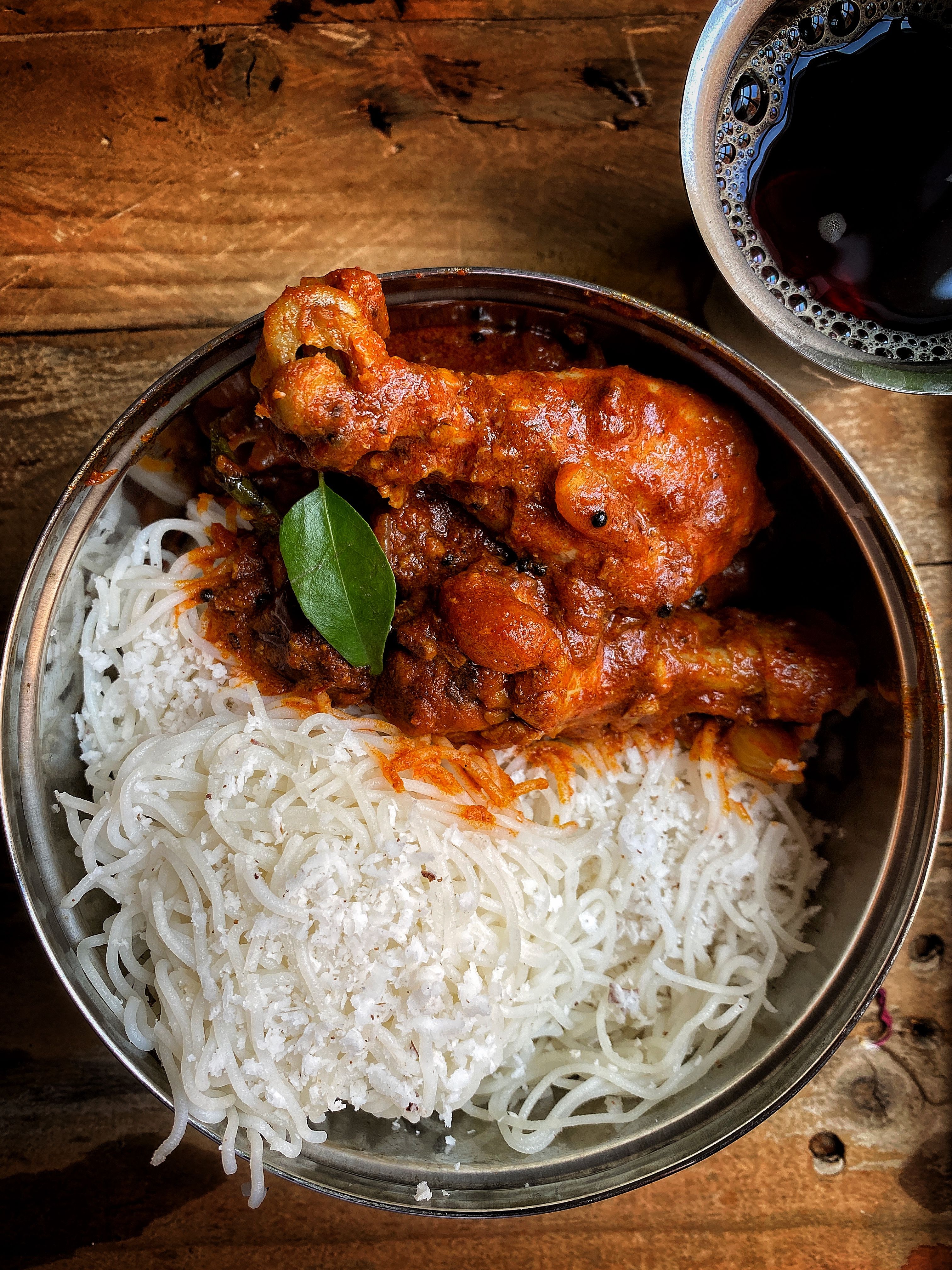
String Hoppers
The diets react (see scores below)
Common Ingredients
- red rice flour
- water
- salt
- coconut milk
- dhal curry
Specific recipes may vary.
Incompatible with 5 of 11 diets
Diet Ratings
String hoppers are fundamentally incompatible with a ketogenic diet. The primary ingredient, red rice flour, is a high-carbohydrate grain flour that will deliver a massive net carb load — a typical serving of string hoppers (6-8 pieces) contains approximately 30-45g of net carbs, easily exceeding or consuming the entire daily keto allowance in a single dish. Dhal curry (lentils) adds further significant carbohydrates, as lentils are legumes with moderate-to-high net carb content. While coconut milk is keto-friendly and salt is neutral, these two ingredients cannot redeem a dish built entirely on a grain-flour base combined with a legume curry. There is no realistic portion size that makes this dish compatible with maintaining ketosis.
String Hoppers (idi appa) made with red rice flour, water, salt, coconut milk, and dhal curry are fully plant-based. All listed ingredients are whole or minimally processed plant foods. Red rice flour is a whole-grain ingredient; coconut milk is a plant-derived fat source; dhal curry is a legume-based accompaniment. There are no animal products, animal-derived additives, or ethically contested ingredients in this dish. This is a traditional Sri Lankan breakfast that aligns well with both ethical veganism and whole-food plant-based eating.
String Hoppers are fundamentally incompatible with the Paleo diet. The dish is built on red rice flour, which is a grain-based flour — grains are explicitly excluded from the Paleo framework regardless of color or processing level. Added salt is also a Paleo exclusion. Dhal curry contains lentils (a legume), which are another clear Paleo violation due to their anti-nutrient content (lectins, phytates) and absence from the Paleolithic food supply. Coconut milk is Paleo-approved and water is neutral, but two of the five ingredients are categorically excluded, and the dish cannot exist without its grain-flour base. There is no meaningful way to adapt this dish while retaining its identity.
String hoppers made with red rice flour are a whole grain preparation, which aligns well with Mediterranean principles favoring whole grains over refined ones. The dhal curry (lentils) is an excellent legume component strongly endorsed by Mediterranean diet guidelines. However, coconut milk is a notable divergence — it is a saturated fat source not traditional to the Mediterranean, where extra virgin olive oil is the canonical fat. The dish contains no olive oil, no fish, and no vegetables beyond the lentil curry. While overall it is plant-forward, minimally processed, and legume-rich, the coconut milk moderates the score. As a breakfast option it is relatively nutritious and fiber-rich, but not a natural fit for core Mediterranean eating patterns.
Some modern Mediterranean diet interpreters view coconut milk more favorably as a plant-based fat, arguing that the diet's anti-inflammatory and whole-food principles matter more than strict regional ingredients. However, traditional Mediterranean diet researchers (e.g., Ancel Keys framework and PREDIMED study guidelines) emphasize olive oil as the defining fat and do not include tropical saturated fats as substitutes.
String Hoppers are entirely plant-based and incompatible with the carnivore diet. The dish consists of red rice flour (a grain), coconut milk (a plant-derived fat), and dhal curry (legumes) — all of which are explicitly excluded from carnivore eating. There are no animal products whatsoever in this dish. Grains and legumes are among the most strictly avoided foods on the carnivore diet, as they are the primary foods the diet is designed to eliminate. This dish represents the antithesis of carnivore eating.
String hoppers are a traditional Sri Lankan dish made from red rice flour pressed into noodle/pasta-like forms and steamed. This dish fails on multiple Whole30 counts: (1) Red rice flour is a grain (rice), which is explicitly excluded from the Whole30 program. (2) Even if the flour were somehow compliant, string hoppers are a noodle/pasta-like food — the Whole30 program explicitly prohibits recreating pasta or noodles even with compliant ingredients. (3) Dhal curry is made from lentils/legumes, which are also explicitly excluded. The coconut milk and salt are compliant, but the core structural ingredients (rice flour, dhal) are both independently disqualifying.
String hoppers (idiyappam) are made from red rice flour pressed into noodle-like rounds, which is itself low-FODMAP. However, the dish as described includes dhal curry as a core component, which is made from lentils/split peas — a high-FODMAP ingredient due to significant GOS (galacto-oligosaccharides) content. Dhal curry is a standard accompaniment to string hoppers in Sri Lankan cuisine and is not a minor garnish but a primary component of the meal. Coconut milk is low-FODMAP at standard serving sizes (up to ~½ cup). Red rice flour is low-FODMAP. Salt and water are FODMAP-free. The red rice flour base and coconut milk alone would be approvable, but the inclusion of dhal curry as a listed ingredient elevates the overall dish to high-FODMAP territory. Even canned lentils (lower GOS than dried) would be borderline, and typical dhal preparations use dried lentils without GOS-leaching steps. The dish cannot be assessed without the dhal component, as it is integral to the meal as presented.
Monash University has not specifically tested Sri Lankan string hoppers as a composite dish. Some FODMAP practitioners might suggest the dish could be modified by omitting dhal curry and substituting a low-FODMAP accompaniment (e.g., coconut sambol), but as described with dhal curry included, clinical FODMAP practitioners would consistently advise avoidance during the elimination phase.
String hoppers made with red rice flour are a reasonable DASH-compatible base — red rice is a whole grain, providing fiber and some micronutrients aligned with DASH principles. Dhal curry (lentils) is an excellent DASH food, rich in potassium, magnesium, fiber, and plant protein. However, coconut milk is a notable concern: it is high in saturated fat from a tropical oil source, which DASH explicitly limits. The salt added during preparation also contributes sodium, though typically in modest amounts for this dish. The combination is not inherently disqualifying, but the coconut milk and added salt require portion awareness. If coconut milk is used minimally or substituted with low-fat dairy or reduced, the dish would score higher. As commonly prepared in Sri Lankan cuisine, the coconut milk component keeps this in the caution range.
NIH DASH guidelines explicitly limit saturated fat and tropical oils including coconut, which would flag coconut milk as a concern. However, some updated clinical interpretations note that when coconut milk is used in small amounts as a flavoring agent rather than a primary ingredient, the overall saturated fat load may remain within acceptable daily limits, and some practitioners focus more on the whole dietary pattern than individual ingredients.
String Hoppers made with red rice flour are a carbohydrate-dominant dish with a moderate glycemic index — better than white rice flour but still a starchy grain-based food. Red rice flour provides more fiber and micronutrients than refined white flour, which slightly improves its Zone compatibility by lowering net carbs per block. However, the dish as a whole is heavily carbohydrate-skewed with no direct lean protein source listed. The coconut milk adds saturated fat rather than the preferred monounsaturated fats, and the dhal curry partially redeems the meal by contributing plant-based protein and fiber, helping to partially balance the macronutrient ratio. Still, this meal is unlikely to hit the 40/30/30 Zone target without significant modification — particularly adding a lean protein source and reducing the portion of hoppers. For a Zone practitioner, String Hoppers would be classified as an 'unfavorable' carbohydrate due to the grain base, though the dhal addition and red rice flour make it more workable than plain white flour hoppers. The coconut milk fat is saturated rather than monounsaturated, which conflicts with Zone's preferred fat profile. Portioning carefully (smaller hopper serving with more dhal and an added lean protein) could make this meal Zone-compatible.
Some Zone practitioners and Sears' later anti-inflammatory writings take a more nuanced view of whole grain and legume-based meals. Dhal (lentils) is actually a Zone-favorable food — high in fiber, moderate protein, and low glycemic — and could partially offset the grain-heavy hoppers. Red rice flour's higher fiber content also lowers net carbs compared to white rice flour, making this more block-friendly than it first appears. A moderate portion of String Hoppers paired with a generous dhal curry could be argued as a reasonable 'unfavorable but usable' Zone meal, especially in cultural dietary contexts where ideal Zone foods are less accessible.
String hoppers made with red rice flour represent a meaningful upgrade over white rice flour versions. Red rice flour retains the bran layer, providing fiber, antioxidants (anthocyanins), and a lower glycemic index than refined white rice — all modestly anti-inflammatory. The dhal curry is a significant asset: lentils are legumes high in fiber, plant protein, folate, and polyphenols, and are well-supported in anti-inflammatory research for reducing CRP. Coconut milk is the main point of concern — it is high in saturated fat (lauric acid), which is debated in the anti-inflammatory context. Most anti-inflammatory frameworks, including Dr. Weil's, recommend limiting saturated fat, though coconut milk in culinary (not heavy-cream) quantities is considered less problematic than butter or cream by some practitioners. The dish is minimally processed, contains no refined sugar, trans fats, or artificial additives. Salt is present but not inherently pro-inflammatory at normal culinary doses. Overall, this is a reasonably wholesome, plant-based breakfast with meaningful fiber and legume content, tempered by the saturated fat from coconut milk and the moderate glycemic load of the rice base.
The saturated fat in coconut milk is the primary point of disagreement. Dr. Weil's framework and mainstream anti-inflammatory guidance flag saturated fat as pro-inflammatory and recommend using coconut milk sparingly, which would push this dish toward a lower caution score. However, some functional medicine and paleo-adjacent practitioners (e.g., those following a whole-food, low-processed approach) argue that medium-chain triglycerides (MCTs) in coconut products have neutral or even beneficial metabolic effects, and that the anti-inflammatory benefits of a legume-rich, additive-free meal outweigh the coconut milk concern.
String hoppers made from red rice flour are a traditional Sri Lankan breakfast consisting of steamed rice noodle discs served with coconut milk and dhal curry. Evaluated as a complete dish, this meal has a mixed GLP-1 profile. The dhal curry is a meaningful positive — lentils provide plant-based protein (roughly 8-9g per half cup) and significant fiber (7-8g per serving), supporting both GLP-1 priorities. Red rice flour offers more fiber and micronutrients than white rice flour, which is a moderate positive. However, the dish lists no primary protein source, and even with dhal the total protein per serving is likely to fall well short of the 15-30g per meal target. Coconut milk is high in saturated fat, which can worsen GLP-1 side effects like nausea, bloating, and reflux — the impact depends heavily on how much coconut milk is used. String hoppers themselves are a refined-starch-dominant base with limited protein density per calorie. The dish is steamed and easy to digest, which is a genuine positive for GLP-1 patients. Portion control is manageable since string hoppers are naturally served in small individual units. Overall this is an acceptable occasional breakfast but nutritionally incomplete as a GLP-1-optimized meal without a dedicated protein addition such as an egg or low-fat yogurt on the side.
Some GLP-1-focused dietitians may rate this more favorably when the dhal curry is served generously, arguing that legume-based protein plus fiber in a low-fat, steamed format is a reasonable GLP-1 breakfast, particularly in cultural contexts where substituting Western protein sources is impractical. Others would flag the coconut milk more strongly, noting that saturated fat tolerance is highly individual among GLP-1 patients and that even moderate amounts worsen nausea in a significant subset.
*See how scores were generated at our methodology page.
Nutritional profile
Six traits that cut across every diet.
Fiber & Plants
How much whole-plant food and fiber it delivers.
Healthy Fats
The quality of its fats (unsaturated, omega-3).
Whole / Unprocessed
How close it is to its natural, unprocessed form.
Gut Gentle
How easy it is on digestion (low FODMAP, few irritants).
Low Glycemic
How little it spikes your blood sugar.
Protein Density
How much protein it packs per calorie.
Controversy Index
Higher controversy = more disagreement between diets.
Diet-Specific Tips
 Vegan — 9/10
View tips
- Red rice flour is a whole-grain, plant-based staple
- Coconut milk is fully plant-derived and replaces dairy completely
- Dhal curry provides plant-based protein from legumes
- No animal products, dairy, eggs, or animal-derived additives present
- Whole-food ingredients score highly on whole-food plant-based criteria
- Traditional preparation is naturally vegan without any substitutions required
 Mediterranean — 5/10
View tips
- Red rice flour is a whole grain, positively aligned with Mediterranean principles
- Dhal (lentils) is a core Mediterranean legume — strongly approved component
- Coconut milk introduces saturated plant fat not traditional to the Mediterranean diet
- No olive oil present — the primary fat source of the Mediterranean diet is absent
- No fish, seafood, or significant vegetables beyond the lentil curry
- Dish is minimally processed and free of added sugars or refined grains
 DASH — 5/10
View tips
- Red rice flour is a whole grain, positively aligned with DASH
- Dhal (lentils) is a DASH-approved legume high in fiber, potassium, and magnesium
- Coconut milk is high in saturated fat from a tropical oil, which DASH limits
- Added salt contributes sodium — preparation amounts matter
- Overall dish is moderate glycemic index and plant-forward
- Low-sodium preparation and reduced coconut milk would improve DASH compatibility
 Zone — 4/10
View tips
- Red rice flour is a grain-based, moderate-glycemic carbohydrate — classified as 'unfavorable' in Zone terminology
- No lean protein source in the dish; dhal curry provides only modest plant protein
- Coconut milk contributes saturated fat, not Zone-preferred monounsaturated fat
- Dhal (lentils) is Zone-favorable: high fiber, low glycemic, moderate protein — partially redeems the meal
- Macronutrient ratio is heavily carbohydrate-skewed; significant portioning adjustments needed to approach 40/30/30
- Red rice flour's higher fiber content vs. white flour reduces net carbs per block, a modest advantage
- No added lean protein means the meal cannot independently satisfy Zone protein block requirements (~25g/meal)
 Anti-Inflammatory — 6/10
View tips
- Red rice flour retains bran, fiber, and anthocyanins — lower glycemic and more anti-inflammatory than white rice flour
- Dhal curry (lentils) is a legume strongly associated with reduced inflammatory markers and is emphasized in anti-inflammatory frameworks
- Coconut milk contributes saturated fat, which most anti-inflammatory authorities recommend limiting
- Dish is minimally processed with no refined sugars, additives, or trans fats
- No significant omega-3 source or anti-inflammatory herbs/spices noted beyond what may be in the dhal curry
- Plant-based, high-fiber profile supports gut health, which is linked to reduced systemic inflammation
 GLP-1 Friendly — 5/10
View tips
- Dhal curry contributes meaningful plant protein and fiber — the strongest positives in this dish
- Red rice flour preferred over white rice flour for marginally higher fiber and micronutrient content
- Coconut milk adds saturated fat which may worsen GLP-1 GI side effects — quantity matters
- Total protein per meal likely falls below the 15-30g per meal target without an added protein source
- Steamed preparation is easy to digest — appropriate for GLP-1 patients with GI sensitivity
- Naturally portion-controlled format (individual hopper units) suits small meal eating pattern
- Nutrient density per calorie is moderate — carbohydrate-dominant with limited protein density
- No primary protein source listed — a significant gap for GLP-1 dietary priorities