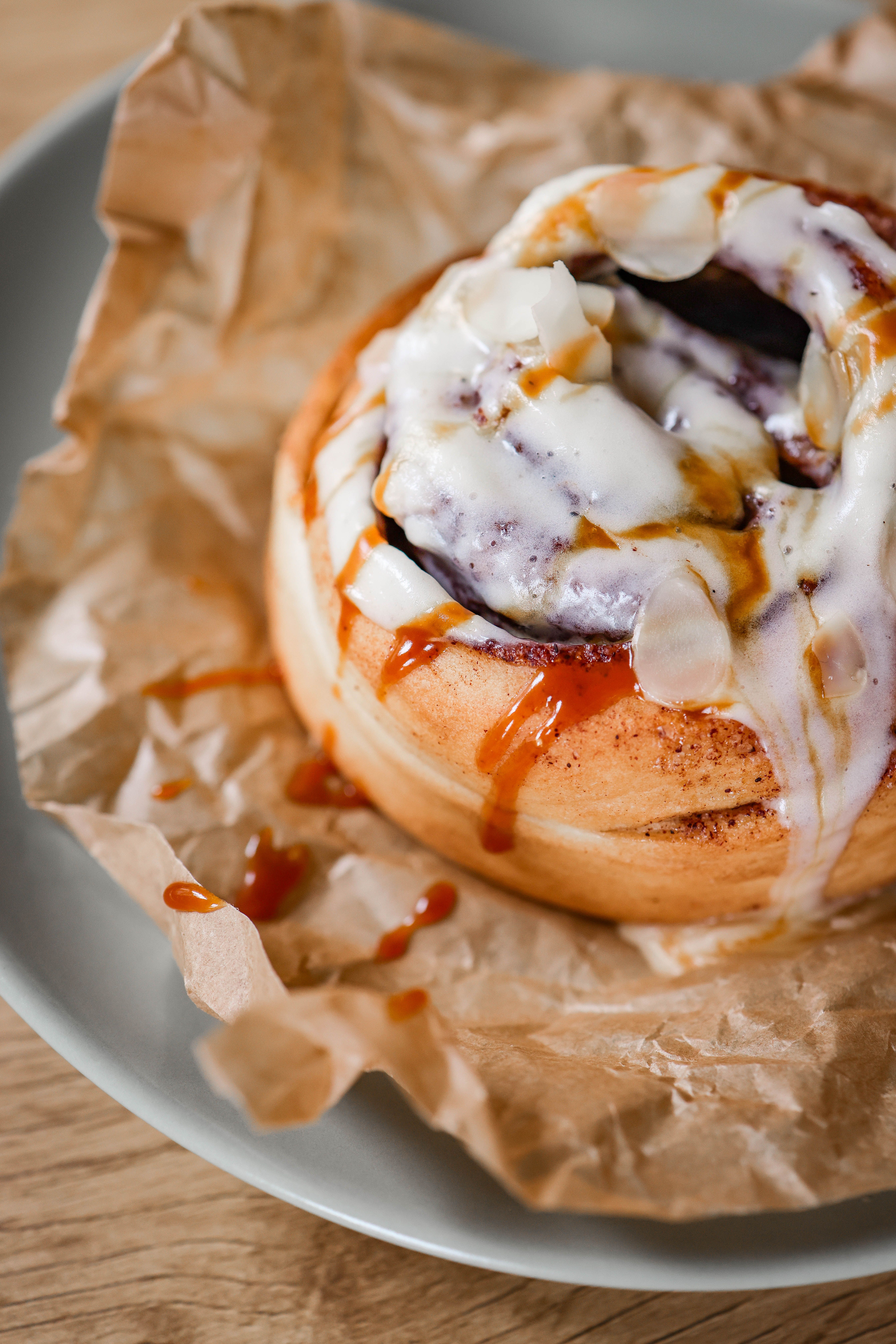
Photo: Valeria Boltneva / Pexels
American
Sticky Bun
The diets react (see scores below)
Common Ingredients
- flour
- yeast
- butter
- sugar
- eggs
- milk
- cinnamon
- pecans
- brown sugar
- salt
Specific recipes may vary.
Incompatible with 11 of 11 diets
Diet Ratings
Sticky buns are fundamentally incompatible with a ketogenic diet. The primary ingredients — wheat flour and multiple forms of sugar (white sugar, brown sugar) — are the two most problematic categories for ketosis. A single sticky bun typically contains 50-80g of net carbs, which exceeds an entire day's keto carb allowance in one snack. The yeast dough is grain-based, the filling and glaze are loaded with refined sugars, and even the milk adds additional carbs. While butter, eggs, and pecans are keto-friendly on their own, they are completely overwhelmed by the high-carb components. There is no portion size that makes a sticky bun compatible with ketosis.
Sticky buns as listed contain multiple animal-derived ingredients: butter (dairy), eggs, and milk. These are direct animal products, not trace cross-contamination, making this dish clearly non-vegan. The flour, yeast, sugar, cinnamon, pecans, brown sugar, and salt are all plant-based, but the presence of three distinct animal ingredients means the dish cannot be considered vegan in this form. A vegan version could be made by substituting plant-based butter (e.g., vegan margarine), flax eggs or commercial egg replacer, and non-dairy milk (oat, almond, soy), which is increasingly common in vegan baking.
Sticky buns are fundamentally incompatible with the paleo diet. The base ingredient is wheat flour, a grain explicitly excluded from paleo eating. Additionally, the recipe contains butter and milk (dairy), refined sugar and brown sugar (processed sweeteners), and added salt — all of which are on the paleo exclusion list. Yeast, while natural, is used here in the context of a grain-based processed baked good. The only paleo-compliant ingredients in this dish are eggs, cinnamon, and pecans. There is no version of a traditional sticky bun that can be considered paleo-compatible without a complete ingredient overhaul.
Sticky buns are a quintessential example of what the Mediterranean diet discourages. They are made with refined white flour (not whole grain), large amounts of added sugars (both white sugar and brown sugar), butter as the primary fat (not olive oil), and a sweet glaze-like topping. While eggs, milk, and pecans have some nutritional value, they are overwhelmed by the refined grain base and excessive sugar content. This is a highly processed, high-sugar, high-saturated-fat pastry with no meaningful plant-forward nutrition. It directly contradicts Mediterranean diet principles of whole grains, minimal added sugars, and olive oil as the primary fat.
Sticky buns are almost entirely plant-derived and processed, making them completely incompatible with the carnivore diet. The primary ingredient is flour (a grain), accompanied by yeast, sugar, brown sugar, cinnamon, and pecans — all plant-based or plant-derived. While butter, eggs, and milk are animal-derived ingredients, they appear in minor supporting roles within a dish that is fundamentally a baked grain product loaded with sugar and plant additives. There is no meaningful animal protein or fat structure here; the dish is a high-carbohydrate, heavily sweetened pastry with zero place in any tier of carnivore eating.
Sticky buns are fundamentally incompatible with Whole30 on multiple levels. The dish contains flour (a grain, excluded), butter (dairy, excluded), sugar (added sugar, excluded), milk (dairy, excluded), and brown sugar (added sugar, excluded). Beyond the individual excluded ingredients, a sticky bun is exactly the type of baked good/junk food recreation that Whole30 Rule 4 explicitly prohibits — it is a pastry, which falls squarely in the excluded category regardless of ingredient substitutions. This is a clear, unambiguous avoid.
Sticky buns contain multiple high-FODMAP ingredients that make them clearly unsuitable during the elimination phase. Regular wheat flour is the primary ingredient and is high in fructans, one of the most problematic FODMAPs. Milk contributes lactose (a disaccharide), and a standard serving would contain enough lactose to trigger symptoms in sensitive individuals. Pecans are low-FODMAP at small amounts (~10 pecan halves per Monash), but in a sticky bun they're typically used generously, potentially pushing them into moderate territory. The remaining ingredients — butter, eggs, sugar, cinnamon, brown sugar, and salt — are individually low-FODMAP. However, the wheat flour alone is sufficient to classify this dish as avoid. There is no realistic portion size at which a sticky bun made with wheat flour becomes low-FODMAP; a meaningful serving (one bun) would contain a large quantity of fructans from flour, well above any safe threshold. Substituting gluten-free flour and lactose-free milk would theoretically make this dish more FODMAP-friendly, but as described with standard ingredients, it must be avoided.
Sticky buns are a quintessential high-sugar, high-saturated-fat pastry that conflicts with DASH diet principles on multiple fronts. The combination of butter (saturated fat), brown sugar and granulated sugar (added sugars), refined white flour (low fiber, not a whole grain), and a sugary glaze creates a food high in calories, saturated fat, and added sugars while offering minimal nutritional benefit. Pecans add some beneficial unsaturated fats and magnesium, but in this context they are coated in caramelized sugar, negating much of their benefit. Milk and eggs contribute some protein and calcium, but the overall nutritional profile is dominated by the negatives. DASH explicitly limits sweets, added sugars, saturated fats, and refined grains. A single sticky bun can easily contain 400-600 calories, 15-20g of sugar or more, and significant saturated fat — far outside DASH's recommended treat threshold of 5 or fewer sweets per week, each kept to small portions.
A sticky bun is essentially a concentrated delivery system for everything the Zone Diet discourages. The primary ingredients — refined white flour, brown sugar, and butter — create a high-glycemic, high-saturated-fat, protein-deficient food that is almost impossible to incorporate into a Zone-balanced meal. Refined flour and brown sugar spike blood glucose rapidly, driving the insulin response that the Zone Diet is specifically designed to prevent. Butter contributes saturated fat rather than the preferred monounsaturated fats. There is virtually no lean protein present, and the fat profile is wrong. The macronutrient ratio of a sticky bun is approximately 60-70% carbohydrates (predominantly high-glycemic), 5-10% protein, and 25-30% fat (primarily saturated) — essentially the inverse of Zone targets. While pecans do provide some monounsaturated fat value, they are a minor component overwhelmed by sugar and refined flour. Even in very small portions, a sticky bun cannot contribute to a Zone-balanced snack without pairing it with substantial lean protein and monounsaturated fat while eating only a tiny fraction of the bun, at which point the food loses its identity as a sticky bun entirely.
Sticky buns are a classic example of a pro-inflammatory indulgence. The base is refined white flour — a refined carbohydrate that spikes blood sugar and insulin, driving inflammatory pathways. The dish is heavily sweetened with both white sugar and brown sugar (which is essentially the same glycemically), and butter adds saturated fat in significant quantity. Milk adds additional saturated fat. The combination of refined carbs and added sugars is one of the most well-established drivers of systemic inflammation, elevating markers like CRP and IL-6. The one redeeming ingredient is cinnamon, a genuine anti-inflammatory spice, and pecans provide some healthy fats and polyphenols — but in the context of this dish, those benefits are thoroughly overwhelmed by the inflammatory load of the refined flour and sugars. Yeast fermentation does offer minor benefits compared to chemical leavening, but not enough to shift the verdict. This is a treat food by design, and from an anti-inflammatory standpoint it sits firmly in the avoid category.
A sticky bun is a poor fit for GLP-1 patients on nearly every criterion. It is built almost entirely from refined flour and sugar (brown sugar, white sugar), with butter and milk adding significant saturated fat. Pecans contribute some healthy fat and trace fiber, but not enough to meaningfully offset the profile. There is virtually no usable protein (eggs and milk contribute minor amounts in the baked form), no meaningful fiber, and a very high calorie load packed into a small, easy-to-eat portion — the opposite of what a GLP-1 patient needs from a snack. The combination of high sugar and high fat is likely to worsen nausea, bloating, and reflux, which are already common GLP-1 side effects. The sugar spike followed by a crash also works against the blood sugar stabilization goal. With slowed gastric emptying, a dense, buttery, sugar-heavy pastry will sit in the stomach and increase discomfort. As a snack category item, it delivers almost exclusively empty calories when every calorie needs to count nutritionally.
*See how scores were generated at our methodology page.
Nutritional profile
Six traits that cut across every diet.
Fiber & Plants
How much whole-plant food and fiber it delivers.
Healthy Fats
The quality of its fats (unsaturated, omega-3).
Whole / Unprocessed
How close it is to its natural, unprocessed form.
Gut Gentle
How easy it is on digestion (low FODMAP, few irritants).
Low Glycemic
How little it spikes your blood sugar.
Protein Density
How much protein it packs per calorie.
Controversy Index
Higher controversy = more disagreement between diets.