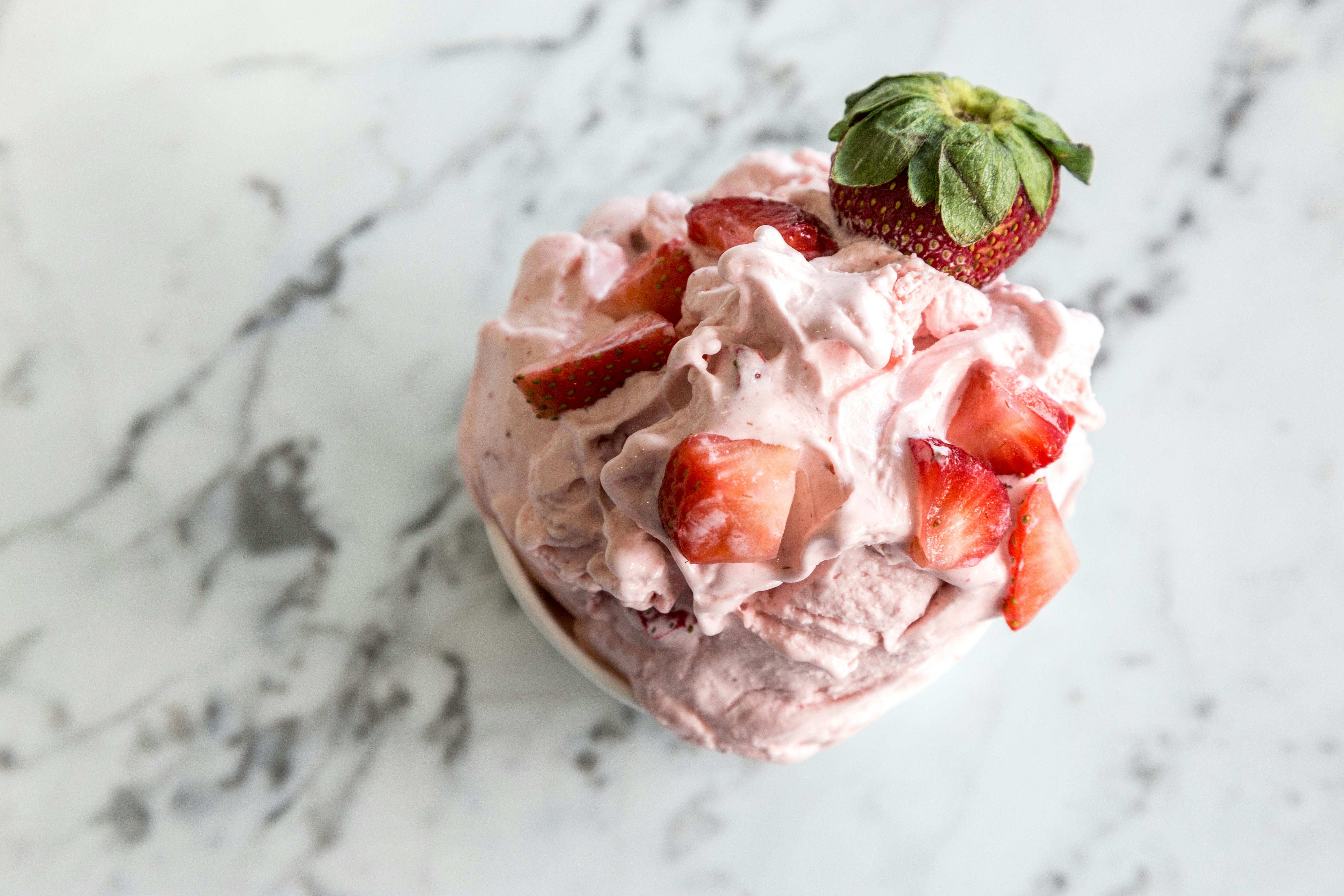
Photo: David Disponett / Pexels
American
Strawberry Ice Cream
The diets react (see scores below)
Common Ingredients
- cream
- milk
- eggs
- strawberries
- sugar
- vanilla extract
Specific recipes may vary.
Incompatible with 11 of 11 diets
Diet Ratings
Traditional strawberry ice cream is fundamentally incompatible with a ketogenic diet. The primary disqualifying ingredient is added sugar, which directly breaks ketosis. A standard serving (1/2 cup) of commercial or homemade strawberry ice cream contains approximately 25-30g of net carbs, largely from the sugar used to sweeten it and natural sugars from milk and strawberries. This single serving can exceed an entire day's carb allowance on a strict keto protocol. While cream and eggs are keto-friendly base ingredients, the substantial added sugar and milk (which contains lactose) make this dish incompatible in its standard form. A keto-adapted version using heavy cream, a keto sweetener (like erythritol or monk fruit), and limited strawberries could be approved, but the dish as described is not keto-compatible.
Strawberry ice cream in its traditional American form contains multiple animal-derived ingredients: cream and milk (dairy) and eggs. All three are explicitly excluded under vegan dietary rules. The strawberries, sugar, and vanilla extract are plant-based, but the core dairy and egg components make this dish entirely incompatible with a vegan diet. Vegan versions of strawberry ice cream do exist, made with plant-based milks (coconut, oat, almond) and without eggs, but the dish as described here is not vegan.
Strawberry ice cream contains multiple non-paleo ingredients that disqualify it outright. Cream and milk are dairy products excluded by virtually all paleo frameworks. Refined sugar is a processed, non-paleo sweetener. While eggs and strawberries are paleo-approved, and vanilla extract is generally accepted in small amounts, the combination of dairy and refined sugar makes this dish clearly incompatible with the paleo diet. Even if dairy were debated, refined sugar alone would push this into 'avoid' territory. This is a processed dessert that contradicts both the ingredient rules and the philosophy of whole, unprocessed foods.
Strawberry ice cream is a highly processed dessert dominated by heavy cream and added sugar, both of which contradict core Mediterranean diet principles. The high saturated fat content from cream and the significant added sugar load place this firmly in the 'avoid' category. While strawberries are a Mediterranean-friendly fruit and dairy in small amounts is acceptable, the overall formulation is a concentrated source of saturated fat and refined sugar with minimal nutritional benefit. The Mediterranean diet does not prohibit occasional indulgences, but ice cream as a category represents the antithesis of the diet's emphasis on whole, minimally processed foods with healthy fats.
Strawberry ice cream contains multiple carnivore-incompatible ingredients. Strawberries are a plant-derived fruit, sugar is a processed plant-based sweetener, and vanilla extract is a plant-derived flavoring — all strictly excluded on any tier of the carnivore diet. While cream, milk, and eggs are animal-derived, they are overshadowed by the disqualifying plant ingredients and added sugar. Even the most permissive 'animal-based' practitioners who allow some fruit would not endorse added refined sugar. This dish is fundamentally a plant-and-sugar-forward dessert with some animal-derived components, not a carnivore-compatible food.
Strawberry ice cream contains multiple excluded ingredients. Cream and milk are dairy products, which are explicitly prohibited on Whole30 (only ghee and clarified butter are excepted). Sugar is an added sweetener, also explicitly excluded. Even if dairy and sugar were somehow replaced with compliant alternatives, ice cream falls squarely into the 'junk food recreation' category that Whole30 prohibits regardless of ingredient compliance.
Strawberry ice cream contains several FODMAP-relevant ingredients that must be assessed by serving size. Cream is low-FODMAP as it is low in lactose. Milk is the primary concern — it is high in lactose and used in meaningful quantities in ice cream, though the final lactose concentration per scoop depends on the milk-to-cream ratio. Eggs and vanilla extract are low-FODMAP. Sugar (sucrose) is low-FODMAP. Strawberries are low-FODMAP at up to 10 medium berries (150g) per Monash, but the strawberry content in ice cream per serving is typically well within safe limits. The main FODMAP risk is lactose from the milk component. A standard 2-scoop serving (~100g) of regular dairy ice cream contains enough lactose to be problematic for most people in the elimination phase, though some commercial recipes are cream-heavy and relatively lower in lactose. Without knowing the exact milk-to-cream ratio, a caution rating is appropriate — small portions (1 small scoop, ~65g) may be tolerable for some, but a standard serving is likely to push into high-lactose territory.
Monash University rates regular dairy ice cream as high-FODMAP due to lactose content, advising avoidance during elimination; however, some clinical FODMAP practitioners note that a single small scoop (~65g) may be acceptable for individuals who tolerate modest lactose loads, and lactose-free versions are clearly safe. The standard 2-scoop serving used by most consumers makes this effectively high-FODMAP in real-world practice.
Strawberry ice cream is incompatible with DASH diet principles. The primary base is heavy cream and whole milk — full-fat dairy products that DASH explicitly discourages in favor of fat-free or low-fat dairy. Heavy cream is high in saturated fat and cholesterol, both of which DASH limits to reduce cardiovascular risk. The dish also contains significant added sugar, another category DASH explicitly restricts. While strawberries are a DASH-friendly fruit and eggs are acceptable in moderation, the overall nutritional profile — high saturated fat, high added sugar, calorie-dense — places this firmly in the avoid category. Occasional very small portions might be tolerated as a rare treat, but as a snack this is not DASH-compatible.
Strawberry ice cream is a poor fit for the Zone Diet across multiple dimensions. The primary issues are: (1) high sugar content — added sugar is one of the most 'unfavorable' carbohydrates in Zone methodology, spiking insulin and disrupting the Zone's eicosanoid balance; (2) the fat profile is dominated by saturated fat from heavy cream, not the monounsaturated fats Dr. Sears recommends; (3) the carbohydrate-to-protein-to-fat ratio is wildly off — ice cream is roughly 45-50% fat by calories, 40-45% carbohydrates (primarily from sugar), and only 5-8% protein, making it nearly impossible to incorporate as a Zone-balanced snack without radical portion reduction that would render it nutritionally insignificant; (4) as a snack category item, Zone snacks are meant to bridge meals with mini-blocks (e.g., a small amount of protein + low-GI carb + monounsaturated fat), and ice cream cannot serve this function. While strawberries themselves are a favorable Zone fruit, they are overwhelmed here by sugar and saturated fat. A very small taste (a few tablespoons) could technically fit as part of a block, but as a practical snack food it fails Zone principles comprehensively.
Strawberry ice cream is primarily composed of cream, milk, sugar, and eggs. The dominant ingredients — heavy cream and added sugar — place this firmly in the 'limit to avoid' category within anti-inflammatory frameworks. Heavy cream is high in saturated fat, which at elevated intakes is associated with increased inflammatory markers (CRP, IL-6) in research. The substantial added sugar load drives insulin spikes and promotes glycation and inflammatory signaling pathways. Full-fat dairy is explicitly listed as a food to limit in anti-inflammatory guidelines. While strawberries do contribute beneficial polyphenols, anthocyanins, and vitamin C with real anti-inflammatory properties, and vanilla extract contains minor antioxidants, these ingredients are present in relatively small quantities compared to the pro-inflammatory base of cream and sugar. The net inflammatory profile of the dish as a whole is clearly unfavorable. Eggs contribute choline and some neutral fatty acids but do not meaningfully offset the other ingredients. This is an occasional indulgence food, not one compatible with regular anti-inflammatory eating patterns.
Strawberry ice cream is a poor fit for GLP-1 patients across nearly every key criterion. It is high in saturated fat from cream and eggs, high in added sugar, low in protein relative to its calorie load, and essentially zero in dietary fiber. GLP-1 medications slow gastric emptying, meaning high-fat, high-sugar foods sit in the stomach longer and are more likely to provoke nausea, bloating, and reflux. The calorie density is high while nutrient density per calorie is very low — exactly the opposite of what patients with suppressed appetites need. A typical half-cup serving delivers roughly 130–150 calories, 7–8g of fat (mostly saturated), 17–20g of sugar, only 2–3g of protein, and negligible fiber. Even the strawberry component, which would otherwise be a fiber and antioxidant positive, is present in quantities too small to offset the cream and sugar base. This is a textbook empty-calorie, high-fat, high-sugar food that is counterproductive for GLP-1 patients.
*See how scores were generated at our methodology page.
Nutritional profile
Six traits that cut across every diet.
Fiber & Plants
How much whole-plant food and fiber it delivers.
Healthy Fats
The quality of its fats (unsaturated, omega-3).
Whole / Unprocessed
How close it is to its natural, unprocessed form.
Gut Gentle
How easy it is on digestion (low FODMAP, few irritants).
Low Glycemic
How little it spikes your blood sugar.
Protein Density
How much protein it packs per calorie.
Controversy Index
Higher controversy = more disagreement between diets.