Photo: Anh Nguyen / Pexels
German
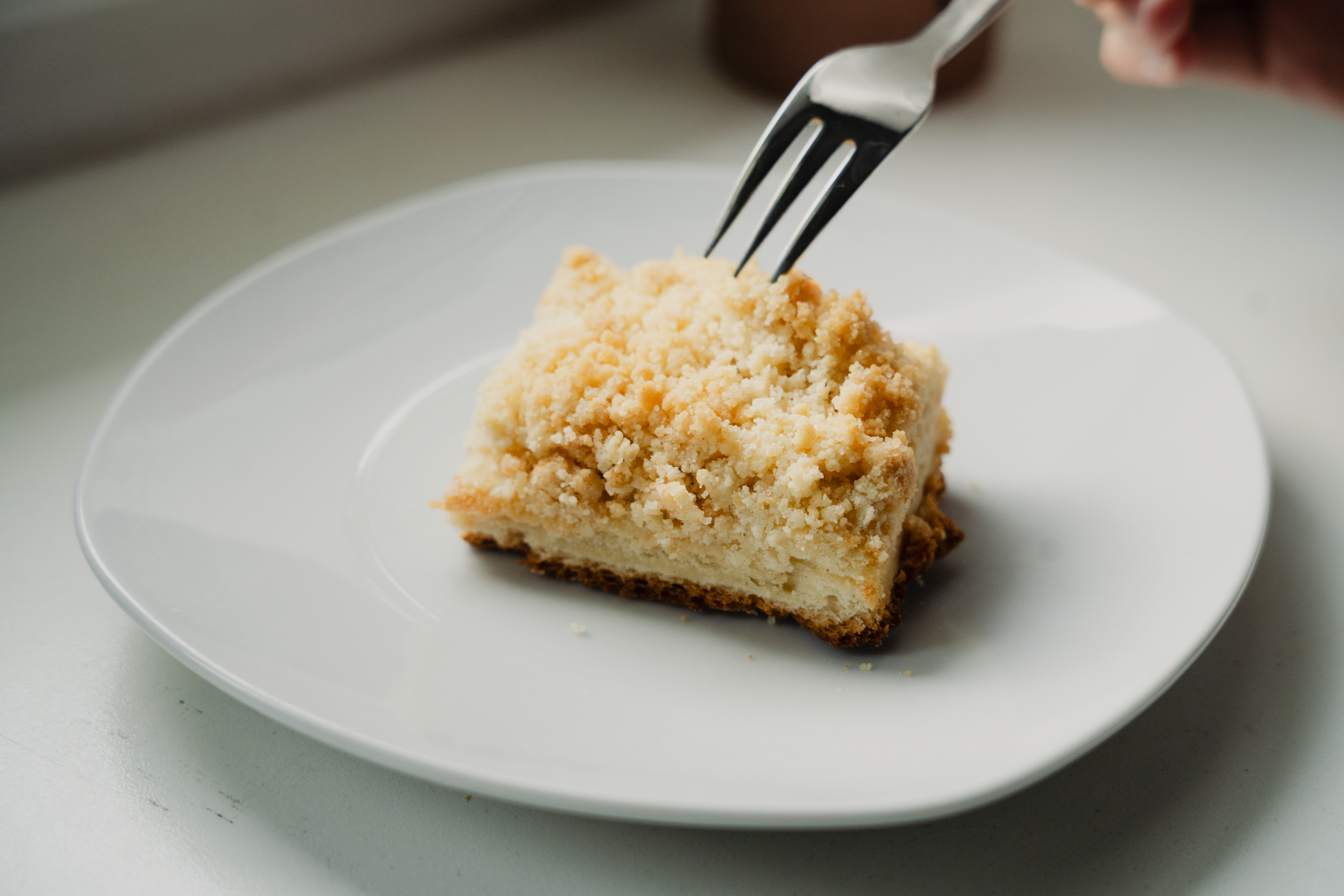
Streuselkuchen
The diets react (see scores below)
Common Ingredients
- flour
- yeast
- butter
- sugar
- eggs
- milk
- salt
- vanilla
- cinnamon
- custard powder
Specific recipes may vary.
Incompatible with 11 of 11 diets
Diet Ratings
Streuselkuchen is a German yeast-leavened cake with a crumble topping, built entirely around flour, sugar, and milk — all major sources of net carbs. A single serving would easily contain 40–60g of net carbs, blowing through the entire daily keto allowance in one snack. Flour (wheat) is a grain and directly violates keto fundamentals, sugar adds rapid-digesting carbohydrates, and custard powder is typically starch- and sugar-based. There is no meaningful fat-to-carb ratio that could redeem this food for ketosis. This is a classic high-carb pastry with no keto-compatible substitutions in its traditional form.
Streuselkuchen contains multiple animal-derived ingredients that disqualify it from a vegan diet. Butter is a dairy product, eggs are an animal product, milk is a dairy product, and custard powder (in its traditional form) typically contains dried egg yolk or is formulated for use with milk. There is no ambiguity here — this is a classic German yeasted cake built on a foundation of animal products. Plant-based substitutes (vegan butter, plant milk, flax eggs, vegan custard powder) exist and could make a vegan version, but the dish as listed with these ingredients is not vegan.
Streuselkuchen is a German crumb cake that is fundamentally incompatible with the Paleo diet. Its core ingredients include flour (wheat grain), milk (dairy), butter (dairy), sugar (refined), salt (added), and custard powder (processed additive). Yeast-leavened wheat flour forms the base, which is a grain and a primary Paleo exclusion. Milk and butter are dairy products, excluded under strict Paleo guidelines. Refined sugar is explicitly prohibited. Custard powder is a processed product typically containing cornstarch (a grain derivative), artificial flavoring, and colorants. Salt is also an added ingredient discouraged in Paleo eating. There is virtually no ingredient in this dish — other than eggs, vanilla, and cinnamon — that qualifies as Paleo-approved. This is one of the clearest possible violations of Paleo principles.
Streuselkuchen is a German crumb cake made primarily from refined white flour, butter, sugar, and custard powder — a combination that directly contradicts Mediterranean diet principles. It is a highly refined, sugar-laden baked good with no whole grains, no plant-forward ingredients, and no olive oil. Butter is the primary fat rather than olive oil, and added sugar and refined grains are explicitly minimized in Mediterranean eating. This is a classic Northern European pastry with essentially no alignment with the Mediterranean dietary pattern.
Streuselkuchen is a German crumb cake that is fundamentally incompatible with the carnivore diet. The dish is built almost entirely on plant-derived and processed ingredients: flour (grain), sugar (processed plant), yeast (fungus), vanilla (plant), and cinnamon (plant spice). Custard powder typically contains starch and artificial flavoring. While it does contain some animal-derived ingredients — eggs, butter, and milk — these are minor components in a predominantly carbohydrate-based baked good. There is no meaningful animal protein source. This is a classic pastry/snack food that represents exactly the category of foods the carnivore diet eliminates.
Streuselkuchen is a German crumb cake that violates Whole30 on multiple levels. It contains flour (a grain, excluded), sugar (added sugar, excluded), butter (dairy, excluded — only ghee/clarified butter is allowed), and milk (dairy, excluded). Additionally, even if all ingredients were somehow made compliant, this dish is a baked good (cake) which is explicitly prohibited under Whole30's 'no recreating baked goods' rule, regardless of ingredient compliance.
Streuselkuchen is a traditional German yeast-leavened cake made primarily with wheat flour, which is high in fructans — one of the most significant FODMAPs. The dough contains regular wheat flour as its base, making it high-FODMAP regardless of serving size. Additionally, milk is used in the dough and potentially the custard filling, introducing lactose, another key FODMAP. Custard powder itself (if it contains wheat starch or is mixed with milk to make custard) adds further concern. The yeast leavening does not provide the extended fermentation needed to significantly reduce fructan content the way traditional long-fermented sourdough can. Butter, eggs, sugar, salt, vanilla, and cinnamon are individually low-FODMAP, but the wheat flour and milk make this dish unsuitable during the elimination phase at any standard serving size.
Streuselkuchen is a German yeast cake topped with a buttery crumble (streusel), made from refined white flour, butter, and sugar as its dominant components. This dish is high in refined carbohydrates, added sugars, and saturated fat from butter, with no meaningful contribution of potassium, magnesium, fiber, or lean protein. DASH guidelines explicitly limit sweets, added sugars, and saturated fats, while emphasizing whole grains over refined flour. The custard powder adds additional sugar and refined starch. As a sweet pastry/cake, it falls squarely in the category DASH recommends limiting to 5 or fewer servings per week (and those servings should be small), making it a poor fit for routine consumption. It offers none of the core DASH nutrients and contributes negatively to the diet's goals of blood pressure reduction.
Streuselkuchen is a German yeast-risen cake topped with a buttery crumble (streusel), typically filled with custard. Its macronutrient profile is fundamentally incompatible with Zone ratios. The base is refined white flour (high-glycemic carbohydrate), the streusel topping is a dense combination of flour, butter, and sugar, and the custard filling adds more sugar and refined starch via custard powder. There is no meaningful lean protein source — eggs contribute minimally and are primarily embedded in a high-carb, high-fat matrix. The fat profile is dominated by saturated fat from butter rather than the Zone-preferred monounsaturated fats. The sugar content alone makes this nearly impossible to fit into a Zone block structure without consuming a negligibly small portion that would not constitute a meaningful snack. This is essentially a dessert cake with a glycemic profile that would spike insulin sharply — the exact hormonal outcome the Zone Diet is designed to prevent. With no lean protein to anchor a block, no low-GI carbohydrates, and saturated fat as the primary fat source, Streuselkuchen offers almost no Zone-favorable attributes.
Streuselkuchen is a German yeast-risen cake topped with a buttery crumble (streusel), typically filled with custard. Its ingredient profile is almost entirely pro-inflammatory from an anti-inflammatory diet standpoint. Refined white flour (high glycemic, stripped of fiber and nutrients) is the base, paired with significant added sugar in both the dough and streusel topping. Butter is present in substantial quantities, contributing saturated fat. Custard powder is a processed ingredient typically containing refined starch, artificial colorings, and flavorings. Eggs and milk provide some neutral nutritional value, and cinnamon and vanilla offer minor anti-inflammatory polyphenols — but these are token quantities relative to the overall inflammatory load. There are no omega-3 sources, no meaningful antioxidant-rich fruits or vegetables, no whole grains, and no anti-inflammatory fats like olive oil. The combination of refined carbohydrates and saturated fat is specifically associated with elevated inflammatory markers (CRP, IL-6) in research. This is an occasional indulgence food, not compatible with anti-inflammatory eating principles.
Streuselkuchen is a traditional German yeast cake topped with a buttery crumble (streusel), typically filled or layered with custard. Its ingredient profile is dominated by refined flour, butter, and sugar — a combination that delivers high refined carbohydrates, significant saturated fat, and minimal protein or fiber. The custard layer (custard powder, eggs, milk, sugar) adds modest protein but is also calorie-dense relative to its nutritional contribution. For GLP-1 patients, this food fails on nearly every priority axis: negligible protein density, very low fiber, high saturated fat (which worsens nausea, bloating, and reflux due to slowed gastric emptying), and high sugar content (which spikes blood glucose and represents empty calories). The refined grain base also digests in a way that offers little satiety despite caloric load. As a snack category item, it competes directly against the small-portion, high-protein, high-fiber snack profile that GLP-1 patients need. There is no meaningful clinical argument for including this food in a GLP-1 dietary plan.
*See how scores were generated at our methodology page.
Nutritional profile
Six traits that cut across every diet.
Fiber & Plants
How much whole-plant food and fiber it delivers.
Healthy Fats
The quality of its fats (unsaturated, omega-3).
Whole / Unprocessed
How close it is to its natural, unprocessed form.
Gut Gentle
How easy it is on digestion (low FODMAP, few irritants).
Low Glycemic
How little it spikes your blood sugar.
Protein Density
How much protein it packs per calorie.
Controversy Index
Higher controversy = more disagreement between diets.