Photo: Mihman Duğanlı / Pexels
Armenian
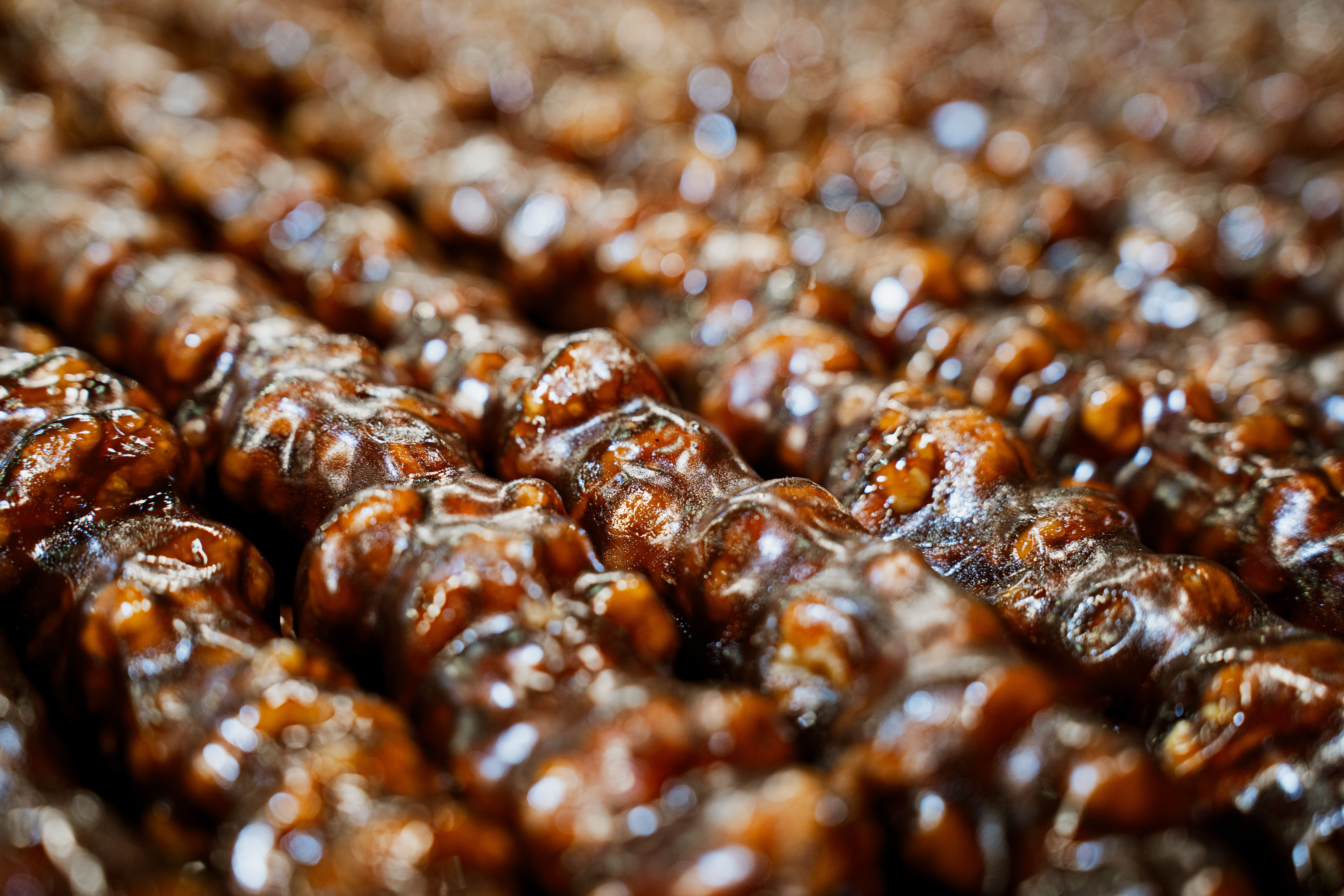
Sujuk Dulce
The diets react (see scores below)
Common Ingredients
- flour
- butter
- eggs
- honey
- pistachios
- salt
- sugar
- water
Specific recipes may vary.
Incompatible with 9 of 11 diets
Diet Ratings
Sujuk Dulce is an Armenian confection made primarily from flour, honey, and sugar — three ingredients that are fundamentally incompatible with a ketogenic diet. Flour is a high-glycemic grain product contributing substantial net carbs, while honey and sugar are pure simple sugars that will immediately spike blood glucose and terminate ketosis. Even a small serving would likely exceed the entire daily net carb limit of 20-50g. The pistachios and butter provide some fat, but they cannot offset the massive carbohydrate load from the other ingredients. This dish has no viable place in a ketogenic diet in its traditional form.
Sujuk Dulce contains multiple clear animal-derived ingredients: butter (dairy), eggs, and honey. Butter is a dairy product, eggs are an animal product, and honey is excluded by mainstream vegan organizations including the Vegan Society and PETA. With three distinct animal-product violations, this dish is firmly non-vegan. A vegan version could theoretically be made by substituting plant-based butter, a flax or chia egg replacer, and agave or maple syrup, but the traditional recipe as listed is incompatible with a vegan diet.
Sujuk Dulce contains multiple non-paleo ingredients that disqualify it outright. Flour (wheat) is a grain and a core exclusion in every paleo framework. Butter is a dairy product excluded by strict paleo guidelines. Refined sugar and added salt are both explicitly prohibited. While honey and eggs are paleo-compatible, and pistachios are an approved nut, the combination of flour, butter, sugar, and salt makes this dish fundamentally incompatible with the paleo diet. The majority of ingredients violate foundational paleo principles.
Sujuk Dulce is an Armenian sweet confection made primarily from refined white flour, butter, added sugars, and honey. The combination of refined grains, saturated fat from butter, and significant added sugar (both honey and sugar) places this dish squarely in the 'avoid' category under Mediterranean diet principles. While pistachios are a genuinely Mediterranean-approved nut, they are a minor component that cannot offset the problematic primary ingredients. Butter is not the canonical Mediterranean fat (olive oil is), and the high refined carbohydrate and sugar load contradicts the diet's emphasis on minimally processed, low-added-sugar foods.
Some interpreters note that traditional Armenian and Eastern Mediterranean sweets using honey and nuts have been part of the regional culinary heritage for centuries, and that honey as a natural sweetener and pistachios as a nutrient-dense nut give this treat a slight edge over purely industrial confections. Occasional consumption as a cultural treat may be tolerated within a broadly Mediterranean lifestyle.
Sujuk Dulce is an Armenian sweet confection made primarily from plant-based ingredients: flour (grain), pistachios (nuts), honey (debated but plant-adjacent), and sugar. While butter and eggs are animal-derived, they are minor components in a dish that is fundamentally built around excluded carnivore foods. Flour and grains are strictly prohibited on the carnivore diet, pistachios are nuts (also strictly excluded), and sugar is a processed plant-derived sweetener. This dish fails carnivore criteria on multiple core ingredients simultaneously.
Sujuk Dulce contains multiple excluded ingredients: flour (a grain product), butter (dairy, not ghee), honey (added sugar), and sugar (added sugar). These are all explicitly prohibited on the Whole30 program. Even setting aside the spirit-of-the-program concerns, this dish fails on multiple foundational rules.
Sujuk Dulce (Armenian walnut/nut sausage candy) as described contains several high-FODMAP ingredients. Wheat flour is high in fructans and is a primary concern during elimination phase. Honey is high in excess fructose and is explicitly listed on Monash's high-FODMAP list at even small servings (>1 tsp becomes problematic). Pistachios are high-FODMAP due to fructans and GOS — Monash rates them as high-FODMAP at a standard snack serving (around 10-15 nuts). Eggs and butter are low-FODMAP. Sugar (sucrose) is low-FODMAP. Salt and water are low-FODMAP. The combination of wheat flour, honey, and pistachios makes this dish unsuitable during the FODMAP elimination phase.
Some FODMAP practitioners note that if honey is used only in very small quantities as a coating or glaze (under 1 tsp total per serving), it may be tolerable, but honey is generally avoided during strict elimination. Similarly, the amount of flour and pistachios per individual serving matters — if portions are tiny (e.g., a very small bite), the fructan and GOS load may be lower, but Monash University's guidance does not support wheat flour or pistachios as safe in typical snack-sized amounts.
Sujuk Dulce is an Armenian sweet confection made by dipping strings of nuts (pistachios here) in a thickened flour-and-sugar syrup, sometimes with honey, shaped into a sausage-like roll. The ingredient profile presents a mixed picture for DASH compliance. On the positive side, pistachios are a DASH-endorsed food — they're rich in potassium, magnesium, healthy unsaturated fats, and fiber, and nuts are explicitly included in DASH guidelines. Honey provides some micronutrients, and eggs contribute protein. However, the combination of refined flour (not a whole grain), butter (saturated fat), added sugar, and honey results in a high added-sugar, moderate saturated fat snack that DASH guidelines explicitly limit. The dish is essentially a sweet confection, a food category DASH recommends minimizing. Butter adds saturated fat inconsistent with DASH's emphasis on vegetable oils over solid fats. The pistachio content is a genuine positive that prevents a lower score, and sodium appears minimal based on ingredient quantities. As an occasional small-portion snack, this is borderline acceptable under DASH, but it is not a food DASH would emphasize.
NIH DASH guidelines restrict sweets and added sugars to ≤5 servings/week (small portions), which would technically allow occasional consumption of this dish in small amounts. Some DASH-oriented nutritionists might note that the pistachio base and honey (vs. refined sugar) give this a slight nutritional edge over purely processed sweets, and a small portion could fit within weekly discretionary allowances.
Sujuk Dulce is an Armenian confection built almost entirely around high-glycemic, Zone-unfavorable ingredients. The base is refined white flour — a high-glycemic carbohydrate that Sears explicitly discourages. It is sweetened with both honey and sugar, two of the most glycemically disruptive carb sources in Zone terminology, capable of spiking insulin sharply and disrupting the hormonal balance the Zone seeks to maintain. Butter contributes saturated fat rather than the preferred monounsaturated fats (olive oil, avocado, almonds). The only redeeming ingredient is pistachios, which provide some monounsaturated fat and protein, but they are clearly a minor garnish here rather than a structural component. There is no lean protein source to anchor a Zone block, and the carbohydrate profile is dominated by refined and simple sugars with no fiber-rich or low-GI vegetables or fruits to moderate glycemic response. As a snack, this dish offers essentially no path to a 40/30/30 balance — it would be nearly pure high-GI carbohydrate and saturated fat. Even in small portions, the ingredient composition makes Zone balancing nearly impossible without fundamentally deconstructing the dish.
Sujuk Dulce is an Armenian confection — essentially a nut-studded sweet pastry or candy made from flour, butter, eggs, honey, pistachios, sugar, salt, and water. The ingredient profile is mixed from an anti-inflammatory standpoint. On the positive side, pistachios are a notable anti-inflammatory nut rich in monounsaturated fats, polyphenols, and antioxidants; honey (especially raw) contains trace anti-inflammatory phenolic compounds; and eggs provide choline and selenium with a neutral-to-moderate inflammatory profile. However, the dish is built around refined flour (a refined carbohydrate that spikes blood glucose and promotes inflammatory signaling), butter (a saturated fat that in excess can promote inflammatory pathways), and added sugar alongside honey (doubling the glycemic load). The combination of refined carbohydrates and significant added sugars is consistently flagged as pro-inflammatory in the literature. Butter in moderate quantities falls into the 'limit' category rather than 'avoid,' and the pistachios provide partial mitigation. Overall, this is an occasional treat — the beneficial nut content and honey prevent a full 'avoid,' but the refined carb and sugar burden keep it firmly in 'caution' territory.
Sujuk Dulce is an Armenian confection — a sweet, dense pastry or candy made primarily from flour, butter, sugar, and honey, studded with pistachios. It is essentially a high-sugar, high-saturated-fat dessert snack with negligible protein and minimal fiber. For GLP-1 patients, this food hits nearly every 'avoid' criterion simultaneously: it is calorie-dense with empty nutritional value per calorie, loaded with saturated fat from butter, high in simple sugars from both honey and sugar, and offers no meaningful protein contribution. The pistachios provide a small amount of protein and healthy fat, but their quantity in a typical serving is insufficient to meaningfully alter the nutritional profile. The buttery, rich composition is likely to worsen GLP-1 side effects including nausea, bloating, and reflux due to high fat content slowing gastric emptying further. As a snack category item, it displaces an opportunity to consume a high-protein, high-fiber option during a meal window where every calorie must count.
*See how scores were generated at our methodology page.
Nutritional profile
Six traits that cut across every diet.
Fiber & Plants
How much whole-plant food and fiber it delivers.
Healthy Fats
The quality of its fats (unsaturated, omega-3).
Whole / Unprocessed
How close it is to its natural, unprocessed form.
Gut Gentle
How easy it is on digestion (low FODMAP, few irritants).
Low Glycemic
How little it spikes your blood sugar.
Protein Density
How much protein it packs per calorie.
Controversy Index
Higher controversy = more disagreement between diets.
Diet-Specific Tips
 DASH — 4/10
View tips
- High added sugar content (sugar + honey) conflicts with DASH limit on sweets
- Butter adds saturated fat, which DASH guidelines restrict
- Refined flour used rather than DASH-preferred whole grains
- Pistachios are a DASH-approved nut — provide potassium, magnesium, fiber, and healthy fats
- Low sodium content is a positive attribute
- Classified as a sweet confection/snack — a category DASH limits to ≤5 small servings per week
- Eggs contribute some protein but are a minor factor in this preparation
 Anti-Inflammatory — 4/10
View tips
- Pistachios: anti-inflammatory — rich in monounsaturated fats, polyphenols, and antioxidants
- Refined wheat flour: pro-inflammatory — refined carbohydrate, raises blood glucose, promotes inflammatory markers
- Added sugar: pro-inflammatory — dual sugar load (honey + sugar) drives glycemic and inflammatory response
- Butter: moderate concern — saturated fat, falls in the 'limit' category per anti-inflammatory guidelines
- Honey: mildly beneficial — contains trace phenolic antioxidants, but still adds to sugar load
- Eggs: neutral-to-moderate — some anti-inflammatory micronutrients (choline, selenium) but also arachidonic acid in yolk
- No omega-3 sources, colorful vegetables, or strongly anti-inflammatory spices present