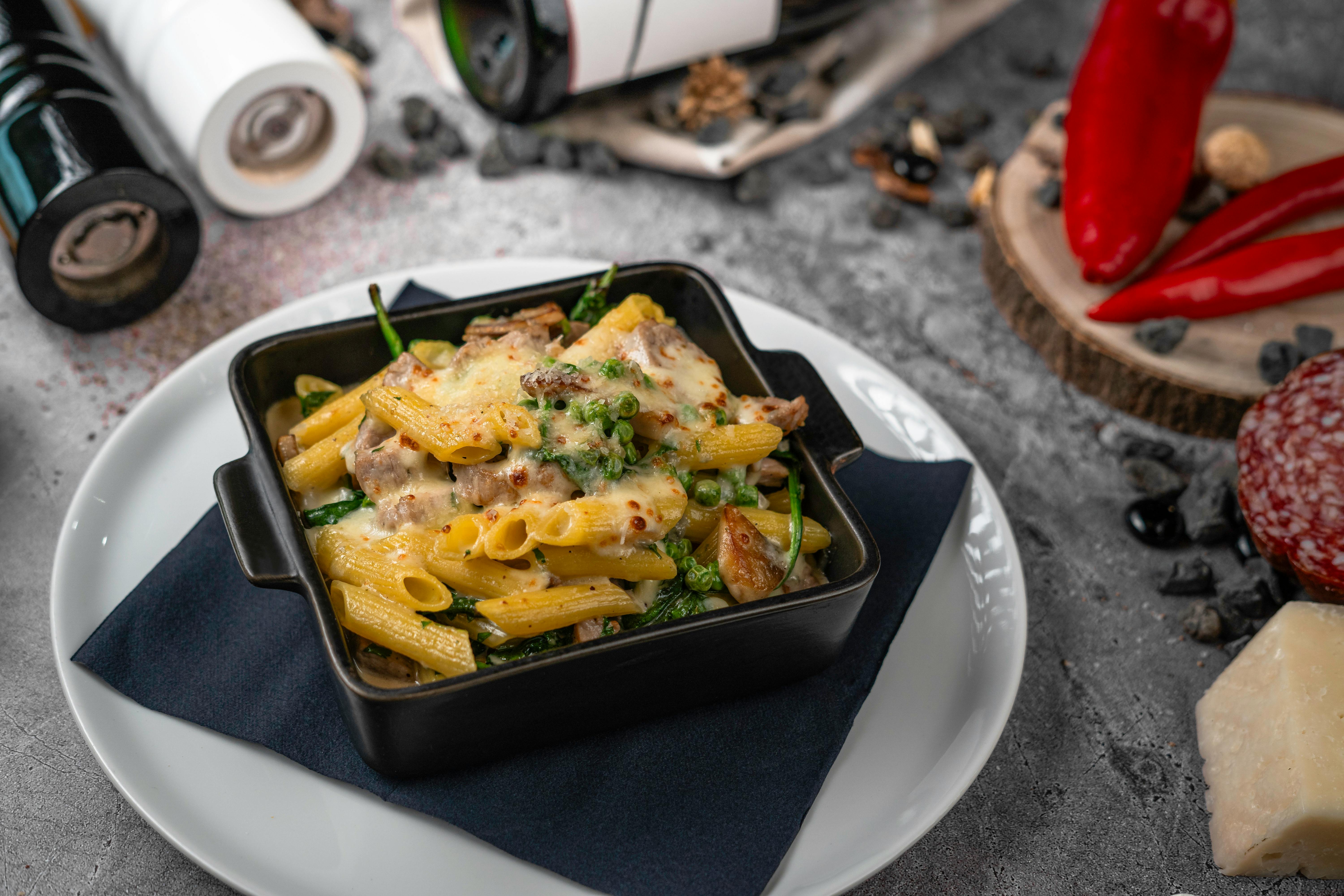
Photo: PEEP THIS PHOTO / Pexels
Swiss
Alplermagronen
The diets react (see scores below)
Common Ingredients
- macaroni
- potatoes
- cheese
- cream
- onion
- butter
- applesauce
- bacon
Specific recipes may vary.
Incompatible with 11 of 11 diets
Diet Ratings
Alplermagronen is fundamentally incompatible with ketogenic diet. The dish is built on two massive carbohydrate sources: macaroni (pasta) and potatoes, both of which are high-net-carb grains and starchy vegetables explicitly excluded from keto. A standard serving would easily contain 50-80g of net carbs from the pasta and potatoes alone, far exceeding the entire daily keto carb budget. The applesauce side condiment adds further sugar and carbs. While some ingredients like cheese, cream, butter, and bacon are keto-friendly, they cannot redeem a dish whose foundational structure is carbohydrate-based. There is no practical way to adapt this dish while retaining its identity.
Alplermagronen is a traditional Swiss alpine pasta dish that contains multiple animal-derived ingredients. Cheese and cream are dairy products, butter is an animal fat, and bacon is pork meat. All four of these ingredients are excluded under vegan dietary rules. There is no plant-based version of this dish by default — it is fundamentally built around animal products at every layer.
Alplermagronen is fundamentally incompatible with the paleo diet. The dish's base ingredient is macaroni, a wheat-based grain pasta — one of the clearest violations of paleo principles. Beyond the pasta, cheese and cream are dairy products explicitly excluded from paleo. Butter is debated but would not redeem the dish. Bacon, while seemingly meat-based, is a processed meat with added salt and typically preservatives, placing it in avoid territory. Potatoes are a gray area in paleo, and applesauce and onion are the only ingredients that could be considered paleo-friendly. With multiple core, non-negotiable violations — grains and dairy — this dish scores at the very bottom of the scale.
Älplermagronen is a traditional Swiss Alpine dish that conflicts significantly with Mediterranean diet principles across multiple dimensions. The dish centers on refined pasta (macaroni) and potatoes — a double refined/high-glycemic carbohydrate load — combined with heavy cream, butter, and generous amounts of cheese, creating a very high saturated fat profile. Bacon adds processed red meat. The only marginally Mediterranean-compatible elements are onion and the incidental use of potatoes as a vegetable. There is no olive oil, no legumes, no fish, no leafy greens, and no whole grains. The applesauce accompaniment adds sugar. This dish is essentially the antithesis of Mediterranean diet construction: it is dairy-fat-heavy, meat-inclusive, refined-grain-based, and lacks the plant diversity and olive oil foundation that define the dietary pattern.
Alplermagronen is a Swiss alpine pasta dish that is fundamentally incompatible with the carnivore diet. The dish is built almost entirely on plant-based ingredients: macaroni (wheat pasta), potatoes, and onions form the base, while applesauce is served as a traditional accompaniment. These are all strictly excluded plant foods. The only carnivore-compatible ingredients are cheese, cream, butter, and bacon — all of which are secondary components and cannot redeem a dish whose primary structure is grain- and starch-based. Even on the most lenient carnivore interpretations (animal-based), macaroni, potatoes, and applesauce have no place in the diet.
Alplermagronen contains multiple excluded ingredients that make it incompatible with Whole30. Macaroni is a grain-based pasta (wheat), which is explicitly excluded. Cheese and cream are dairy products (excluded), and butter is also excluded (only ghee/clarified butter is the dairy exception). Additionally, even if all ingredients were compliant, macaroni-based pasta dishes fall directly under the 'no recreating pasta or noodles' rule. This dish is fundamentally a Swiss alpine mac-and-cheese and cannot be made Whole30-compliant without completely transforming it into a different dish.
Alplermagronen is a traditional Swiss alpine pasta dish that contains multiple high-FODMAP ingredients, making it unsuitable during the elimination phase. The most critical offender is macaroni (wheat pasta), which is high in fructans — one of the most problematic FODMAP categories. Onion is another major FODMAP trigger, extremely high in fructans even in small quantities and essentially unavoidable in this dish as a core flavoring. Cream is high in lactose at typical serving sizes used in this dish, and the cheese component (typically melted alpine cheese like Gruyère or Emmental) adds further lactose load, though hard aged cheeses like Gruyère are technically low-lactose in small amounts. Applesauce, served as the traditional sweet accompaniment, contains excess fructose and is high-FODMAP. Potatoes and bacon are low-FODMAP and do not contribute to FODMAP load. Butter is also low-FODMAP. However, the combination of wheat macaroni, onion, cream, and applesauce creates an unavoidably high-FODMAP dish that cannot reasonably be modified to become compliant without fundamentally changing its character.
Alplermagronen is a traditional Swiss alpine macaroni dish that is fundamentally incompatible with DASH diet principles. It combines multiple high-saturated-fat ingredients — full-fat cheese, heavy cream, and butter — as core components, directly violating DASH's explicit limits on saturated fat and full-fat dairy. Bacon adds both saturated fat and significant sodium, compounding the problem. The dish is calorie-dense with a poor nutrient profile relative to DASH priorities: it lacks meaningful fiber, potassium, magnesium, or calcium from DASH-approved sources, and provides no lean protein. Refined macaroni (typically not whole grain) and potatoes without skin offer minimal DASH nutritional benefit. While the applesauce component is DASH-friendly and onions are acceptable, these minor positives are overwhelmed by the dish's structural reliance on cream, cheese, butter, and bacon. A DASH-compliant version would require wholesale reformulation — swapping full-fat dairy for low-fat alternatives, eliminating or drastically reducing bacon, using whole-grain pasta — resulting in a fundamentally different dish.
Alplermagronen is a quintessential high-glycemic, high-saturated-fat Alpine comfort dish that runs almost entirely contrary to Zone principles. The dish stacks two unfavorable high-glycemic carbohydrate sources — macaroni (refined pasta) and potatoes — creating a carbohydrate load that is both excessive and dominated by fast-digesting starches. The protein source is cheese with bacon, both high in saturated fat, far from the lean protein profile Zone prescribes. The fat profile is heavily saturated via cream, butter, and cheese, with virtually no monounsaturated fat present. The applesauce sidedish, while a fruit, adds additional sugar in a context already drowning in glycemic load. There is essentially no lean protein, no low-glycemic vegetable, and no monounsaturated fat — the three pillars of a Zone-favorable meal. Even with aggressive portioning, the ratio cannot be brought anywhere near 40/30/30 without fundamentally deconstructing the dish, at which point it is no longer Alplermagronen. This is one of the rare cases where the core structure of the dish is incompatible with Zone methodology.
Älplermagronen is a classic Swiss Alpine comfort dish that stacks multiple pro-inflammatory ingredients. The base is refined macaroni (refined carbohydrate with high glycemic load), paired with potatoes (additional starch load). The dish is finished with cream and butter (saturated fat), high-fat melting cheese (full-fat dairy, more saturated fat), and bacon (processed red meat with nitrates and saturated fat). Together these ingredients represent exactly the combination anti-inflammatory guidelines advise against: refined carbs + saturated fat + processed meat. The onion is the only genuinely anti-inflammatory ingredient (quercetin, allicin), and the applesauce side contributes a small amount of polyphenols, but neither meaningfully offsets the inflammatory load of the rest of the dish. There are no omega-3 sources, no meaningful antioxidant-rich vegetables, no herbs or spices with anti-inflammatory properties, and no healthy fats (e.g., olive oil). The cream and butter combination alone places this firmly in the 'limit to avoid' category under anti-inflammatory principles. Bacon as a processed meat is broadly flagged across anti-inflammatory frameworks. This dish is not inherently 'toxic,' but as a regular dietary choice it is poorly aligned with anti-inflammatory eating.
Alplermagronen is a traditional Swiss alpine dish built almost entirely around ingredients that conflict with GLP-1 dietary priorities. The base is macaroni and potatoes — two high-starch, low-protein, low-fiber refined carbohydrate sources that offer minimal nutritional density per calorie. The dish is enriched with cream, butter, and a substantial amount of cheese, making it very high in saturated fat and calories per serving. Bacon adds more saturated fat and sodium with negligible protein benefit at typical portion sizes in this dish. Applesauce, while not harmful, contributes sugar with minimal fiber. Critically, the fat load from cream, butter, and cheese is likely to worsen GLP-1 side effects — particularly nausea, bloating, and reflux — because high-fat meals are retained in the stomach longer and are poorly tolerated when gastric emptying is already slowed. Protein density is low relative to total calories, with cheese being the primary protein source but also delivering a high saturated fat burden. There is no meaningful fiber contribution from the ingredient list. This dish fails on nearly every GLP-1 dietary criterion: high saturated fat, low protein density, low fiber, poor digestibility, and low nutrient density per calorie.
*See how scores were generated at our methodology page.
Nutritional profile
Six traits that cut across every diet.
Fiber & Plants
How much whole-plant food and fiber it delivers.
Healthy Fats
The quality of its fats (unsaturated, omega-3).
Whole / Unprocessed
How close it is to its natural, unprocessed form.
Gut Gentle
How easy it is on digestion (low FODMAP, few irritants).
Low Glycemic
How little it spikes your blood sugar.
Protein Density
How much protein it packs per calorie.
Controversy Index
Higher controversy = more disagreement between diets.