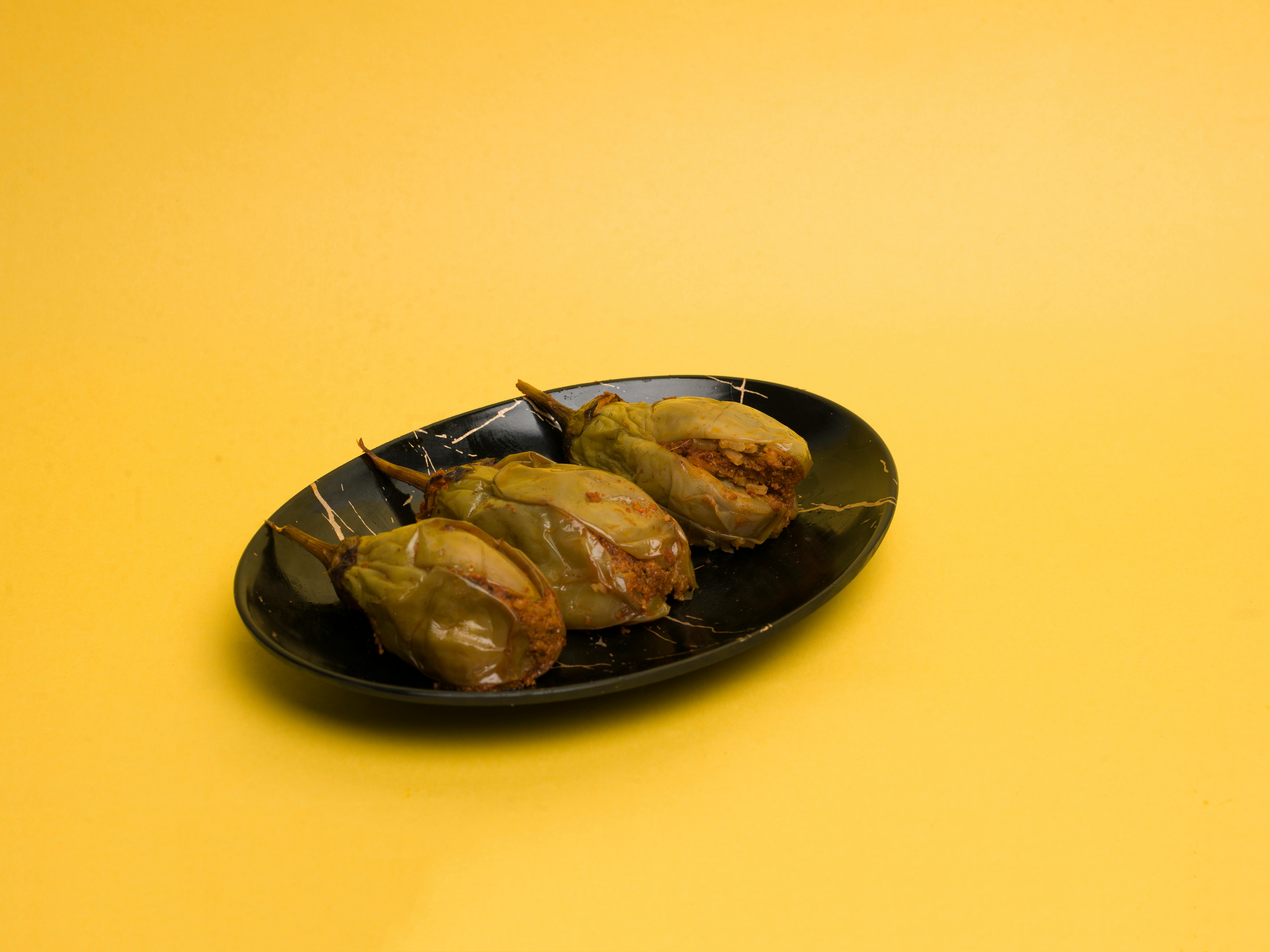
Photo: Milton Das / Pexels
The diets react (see scores below)
Common Ingredients
- baby eggplant
- walnuts
- red pepper
- garlic
- chili
- olive oil
- salt
Specific recipes may vary.
Incompatible with 3 of 11 diets
Diet Ratings
Makdous is a Syrian fermented/oil-cured baby eggplant stuffed with walnuts, red pepper, garlic, and chili, preserved in olive oil. The core ingredients are largely keto-friendly: olive oil is ideal, walnuts provide healthy fats, garlic and chili add negligible carbs, and the fermentation process may slightly reduce eggplant's carb content. However, eggplant carries moderate net carbs (~3-4g per 100g after fiber), and baby eggplants are consumed whole, meaning portion size matters significantly. A serving of 2-3 pieces (roughly 100-150g of eggplant) could contribute 4-6g net carbs, which is manageable within a daily keto budget but requires tracking. The walnuts and olive oil push the fat profile favorably. This dish is conditionally keto-compatible with portion control — 1-2 pieces as a side is reasonable, but eating liberally could push carb limits.
Strict keto practitioners may flag eggplant as a borderline vegetable and caution against fermented/cured dishes where carb content can be harder to quantify precisely; some very low-carb (under 20g/day) adherents would prefer to spend their carb allowance on lower-carb vegetables like leafy greens instead.
Makdous is a traditional Syrian pickled baby eggplant dish stuffed with walnuts, red pepper, garlic, and chili, then preserved in olive oil. Every single ingredient is 100% plant-based: eggplant, walnuts, red pepper, garlic, chili, olive oil, and salt. There are no animal products, animal-derived ingredients, or ethically contested components. This is a whole-food, minimally processed dish that aligns perfectly with vegan principles. It scores 9 rather than a perfect 10 only because olive oil is a processed fat rather than a whole food, though it is fully plant-derived and widely embraced by vegans.
Makdous is a traditional Syrian dish of oil-cured baby eggplants stuffed with walnuts, red pepper, garlic, and chili, preserved in olive oil. While most individual ingredients are paleo-friendly — eggplant, walnuts, red pepper, garlic, chili, and olive oil are all approved — the dish is disqualified primarily by the inclusion of added salt, which is excluded under paleo rules. Beyond salt, Makdous is a fermented/cured preserve, meaning it undergoes a multi-day anaerobic curing process that classifies it as a processed food by paleo standards. The processing method itself — salt-curing and long fermentation — contradicts the paleo philosophy of minimally processed, whole foods. Even setting aside the salt, this dish would fall into caution territory as a processed product. With salt included as a core, non-optional ingredient, it moves firmly into avoid territory.
Makdous is a Syrian oil-cured baby eggplant dish stuffed with walnuts, red pepper, garlic, and chili, preserved in olive oil. Every single ingredient aligns perfectly with Mediterranean diet principles. Eggplant is a quintessential Mediterranean vegetable, walnuts are a celebrated healthy fat and protein source, red pepper and garlic are staple aromatics, and extra virgin olive oil is the canonical fat of the Mediterranean diet. This is a traditional Levantine meze that exemplifies the plant-forward, olive-oil-based eating pattern the Mediterranean diet is built upon. There are no red meats, refined grains, added sugars, or processed ingredients.
Makdous is a Syrian pickled dish consisting entirely of plant-based ingredients — baby eggplant stuffed with walnuts, red pepper, garlic, and chili, preserved in olive oil. There is not a single animal-derived ingredient in this dish. Every component is explicitly excluded on the carnivore diet: eggplant is a vegetable, walnuts are nuts/seeds, red pepper and garlic are plant foods, chili is a plant spice, and olive oil is a plant-derived oil. This dish is fundamentally incompatible with carnivore principles at every level.
Makdous is a Syrian oil-cured pickled eggplant dish stuffed with walnuts, red pepper, garlic, and chili, preserved in olive oil. All listed ingredients are individually Whole30-compliant: eggplant, walnuts, red pepper, garlic, chili, olive oil, and salt are all allowed. However, traditional Makdous is a fermented/cured food — the eggplants are salted, partially dried, then left to ferment for several days before being packed in olive oil. The fermentation process is natural and involves no added non-compliant ingredients, so it is technically compliant. The caution arises because commercial or store-bought versions may include added sulfites (though sulfites are now allowed per 2024 rules), citric acid, or other preservatives that require label verification. Additionally, some recipes include vinegar, which would be allowed, but some may include other additives. As a whole-food, homemade preparation this dish is squarely compliant; commercial versions warrant label scrutiny.
Most Whole30 community members and official guidelines would consider homemade Makdous fully compliant given its clean ingredient list. However, some practitioners caution that relying on commercially prepared fermented/pickled foods without thorough label-reading can introduce hidden non-compliant additives, so homemade is always the safer choice.
Makdous is a Syrian oil-cured stuffed baby eggplant dish. Two ingredients make it high-FODMAP at any realistic serving size. First, garlic is a major FODMAP offender (high fructans) and is used as a core stuffing ingredient in significant quantity — not merely a trace flavoring. Unlike garlic-infused oil, the garlic cloves used in makdous are water-present and their fructans fully transfer to the dish. Second, eggplant itself is low-FODMAP only at small portions (75g per Monash), but a single stuffed baby eggplant likely exceeds this threshold, and most servings involve 2-3 pieces. Walnuts are low-FODMAP at ≤30g (10 halves), which is manageable, and red pepper (capsicum) is low-FODMAP in moderate amounts. Olive oil, salt, and chili are not FODMAP concerns. However, the combination of garlic as a primary stuffing ingredient plus portion-dependent eggplant makes this dish essentially unavoidable as a high-FODMAP food during the elimination phase.
Monash University rates eggplant as low-FODMAP at 75g and notes that some polyols (particularly mannitol in eggplant) may be tolerated by certain individuals; a FODMAP-aware cook could theoretically substitute garlic-infused oil for garlic cloves and control eggplant portion size, but this would no longer be traditional makdous. Clinical FODMAP practitioners would advise avoiding the traditional dish entirely during elimination due to the garlic content.
Makdous is a Syrian oil-cured pickled baby eggplant stuffed with walnuts, red pepper, garlic, and chili, preserved in olive oil with significant salt. While many of its individual components align well with DASH principles — eggplant is a DASH-friendly vegetable, walnuts provide heart-healthy unsaturated fats and magnesium, olive oil is a preferred fat, and red pepper adds potassium and antioxidants — the preservation method is the critical issue. Makdous is a salt-cured, fermented/pickled product, meaning sodium content is very high (typically 600–900mg+ per small serving of 2–3 pieces). This directly conflicts with DASH's core sodium restriction (<2,300mg/day standard, <1,500mg/day low-sodium DASH). The olive oil base is DASH-compatible, unlike tropical oils, but the oil volume is substantial, increasing caloric density. Walnuts are DASH-approved but portion-controlled. The dish is acceptable only in very small quantities as an occasional condiment rather than a regular side dish, and it warrants a 'caution' rating due to sodium load despite its otherwise wholesome ingredients.
NIH DASH guidelines clearly limit high-sodium preserved and pickled foods due to their sodium burden. However, some updated DASH-oriented clinicians note that when Makdous is consumed in very small portions (1 piece as a condiment), the actual sodium intake may remain manageable within an otherwise low-sodium day, and the accompanying benefits of walnuts, olive oil, and eggplant offer cardiovascular value consistent with Mediterranean-DASH hybrid interpretations.
Makdous is a Syrian fermented/oil-cured baby eggplant dish stuffed with walnuts, red pepper, garlic, and chili, preserved in olive oil. From a Zone perspective, this is quite favorable: eggplant is a low-glycemic vegetable (favorable Zone carb), walnuts provide both fat and some protein with a good monounsaturated/polyunsaturated profile, red pepper adds polyphenols and minimal carbs, garlic contributes anti-inflammatory compounds Sears emphasizes, and olive oil is the ideal Zone fat source. The fat content is higher relative to protein (this is a side with no primary protein), so Makdous functions best as the fat block component of a Zone meal rather than a standalone balanced dish. The walnuts do provide some protein but not enough to anchor a meal. As a condiment or side paired with lean protein, it fits Zone principles well — delivering favorable carbs, anti-inflammatory polyphenols, and predominantly monounsaturated and omega-3-leaning fats. Portion control matters since olive oil and walnuts are calorie-dense fat blocks.
Some Zone practitioners might rate this higher (8-9) arguing that the combination of eggplant polyphenols, olive oil, walnuts (omega-3 source), and anti-inflammatory garlic and chili makes this nearly ideal as a Zone fat-and-carb component. Others might caution that walnuts are relatively high in omega-6 compared to macadamia nuts or avocado, which are Sears' preferred fat sources, slightly reducing the anti-inflammatory profile he emphasizes in later works.
Makdous is a Syrian oil-cured baby eggplant dish stuffed with walnuts, red pepper, garlic, and chili, preserved in olive oil. From an anti-inflammatory standpoint, this is a remarkably strong profile. Eggplant contains nasunin (a potent anthocyanin antioxidant), chlorogenic acid, and fiber, all of which have demonstrated anti-inflammatory activity. Walnuts are one of the best plant-based sources of ALA omega-3 fatty acids and polyphenols, making them a cornerstone of anti-inflammatory eating. Garlic contains allicin and organosulfur compounds shown to reduce CRP and NF-κB inflammatory signaling. Chili and red pepper supply capsaicin and capsaicinoids, which inhibit substance P and pro-inflammatory cytokines. Olive oil — the preservation medium — is extra virgin in traditional preparations and contributes oleocanthal, a COX-inhibiting polyphenol functionally similar to ibuprofen. Salt content is the primary concern: oil-cured preserved foods are typically high in sodium, and excessive sodium intake has been linked to endothelial inflammation and hypertension. This doesn't undermine the dish's anti-inflammatory ingredient base, but warrants moderation in serving size. The eggplant nightshade consideration is noted below.
Eggplant is a nightshade vegetable, and while mainstream anti-inflammatory nutrition (including Dr. Weil's pyramid) endorses nightshades for their high antioxidant content, the Autoimmune Protocol (AIP) and practitioners like Dr. Tom O'Bryan argue that solanine and lectins in nightshades can trigger or worsen inflammation in individuals with autoimmune conditions or intestinal permeability. For the general population this concern is not well-supported by clinical evidence, but individuals following AIP would avoid this dish.
Makdous is a fermented, oil-cured Syrian side dish of baby eggplants stuffed with walnuts, red pepper, garlic, and chili, then preserved in olive oil. It has several GLP-1-friendly qualities: eggplant provides fiber and is nutrient-dense per calorie, walnuts offer heart-healthy unsaturated and omega-3 fats, and fermentation may support gut health. However, the oil-curing process means each serving carries a meaningful fat load from both olive oil and walnuts combined, which can worsen nausea, bloating, or reflux — common GLP-1 side effects. Protein content is negligible, which is a significant drawback given that protein is the top dietary priority on GLP-1 medications. The chili and garlic content may also irritate the GI tract in sensitive patients, particularly those already experiencing nausea. As a condiment or very small garnish alongside a high-protein main, it is acceptable; as a standalone side dish it falls short nutritionally for GLP-1 patients. Portion control is essential.
Some GLP-1-focused dietitians view fermented and olive-oil-based Mediterranean foods favorably due to their anti-inflammatory fat profile and gut microbiome benefits, and would permit small portions freely. Others flag the cumulative fat load from oil-soaked preparations as a meaningful nausea trigger and recommend limiting oil-preserved foods entirely during the early adjustment phase of GLP-1 therapy.
*See how scores were generated at our methodology page.
Nutritional profile
Six traits that cut across every diet.
Fiber & Plants
How much whole-plant food and fiber it delivers.
Healthy Fats
The quality of its fats (unsaturated, omega-3).
Whole / Unprocessed
How close it is to its natural, unprocessed form.
Gut Gentle
How easy it is on digestion (low FODMAP, few irritants).
Low Glycemic
How little it spikes your blood sugar.
Protein Density
How much protein it packs per calorie.
Controversy Index
Higher controversy = more disagreement between diets.
Diet-Specific Tips
 Keto — 5/10
View tips
- Baby eggplant has moderate net carbs (~3-4g/100g); portion control is essential
- Olive oil preservation is excellent for keto fat profile
- Walnuts add healthy fats and protein with low net carbs
- Fermentation may marginally reduce carbohydrate content
- Red pepper and garlic contribute minor carbs but are negligible in small stuffing quantities
- No added sugars or grains present
- 2-3 pieces per serving is manageable; larger portions risk exceeding carb limits
 Vegan — 9/10
View tips
- All ingredients are fully plant-based
- Whole-food preparation with minimal processing
- Traditional preservation method uses olive oil, which is plant-derived
- No animal products, dairy, eggs, or animal-derived additives
- Walnuts provide healthy fats and protein
- Nutrient-dense and aligned with whole-food plant-based eating
 Mediterranean — 9/10
View tips
- Eggplant is a core Mediterranean vegetable, eaten frequently in Levantine and broader Mediterranean cuisines
- Walnuts provide healthy unsaturated fats, fiber, and plant-based protein, all strongly encouraged
- Extra virgin olive oil is the primary fat — both as an ingredient and preservation medium
- Garlic, red pepper, and chili are traditional Mediterranean aromatics with documented health benefits
- No animal products, refined grains, added sugars, or processed ingredients
- Traditional Syrian/Levantine dish with deep roots in the Mediterranean culinary heritage
 Whole30 — 5/10
View tips
- All core ingredients (eggplant, walnuts, red pepper, garlic, chili, olive oil, salt) are Whole30-compliant
- Fermentation process is natural and does not require non-compliant ingredients
- Commercial versions may contain additives, preservatives, or citric acid requiring label verification
- Sulfites, previously a concern for cured/preserved foods, are now allowed per 2024 Whole30 rule change
- Homemade preparation with listed ingredients is fully compliant
 DASH — 4/10
View tips
- High sodium content from salt-curing and pickling process — primary DASH concern
- Eggplant is a DASH-approved non-starchy vegetable rich in fiber and potassium
- Walnuts provide magnesium, healthy unsaturated fats, and are DASH-approved in moderation
- Olive oil is the preferred DASH fat source — positive factor
- Red pepper and garlic add potassium and beneficial phytonutrients
- High oil volume increases caloric density — portion control essential
- Not suitable for low-sodium DASH (<1,500mg/day) without significant recipe modification
- Low-sodium preparation (reducing curing salt) would score considerably higher
 Zone — 7/10
View tips
- Eggplant is a low-glycemic favorable Zone carbohydrate
- Olive oil is the ideal Zone monounsaturated fat source
- Walnuts provide Zone-friendly fat with some omega-3 content but also notable omega-6
- Red pepper and garlic contribute polyphenols aligned with Sears' anti-inflammatory focus
- No primary protein — must be paired with lean protein to complete a Zone meal
- Functions best as the fat block in a Zone meal due to high fat-to-protein ratio
- Fermentation/curing process does not significantly alter Zone macronutrient classification
 Anti-Inflammatory — 8/10
View tips
- Walnuts: high ALA omega-3 content and polyphenols — a primary anti-inflammatory strength
- Eggplant: rich in nasunin and chlorogenic acid, potent antioxidants that reduce oxidative stress
- Garlic: allicin and organosulfur compounds shown to lower CRP and suppress NF-κB
- Chili/red pepper: capsaicin inhibits pro-inflammatory cytokines and substance P
- Olive oil (preservation medium): oleocanthal acts as a natural COX inhibitor
- High sodium from salt-curing process — a caution for those monitoring sodium intake
- Nightshade consideration (eggplant, red pepper) relevant for autoimmune-sensitive individuals
 GLP-1 Friendly — 5/10
View tips
- Negligible protein — fails the #1 GLP-1 dietary priority
- High fat per serving due to combined olive oil curing and walnuts — risk of worsening nausea and reflux
- Eggplant and walnuts provide fiber and micronutrients — supports digestive health
- Unsaturated fat profile (olive oil, walnuts) is preferable to saturated fat sources
- Fermented preparation may offer modest gut health benefits
- Chili and garlic may irritate GI tract in GLP-1 patients with active nausea
- Portion-sensitive: small amounts as a condiment are more appropriate than a full serving as a side