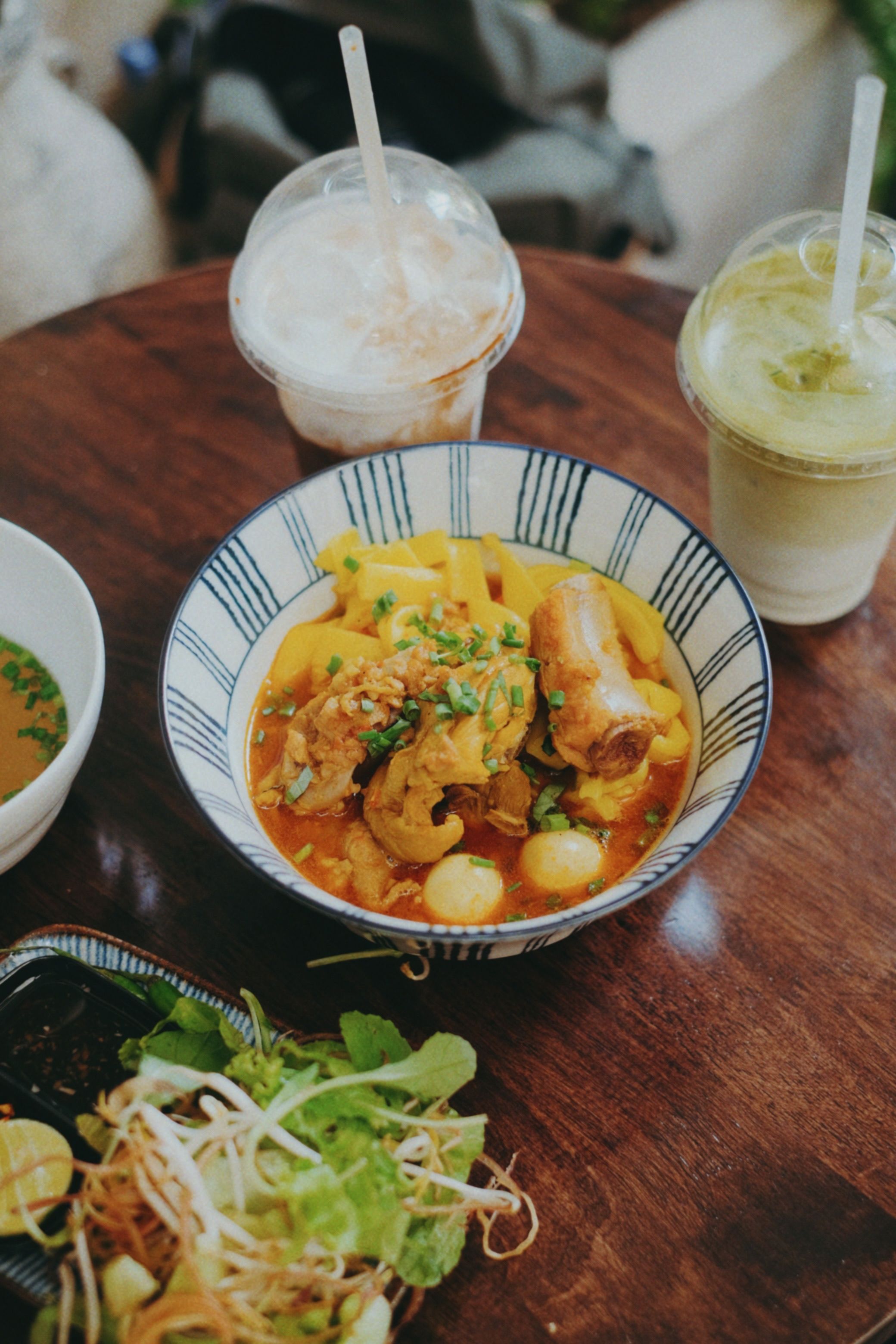
Photo: Pew Nguyen / Pexels
The diets react (see scores below)
Common Ingredients
- fermented rice noodles
- fish
- coconut milk
- curry paste
- lemongrass
- kaffir lime leaves
- bean sprouts
- long beans
- cucumber
- basil
Specific recipes may vary.
Incompatible with 5 of 11 diets
Diet Ratings
Khanom Jeen is built on a foundation of fermented rice noodles, which are essentially processed rice-based pasta with very high net carbs — a single serving can easily contain 40-60g of net carbs from the noodles alone, far exceeding daily keto limits. The dish is fundamentally defined by these noodles; they are not an optional component. While several ingredients are keto-friendly (fish, coconut milk, curry paste, lemongrass, kaffir lime leaves, basil), the vegetable accompaniments (bean sprouts, long beans, cucumber) add modest additional carbs. The entire dish framework is incompatible with ketosis as it is traditionally prepared and served.
Khanom Jeen contains fish as its primary protein, which is a direct animal product and unambiguously excluded from a vegan diet. Fish is explicitly listed as an ingredient, making this dish incompatible with veganism regardless of the many plant-based components (fermented rice noodles, coconut milk, vegetables, herbs) that accompany it. There is no meaningful debate within the vegan community about fish consumption — it is an animal and its flesh is not vegan.
Khanom Jeen is fundamentally built around fermented rice noodles, which are a grain-based product and a clear violation of paleo principles regardless of fermentation. Rice in any form — white, brown, or fermented — is excluded under strict paleo rules as a grain. Additionally, bean sprouts and long beans are legumes, which are also explicitly excluded from the paleo diet. The remaining ingredients (fish, coconut milk, curry paste, lemongrass, kaffir lime leaves, cucumber, and basil) are largely paleo-compatible, but the core structural components of this dish make it incompatible with the paleo framework. The dish cannot be considered paleo without fundamentally changing its identity.
Khanom Jeen has several Mediterranean diet-compatible elements: fish as the primary protein is strongly encouraged (2-3x weekly), and the abundant fresh vegetables (bean sprouts, long beans, cucumber, basil, lemongrass, kaffir lime leaves) align well with the plant-forward emphasis. However, two key ingredients create friction with Mediterranean principles. First, the fermented rice noodles are a refined grain product — while fermentation adds some nutritional value, they lack the fiber of whole grains and are not a Mediterranean staple. Second, coconut milk is a saturated fat source that directly conflicts with the diet's emphasis on extra virgin olive oil as the primary fat. Coconut milk is not traditional in Mediterranean cuisine and is notably high in saturated fat. The curry paste and aromatic herbs are nutritionally neutral to positive. Overall, the dish is nutritionally mixed: excellent protein source and vegetable load, but the coconut milk and refined rice noodles pull it away from core Mediterranean principles.
Some modern Mediterranean diet interpreters take a broader 'whole foods' view, arguing that coconut milk in modest quantities is acceptable as a minimally processed plant fat, and that fermented foods (including fermented rice noodles) offer probiotic benefits that align with gut-health aspects of Mediterranean eating. From this lens, the dish's fish, herbs, and vegetables could lift it to a low 'approve' rating.
Khanom Jeen is fundamentally incompatible with the carnivore diet. The dish is built on a base of fermented rice noodles — a grain-derived carbohydrate that violates the core rule of excluding all plant foods. The curry paste contains multiple plant compounds (chili, galangal, shrimp paste blended with plant aromatics), lemongrass and kaffir lime leaves are plant-based aromatics, coconut milk is a plant-derived fat source, and the accompanying vegetables — bean sprouts, long beans, cucumber, and basil — are all explicitly excluded plant foods. While fish is carnivore-approved, it is a minor component overwhelmed by a dish that is structurally and nutritionally plant-dominant. There is no version of this dish that could be made carnivore-compliant without completely deconstructing it.
Khanom Jeen is built around fermented rice noodles, which are a grain-based product (rice). Grains — including rice and all rice-derived products such as rice noodles — are explicitly excluded on the Whole30 for the full 30 days. No compliant substitution exists that would preserve the identity of this dish; the noodles are the defining, foundational ingredient. The remaining components (fish, coconut milk, curry paste, lemongrass, kaffir lime leaves, bean sprouts, long beans, cucumber, basil) are largely Whole30-compatible in their whole forms, but the grain noodle base makes the dish non-compliant regardless.
Khanom Jeen presents multiple FODMAP concerns despite some individually low-FODMAP components. The fermented rice noodles are rice-based and generally low-FODMAP, and plain fish is safe. However, the dish carries significant risk from several ingredients: (1) Curry paste is the biggest concern — Thai curry pastes almost universally contain garlic and shallots/onion, both high-FODMAP fructan sources, and the quantity used in a standard serving is typically enough to push the dish into high-FODMAP territory. (2) Long beans (yard-long beans) are high-FODMAP due to GOS content at typical serving sizes. (3) Bean sprouts are low-FODMAP at 65g but are often served generously. (4) Coconut milk is low-FODMAP at 60ml but high-FODMAP at 120ml+ due to sorbitol — Thai curries frequently use more than 60ml per portion. (5) Lemongrass and kaffir lime leaves are low-FODMAP as flavor aromatics. (6) Cucumber and Thai basil are low-FODMAP. The combination of high-FODMAP curry paste (garlic/onion), long beans with GOS, and potentially high coconut milk volume makes this dish risky during elimination phase without significant modification.
Monash University has not tested traditional Khanom Jeen as a composite dish, and FODMAP load depends heavily on recipe execution — a homemade version using garlic-free, onion-free curry paste and limiting coconut milk to 60ml per serve could be made low-FODMAP, but restaurant or traditional preparations almost certainly contain high-FODMAP curry paste ingredients. Clinical FODMAP practitioners would typically advise avoiding this dish during strict elimination unless full ingredient control is confirmed.
Khanom Jeen presents a mixed DASH profile. On the positive side, it features lean fish protein (excellent for DASH), abundant vegetables (bean sprouts, long beans, cucumber, basil), and fermented rice noodles which are relatively low in fat. However, two ingredients raise concerns: coconut milk is high in saturated fat from a tropical oil source, which DASH guidelines explicitly limit, and curry paste typically contains significant sodium. The combination of coconut milk and curry paste is the primary reason this dish falls into 'caution' rather than 'approve.' The vegetable accompaniments are a strong DASH positive, and fish is a preferred DASH protein. Sodium from curry paste can be substantial (curry pastes often contribute 400-800mg per serving), though home preparation allows control. Coconut milk contributes saturated fat in a form DASH guidelines discourage. With modifications — reduced coconut milk or light coconut milk, low-sodium curry paste — this dish could score higher. As commonly consumed in Thai cuisine, the coconut milk quantity is typically generous, warranting a caution rating.
NIH DASH guidelines explicitly limit saturated fat and tropical oils including coconut milk, placing this dish in caution territory. However, some updated clinical interpretations note that coconut milk in the context of a vegetable-rich, fish-based meal with a favorable overall dietary pattern may not carry the cardiovascular risk that isolated saturated fat consumption would, and some DASH-aligned dietitians permit small amounts of coconut milk when the rest of the meal is otherwise compliant.
Khanom Jeen presents a mixed Zone Diet profile. On the positive side, the fish protein is lean and Zone-favorable, providing excellent omega-3 fatty acids. The vegetable accompaniments — bean sprouts, long beans, cucumber, and basil — are all low-glycemic, polyphenol-rich, and strongly Zone-approved. Lemongrass and kaffir lime leaves add anti-inflammatory value with negligible macro impact. However, two ingredients create Zone friction: (1) Fermented rice noodles are the base carbohydrate and, while fermented rice has a modestly lower glycemic impact than plain white rice noodles due to fermentation, they are still a refined-grain, higher-glycemic carb source — classified as 'unfavorable' in Zone terminology. A typical serving is carb-heavy, making block balancing difficult without drastically reducing portion size. (2) Coconut milk contributes significant saturated fat, which conflicts with the Zone's preference for monounsaturated fats and its anti-inflammatory framework, particularly in Sears' later writings. The curry paste itself is typically fine. With careful portioning — a small noodle portion, generous vegetables, adequate fish, and light coconut milk — the dish can approximate Zone ratios, but the default restaurant serving will likely be carb- and fat-heavy relative to protein, skewing away from the 40/30/30 target.
Some Zone practitioners and later Sears' anti-inflammatory writings (e.g., 'The Anti-Inflammation Zone') place greater emphasis on fermented foods and acknowledge that fermentation reduces glycemic load. Fermented rice noodles may have a meaningfully lower glycemic index than standard rice noodles, making them somewhat more Zone-compatible than a simple rice comparison would suggest. Additionally, coconut milk contains medium-chain triglycerides (MCTs) that Sears acknowledges have metabolic benefits distinct from long-chain saturated fats, softening the saturated fat concern. Under this more lenient reading, a well-portioned Khanom Jeen with generous vegetables could approach a score of 6.
Khanom Jeen presents a mixed anti-inflammatory profile. On the positive side, the dish features fish as its primary protein (a source of omega-3 fatty acids, though species matters — freshwater fish common in Thai versions offer less EPA/DHA than fatty marine fish), along with a rich array of anti-inflammatory aromatics and herbs: lemongrass, kaffir lime leaves, and basil all contain bioactive compounds with demonstrated anti-inflammatory properties. Curry paste typically includes turmeric, galangal, and chili pepper — all strongly endorsed by anti-inflammatory frameworks. The fresh vegetable accompaniments (bean sprouts, long beans, cucumber) add fiber, antioxidants, and micronutrients. However, coconut milk is a significant source of saturated fat, which most anti-inflammatory guidelines recommend limiting. The fermented rice noodles are refined carbohydrates with minimal fiber, though the fermentation process may offer modest probiotic benefit. The overall dish is not strongly pro-inflammatory, but the coconut milk-heavy curry base and refined noodle base temper its anti-inflammatory potential. The vegetable garnishes and herb-forward aromatics partially offset these concerns.
Most anti-inflammatory authorities including Dr. Weil's pyramid recommend limiting saturated fat from coconut milk, placing this dish in 'caution' territory. However, a growing camp within paleo and ancestral health frameworks (e.g., Mark Hyman, Paul Jaminet) argues that medium-chain triglycerides (MCTs) in coconut milk are metabolized differently from long-chain saturated fats and may not drive inflammation in the same way — which would push this dish's score higher. The fermented noodles also sit in a gray zone: some practitioners value fermented foods broadly, while mainstream anti-inflammatory guidance focuses primarily on the refined carbohydrate load.
Khanom Jeen is a Thai dish of fermented rice noodles served in a fish-based curry broth with fresh vegetables. It has genuine strengths for GLP-1 patients — the fish provides lean protein, the fresh vegetable accompaniments (bean sprouts, long beans, cucumber, basil) add fiber and water content, and the dish is generally light and easy to eat in small portions. The fermented rice noodles are easier to digest than many grain-based carbs and have modest fiber. However, the coconut milk is the primary concern: it is high in saturated fat and can worsen GLP-1 side effects including nausea, bloating, and reflux. The amount of coconut milk in the broth is the key variable — a heavily coconut-milk-based curry sauce pushes this dish toward avoid territory, while a lighter broth version is more acceptable. Protein content is moderate but not high — fish is present but not in large quantities relative to the noodle-heavy composition, making it harder to hit the 15-30g per meal protein target without a supplemental protein source. The refined rice noodles also contribute empty carbohydrate calories with limited nutritional payoff. Overall, this is an acceptable occasional choice in a lighter preparation, but not an ideal GLP-1 staple.
Some GLP-1 nutrition practitioners flag coconut milk categorically due to its saturated fat content and its known association with worsening nausea and delayed gastric emptying symptoms; they would rate this dish lower (avoid range) regardless of portion. Others note that traditional Khanom Jeen broth can be prepared with minimal coconut milk or in a lighter fish-stock base, and that the fresh vegetable accompaniments and fish protein make it more defensible than most curry dishes — individual GI tolerance to coconut milk varies significantly among GLP-1 patients.
*See how scores were generated at our methodology page.
Nutritional profile
Six traits that cut across every diet.
Fiber & Plants
How much whole-plant food and fiber it delivers.
Healthy Fats
The quality of its fats (unsaturated, omega-3).
Whole / Unprocessed
How close it is to its natural, unprocessed form.
Gut Gentle
How easy it is on digestion (low FODMAP, few irritants).
Low Glycemic
How little it spikes your blood sugar.
Protein Density
How much protein it packs per calorie.
Controversy Index
Higher controversy = more disagreement between diets.
Diet-Specific Tips
 Mediterranean — 5/10
View tips
- Fish as primary protein strongly aligns with Mediterranean guidelines (2-3x weekly)
- Abundant fresh vegetables (bean sprouts, long beans, cucumber, basil) are Mediterranean staples
- Coconut milk is high in saturated fat and contradicts the olive oil-as-primary-fat principle
- Fermented rice noodles are a refined grain, not a whole grain as Mediterranean diet prefers
- No added sugars or heavily processed ingredients
- Aromatic herbs and spices are nutritionally positive and compatible
 Low-FODMAP — 4/10
View tips
- Curry paste almost certainly contains garlic and shallots — high-FODMAP fructans
- Long beans are high-FODMAP at typical serving sizes due to GOS
- Coconut milk becomes high-FODMAP above 60ml — standard Thai curry servings often exceed this
- Fermented rice noodles are rice-based and low-FODMAP
- Plain fish is safe and low-FODMAP
- Bean sprouts are borderline at generous portions
- Lemongrass, kaffir lime leaves, cucumber, and basil are low-FODMAP
 DASH — 5/10
View tips
- Coconut milk is high in saturated fat from a tropical oil, explicitly limited by DASH guidelines
- Curry paste contributes moderate-to-high sodium depending on brand and quantity
- Fish is an ideal DASH protein source, strongly approved
- Bean sprouts, long beans, cucumber, and basil provide DASH-friendly vegetables and micronutrients
- Fermented rice noodles are a refined carbohydrate with low fat but also low fiber compared to whole grains
- Light or reduced coconut milk and low-sodium curry paste would improve DASH compatibility significantly
- Dish provides potassium and magnesium from vegetables and fish
 Zone — 5/10
View tips
- Fermented rice noodles are a high-glycemic, refined-grain carbohydrate — Zone 'unfavorable' carb source
- Fermentation modestly lowers glycemic index relative to plain rice noodles
- Fish protein is lean, omega-3-rich, and strongly Zone-favorable
- Coconut milk adds significant saturated fat, conflicting with Zone's monounsaturated fat preference
- Vegetable accompaniments (bean sprouts, long beans, cucumber, basil) are all low-glycemic and Zone-approved
- Typical serving ratios skew carb- and fat-heavy relative to protein, making 40/30/30 difficult without deliberate portioning
- Anti-inflammatory herbs (lemongrass, kaffir lime) align with Sears' polyphenol emphasis
 Anti-Inflammatory — 6/10
View tips
- Fish provides omega-3 fatty acids (anti-inflammatory), though species-dependent in potency
- Lemongrass, kaffir lime leaves, and basil contain anti-inflammatory polyphenols and volatile compounds
- Curry paste typically rich in turmeric, galangal, and chili — strongly anti-inflammatory spice profile
- Coconut milk is high in saturated fat, flagged as a 'limit' ingredient in most anti-inflammatory frameworks
- Fermented rice noodles are refined carbohydrates with low fiber; fermentation offers minimal mitigation
- Fresh vegetable accompaniments (bean sprouts, long beans, cucumber) add fiber and antioxidants
- Dish is nutrient-dense overall but coconut milk volume and refined noodle base limit the approval rating
 GLP-1 Friendly — 5/10
View tips
- Coconut milk is high in saturated fat and may worsen GLP-1 side effects (nausea, bloating, reflux)
- Fish provides lean protein but overall protein per serving is moderate, not high
- Fermented rice noodles are refined carbohydrates with limited fiber and nutritional density
- Fresh vegetable toppings (bean sprouts, cucumber, long beans) add fiber and hydration support
- Dish is portion-friendly and generally easy to eat in small amounts
- Preparation heavily influences rating — light broth vs. heavy coconut milk broth changes the risk profile significantly
- Curry paste and lemongrass are GLP-1 neutral; spice level of the curry paste is an individual tolerance factor