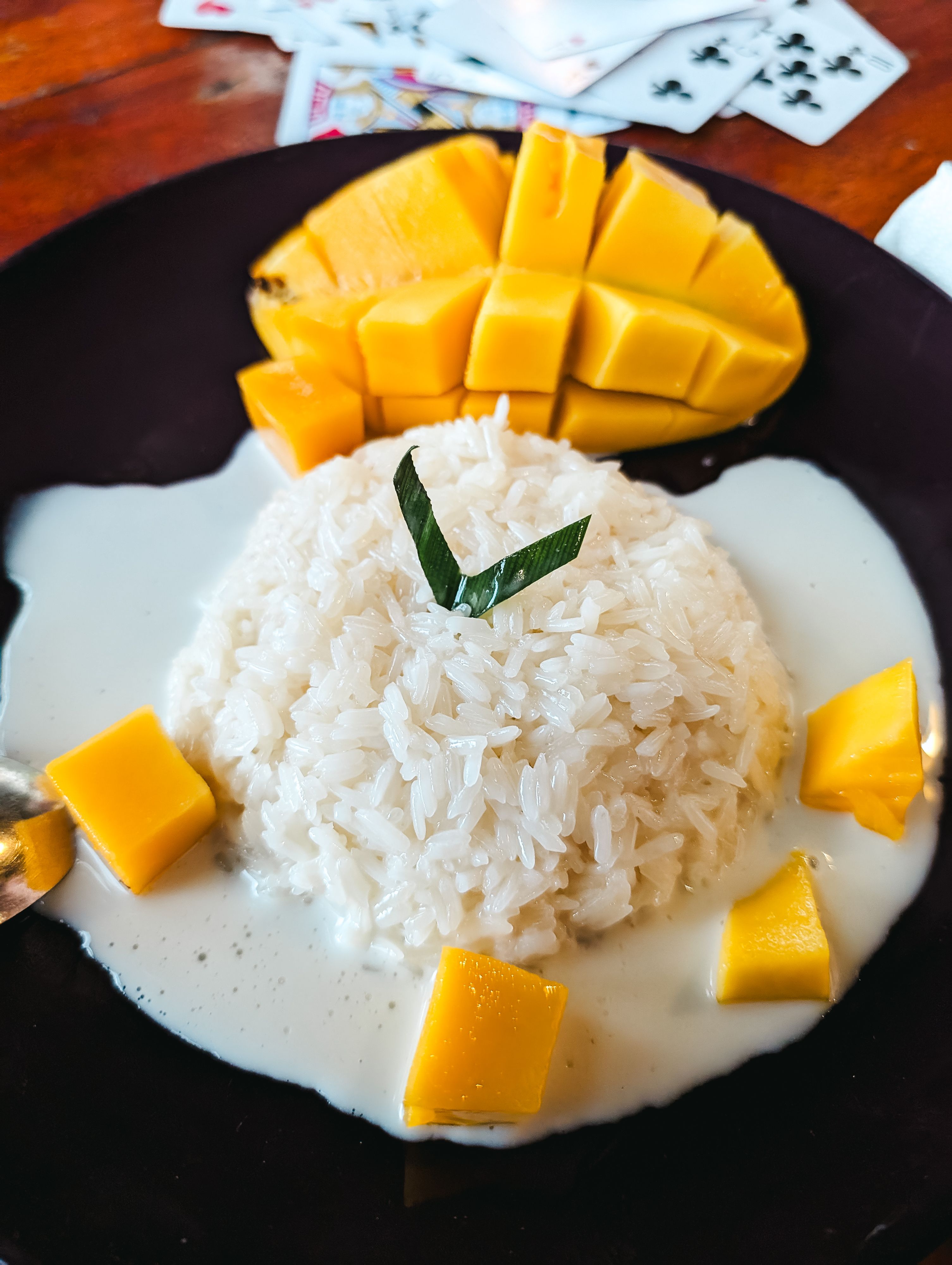
Photo: Markus Winkler / Pexels
Thai
Khao Niao Mamuang
The diets react (see scores below)
Common Ingredients
- glutinous rice
- coconut milk
- sugar
- salt
- ripe mango
- mung beans
- pandan leaves
Specific recipes may vary.
Incompatible with 9 of 11 diets
Diet Ratings
Khao Niao Mamuang (Thai Mango Sticky Rice) is one of the most keto-incompatible dishes imaginable. Glutinous rice is a high-glycemic starch delivering approximately 35-40g of net carbs per 100g serving. Ripe mango adds another significant carb load (roughly 13-15g net carbs per 100g), composed largely of fructose and glucose. Added sugar in the coconut milk sauce compounds the problem further. A standard serving of this dish likely delivers 70-100g+ of net carbs — three to five times the entire daily keto budget — making it completely incompatible with ketosis. The coconut milk is the only keto-friendly ingredient present, but it cannot offset the overwhelming carbohydrate content of the other components.
Khao Niao Mamuang (Thai mango sticky rice) is entirely plant-based as listed. Glutinous rice, coconut milk, sugar, salt, ripe mango, mung beans, and pandan leaves are all derived from plants with no animal products or animal-derived ingredients present. Coconut milk serves as the dairy alternative here, making this dish naturally vegan. The ingredients are predominantly whole foods with minimal processing, and the dish is nutritionally substantive with fruit, legumes, and whole grain components. Sugar is worth noting — some refined white sugars are processed using bone char — but this is a manufacturing process concern rather than an ingredient issue, and most vegans do not consider it disqualifying. This is a high-scoring approve.
Khao Niao Mamuang (Thai Mango Sticky Rice) is fundamentally incompatible with the Paleo diet. The dish is built on glutinous rice, a grain that is strictly excluded from Paleo — no grain variant, sticky or otherwise, is permitted. Mung beans are legumes, another categorically excluded food group. Added salt and refined sugar are also explicitly banned. Coconut milk is the only paleo-friendly ingredient, and ripe mango and pandan leaves are acceptable, but the core structural ingredients of this dish — glutinous rice, mung beans, sugar, and salt — make it an unambiguous avoid with no meaningful gray area.
Khao Niao Mamuang is a Thai dessert built around glutinous (sticky) rice, which is a refined, high-glycemic-index grain that Mediterranean diet principles actively discourage in favor of whole grains. It is sweetened with added sugar and enriched with coconut milk, a saturated fat source that is not traditional in Mediterranean cuisine and contrasts with the central role of extra virgin olive oil. While mango and mung beans are plant-based positives, and mango provides fruit value, the dominant components — refined glutinous rice, added sugar, and coconut milk — collectively place this dish squarely in the 'avoid' category. The dish is essentially a high-sugar, refined-grain dessert with a non-Mediterranean fat profile, contradicting core Mediterranean diet principles on multiple fronts.
Khao Niao Mamuang (Thai mango sticky rice) is entirely plant-based and contains no animal products whatsoever. Every single ingredient — glutinous rice, coconut milk, sugar, mango, mung beans, pandan leaves, and even the salt — is either a grain, fruit, legume, plant-derived fat, added sugar, or plant flavoring. This dish is the antithesis of the carnivore diet, containing multiple categories of explicitly excluded foods: grains (glutinous rice), fruit (mango), legumes (mung beans), plant-based fat (coconut milk), sugar, and plant aromatics (pandan leaves). There is unanimous consensus across all tiers of the carnivore community — from the strictest Lion Diet adherents to the more permissive animal-based practitioners — that this dish is completely incompatible with carnivore eating.
Khao Niao Mamuang (Thai Mango Sticky Rice) contains multiple excluded ingredients that make it clearly non-compliant with Whole30. Glutinous rice is a grain and is explicitly excluded from the Whole30 program. Sugar is an added sweetener, also explicitly excluded. These two violations alone are disqualifying, regardless of the other ingredients. Coconut milk, salt, ripe mango, and pandan leaves would individually be compliant, and mung beans — while a legume — are sometimes debated, but the presence of rice and added sugar makes this dish a clear avoid.
Khao Niao Mamuang (Thai mango sticky rice) contains multiple high-FODMAP ingredients that make it problematic during the elimination phase. The biggest offenders are: (1) Ripe mango — Monash rates ripe mango as high-FODMAP above 40g due to excess fructose, and a standard serving of this dessert typically contains 100-150g or more of mango, well into high-FODMAP territory. (2) Mung beans — while split mung beans have some Monash data suggesting lower GOS levels, whole mung beans are a legume and high in GOS; their inclusion in this dish (often as a topping) adds FODMAP load. (3) Coconut milk — low-FODMAP at 1/2 cup (125ml) but the sweetened, reduced coconut milk sauce used generously in this dish may push portions into moderate-high FODMAP range. Glutinous rice itself is low-FODMAP (it is a rice-based grain, not wheat), sugar is low-FODMAP, salt is low-FODMAP, and pandan leaves are low-FODMAP. However, the combination of a large mango serving and mung beans makes this dish very difficult to consume safely during elimination.
Monash University has tested ripe mango with a low-FODMAP serve of 40g (about 1/4 cup), and split/hulled mung beans may have lower GOS than whole beans. Some clinical FODMAP practitioners might allow a very small tasting portion of this dish, but the standard Thai restaurant serving size virtually guarantees high-FODMAP consumption — particularly from the mango — making this impractical to approve during strict elimination phase.
Khao Niao Mamuang (Thai mango sticky rice) is problematic for DASH in multiple dimensions. Coconut milk is a tropical oil-based product high in saturated fat, which DASH explicitly limits. The dish is sweetened with added sugar, which DASH discourages. Glutinous rice is a refined, high-glycemic carbohydrate with no fiber benefit — DASH emphasizes whole grains, not refined sticky rice. The combination of saturated fat from coconut milk, added sugar, and refined carbohydrates places this firmly in the avoid category. The mango and mung beans are DASH-positive components (potassium, fiber, plant protein), and the portion of salt is modest, but the overall nutritional profile is dominated by the coconut milk and sugar, which undermine DASH goals of limiting saturated fat and added sugars. As a snack, it provides little redeeming nutritional value aligned with DASH priorities.
Khao Niao Mamuang (Thai Mango Sticky Rice) is one of the most Zone-incompatible dishes possible. The macronutrient profile is almost entirely carbohydrate and fat with virtually no lean protein, making the 40/30/30 block ratio impossible to achieve within the dish itself. Glutinous rice is extremely high-glycemic — sticky/waxy rice has an even higher glycemic index than regular white rice, spiking blood sugar and insulin sharply. Added sugar compounds the glycemic load further. Coconut milk contributes primarily saturated fat rather than the preferred monounsaturated fat. Ripe mango, while a whole fruit, is one of the higher-sugar fruits and would be used in only very small quantities in Zone planning. There is no lean protein source whatsoever. The combination of high-GI starch + added sugar + saturated fat + no protein is essentially the opposite of a Zone-favorable meal or snack. Even as a very occasional indulgence requiring heavy portioning, the glutinous rice and added sugar make meaningful Zone balancing nearly impossible — unlike, say, whole-grain rice where small portions can be worked into a block system. The mung beans provide modest protein and fiber but are present in small garnish quantities insufficient to shift the macronutrient profile meaningfully.
Khao Niao Mamuang (Thai mango sticky rice) has a mixed anti-inflammatory profile. On the positive side, ripe mango is a standout ingredient — rich in vitamin C, beta-carotene, quercetin, and other polyphenols with documented anti-inflammatory properties. Mung beans provide fiber, plant protein, and antioxidants. Pandan leaves contain flavonoids and have shown mild anti-inflammatory activity in preliminary research. Coconut milk contributes medium-chain triglycerides (MCTs), though its saturated fat content is a caution flag. The core problem is the glutinous (sticky) rice: it is a highly refined, high-glycemic starch with virtually no fiber, which drives rapid blood glucose spikes and can promote inflammatory signaling (elevated insulin, AGE formation). Combined with added sugar — typically a significant amount in this dessert preparation — the glycemic load of the dish is substantial. The sugar + refined starch combination is a classic pro-inflammatory pairing. The dish is not 'avoid' territory because the mango, mung beans, and pandan meaningfully offset the picture, but the refined carbohydrate and added sugar load makes it a 'caution' food appropriate only occasionally rather than regularly.
Khao Niao Mamuang (Thai mango sticky rice) is a high-sugar, high-fat, low-protein dessert that conflicts with nearly every GLP-1 dietary priority. The dish is built on glutinous (sticky) rice — a refined, high-glycemic carbohydrate with minimal fiber — cooked in sweetened coconut milk, which adds significant saturated fat and sugar. Ripe mango contributes natural sugars on top of the added sugar in the coconut milk sauce. Mung beans provide a small protein and fiber contribution, but in the quantities typically used as a garnish topping, the impact is negligible. The dish has essentially no meaningful protein, little fiber, high saturated fat from coconut milk, and a large sugar load — all of which are counterproductive for GLP-1 patients who must prioritize nutrient density in a reduced-calorie context. The high fat and sugar content also risks worsening GLP-1 side effects including nausea, reflux, and blood sugar fluctuations. Even a small portion delivers empty calories with no protein payoff.
*See how scores were generated at our methodology page.
Nutritional profile
Six traits that cut across every diet.
Fiber & Plants
How much whole-plant food and fiber it delivers.
Healthy Fats
The quality of its fats (unsaturated, omega-3).
Whole / Unprocessed
How close it is to its natural, unprocessed form.
Gut Gentle
How easy it is on digestion (low FODMAP, few irritants).
Low Glycemic
How little it spikes your blood sugar.
Protein Density
How much protein it packs per calorie.
Controversy Index
Higher controversy = more disagreement between diets.
Diet-Specific Tips
 Vegan — 9/10
View tips
- Coconut milk replaces dairy — fully plant-based
- All seven ingredients are plant-derived with no animal products
- Predominantly whole-food ingredients elevate the score
- Glutinous rice, mango, and mung beans provide nutritional value
- Sugar bone-char processing is a non-ingredient concern that does not affect vegan classification for the vast majority of the community
- Pandan leaves are a natural plant flavoring with no controversy
 Anti-Inflammatory — 4/10
View tips
- Glutinous rice is a high-glycemic, low-fiber refined starch — raises blood glucose sharply and promotes inflammatory signaling
- Added sugar is a clear pro-inflammatory element per all major anti-inflammatory frameworks
- Ripe mango is rich in beta-carotene, vitamin C, quercetin, and mangiferin — genuinely anti-inflammatory
- Mung beans provide fiber, plant protein, and antioxidants, adding a modest anti-inflammatory contribution
- Coconut milk adds saturated fat (lauric acid) — neutral to mildly pro-inflammatory at the amounts used; MCTs are a mild offset
- Pandan leaves contain flavonoids and contribute minor anti-inflammatory benefit
- Overall glycemic load of the dish is high, making it a treat food rather than a regular anti-inflammatory staple