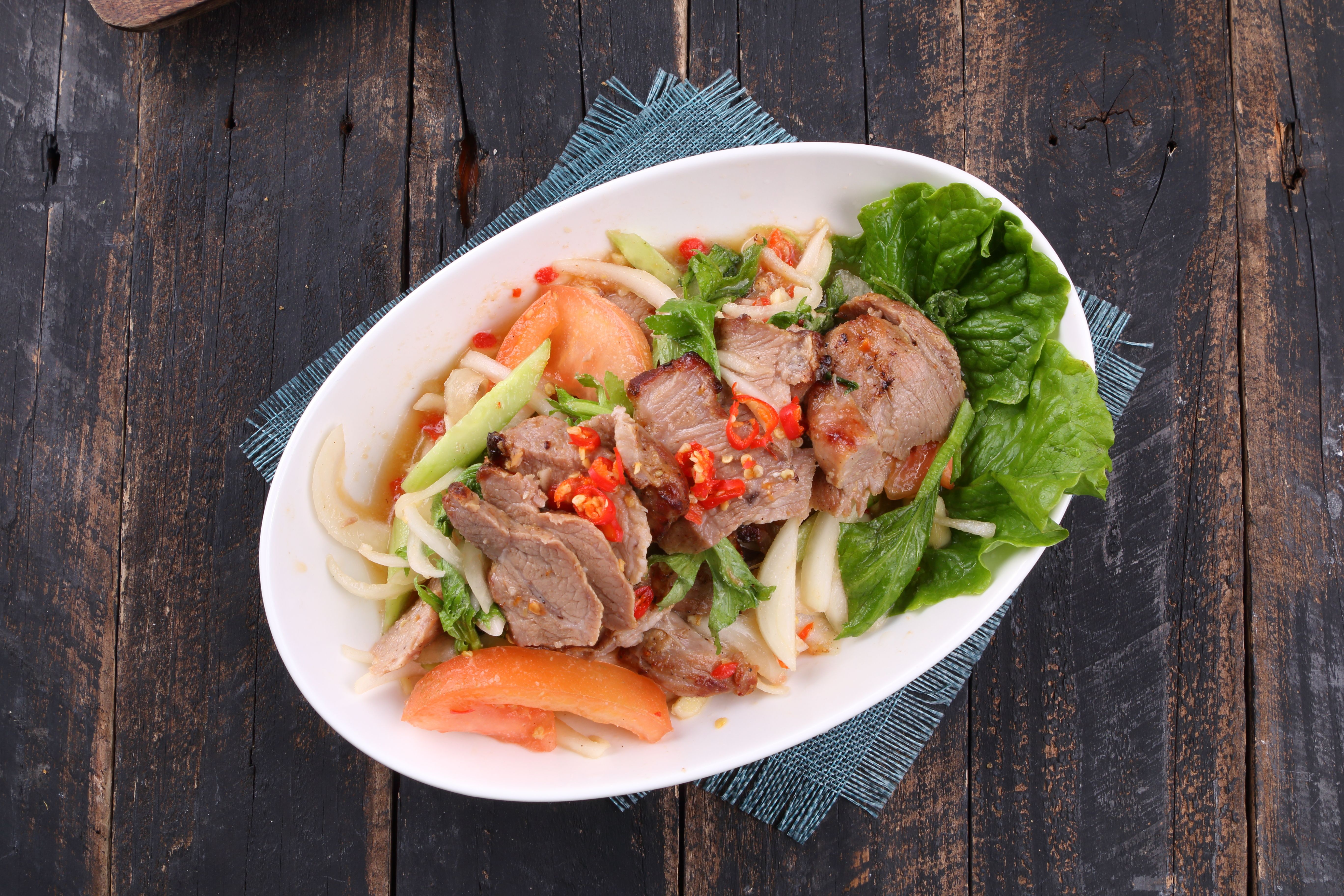
The diets react (see scores below)
Common Ingredients
- pork
- toasted rice powder
- lime
- fish sauce
- chili
- shallots
- mint
- scallions
- cilantro
- galangal
Specific recipes may vary.
Incompatible with 5 of 11 diets
Diet Ratings
Nam Tok is a Thai grilled pork salad that is largely keto-friendly but contains one notable concern: toasted rice powder (khao khua). This ingredient is a traditional thickener/textural element made from toasted glutinous rice — it adds net carbs from grain starch. In a standard serving, the amount used is small (roughly 1-2 teaspoons per portion), contributing perhaps 3-6g of net carbs from the rice powder alone. The remaining ingredients are well-suited to keto: pork provides protein and fat, lime juice and fish sauce add minimal carbs in typical quantities, shallots and scallions contribute modest carbs, and the fresh herbs (mint, cilantro) are negligible. Chili and galangal add small amounts of carbs. A typical serving could land in the 8-14g net carb range depending on portion sizes and rice powder quantity, which is manageable within a daily keto budget but requires awareness. The dish is approved with caution primarily due to the toasted rice powder as a grain-derived ingredient.
Strict keto practitioners argue that toasted rice powder — even in small amounts — represents a grain-based starch that should be entirely avoided, as zero-tolerance for grains is a core principle; some in this camp suggest simply omitting the rice powder to make the dish fully keto-compliant, while lazy keto adherents consider the small quantity a non-issue.
Nam Tok contains multiple animal-derived ingredients that are strictly incompatible with a vegan diet. Pork is a direct animal product (meat), and fish sauce is derived from fermented fish — both are unambiguously non-vegan. There is no meaningful debate within the vegan community about either ingredient. The dish cannot be considered vegan in its traditional form, though a vegan adaptation could substitute mushrooms or tofu for the pork and soy sauce or tamari for the fish sauce.
Nam Tok is disqualified primarily by two non-paleo ingredients: toasted rice powder (a grain) and fish sauce (a processed condiment typically containing added salt and sometimes sugar or preservatives). Toasted rice powder is a core ingredient in this dish — it's not a trace amount but a defining textural and flavor component — and rice is a grain excluded under strict paleo rules. Fish sauce, while derived from fish, is a fermented, processed condiment with added salt, placing it outside paleo guidelines. The remaining ingredients — pork, lime, chili, shallots, mint, scallions, cilantro, and galangal — are all paleo-compliant and would otherwise make this a strong candidate for approval. Without a paleo substitution for the rice powder and fish sauce, the dish as traditionally prepared cannot be approved.
Nam Tok is a Thai grilled pork salad. While the dish features many Mediterranean-compatible elements — abundant fresh herbs (mint, cilantro, scallions), aromatics (shallots, galangal, chili), lime juice, and a light dressing without added sugars or refined oils — the primary protein is pork, which in the Mediterranean framework is categorized as red meat, recommended only a few times per month. Fish sauce is a non-traditional condiment but is minimally processed and used in small quantities, making it a minor concern. The herb-forward, low-fat profile is genuinely positive, but the red meat centerpiece places this dish outside core Mediterranean diet principles for regular consumption.
Some Mediterranean diet interpreters, particularly those following traditional Southern European practices, would note that small portions of lean pork appear in Sardinian and Spanish Mediterranean traditions, and the generous herb, allium, and citrus profile of this dish closely mirrors Mediterranean flavor principles. In this view, an occasional small serving could be considered 'caution' rather than 'avoid.'
Nam Tok is a Thai grilled pork salad that is fundamentally incompatible with the carnivore diet. While pork is an approved animal protein, the dish is defined by its plant-based ingredients: toasted rice powder (a grain), lime juice (fruit), shallots, mint, scallions, cilantro, galangal, and chili — all strictly excluded plant foods. Fish sauce is carnivore-friendly, but it cannot offset the overwhelming plant content of this dish. This is essentially a plant-heavy herb salad with pork as a secondary component, not a carnivore meal.
Nam Tok (Thai 'waterfall' pork salad) is largely Whole30-compliant in its core ingredients: grilled pork, lime juice, fish sauce, chili, shallots, mint, scallions, cilantro, and galangal are all allowed. The one ingredient warranting scrutiny is toasted rice powder (khao khua), which is ground toasted rice — a grain. Rice is explicitly excluded on Whole30. While the quantity used is typically very small (1–2 teaspoons per serving, used primarily as a textural and aromatic agent rather than a nutritional grain), the official Whole30 rules exclude all grains regardless of quantity or form. There is no explicit exception for trace grain use as a flavoring. Fish sauce should be label-checked for added sugar or other excluded ingredients, but compliant versions exist. Assuming compliant fish sauce is used, the dish still contains an excluded grain ingredient in the toasted rice powder, making it technically non-compliant, though the community sometimes debates whether such a trace amount violates the spirit of the exclusion.
Some Whole30 community members and practitioners argue that the minuscule amount of toasted rice powder (used as a seasoning/texture element rather than a grain serving) is analogous in spirit to trace grain-derived ingredients and shouldn't disqualify an otherwise whole-food dish. However, official Whole30 guidelines by Melissa Urban are clear that grains — including rice — are excluded in any form for the full 30 days, with no stated exception for trace quantities.
Nam Tok (Thai waterfall pork salad) contains several ingredients that require careful consideration. Pork, lime juice, fish sauce, chili, mint, cilantro, and galangal are all low-FODMAP and safe. Toasted rice powder (khao khua) is low-FODMAP in typical culinary quantities. However, shallots are high in fructans and are a significant FODMAP concern — they are used more than incidentally in this dish. Scallions (green tops only) are low-FODMAP, but if white parts are included, they contribute fructans. The combination of shallots and potentially the white parts of scallions makes this dish problematic during strict elimination. In a restaurant or traditional preparation, shallot quantity is often generous, pushing this dish into high-FODMAP territory. If shallots are omitted or strictly limited and only green scallion tops are used, the dish could be low-FODMAP, but as traditionally prepared it warrants caution.
Monash University rates shallots as high-FODMAP even in small servings (fructans become significant at portions commonly used in cooking). Many clinical FODMAP dietitians would advise avoiding this dish during elimination unless specifically prepared without shallots, since the herb-forward dressing typically relies on shallots as a key flavor component and portioning is difficult to control.
Nam Tok is a Thai grilled pork salad with several DASH-positive elements — fresh herbs (mint, cilantro, scallions), shallots, lime juice, and chili all align well with DASH principles by contributing potassium, fiber, and flavor without relying on sodium. Toasted rice powder adds modest whole-grain character. However, the dish presents two notable concerns for DASH: (1) Fish sauce is a high-sodium condiment — a typical serving can contribute 400–700mg of sodium or more depending on quantity used, meaningfully cutting into the <2,300mg/day (or especially the <1,500mg/day low-sodium) DASH threshold. (2) Pork, depending on the cut, can carry moderate saturated fat, which DASH limits. Lean cuts (pork loin, tenderloin) are acceptable under DASH; fattier cuts used in traditional nam tok (e.g., pork collar or neck) push it toward caution. The dish is not inherently incompatible with DASH but requires meaningful modifications — reduced fish sauce, lean pork cuts — to fit comfortably. As typically prepared in Thai cuisine, it sits in the caution zone.
NIH DASH guidelines do not explicitly address Thai cuisine or fish sauce, creating interpretation gaps. Some DASH-oriented clinicians and registered dietitians note that when fish sauce is used as a flavor base rather than a salt substitute, portions may be modest enough to keep total sodium acceptable, and the herb-heavy, vegetable-forward profile of nam tok is otherwise closely aligned with DASH spirit — these practitioners may rate it more favorably if lean pork is used and fish sauce is reduced.
Nam Tok (Thai waterfall beef/pork salad) is a fairly Zone-compatible dish with some caveats. The protein base is pork, which can range from lean (pork loin/tenderloin) to fatty (pork shoulder/neck), making it inherently variable. The dish is rich in Zone-favorable elements: abundant fresh herbs (mint, cilantro, scallions) and shallots provide low-glycemic carbohydrate blocks with polyphenol benefits, and lime juice adds flavor without glycemic load. Fish sauce contributes sodium but negligible macronutrient impact. Chili provides anti-inflammatory capsaicin, aligning with Sears' anti-inflammatory focus. The primary concern is toasted rice powder (khao khua), which is a traditional thickener/textural element — it contributes a modest glycemic load from refined starch, though the quantity used per serving is small (typically 1-2 teaspoons). Pork fat content depends heavily on the cut used. If prepared with lean pork loin and modest rice powder, this dish can fit reasonably into a Zone meal as a protein/vegetable component, though it lacks a clean fat block and the overall macro ratio would need supplementation (e.g., adding avocado or olive oil drizzle to supply monounsaturated fat). The dish is low in fat as prepared, which is actually a Zone challenge — you'd need to add a fat source to hit the 30% fat target.
Some Zone practitioners may rate this higher (7-8) arguing that the toasted rice powder is negligible in quantity and pork loin is comparable to other lean proteins Sears approves. Others may note that traditional Nam Tok often uses fattier pork cuts, which could push saturated fat content higher and warrant more caution. Sears' later writings (The Anti-Inflammation Zone) would view the polyphenol-rich herb profile and chili content very favorably, potentially upgrading the assessment.
Nam Tok is a Thai grilled pork salad with a genuinely mixed anti-inflammatory profile. On the positive side, the dish is loaded with potent anti-inflammatory ingredients: chili peppers (capsaicin reduces NF-κB signaling), fresh mint and cilantro (flavonoids, antioxidants), scallions and shallots (quercetin, allicin), lime juice (vitamin C, flavonoids), galangal (a relative of ginger with well-documented anti-inflammatory compounds including galangin), and fish sauce (minimal volume, fermented). Toasted rice powder is a whole grain element in small quantity. The herb-to-protein ratio is favorable — this is a salad-forward dish, not a meat-heavy one. The limiting factor is the primary protein: pork. Lean cuts of pork (loin, tenderloin) are categorized under 'moderate' — acceptable but not anti-inflammatory assets. Fattier cuts commonly used in Nam Tok (pork neck/collar, shoulder) contain more saturated fat and arachidonic acid, which can nudge the profile toward pro-inflammatory. The preparation method (grilled rather than fried, no added oils) is a significant positive — it avoids inflammatory seed oils entirely and keeps the dish clean. Overall, this dish is a reasonable choice in the context of an anti-inflammatory diet due to its exceptional herb content and oil-free preparation, but pork as the primary protein and potential use of fattier cuts prevent a full approval.
Dr. Weil's anti-inflammatory framework places lean pork in an acceptable 'moderate' category alongside poultry, and the dominant herbs and spices (galangal, chili, mint, cilantro) are strongly anti-inflammatory — some practitioners would rate this dish higher, closer to approval, given the herb density and absence of refined carbs or inflammatory oils. Conversely, stricter anti-inflammatory and autoimmune protocol (AIP) advocates would caution more strongly against pork due to arachidonic acid content and would also flag fish sauce for its sodium load and potential histamine content, which may drive inflammation in sensitive individuals.
Nam Tok is a Thai grilled meat salad built around pork, toasted rice powder, lime juice, fish sauce, chili, and fresh herbs. Its strengths for GLP-1 patients are real: the herb-forward, low-volume profile works well for reduced-appetite eating, lime and fish sauce add flavor without fat, and the fresh herbs (mint, cilantro, scallions, shallots) contribute micronutrients and modest fiber. Toasted rice powder adds a small amount of whole-grain carbohydrate and a negligible fiber contribution. The core problem is the pork. Nam Tok is traditionally made with fatty cuts — typically pork shoulder or neck — which significantly raises saturated fat content per serving and can worsen GLP-1 side effects including nausea, bloating, and delayed gastric emptying. The dish also contains chili, which may irritate the GI tract in patients already experiencing reflux or nausea. Protein content is meaningful but depends heavily on cut and portion size. If made with a lean pork cut (loin, tenderloin) in a moderate portion, it becomes considerably more appropriate. The chili level is also a variable — Thai restaurant preparations can range from mild to very spicy, which is a real GI risk factor on GLP-1 medications.
Some GLP-1-aware dietitians would rate this higher, arguing that Nam Tok's overall structure — low carbohydrate, herb-dense, acid-forward, no added sugar, no frying — makes it one of the more GLP-1-compatible Thai restaurant options available, with fatty pork being a manageable issue if portions are controlled. Others flag the fatty pork cut and chili content as meaningful GI risk factors that outweigh the structural benefits, particularly in patients in early weeks of GLP-1 therapy when nausea and reflux sensitivity are highest.
*See how scores were generated at our methodology page.
Nutritional profile
Six traits that cut across every diet.
Fiber & Plants
How much whole-plant food and fiber it delivers.
Healthy Fats
The quality of its fats (unsaturated, omega-3).
Whole / Unprocessed
How close it is to its natural, unprocessed form.
Gut Gentle
How easy it is on digestion (low FODMAP, few irritants).
Low Glycemic
How little it spikes your blood sugar.
Protein Density
How much protein it packs per calorie.
Controversy Index
Higher controversy = more disagreement between diets.
Diet-Specific Tips
 Keto — 5/10
View tips
- Toasted rice powder is a grain-based starch that adds net carbs and conflicts with strict no-grain rules
- Pork is an excellent keto protein and fat source
- Fish sauce and lime contribute minimal carbs in typical quantities
- Shallots and scallions add moderate carbs — portion control matters
- Fresh herbs (mint, cilantro, galangal) are keto-negligible
- Overall net carbs per serving are moderate and budget-dependent
- Omitting the rice powder would significantly improve keto compatibility
 Whole30 — 5/10
View tips
- Toasted rice powder (khao khua) is ground rice — an excluded grain — and is a traditional, integral ingredient in Nam Tok
- No Whole30 exception exists for trace grain quantities used as a flavoring or textural agent
- Fish sauce must be label-checked for added sugar to ensure compliance
- All other ingredients (pork, lime, chili, shallots, fresh herbs, galangal) are fully Whole30-compliant
- Dish could be made compliant by omitting the toasted rice powder, though this changes the authentic character of the dish
 DASH — 5/10
View tips
- Fish sauce is high in sodium and a primary DASH concern — can contribute 400–700mg+ per serving
- Pork cut determines saturated fat load — lean cuts (tenderloin/loin) are DASH-acceptable, fatty cuts (collar/neck) are not
- Abundant fresh herbs, lime, shallots, and chili are strongly DASH-positive flavor contributors
- No added sugar, no heavy oils, no refined grains — overall dish structure is relatively clean
- Toasted rice powder adds modest whole-grain benefit
- Low-sodium fish sauce or reduced quantity would improve DASH compatibility significantly
 Zone — 6/10
View tips
- Pork cut matters significantly — lean pork loin is Zone-favorable; fatty pork shoulder is less ideal due to saturated fat
- Toasted rice powder adds modest glycemic load but in small quantities typical of the dish
- Abundant fresh herbs (mint, cilantro, scallions) provide low-glycemic carb blocks with anti-inflammatory polyphenols
- Dish is naturally low in fat, requiring addition of a monounsaturated fat source to achieve 40/30/30 ratio
- Fish sauce and lime are Zone-neutral flavor enhancers with negligible macro impact
- Chili and galangal align with Sears' anti-inflammatory dietary emphasis
- As a standalone dish, macros skew toward protein/carb without adequate fat — needs pairing
 Anti-Inflammatory — 5/10
View tips
- Pork as primary protein — pro-inflammatory potential varies with cut (lean = moderate, fatty = limit)
- Galangal: potent anti-inflammatory compounds (galangin, AKT/mTOR pathway inhibition)
- Chili peppers: capsaicin reduces inflammatory cytokines (NF-κB pathway)
- Rich herb profile (mint, cilantro, scallions, shallots) — high polyphenol and flavonoid content
- Lime juice: vitamin C and citrus flavonoids support antioxidant defense
- No added oils — grilled preparation avoids inflammatory seed oils
- Toasted rice powder: whole grain, low quantity, minimal inflammatory impact
- Fish sauce: fermented, small quantity, not a meaningful inflammatory driver at culinary doses
 GLP-1 Friendly — 5/10
View tips
- Traditional preparation uses fatty pork cuts (shoulder, neck) — high saturated fat worsens GLP-1 GI side effects
- Chili content may trigger or worsen reflux and nausea, especially at restaurant spice levels
- No frying, no added sugar, no refined grains — structurally clean dish
- Fresh herbs, lime, and shallots add micronutrients and flavor with minimal caloric cost
- Protein content is meaningful but cut-dependent — lean pork loin/tenderloin version significantly improves the rating
- Small-portion friendly — herb salad format works well with reduced appetite
- Toasted rice powder adds minimal but negligible fiber contribution
- Fish sauce adds sodium — relevant for patients with blood pressure considerations but not a GLP-1-specific concern