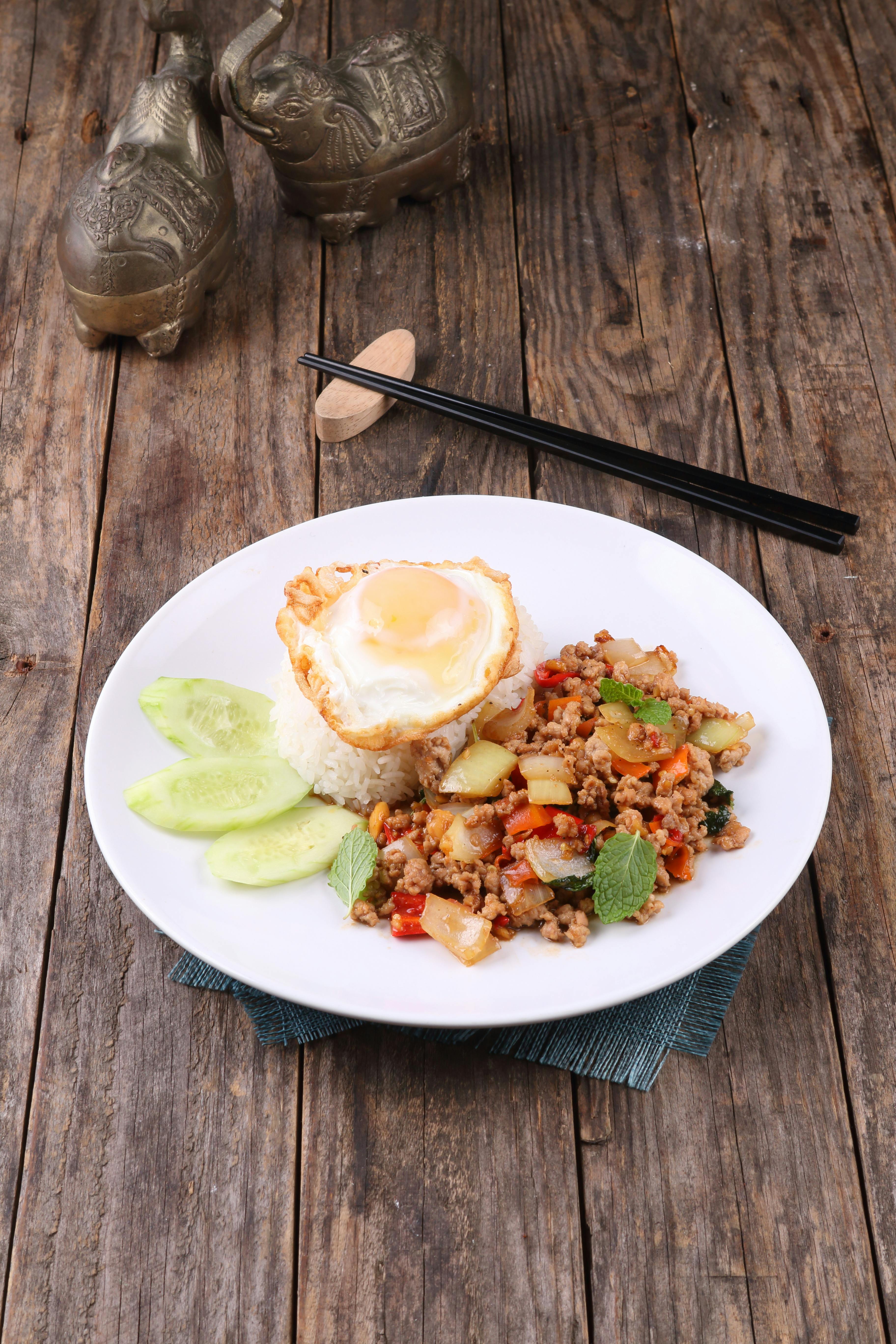
The diets react (see scores below)
Common Ingredients
- minced pork
- holy basil
- chili
- garlic
- fish sauce
- oyster sauce
- soy sauce
- palm sugar
- long beans
- fried egg
Specific recipes may vary.
Incompatible with 7 of 11 diets
Diet Ratings
Pad Kra Pao has several keto-friendly elements — minced pork is an excellent high-fat protein, holy basil, chili, and garlic are low-carb aromatics, fish sauce adds minimal carbs, and the fried egg is ideal for keto. However, the dish is problematic due to palm sugar (a direct added sugar used in traditional recipes), oyster sauce (contains starch and sugar, typically 4-6g carbs per tablespoon), and soy sauce (minor carbs but generally acceptable). Long beans add modest carbs but are manageable in small portions. The combination of palm sugar and oyster sauce in a standard restaurant serving can push net carbs into the 15-25g range for a single dish, which could consume most or all of a day's carb budget. A home-modified version omitting palm sugar and minimizing oyster sauce could be made keto-friendly, but the traditional dish as served is borderline.
Some lazy keto or flexible keto practitioners consider a single serving acceptable if it fits within their daily 50g net carb limit, arguing the protein and fat profile of the pork and egg outweigh the minor sugar additions. Strict keto adherents, however, reject it entirely due to the presence of palm sugar and starchy oyster sauce, citing zero tolerance for added sugars regardless of portion size.
Pad Kra Pao as described contains multiple animal products and animal-derived ingredients, making it entirely incompatible with a vegan diet. The dish includes minced pork (meat), a fried egg (eggs), fish sauce (derived from fermented fish), and oyster sauce (derived from oysters). Any single one of these ingredients would be disqualifying; the combination of four distinct animal-derived components makes this one of the clearest possible 'avoid' verdicts. The plant-based components — holy basil, chili, garlic, soy sauce, palm sugar, and long beans — are vegan-friendly, but they are insufficient to redeem the dish as a whole. A vegan version of this dish is achievable by substituting minced tofu or mushrooms for pork, omitting the egg, and replacing fish sauce and oyster sauce with vegan alternatives (e.g., soy sauce, seaweed-based fish sauce substitutes, mushroom-based oyster sauce).
Pad Kra Pao contains multiple non-paleo ingredients that disqualify it. Oyster sauce and soy sauce are both processed condiments — soy sauce is soy-derived (a legume) and typically contains wheat (a grain), making it doubly non-paleo. Oyster sauce contains added sugar, starch thickeners, and preservatives. Fish sauce, while made from fermented fish, commonly contains added salt and sometimes sugar, placing it in a gray area, but it is the least problematic of the sauces here. Palm sugar is a refined/processed sugar and non-paleo. Long beans are legumes and excluded from the paleo diet. The minced pork, holy basil, chili, garlic, and fried egg are all paleo-approved ingredients, but the volume and severity of the non-compliant ingredients — soy sauce (legume + grain), oyster sauce (processed), palm sugar (refined sugar), and long beans (legume) — make this dish firmly non-paleo in its traditional preparation.
Pad Kra Pao conflicts with Mediterranean diet principles on multiple fronts. The primary protein is minced pork, a red meat that the Mediterranean diet limits to just a few times per month. The dish relies on oyster sauce, soy sauce, fish sauce, and palm sugar — all processed condiments high in sodium and/or added sugar, which the Mediterranean diet minimizes. There is no olive oil; the dish is typically cooked in neutral vegetable oil or lard. While there are some positive elements — garlic, chili, holy basil, and long beans are plant-based and welcome — these are overwhelmed by the problematic protein and processed sauce base. The fried egg adds some acceptable protein but does not redeem the dish overall. This is not a Mediterranean dish and its core components directly contradict the diet's guiding principles.
Pad Kra Pao is fundamentally incompatible with the carnivore diet. While it contains animal products (minced pork and a fried egg), the dish is built around numerous plant-based ingredients and problematic additives. Holy basil, chili, garlic, and long beans are all plant foods explicitly excluded from the carnivore diet. Fish sauce is borderline acceptable in pure form, but oyster sauce, soy sauce, and palm sugar are processed condiments containing plant-derived ingredients and sugars. The dish is essentially a stir-fry centered on plant aromatics and sauces, with meat as a secondary component. The pork and egg alone would be carnivore-approved, but this preparation method disqualifies the dish entirely as served.
Pad Kra Pao as commonly prepared contains multiple Whole30-excluded ingredients. Soy sauce is a soy-based product (legume derivative) and is explicitly excluded. Oyster sauce typically contains added sugar and sometimes thickeners. Palm sugar is an added sugar, which is excluded on Whole30. These three ingredients together make this dish clearly non-compliant in its standard form. Fish sauce is generally compliant (check for no added sugar), minced pork, holy basil, chili, garlic, and the fried egg are all compliant. Long beans are also compliant. However, the core seasoning trio of soy sauce, oyster sauce, and palm sugar cannot be used, making this dish fundamentally incompatible with Whole30 as traditionally prepared.
Pad Kra Pao contains two high-FODMAP ingredients that are fundamental to the dish and cannot be reduced to safe portions without fundamentally altering the recipe. Garlic is one of the highest-FODMAP foods tested by Monash University, containing significant fructans even at very small amounts (1/4 clove is the threshold). It is used in meaningful quantities in this dish. Long beans (yard-long beans) are high in GOS and fructans at standard serving sizes per Monash, making them a second major FODMAP source. Oyster sauce also typically contains garlic and/or onion extract, adding further fructan load. Holy basil, chili, fish sauce, soy sauce (in small amounts), palm sugar, minced pork, and fried egg are all individually low-FODMAP. However, the combination of garlic and long beans makes this dish unsuitable during the elimination phase at any standard restaurant serving. A modified version using garlic-infused oil instead of garlic cloves and substituting green beans or another low-FODMAP vegetable could potentially be made compliant, but authentic Pad Kra Pao as described is high-FODMAP.
Pad Kra Pao as commonly prepared is poorly aligned with DASH diet principles. The dish combines multiple high-sodium condiments — fish sauce, oyster sauce, and soy sauce — which together can easily deliver 1,500–2,500mg of sodium in a single serving, potentially exceeding the entire daily sodium budget for either standard DASH (<2,300mg) or low-sodium DASH (<1,500mg). Minced pork, while leaner than some red meats, is still a red meat that DASH recommends limiting. Palm sugar adds unnecessary refined sugar. The fried egg adds saturated fat and cholesterol, though this is a lesser concern under current guidelines. The dish does contain some DASH-positive elements — holy basil, chili, garlic, and long beans provide vegetables, fiber, and phytonutrients — but these are overwhelmed by the cumulative sodium load from the three high-sodium sauces, which is the dominant DASH disqualifier. This dish would require substantial reformulation (reduced-sodium soy sauce, minimal fish sauce, substituting chicken or tofu for pork, poaching the egg) to approach DASH compatibility.
Pad Kra Pao has a reasonable Zone-compatible foundation but requires meaningful modifications to fit well. The minced pork provides a lean-ish protein source, though it carries more saturated fat than ideal Zone proteins like skinless chicken or fish. The holy basil, chili, garlic, and long beans contribute polyphenols and low-glycemic carbohydrates, which Sears would enthusiastically endorse — especially holy basil, which has anti-inflammatory properties. However, several elements create friction with Zone principles: palm sugar is a high-glycemic sweetener that spikes insulin, oyster sauce and fish sauce add significant sodium and hidden sugars, and the fried egg introduces additional fat (including saturated fat from yolk and likely the frying oil). The dish is typically served over white rice in traditional Thai preparation, which would be a significant glycemic problem, though this assessment focuses on the dish itself. Without rice, the carb load is relatively moderate. The key issue is the palm sugar and sauce combination creating a glycemically unfavorable profile, plus the fat balance being harder to control. A Zone practitioner could adapt this dish by eliminating palm sugar, reducing sauce quantities, using leaner pork or substituting chicken breast, and swapping the fried egg for poached or using egg whites only — making it a reasonable 3-block meal component. As prepared traditionally, it sits firmly in caution territory.
Some Zone practitioners following Sears' later anti-inflammatory writings (Toxic Fat, The Mediterranean Zone) might rate this more favorably, noting that holy basil and chili are polyphenol-rich ingredients Sears specifically champions, and that the dish's overall structure — protein + vegetables + modest fat — maps reasonably onto Zone meal architecture. The palm sugar concern may be overstated if the total quantity is small (1 teaspoon across multiple servings), and minced pork is not categorically excluded from Zone. These practitioners might score it a 6.
Pad Kra Pao presents a genuinely mixed anti-inflammatory profile. On the positive side, holy basil is a potent anti-inflammatory herb rich in eugenol, linalool, and ursolic acid — compounds with well-documented anti-inflammatory properties. Chili peppers contribute capsaicin, a notable anti-inflammatory compound. Garlic provides allicin and other organosulfur compounds that reduce inflammatory markers. Long beans add fiber and plant nutrients. The fried egg contributes selenium and choline, which have anti-inflammatory roles. On the negative side, minced pork is red meat — flagged for moderation in anti-inflammatory frameworks due to saturated fat content and arachidonic acid, though it is leaner than most red meat cuts. Palm sugar is a refined/added sugar, contributing to glycemic load and potential inflammatory signaling; it is slightly less refined than white sugar but still limited in anti-inflammatory diets. Fish sauce, oyster sauce, and soy sauce are high in sodium, which at excessive levels may promote low-grade inflammation. The fried egg adds additional saturated fat depending on the oil used. The dish is not processed in the industrial sense, relies heavily on anti-inflammatory aromatics, and is a whole-food preparation — these factors prevent it from rating lower. However, the red meat base, added sugar, and high sodium push it away from a clear approval. This is a contextually reasonable dish eaten occasionally in the context of an otherwise anti-inflammatory diet.
Dr. Weil's pyramid permits lean poultry and emphasizes moderation for red meat rather than avoidance, and some anti-inflammatory practitioners would consider a small portion of lean minced pork acceptable when offset by the potent anti-inflammatory aromatics (basil, chili, garlic) that dominate this dish. Conversely, stricter anti-inflammatory protocols — particularly those addressing autoimmune or metabolic conditions — would flag the red meat, added sugar, and high sodium more severely and recommend swapping pork for chicken or tofu.
Pad Kra Pao with minced pork and a fried egg offers meaningful protein — a typical serving (minced pork plus egg) can deliver 25-35g, which aligns with GLP-1 protein priorities. Long beans contribute modest fiber and micronutrients. However, several factors pull the score down. Minced pork is a moderate-to-high fat protein depending on the cut used (often 15-20g fat per 150g serving), and the fried egg adds additional fat. The fried egg preparation introduces extra oil. The sauce profile — fish sauce, oyster sauce, soy sauce, and palm sugar — contributes meaningful sodium and added sugar, with limited nutritional return. The chili load is the most significant concern: holy basil dishes are typically quite spicy, and spicy foods are a well-documented trigger for nausea, reflux, and GI discomfort in GLP-1 patients due to slowed gastric emptying. The overall fat and spice combination represents a real GI risk for many patients on GLP-1 medications, even though the dish is not fried. Eaten in a modest portion with rice replaced by cauliflower rice or skipped, and with spice reduced, it becomes more manageable — but as typically served, caution is warranted.
Some GLP-1-focused dietitians would be more permissive with this dish if the patient tolerates spice well and the pork is lean mince, noting that the protein density and whole-food ingredient profile compares favorably to many processed alternatives. Others would flag the sodium content from the triple-sauce combination as an additional concern, particularly for patients managing blood pressure alongside weight loss on GLP-1 therapy.
*See how scores were generated at our methodology page.
Nutritional profile
Six traits that cut across every diet.
Fiber & Plants
How much whole-plant food and fiber it delivers.
Healthy Fats
The quality of its fats (unsaturated, omega-3).
Whole / Unprocessed
How close it is to its natural, unprocessed form.
Gut Gentle
How easy it is on digestion (low FODMAP, few irritants).
Low Glycemic
How little it spikes your blood sugar.
Protein Density
How much protein it packs per calorie.
Controversy Index
Higher controversy = more disagreement between diets.
Diet-Specific Tips
 Keto — 4/10
View tips
- Palm sugar is a direct added sugar — incompatible with strict keto
- Oyster sauce contains starch and sugar, adding 4-6g net carbs per tablespoon
- Minced pork is an excellent high-fat keto protein source
- Fried egg adds healthy fat and protein with zero carbs
- Long beans are relatively low-carb but add to cumulative carb load
- Fish sauce is low-carb and keto-acceptable
- Total net carbs for a standard serving likely 15-25g, consuming most of the daily budget
- Home preparation with sugar and oyster sauce omitted would significantly improve keto compatibility
 Zone — 5/10
View tips
- Palm sugar adds high-glycemic carbohydrates that promote insulin spikes — contrary to Zone principles
- Minced pork is a moderately favorable Zone protein but carries more saturated fat than ideal lean options like chicken breast or fish
- Holy basil, chili, and garlic are polyphenol-rich ingredients aligned with Sears' anti-inflammatory focus
- Long beans are a favorable low-glycemic Zone vegetable carbohydrate source
- Fried egg adds saturated fat and cholesterol, with frying oil potentially introducing omega-6-heavy seed oils
- Oyster and fish sauces contribute hidden sugars and high sodium, complicating block calculation
- Typically served with white rice — a high-glycemic carb that would make Zone compliance very difficult if included
- Dish is adaptable: removing palm sugar, using egg whites, and choosing leaner pork would significantly improve Zone compatibility
 Anti-Inflammatory — 5/10
View tips
- Holy basil: rich in eugenol and ursolic acid — strong anti-inflammatory herb
- Chili: capsaicin content is anti-inflammatory
- Garlic: organosulfur compounds reduce CRP and IL-6
- Minced pork: red meat flagged for moderation — saturated fat and arachidonic acid
- Palm sugar: added sugar — pro-inflammatory at regular or high intake
- Fish sauce + oyster sauce + soy sauce: high sodium load
- Long beans: fiber and plant nutrients are positive
- Egg: mixed profile — selenium and choline anti-inflammatory, but adds saturated fat
- Whole-food, minimally processed preparation is a positive contextual factor
 GLP-1 Friendly — 5/10
View tips
- Moderate-to-high fat from minced pork (fat content varies by pork cut blend used)
- Fried egg adds additional fat and cooking oil
- High spice level from chili is a significant GLP-1 GI risk — may worsen nausea and reflux
- Protein yield is a genuine positive — 25-35g per serving from pork and egg combined
- Long beans provide some fiber and micronutrient value
- High sodium from fish sauce, oyster sauce, and soy sauce combination
- Added sugar from palm sugar — modest but unnecessary
- Not fried as a dish, which is a relative positive versus many Thai street food alternatives
- Portion sensitivity: smaller servings reduce fat and sodium load meaningfully