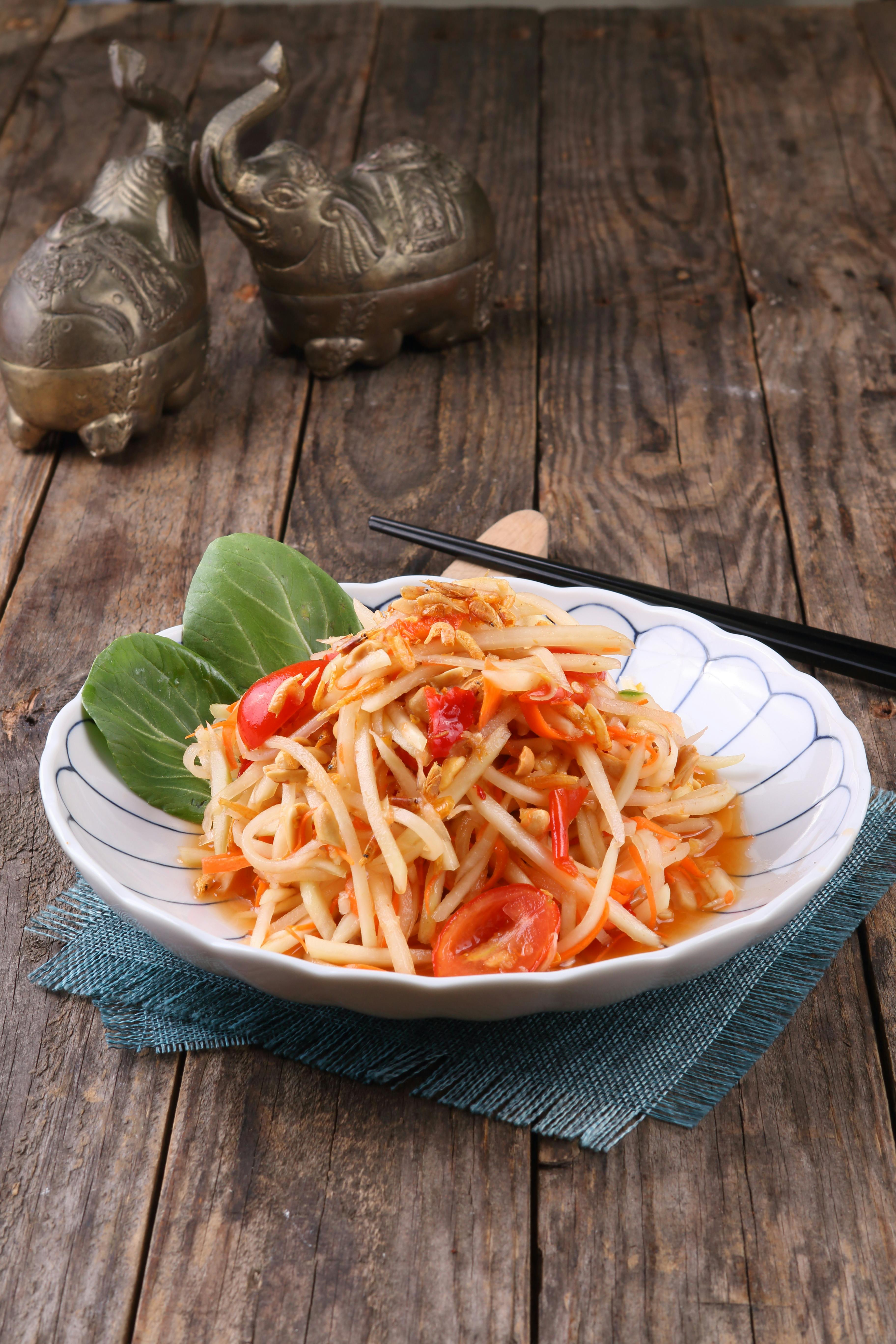
The diets react (see scores below)
Common Ingredients
- green papaya
- tomatoes
- long beans
- peanuts
- dried shrimp
- chili
- garlic
- palm sugar
- lime
- fish sauce
Specific recipes may vary.
Incompatible with 6 of 11 diets
Diet Ratings
Som Tam is fundamentally incompatible with ketogenic diets in its traditional form. Green papaya, while less sweet than ripe papaya, still contains significant net carbs (approximately 7-8g per 100g). Palm sugar is a direct added sugar with high glycemic impact. Long beans contribute additional carbs. Combined, a standard serving easily exceeds 20-30g net carbs, potentially consuming an entire day's keto carb budget in one dish. The fish sauce and lime juice add minor carbs, and peanuts, while containing fat, are legumes with moderate carb content that many strict keto practitioners limit. The only keto-friendly elements are the protein from dried shrimp, healthy fats from peanuts, and negligible carbs from chili and garlic. The palm sugar alone is a disqualifying ingredient under keto rules.
Traditional Som Tam as listed contains multiple animal-derived ingredients that make it incompatible with a vegan diet. Dried shrimp is a direct animal product (crustacean), and fish sauce is made from fermented fish — both are clear animal-derived ingredients with no ambiguity in vegan classification. The base of green papaya, tomatoes, long beans, peanuts, chili, garlic, palm sugar, and lime are all plant-based and would be excellent vegan components, but the presence of dried shrimp and fish sauce means this dish as described must be avoided. Vegan versions of Som Tam do exist and are widely made by substituting soy sauce or tamari for fish sauce and simply omitting the dried shrimp, but those substitutions are not present in this ingredient list.
Som Tam contains multiple non-paleo ingredients that disqualify it from approval. Peanuts are legumes, long beans are legumes, and fish sauce typically contains added salt (and often sugar/preservatives). Palm sugar is a refined/processed sugar. Even setting aside the legumes, the combination of peanuts and long beans alone makes this a clear avoid. The paleo-compliant ingredients — green papaya, tomatoes, chili, garlic, and lime — are fine, and dried shrimp and fish sauce in principle align with paleo protein sources, but the overall dish as traditionally prepared fails on multiple counts.
Som Tam is a vegetable-forward salad built primarily on green papaya, tomatoes, long beans, chili, and garlic — all plant-based ingredients strongly aligned with Mediterranean diet principles. Peanuts add healthy unsaturated fats and plant protein consistent with the diet's emphasis on nuts and legumes. Lime juice provides acidity in a role similar to lemon in Mediterranean cooking. The main caveats are palm sugar (an added sugar, though used in small amounts as a condiment), fish sauce (a processed, high-sodium condiment), and dried shrimp (a processed seafood product). These are minor ingredients used in small quantities to season the dish rather than as primary components, so they do not substantially undermine the overall profile. The dish contains no red meat, refined grains, or significant saturated fat, and is rich in vegetables and nuts. It rates as an approve with moderate confidence given the non-Mediterranean origin and the presence of added sugar and processed condiments.
Some Mediterranean diet purists would flag palm sugar as an added sugar and fish sauce as a highly processed, sodium-dense condiment that should be minimized, potentially lowering this to a caution rating. Modern clinical Mediterranean diet guidelines (e.g., from the PREDIMED study framework) emphasize avoiding added sugars broadly, which could apply here even in small amounts.
Som Tam is almost entirely plant-based and is incompatible with the carnivore diet. The dish consists predominantly of green papaya, tomatoes, long beans, peanuts, chili, garlic, palm sugar, and lime — all strictly excluded plant foods. While it contains small amounts of dried shrimp and fish sauce (animal-derived), these are minor components in what is fundamentally a plant-based salad. The palm sugar adds processed plant sugar, peanuts are legumes, and the array of vegetables and fruits violates every tier of carnivore eating. No meaningful reclassification is possible here — the dish cannot be adapted without replacing virtually every ingredient.
Som Tam contains two clearly excluded ingredients: peanuts (a legume, explicitly banned on Whole30) and palm sugar (an added sugar, explicitly banned on Whole30). These are not edge cases — both fall squarely within the program's core exclusions. Long beans are a standard legume (not one of the explicitly excepted pod legumes like green beans, sugar snap peas, or snow peas), making them a third excluded ingredient. Fish sauce and dried shrimp are generally compliant (watch for added sugar or MSG in commercial fish sauce, though MSG is now allowed per 2024 rules). Lime, chili, garlic, tomatoes, and green papaya are all compliant. However, with peanuts, palm sugar, and long beans all present, this dish cannot be made Whole30-compliant without fundamentally altering the recipe.
Som Tam contains multiple high-FODMAP ingredients that make it unsuitable during the elimination phase. Garlic is one of the highest-FODMAP foods (fructans) and is used as a core ingredient — even small amounts are problematic. Long beans (yard-long beans) are high in GOS/fructans at typical serving sizes. Green papaya itself is low-FODMAP at moderate servings, but the cumulative FODMAP load from garlic and long beans alone disqualifies this dish. Peanuts are borderline (low-FODMAP only at ~28g/32 nut limit), palm sugar may contribute excess fructose in quantity, and dried shrimp is generally low-FODMAP. Fish sauce, lime, chili, and tomatoes are low-FODMAP. However, garlic's presence as a non-negotiable ingredient — not just a trace amount — makes this dish a clear avoid during elimination phase.
Som Tam is a vegetable-forward dish with many DASH-friendly elements — green papaya, tomatoes, long beans, and lime juice provide fiber, potassium, and vitamins with minimal saturated fat. However, the dish is typically high in sodium due to fish sauce and dried shrimp, two ingredients that can contribute 800–1,500mg of sodium per serving, bringing it close to or exceeding DASH's per-meal sodium budget. Palm sugar adds modest amounts of added sugar, which DASH limits. Peanuts are acceptable in DASH (nuts are encouraged in small portions), and the vegetables themselves are exemplary. The dish is not inherently incompatible with DASH but requires significant sodium reduction — using reduced-sodium fish sauce, limiting or omitting dried shrimp, and moderating palm sugar — to fit comfortably within DASH guidelines. As typically prepared in Thai cuisine, the sodium load warrants a caution rating.
NIH DASH guidelines explicitly restrict high-sodium condiments like fish sauce and dried shrimp, making the standard preparation problematic. However, some DASH-oriented dietitians note that the exceptional vegetable density, potassium content, and low saturated fat profile mean a modified Som Tam (reduced fish sauce, no dried shrimp) could qualify as a DASH-approved dish — the verdict hinges heavily on preparation rather than the dish concept itself.
Som Tam is a nutrient-dense, vegetable-forward salad with a generally favorable macro profile for the Zone, but several elements require attention. The base of shredded green papaya is a low-glycemic carbohydrate source (unripe papaya has far lower sugar content than ripe papaya), and tomatoes, long beans, chili, garlic, and lime are all Zone-favorable, low-glycemic vegetables and flavor agents. However, palm sugar is a notable concern — it contributes added sugar that raises the glycemic load of the dressing, though typically in modest quantities in a single serving. The peanuts add fat but are omega-6-heavy legumes rather than Zone-preferred monounsaturated sources like almonds or avocado. Dried shrimp provide a small amount of protein but not enough to constitute a meaningful Zone protein block (~7g per block). Fish sauce is essentially sodium with negligible macros. The dish as a whole is carb-heavy with modest protein and fat, meaning the 40/30/30 ratio is not well-balanced without adding a lean protein source on the side. The lack of a primary protein makes this a partial meal component rather than a standalone Zone meal. With protein augmentation (grilled chicken, shrimp, or tofu) and reduced palm sugar, this dish slots comfortably into Zone eating.
Some Zone practitioners would rate this more favorably, noting that green papaya is genuinely low-glycemic and the overall dish is light, vegetable-dense, and anti-inflammatory in character — aligning well with Sears' later polyphenol-focused writing. The palm sugar quantity per serving is small enough that strict Zone counters might absorb it within a carb block without concern. Others would score it lower due to the peanut fat profile (omega-6 dominance) and the absence of a meaningful lean protein source, making it difficult to hit Zone ratios without significant modification.
Som Tam is a nutrient-dense salad with a strong anti-inflammatory foundation. Green papaya provides papain enzymes, vitamin C, and beta-carotene with antioxidant properties. Tomatoes contribute lycopene and polyphenols. Long beans offer fiber and plant-based nutrients. Chili peppers contain capsaicin, a well-documented anti-inflammatory compound. Garlic has allicin and organosulfur compounds shown to reduce CRP and IL-6. Lime juice provides vitamin C and flavonoids. Peanuts offer some polyphenols and healthy fats, though their omega-6 content is notable. The main cautions are palm sugar (added sugar, though used in small amounts as a seasoning), fish sauce (high sodium, but fermented and used sparingly), and dried shrimp (processed, high sodium). The dish as a whole is predominantly vegetables with anti-inflammatory spices and minimal processed content — the sugar and sodium are condiment-level rather than dominant ingredients. This is a reasonable anti-inflammatory choice in the context of an overall balanced diet.
Tomatoes are flagged by Autoimmune Protocol (AIP) advocates and practitioners like Dr. Tom O'Bryan as potential triggers due to solanine and lectins in nightshades, which may provoke inflammation in genetically susceptible individuals. Additionally, some strict anti-inflammatory frameworks caution against any added sugar (palm sugar) and high-sodium fermented condiments (fish sauce, dried shrimp) due to their potential to increase inflammatory markers at higher intake levels.
Som Tam is a nutrient-dense, fiber-rich salad built around raw green papaya, vegetables, and legumes — a strong foundation for GLP-1 patients. The green papaya and long beans provide meaningful fiber and digestive support, and the lime juice, tomatoes, and high water content aid hydration. However, several factors temper the rating. Protein content is low for a standalone dish: dried shrimp contributes a modest amount but not enough to meet the 15–30g per meal target, and peanuts add some protein alongside significant fat. The peanuts also raise the fat-per-serving concern relevant to GLP-1 side effects, though the fat is predominantly unsaturated. More critically, the chili content is significant in a traditional Som Tam preparation — fresh chilies plus garlic can worsen reflux, nausea, and GI irritation, which are already common GLP-1 side effects. Palm sugar adds refined sugar, a category to limit. Fish sauce is high in sodium, which requires monitoring especially given reduced food volume. This dish works best as a side or starter paired with a lean protein source (grilled chicken, tofu, fish), with chili reduced or omitted and peanuts used sparingly.
Some GLP-1-focused dietitians would rate this more favorably given its low calorie density, high fiber, and fresh whole-food ingredients — arguing that modest chili and peanut amounts are well-tolerated by many patients and that the micronutrient profile justifies flexibility. Others caution more firmly against the spice level and sugar content, particularly on injection days when GI sensitivity is heightened, and would advise a modified preparation rather than the traditional recipe.
*See how scores were generated at our methodology page.
Nutritional profile
Six traits that cut across every diet.
Fiber & Plants
How much whole-plant food and fiber it delivers.
Healthy Fats
The quality of its fats (unsaturated, omega-3).
Whole / Unprocessed
How close it is to its natural, unprocessed form.
Gut Gentle
How easy it is on digestion (low FODMAP, few irritants).
Low Glycemic
How little it spikes your blood sugar.
Protein Density
How much protein it packs per calorie.
Controversy Index
Higher controversy = more disagreement between diets.
Diet-Specific Tips
 Mediterranean — 7/10
View tips
- High proportion of fresh vegetables (green papaya, tomatoes, long beans, garlic, chili)
- Peanuts contribute healthy plant-based fats and protein consistent with Mediterranean nut consumption
- Lime juice as an acidic dressing component mirrors Mediterranean use of citrus
- Palm sugar is an added sugar, though used sparingly as a seasoning
- Fish sauce is a processed, high-sodium condiment — not Mediterranean but used in small amounts
- Dried shrimp is a processed seafood product, though seafood broadly is encouraged
- No red meat, no refined grains, no saturated fat sources
- Non-Mediterranean cuisine but ingredient composition largely aligns with diet principles
 DASH — 5/10
View tips
- Fish sauce is very high in sodium (~1,000–1,400mg per tablespoon) — a primary DASH concern
- Dried shrimp adds significant additional sodium
- Green papaya, tomatoes, and long beans are DASH-friendly vegetables rich in fiber and potassium
- Peanuts align with DASH encouragement of nuts in moderation
- Palm sugar contributes added sugar, which DASH limits
- Dish is naturally low in saturated fat and contains no red meat or full-fat dairy
- Low-sodium modification (reduced fish sauce, omit dried shrimp) would substantially improve DASH compatibility
 Zone — 6/10
View tips
- Green papaya is low-glycemic and Zone-favorable as a carbohydrate base
- Palm sugar adds refined sugar to the dressing, raising glycemic load
- Peanuts contribute omega-6-dominant fat, not the preferred monounsaturated fat of Zone protocol
- Dried shrimp provide minimal protein — insufficient for a Zone protein block
- No primary protein source makes this an incomplete Zone meal without additions
- Tomatoes, long beans, chili, garlic, and lime are all Zone-favorable ingredients
- Fish sauce adds sodium but has negligible macronutrient impact
- Dish is naturally low in saturated fat and processed ingredients, aligning with anti-inflammatory Zone principles
 Anti-Inflammatory — 7/10
View tips
- Green papaya: rich in papain, vitamin C, beta-carotene — antioxidant and anti-inflammatory
- Chili peppers: capsaicin shown to reduce inflammatory cytokines
- Garlic: organosulfur compounds (allicin) reduce CRP and IL-6
- Tomatoes: lycopene and polyphenols are anti-inflammatory; nightshade caution for autoimmune individuals
- Peanuts: some polyphenols but moderate omega-6 content
- Palm sugar: small amount of added sugar — minor inflammatory concern
- Fish sauce + dried shrimp: high sodium, processed — limit concern but used in small quantities
- Overall: vegetable-forward, herb/spice-rich, low in saturated fat and refined carbohydrates
 GLP-1 Friendly — 5/10
View tips
- High fiber from green papaya, long beans, and tomatoes — supports digestion and GLP-1 side effect management
- Low protein as served — dried shrimp and peanuts insufficient to meet 15–30g per meal target without a paired protein source
- Significant chili content risks worsening nausea, reflux, and GI irritation — common GLP-1 side effects
- Peanuts add unsaturated fat — acceptable in moderation but portion-sensitive
- Palm sugar adds refined sugar — a category to limit on GLP-1 medications
- High water content from papaya and vegetables supports hydration
- High sodium from fish sauce — relevant given reduced overall food intake
- Nutrient-dense per calorie — strong micronutrient and antioxidant profile