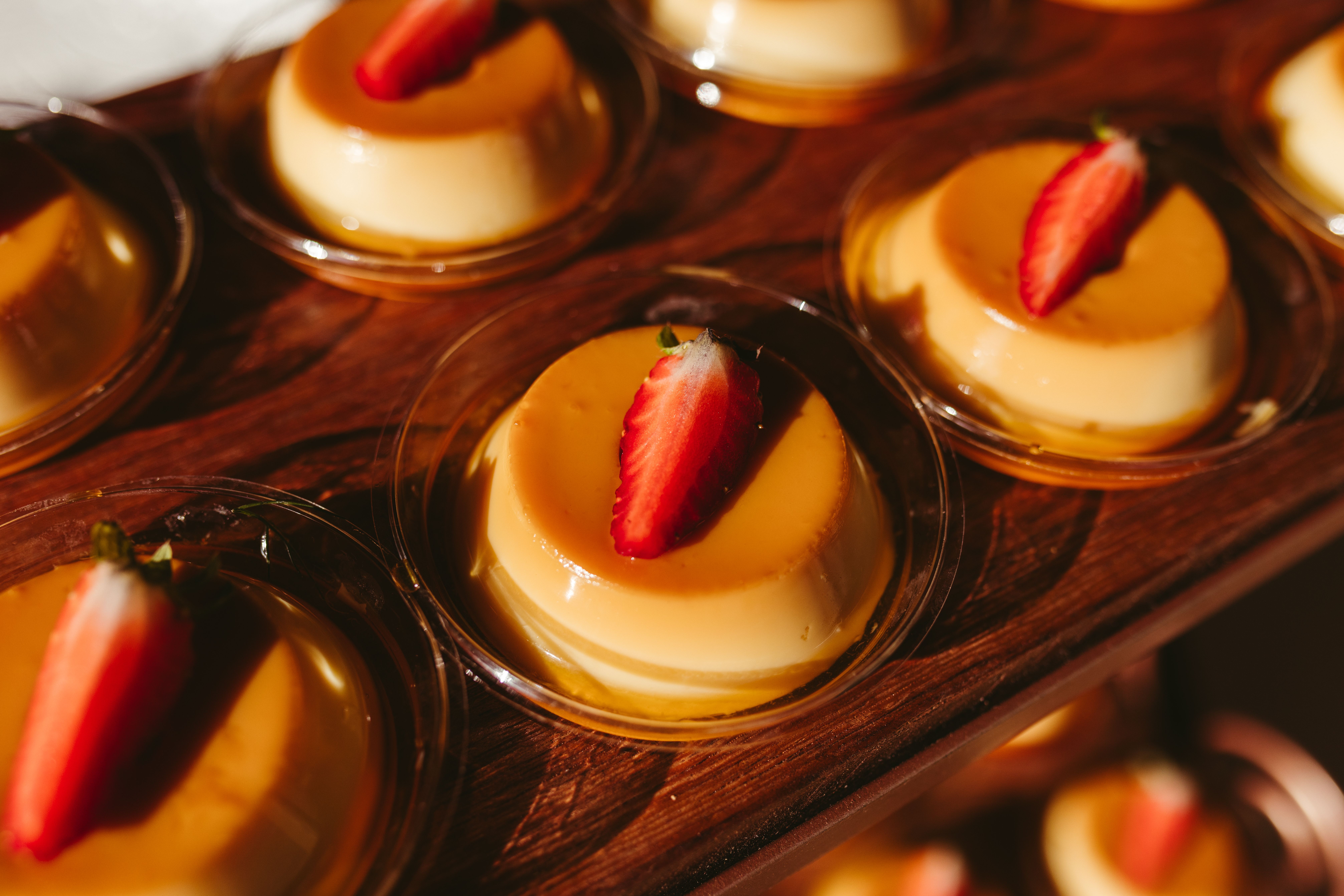
Photo: Jonathan Borba / Pexels
Spanish
Tocino de Cielo
The diets react (see scores below)
Common Ingredients
- egg yolks
- sugar
- water
- cinnamon
Specific recipes may vary.
Incompatible with 10 of 11 diets
Diet Ratings
Tocino de Cielo is a Spanish dessert made almost entirely of egg yolks and sugar, with water and cinnamon as supporting ingredients. Sugar is the second primary ingredient and constitutes a massive portion of the dish by weight — traditional recipes use roughly equal parts sugar and egg yolks by volume. A single small serving can easily contain 30-50g or more of pure sucrose, which is direct glucose and fructose with zero fiber offset. This completely obliterates the daily net carb budget of 20-50g and would immediately break ketosis. The egg yolks themselves are keto-friendly (high fat, zero carbs), but the dominant sugar content makes this dish entirely incompatible with a ketogenic diet in any reasonable serving size.
Tocino de Cielo is a traditional Spanish custard dessert whose primary and essential ingredient is egg yolks — an animal product explicitly excluded from all vegan diets. The dish is essentially a concentrated egg yolk preparation (similar to crème caramel but richer), with no plant-based substitute used in its authentic form. There is no ambiguity here: eggs are a core animal product, and their exclusion is one of the most foundational and universally agreed-upon rules of veganism.
Tocino de Cielo is a Spanish custard dessert made primarily from egg yolks, refined sugar, water, and cinnamon. While egg yolks and cinnamon are fully paleo-approved ingredients, refined sugar is explicitly excluded from the paleo diet as a processed, non-ancestral sweetener with no nutritional value. Refined sugar is one of the clearest 'avoid' items across all paleo frameworks — it is not a gray-area ingredient. The dish is essentially a sugar syrup custard, meaning refined sugar is not incidental but foundational to the recipe. The overall dish cannot be considered paleo-compatible due to this core ingredient, regardless of the approved components.
Tocino de Cielo is a traditional Spanish dessert composed almost entirely of egg yolks and sugar — two ingredients that directly conflict with Mediterranean diet principles. The dish is extremely high in added sugar and saturated fat from concentrated egg yolks, with no plant-based fiber, vegetables, whole grains, or olive oil present. While eggs are acceptable in moderation on the Mediterranean diet, this preparation uses a large quantity of yolks stripped of any nutritional balance. The sugar content alone places it firmly in the 'avoid' category, as the Mediterranean diet calls for minimal added sugars and discourages sweets except occasionally. Cinnamon is the only mildly beneficial ingredient. As a snack category item, this would be a particularly poor choice since snacks in the Mediterranean pattern should emphasize nuts, fruits, or vegetables.
Tocino de Cielo is a Spanish egg yolk custard dessert that is fundamentally incompatible with the carnivore diet. While egg yolks are a carnivore-approved ingredient, the dish is built around large quantities of sugar (a processed plant-derived sweetener explicitly excluded from carnivore) and cinnamon (a plant-based spice). Water is neutral, but the sugar content alone disqualifies this dish entirely. This is essentially a sugar-syrup dessert that uses egg yolks as a binding agent — the sugar is not incidental but a primary structural ingredient. Even the most permissive carnivore practitioners who include eggs, dairy, and even honey would not approve refined processed sugar.
Tocino de Cielo is a Spanish egg yolk custard dessert whose defining ingredient is sugar — a direct violation of the Whole30 rule prohibiting added sugar. Beyond the added sugar exclusion, this dish also falls squarely into the 'no recreating baked goods/junk food/sweets' spirit of the program; it is a confection/dessert by nature. Even if sugar were somehow substituted with a compliant sweetener, the dish would still violate the program's prohibition on recreating sweet treat analogs. There is no compliant version of this dish possible within Whole30.
Tocino de Cielo is a Spanish custard dessert made from egg yolks, sugar, water, and cinnamon — all of which are low-FODMAP ingredients. Egg yolks contain no FODMAPs. Plain white sugar (sucrose) is low-FODMAP as it is a 1:1 fructose-to-glucose ratio and does not create excess fructose. Water is FODMAP-free. Cinnamon used as a spice is low-FODMAP at typical culinary amounts (up to 1 teaspoon per Monash). The dish contains no wheat, lactose, garlic, onion, legumes, polyols, or high-fructose ingredients. A standard serving of this dessert poses no significant FODMAP concern during the elimination phase.
Tocino de Cielo is a Spanish dessert made almost entirely of egg yolks and sugar, making it incompatible with DASH diet principles. It is extremely high in added sugar and cholesterol-rich egg yolks, with negligible fiber, potassium, calcium, magnesium, or other DASH-valued nutrients. DASH explicitly limits sweets and added sugars, and a dish whose primary components are sugar and egg yolks provides little nutritional benefit while delivering a concentrated dose of nutrients DASH discourages. Even as an occasional snack, this dish offers no meaningful alignment with DASH food group targets.
Tocino de Cielo is a Spanish dessert composed almost entirely of egg yolks and sugar, making it nutritionally incompatible with Zone Diet principles. The macronutrient profile is severely imbalanced: the dominant macronutrient is simple sugar (high-glycemic carbohydrates), with fat from egg yolks (primarily saturated) and virtually no lean protein contribution. There is no realistic way to portion this dish into a Zone block structure without consuming an enormous glycemic spike. A typical serving delivers a large hit of pure sucrose with no fiber, no low-glycemic carbohydrate offset, and no lean protein to balance the insulin response. The fat present is egg yolk saturated fat rather than the preferred monounsaturated sources. Even the Zone's flexibility-first philosophy cannot accommodate a food whose primary caloric driver is refined sugar — this is precisely the category Zone reserves for avoidance, alongside candy and soda. Cinnamon has minor polyphenol value but does not meaningfully alter the assessment.
Tocino de Cielo is a Spanish dessert made almost entirely of egg yolks and sugar — two ingredients that present significant anti-inflammatory concerns in combination and quantity. The dish is essentially a concentrated sugar syrup set with a very high ratio of egg yolks, meaning sugar is the dominant macronutrient driver. High added sugar intake is strongly and consistently linked to elevated inflammatory markers including CRP, IL-6, and TNF-alpha. Egg yolks do provide some choline and fat-soluble nutrients, but in the context of this dish they also contribute arachidonic acid (a precursor to pro-inflammatory eicosanoids) with no balancing omega-3 context. The cinnamon is a genuine anti-inflammatory spice and a positive element, but present only as a flavoring agent in negligible quantity — insufficient to offset the heavy sugar load. Water is neutral. There are no vegetables, fiber, polyphenols, omega-3s, or other anti-inflammatory components present. As a category, this is a dessert confection with an overwhelmingly pro-inflammatory nutritional profile dominated by refined sugar and concentrated egg yolk fat. Occasional consumption is not catastrophic, but by anti-inflammatory diet criteria this dish offers minimal benefit and meaningful inflammatory downside.
Tocino de Cielo is a Spanish dessert made almost entirely of egg yolks and sugar — it is essentially a pure sugar-and-fat confection with virtually no fiber, no lean protein, and extremely high sugar content. A standard serving (approximately 80-100g) delivers roughly 30-40g of sugar and significant dietary cholesterol from the concentrated egg yolks, with negligible fiber and minimal usable protein relative to calories. While egg yolks do contain some protein, the yolk-to-sugar ratio means this dish functions nutritionally as a high-sugar dessert, not a protein source. High sugar loads are explicitly counterproductive for GLP-1 patients — they spike blood glucose, add empty calories during a period of severely reduced appetite when every calorie must count, and can worsen nausea. The high fat content of concentrated egg yolks combined with high sugar also increases the risk of GI discomfort given slowed gastric emptying. It fails on nearly every GLP-1 dietary priority: low fiber, high sugar, high saturated fat per calorie, poor nutrient density, and not portion-friendly for the caloric payload it delivers.
*See how scores were generated at our methodology page.
Nutritional profile
Six traits that cut across every diet.
Fiber & Plants
How much whole-plant food and fiber it delivers.
Healthy Fats
The quality of its fats (unsaturated, omega-3).
Whole / Unprocessed
How close it is to its natural, unprocessed form.
Gut Gentle
How easy it is on digestion (low FODMAP, few irritants).
Low Glycemic
How little it spikes your blood sugar.
Protein Density
How much protein it packs per calorie.
Controversy Index
Higher controversy = more disagreement between diets.
Diet-Specific Tips
 Low-FODMAP — 8/10
View tips
- Egg yolks are FODMAP-free
- Sugar (sucrose) is low-FODMAP — equal glucose to fructose ratio, no excess fructose
- Water is FODMAP-free
- Cinnamon is low-FODMAP at standard spice quantities
- No wheat, dairy, garlic, onion, or polyols present
- High sugar content is a nutritional concern but not a FODMAP concern