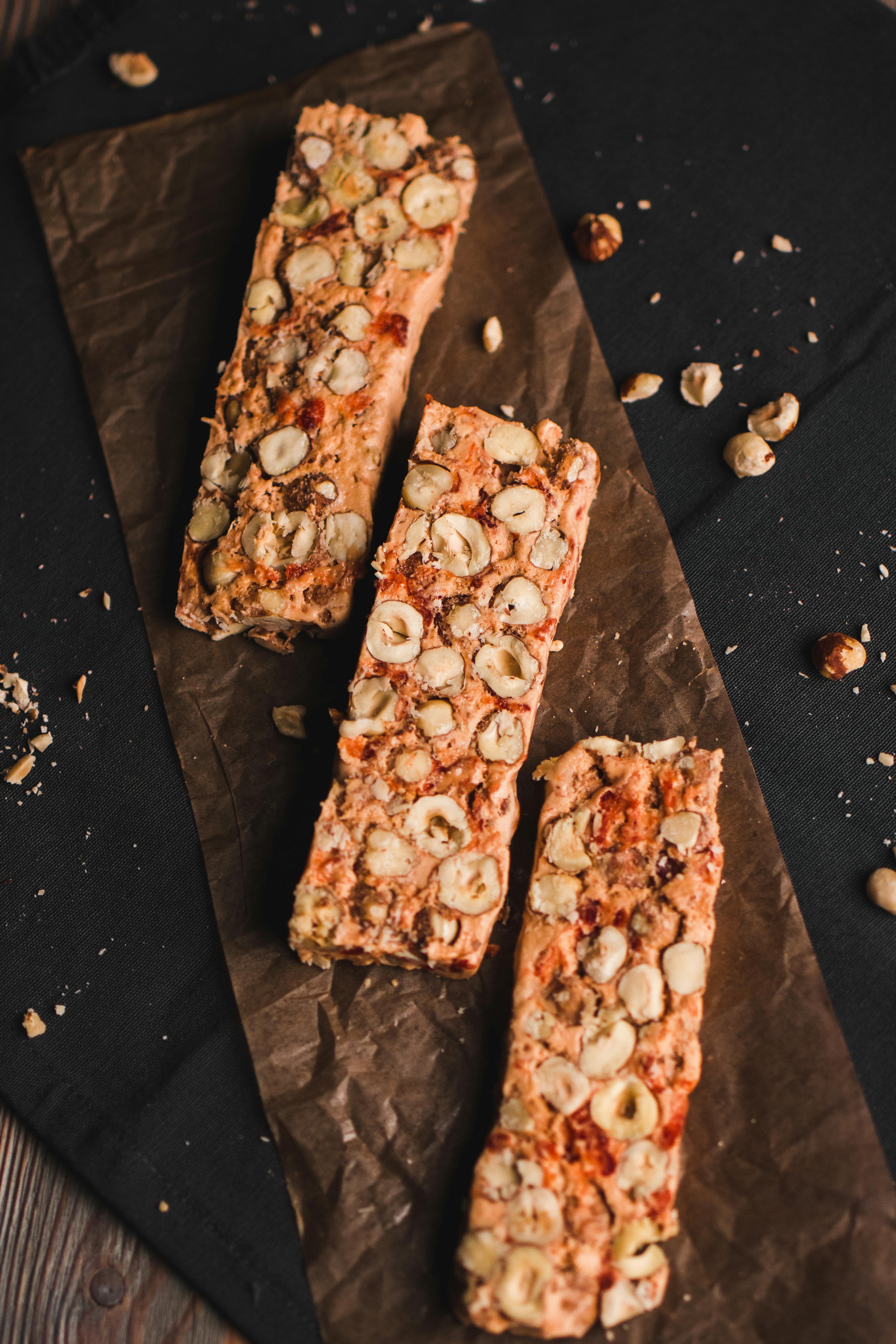
Photo: Vladimir Gladkov / Pexels
The diets react (see scores below)
Common Ingredients
- egg whites
- honey
- almonds
- hazelnuts
- candied orange peel
- wafer sheets
- powdered sugar
Specific recipes may vary.
Incompatible with 9 of 11 diets
Diet Ratings
Torrone is a traditional Italian nougat confection that is fundamentally incompatible with a ketogenic diet. Its primary structure is built from honey and powdered sugar — both pure, rapidly-absorbed sugars — combined with candied orange peel (coated in sugar) and wafer sheets (grain-based). A standard 30-40g serving easily contains 20-30g of net carbs, which alone can exceed an entire day's keto carb allowance. While almonds and hazelnuts are keto-friendly and egg whites are acceptable, they are minor players in a sugar-dominant recipe. There is no meaningful way to portion-control torrone into keto compliance without consuming a negligible, unsatisfying sliver.
Torrone contains multiple animal-derived ingredients that place it firmly outside vegan dietary guidelines. Egg whites are a direct animal product (eggs), and honey is excluded by virtually all major vegan organizations including the Vegan Society and PETA on the grounds that bees are animals and their labor and products are exploited in beekeeping. With two clear animal-derived ingredients — egg whites and honey — this dish is unambiguously non-vegan. Almonds, hazelnuts, candied orange peel, wafer sheets (typically made from starch and water), and powdered sugar are plant-based, but the presence of egg whites and honey overrides any plant-based components.
Torrone contains multiple non-paleo ingredients that make it clearly incompatible with the diet. Wafer sheets are made from grain-based flour (typically wheat or rice), which is explicitly excluded. Powdered sugar is refined sugar, also a clear exclusion. Candied orange peel is typically prepared with refined sugar as well. While egg whites, honey, almonds, and hazelnuts are individually paleo-friendly or at least acceptable, the dish as a whole is built around two hard-excluded ingredients (grains and refined sugar), making it an avoid with high confidence.
Torrone is a traditional Italian confection made primarily from honey, egg whites, nuts, and sugar. While it contains genuinely Mediterranean-friendly ingredients — almonds and hazelnuts are excellent nut sources, and honey is a traditional natural sweetener — the overall profile is that of a high-sugar confection. The powdered sugar and candied orange peel (which contains added sugars) push this firmly into the 'added sugars' category that the Mediterranean diet minimizes. Honey in large quantities is still concentrated sugar, and torrone's primary nutritional identity is as a candy. Despite its traditional Italian heritage, it does not align with the Mediterranean diet's emphasis on minimally processed foods with limited added sugars. It is best treated as an occasional indulgence rather than a regular snack.
Some Mediterranean diet authorities point out that honey has been a traditional sweetener in Mediterranean cultures for millennia and is nutritionally superior to refined sugar, and that nut-dense sweets like torrone — eaten in small portions during festivals — reflect authentic traditional Mediterranean eating patterns rather than the hyperprocessed sweets the diet aims to exclude. Regional Italian and Greek dietary traditions do incorporate nut-and-honey confections as part of celebratory, occasional consumption.
Torrone is a traditional Italian nougat confection that is almost entirely incompatible with the carnivore diet. While egg whites are an animal product, they are a minor component here, and every other ingredient is plant-derived or heavily processed: almonds and hazelnuts are nuts (excluded), candied orange peel is fruit with sugar, wafer sheets are grain-based, powdered sugar is refined carbohydrate, and honey — even in the most permissive animal-based frameworks — is used here as a sugar-laden candy base rather than a whole food. The dish is fundamentally a sugar-and-nut confection with a token amount of egg white. No meaningful tier of carnivore eating would accommodate this food.
Torrone contains multiple Whole30-excluded ingredients. Powdered sugar is an added sugar, which is explicitly prohibited. Candied orange peel is coated in sugar, making it non-compliant. Wafer sheets are a grain-based product (typically made from wheat or rice flour), falling under the excluded grains category. Additionally, torrone is essentially a nougat confection — a form of candy — which falls squarely under the 'no recreating junk food/sweets' rule even if individual ingredients could theoretically be swapped. The combination of added sugar, grain-based wafers, and candied fruit makes this decisively non-compliant.
Torrone is a traditional Italian nougat that contains multiple high-FODMAP ingredients. The most significant offender is honey, which is high in excess fructose and is explicitly listed as high-FODMAP by Monash University even in small amounts. Candied orange peel may contain high-fructose corn syrup or concentrated fruit sugars, adding further fructose load. Almonds are low-FODMAP at 10 nuts (approx. 12g) but become high-FODMAP at larger servings due to GOS and excess fructose. Hazelnuts are low-FODMAP at around 10 nuts. Egg whites and powdered sugar (sucrose) are low-FODMAP. Wafer sheets are typically made from wheat or rice flour — wheat-based wafers would contribute fructans. The combination of honey as a primary ingredient (used in large quantities as the binding nougat base) and candied fruit makes this dish essentially unavoidable as high-FODMAP at any realistic serving size. Even a small piece of torrone would contain a meaningful dose of honey-derived fructose.
Monash University has not specifically tested torrone as a composite dish, so the verdict relies on ingredient-level analysis. Some clinical FODMAP practitioners might allow very small tastes (e.g., 10–15g) if honey content is minimal in that portion, but the traditional recipe relies on honey as a core structural ingredient, making safe portion sizes unrealistically small for practical enjoyment.
Torrone is an Italian confection made primarily from honey, egg whites, nuts (almonds and hazelnuts), candied fruit, and sugar. From a DASH perspective, the picture is mixed. The nuts (almonds and hazelnuts) are explicitly encouraged in DASH guidelines for their healthy fats, magnesium, and potassium content. Egg whites are lean protein with no fat or cholesterol. Honey is a natural sweetener, and the sodium content of torrone is very low. However, torrone is fundamentally a candy: powdered sugar and honey make it high in added sugars, and candied orange peel adds further refined sugar. DASH limits sweets and added sugars, recommending no more than 5 servings per week of sweets and minimal added sugar overall. The caloric density from sugar and nuts requires strict portion control. It does not contain saturated fat, sodium, or processed meat concerns, but its primary nutritional profile is that of a sugary confection, not a DASH-encouraged snack. It sits in 'caution' territory — acceptable as an occasional small treat given its beneficial nut content and low sodium, but not a food DASH would recommend as a snack choice due to its high sugar load.
NIH DASH guidelines broadly categorize sweets and added sugars as items to limit, placing torrone firmly in the 'use sparingly' category. However, some DASH-aligned nutritionists note that torrone's primary caloric contributors include whole nuts with meaningful micronutrient value, and its very low sodium and saturated fat profile distinguish it favorably from most Western candy — a small portion could fit within the DASH weekly sweets allowance more comfortably than many alternatives.
Torrone is an Italian nougat confection whose macronutrient profile is dominated by high-glycemic, high-sugar carbohydrates. Honey and powdered sugar are the primary structural elements of the candy, making it essentially a concentrated sugar delivery vehicle. While it does contain some favorable Zone components — egg whites (lean protein) and almonds/hazelnuts (monounsaturated fats and some protein) — these are present in minor proportions relative to the sugar load. The 40/30/30 Zone ratio cannot realistically be achieved here: carbohydrates are overwhelmingly high-glycemic (honey + powdered sugar + candied orange peel + wafer sheets), protein from egg whites is minimal in the final product, and the fat from nuts, while favorable in type, cannot offset the glycemic impact. Honey and powdered sugar are among the highest-glycemic carbohydrate sources in Zone terminology, essentially equivalent to pure sugar. Candied orange peel adds further refined sugar. This is a confection, not a meal component, and even in very small portions it delivers negligible protein and a spike-inducing sugar bolus that is antithetical to Zone's insulin-management goals. It is not impossible to eat one small piece, but it cannot function as any meaningful Zone block and offers no path to a balanced Zone ratio.
Torrone is a traditional Italian nougat confection with a mixed anti-inflammatory profile. On the positive side, almonds and hazelnuts are genuinely anti-inflammatory foods — rich in vitamin E, healthy monounsaturated fats, magnesium, and polyphenols that have been associated with reduced inflammatory markers. Honey, particularly raw honey, contains trace antioxidants and has some anti-inflammatory properties at moderate amounts. Egg whites are a clean, low-fat protein source with no meaningful inflammatory load. Candied orange peel retains some flavonoids from the orange, though the candying process adds significant sugar. The wafer sheets are essentially neutral — refined starch with minimal impact. The primary concern is the high sugar content: torrone is substantially sweetened with honey and powdered sugar, making it a high-glycemic confection overall. Excess sugar is a well-established driver of inflammation through mechanisms including AGE formation, insulin spikes, and NF-κB activation. The nut content partially redeems the profile — the ratio of nuts to sugar is relatively favorable compared to most candy — but the overall product remains a dessert/confection that should be consumed in moderation. This is not a food to build an anti-inflammatory diet around, but occasional consumption as part of a largely anti-inflammatory pattern is acceptable, which places it squarely in 'caution' territory.
Some anti-inflammatory practitioners (e.g., those following stricter glycemic-focused protocols like Dr. David Ludwig's work on blood sugar) would push this closer to 'avoid' given the concentrated sugar load from both honey and powdered sugar, arguing that any glycemic spike is pro-inflammatory regardless of the nut content. Conversely, Mediterranean diet researchers might note that traditional torrone, eaten in small portions during holidays, fits within the Mediterranean eating pattern — which is the foundation of anti-inflammatory nutrition — and the nuts deliver genuine benefit.
Torrone is an Italian confection made primarily from honey, sugar, and egg whites, with nuts and candied fruit. Despite containing egg whites and nuts (which offer modest protein and healthy fats), the dominant nutritional profile is high sugar and high calorie density with very low fiber. A standard 40g serving delivers roughly 20-25g of sugar and only 2-4g of protein — far below the 15-30g per meal protein target for GLP-1 patients. The high sugar content causes rapid blood glucose spikes, counteracting the glycemic stabilization GLP-1 medications promote. Candied orange peel and powdered sugar add empty calories with no nutritional benefit. The sticky, dense texture is also difficult to portion meaningfully in small servings. While the nuts provide unsaturated fats and the egg whites are a lean protein source in principle, their contribution is overwhelmed by the sugar load. This is a classic empty-calorie confection that offers poor nutrient density per calorie — exactly what GLP-1 patients cannot afford given their significantly reduced appetite and intake.
*See how scores were generated at our methodology page.
Nutritional profile
Six traits that cut across every diet.
Fiber & Plants
How much whole-plant food and fiber it delivers.
Healthy Fats
The quality of its fats (unsaturated, omega-3).
Whole / Unprocessed
How close it is to its natural, unprocessed form.
Gut Gentle
How easy it is on digestion (low FODMAP, few irritants).
Low Glycemic
How little it spikes your blood sugar.
Protein Density
How much protein it packs per calorie.
Controversy Index
Higher controversy = more disagreement between diets.
Diet-Specific Tips
 DASH — 4/10
View tips
- High added sugar content from honey, powdered sugar, and candied orange peel — conflicts with DASH limits on sweets
- Almonds and hazelnuts are DASH-approved foods rich in healthy fats, magnesium, and potassium
- Very low sodium — no conflict with DASH sodium targets
- Egg whites provide lean protein with no cholesterol or fat
- No saturated fat, trans fat, or red meat concerns
- Caloric density requires strict portion control to fit within DASH eating plan
- Categorized as a confection/candy, a food group DASH explicitly limits to ≤5 servings/week
 Anti-Inflammatory — 4/10
View tips
- Almonds and hazelnuts provide vitamin E, monounsaturated fats, and polyphenols with anti-inflammatory properties
- High combined sugar load from honey and powdered sugar drives glycemic response and potential inflammatory signaling
- Candied orange peel adds further concentrated sugar with only trace residual flavonoids
- Egg whites are neutral — clean protein with no inflammatory load
- Honey contains trace antioxidants but at the quantities used in torrone, the sugar effect dominates
- No trans fats, seed oils, or artificial additives — relatively clean ingredient list for a confection
- Appropriate only as an occasional treat, not a regular dietary staple in an anti-inflammatory pattern