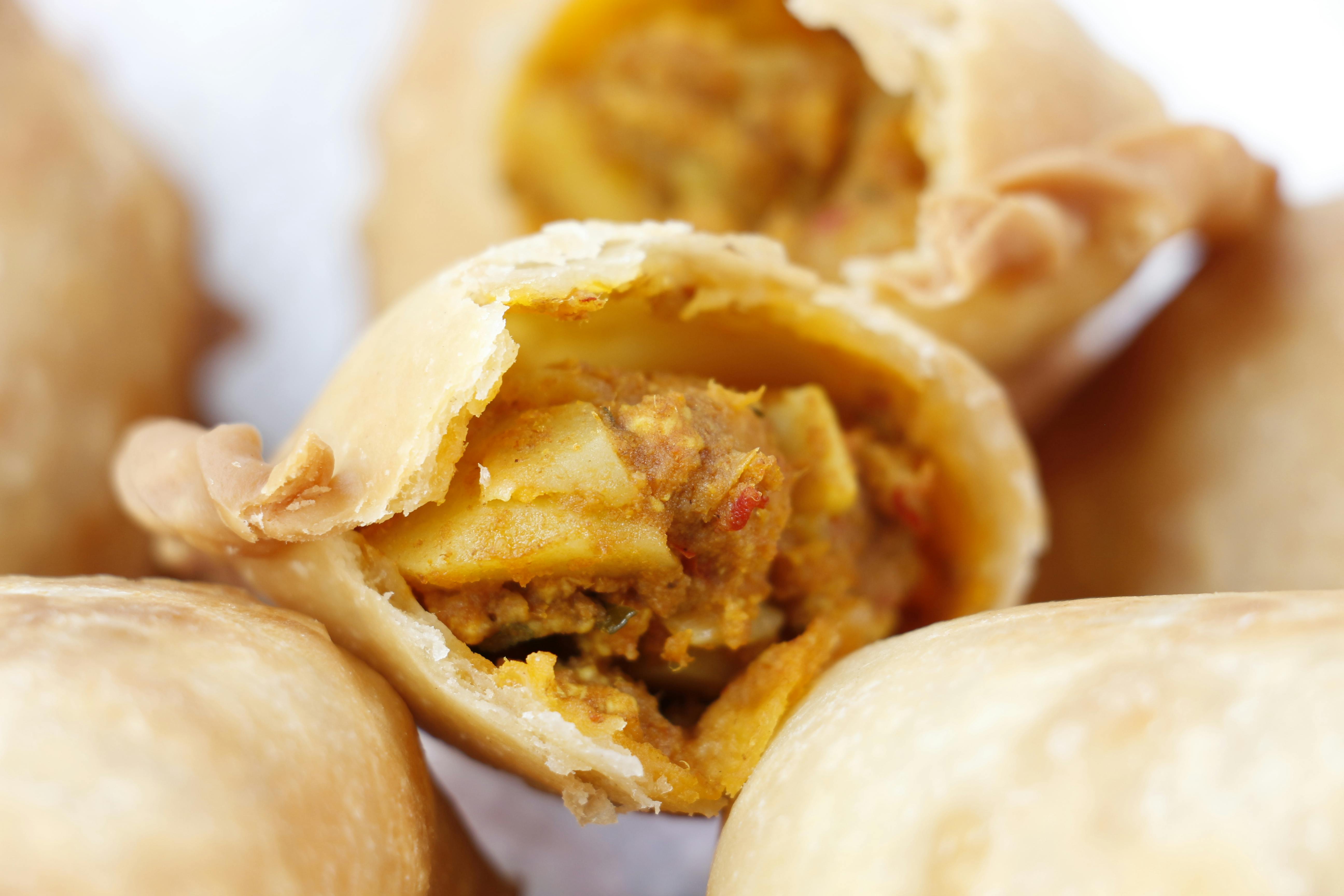
Trinidadian
Aloo Pie
The diets react (see scores below)
Common Ingredients
- potato
- flour
- cumin
- garlic
- turmeric
- scotch bonnet
- tamarind
- onion
Specific recipes may vary.
Incompatible with 8 of 11 diets
Diet Ratings
Aloo Pie is fundamentally incompatible with a ketogenic diet. The two primary ingredients — potato and flour — are both high-carb foods that will immediately spike blood glucose and disrupt ketosis. Potato is a starchy vegetable with roughly 15-17g net carbs per 100g, and wheat flour adds another dense carbohydrate load as the pastry/dough wrapper. A single Aloo Pie likely contains 40-60g+ of net carbs, exceeding the entire daily keto carb allowance in one snack. The spices (cumin, turmeric, garlic, scotch bonnet) and tamarind are relatively minor in quantity but tamarind also contributes additional sugars. There is no meaningful fat content or protein to offset the carbohydrate load. This dish cannot be made keto-compatible through portion control — even a small serving would be problematic.
Aloo Pie is a Trinidadian fried or baked flatbread stuffed with spiced potato filling. Every ingredient listed — potato, flour, cumin, garlic, turmeric, scotch bonnet, tamarind, and onion — is fully plant-based with no animal products or animal-derived ingredients. The dish is a whole-food-forward street snack built on vegetables and legume-adjacent spices. The only minor consideration is that flour-based frying can involve refined ingredients and oil, but nothing in the listed ingredient set raises any vegan concern. This is a straightforwardly vegan-compatible dish with high confidence.
Aloo Pie is fundamentally incompatible with the paleo diet. The dish consists of a spiced potato filling encased in a flour-based fried dough shell. Flour (wheat) is a grain and one of the most clearly excluded foods in paleo — this alone makes the dish a hard avoid. The dish's structure depends entirely on the wheat flour pastry, which cannot be removed or substituted without fundamentally changing the dish. White potatoes are themselves debated in paleo, but the flour wrapper is an unambiguous disqualifier. The remaining ingredients — cumin, garlic, turmeric, scotch bonnet, tamarind, and onion — are paleo-compatible herbs, spices, and vegetables, but they cannot redeem a dish whose defining element is a grain-based dough.
Aloo Pie is a deep-fried Trinidadian street snack made with a refined white flour dough encasing a spiced potato filling. The core issue from a Mediterranean diet perspective is the refined flour shell, which is likely deep-fried in oil — representing both a refined grain and a processed, high-fat cooking method that contradicts Mediterranean principles. While the filling ingredients (potato, cumin, garlic, turmeric, onion, tamarind, scotch bonnet) are all whole, plant-based foods that align well individually, the delivery vehicle — a fried refined-flour pastry — pushes this firmly into 'avoid' territory. The dish has no olive oil, no whole grains, and the frying method adds poor-quality fats. It is not a whole, minimally processed plant food as the diet emphasizes.
Some Mediterranean diet interpreters might note that the filling is entirely plant-based and the spices are health-promoting; if the pie were baked rather than fried and the dough made with whole wheat flour, this could be elevated to a 'caution' rating. Additionally, fried dough pastries do appear in some traditional Mediterranean cuisines (e.g., Maltese pastizzi, Greek tiropita variations), suggesting occasional indulgence in similar formats has regional precedent.
Aloo Pie is entirely plant-based with zero animal-derived ingredients. It consists of a fried dough shell (flour) filled with spiced potato (aloo), seasoned with cumin, garlic, turmeric, scotch bonnet pepper, tamarind, and onion. Every single ingredient is explicitly excluded on the carnivore diet — starchy vegetables, grains, legume-derived sauces, plant spices, and plant-derived condiments. There is no animal protein, animal fat, or any animal product present whatsoever. This dish is the antithesis of carnivore eating.
Aloo Pie is a Trinidadian fried pastry filled with spiced potato. The dough is made with wheat flour, which is a grain and explicitly excluded on Whole30. Regardless of how compliant the filling ingredients are (potato, cumin, garlic, turmeric, scotch bonnet, onion, tamarind are all fine), the flour-based pastry shell disqualifies this dish entirely. Furthermore, even if a grain-free flour substitute were used, the resulting dish would be a fried pastry/pie — exactly the kind of baked good or junk food recreation that Whole30 Rule 4 prohibits. This dish fails on two levels: excluded ingredient (wheat flour) and excluded food form (fried pastry/pie).
Aloo Pie contains multiple high-FODMAP ingredients that make it unsuitable during the elimination phase. Wheat flour (the dough/pastry shell) is high in fructans and is a primary FODMAP trigger. Garlic is one of the highest-FODMAP foods tested by Monash University, rich in fructans even in tiny amounts. Onion is similarly high in fructans and a major FODMAP offender. Tamarind paste/concentrate is high in excess fructose and polyols at typical serving amounts. These four ingredients collectively make this dish very high-FODMAP regardless of portion size. Potato itself is low-FODMAP, cumin is low-FODMAP in culinary amounts, turmeric is low-FODMAP, and scotch bonnet pepper is low-FODMAP — but the problematic ingredients (flour, garlic, onion, tamarind) are structural to the dish and cannot be easily removed or reduced to safe thresholds in a standard serving.
Aloo Pie is a Trinidadian fried street snack consisting of spiced mashed potato filling encased in a flour-based dough and deep-fried. The individual ingredients are largely DASH-friendly — potatoes provide potassium, cumin/turmeric/garlic are beneficial spices, tamarind and scotch bonnet are natural flavor enhancers low in sodium. However, the preparation method (deep frying in oil) significantly increases total fat and caloric density, and refined white flour rather than whole grain flour reduces fiber value. The dish is not inherently high in sodium, saturated fat, or added sugar, but the fried refined-dough shell conflicts with DASH's emphasis on whole grains and limiting total fat. As a snack, portion control is feasible. It occupies a middle ground: far better than processed snacks with added sodium or saturated fat, but not a core DASH food due to frying and refined flour.
NIH DASH guidelines emphasize whole grains and limiting total fat, which would flag deep-fried refined-flour dough as a caution item. However, updated clinical interpretations note that the fat used matters — if fried in a DASH-approved vegetable oil (e.g., canola or olive oil) and consumed in small portions, some DASH-oriented dietitians consider this acceptable occasionally, particularly given its low sodium and the potassium contribution of the potato filling.
Aloo Pie is a deep-fried dough pocket filled with spiced mashed potato — essentially two high-glycemic carbohydrate sources combined with no meaningful protein and likely saturated/omega-6-heavy frying fat. Potato is explicitly listed by Dr. Sears as an 'unfavorable' high-glycemic carbohydrate to avoid in Zone methodology. White flour dough is similarly high-glycemic and nutritionally empty from a Zone perspective. The dish has virtually no lean protein to anchor a Zone block ratio, and the frying medium (typically vegetable shortening or neutral oil) adds unfavorable fat with no monounsaturated benefit. The flavor-enhancing ingredients (cumin, turmeric, tamarind, scotch bonnet, garlic, onion) are Zone-friendly in isolation but they cannot redeem the macro profile. With ~0% protein calories, dominated by high-glycemic carbohydrates and saturated/omega-6 fats, this dish is essentially impossible to incorporate into a balanced Zone meal without completely deconstructing it. Even eating a very small portion would provide carb blocks with no corresponding protein or favorable fat blocks. The tamarind chutney component adds additional sugar. This falls into the narrow 'avoid' category because the core macro structure is antithetical to the 40/30/30 Zone ratio.
Aloo Pie is a Trinidadian fried or baked flatbread stuffed with spiced potatoes. The ingredient profile is a genuine mix of anti-inflammatory positives and neutrals. On the beneficial side: turmeric (curcumin), garlic, cumin, scotch bonnet pepper (capsaicin), tamarind (polyphenols), and onion (quercetin) are all recognized anti-inflammatory ingredients. These spices are strongly emphasized in anti-inflammatory eating patterns. However, the dish is anchored by refined white flour (a refined carbohydrate with a high glycemic index) and white potato (moderate glycemic load, starchy), and is typically deep-fried in seed oils — adding pro-inflammatory potential through refined carbs and oxidized fats. The spice payload meaningfully offsets some concern, but the refined flour base and frying method are the limiting factors. If baked with minimal oil, the score edges upward. As commonly prepared (deep-fried), this sits solidly in the caution zone.
Some anti-inflammatory practitioners, including those following Dr. Weil's broader framework, would argue the potent spice combination — turmeric, garlic, cumin, scotch bonnet, and onion — provides meaningful anti-inflammatory benefit that outweighs the starchy base, especially as an occasional snack. Conversely, stricter anti-inflammatory and autoimmune protocol (AIP) advocates would flag both the nightshade potato and the refined flour as problematic, and would be more critical of the frying method regardless of the spice content.
Aloo Pie is a deep-fried dough pocket filled with spiced mashed potato — a combination that hits nearly every GLP-1 avoid category simultaneously. The wheat-flour dough is refined and fried, making it high in fat and low in nutrient density per calorie. The potato filling is a starchy, low-protein, low-fiber carbohydrate. There is no meaningful protein source in this dish. The scotch bonnet pepper is one of the hottest chilies used in cooking and is very likely to worsen GLP-1-related nausea, reflux, and gastric irritation, especially given that gastric emptying is already slowed. Tamarind chutney (a common accompaniment) adds sugar. The fried exterior slows digestion further in a patient whose gastric emptying is already delayed. This dish provides empty starchy calories, negligible protein, minimal fiber relative to its calorie load, and carries real GI side-effect risk from both the frying and the scotch bonnet. It scores 2 rather than 1 only because the turmeric, cumin, garlic, and onion have minor anti-inflammatory and digestive benefits, and a very small portion would not be catastrophic.
*See how scores were generated at our methodology page.
Nutritional profile
Six traits that cut across every diet.
Fiber & Plants
How much whole-plant food and fiber it delivers.
Healthy Fats
The quality of its fats (unsaturated, omega-3).
Whole / Unprocessed
How close it is to its natural, unprocessed form.
Gut Gentle
How easy it is on digestion (low FODMAP, few irritants).
Low Glycemic
How little it spikes your blood sugar.
Protein Density
How much protein it packs per calorie.
Controversy Index
Higher controversy = more disagreement between diets.
Diet-Specific Tips
 Vegan — 8/10
View tips
- All listed ingredients are plant-derived
- Potato filling is a whole food with good nutritional value
- Spice blend (cumin, turmeric, garlic, scotch bonnet) is entirely plant-based
- Tamarind used as souring agent is a fruit product — fully vegan
- No dairy, eggs, or animal-derived additives in the traditional preparation
- Flour dough contains no listed animal ingredients such as milk or eggs
 DASH — 5/10
View tips
- Deep-fried preparation increases total fat content significantly
- Refined white flour dough lacks the fiber and nutrients of whole grains
- Potato filling provides potassium, a key DASH nutrient
- No significant sodium sources in the ingredient list — sodium level depends on added salt during cooking
- Beneficial spices (cumin, turmeric, garlic) align with DASH flavor principles
- Tamarind sauce condiment is low in sodium and natural
- No saturated fat concern if fried in vegetable oil
- Portion control critical — as a snack, one piece is manageable within DASH caloric limits
 Anti-Inflammatory — 5/10
View tips
- Turmeric contains curcumin, a well-studied anti-inflammatory compound
- Garlic, cumin, scotch bonnet (capsaicin), and onion (quercetin) provide additional anti-inflammatory polyphenols and phytochemicals
- Tamarind adds polyphenol content with some antioxidant activity
- Refined white flour base is a pro-inflammatory refined carbohydrate with high glycemic index
- White potato has moderate glycemic load; nightshade consideration for autoimmune-sensitive individuals
- Typically deep-fried in seed oils, adding oxidized omega-6 fats — a significant anti-inflammatory concern
- No omega-3 sources or leafy greens; limited antioxidant density beyond spices