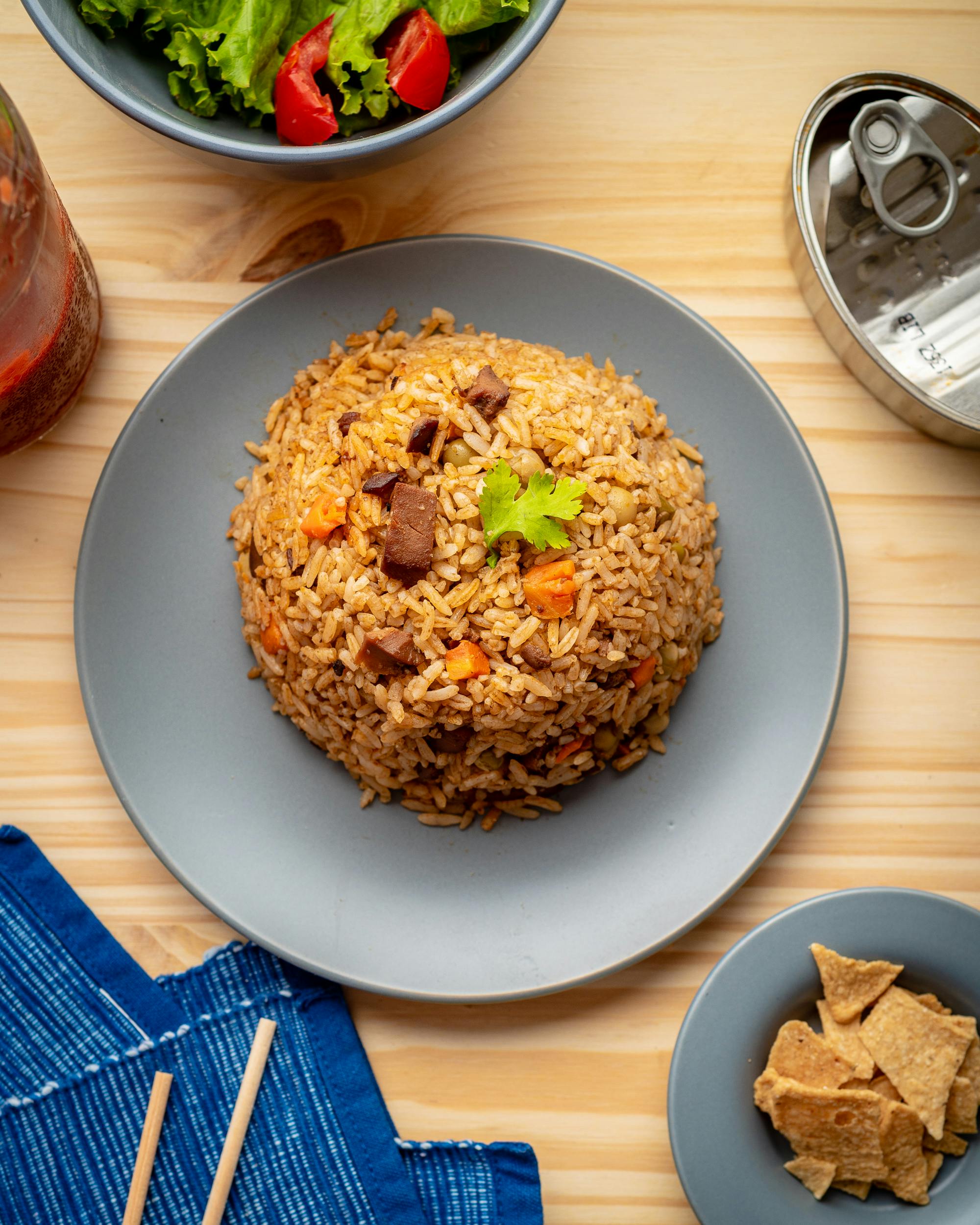
Photo: Luis Kuthe / Pexels
The diets react (see scores below)
Common Ingredients
- chicken
- rice
- pigeon peas
- coconut milk
- brown sugar
- onion
- garlic
- carrot
- scotch bonnet
Specific recipes may vary.
Incompatible with 6 of 11 diets
Diet Ratings
Pelau is fundamentally incompatible with a ketogenic diet. The dish is built on rice as its base, a high-glycemic grain that alone would exceed the daily net carb limit in a single serving. Pigeon peas add substantial additional net carbs (roughly 20g per half cup). Brown sugar is used in the cooking process, adding direct sugar that spikes blood glucose. The combination of rice, legumes, and added sugar makes this dish a triple threat against ketosis. The positive elements — chicken, coconut milk, and aromatics — are keto-friendly, but they are overwhelmed by the carbohydrate-heavy core ingredients. A standard serving of Pelau would likely contain 60-80g+ of net carbs, far exceeding the entire daily keto allowance.
Pelau is a traditional Trinidadian one-pot dish that prominently features chicken as its primary protein. Chicken is an animal product and is categorically excluded under all vegan dietary frameworks. There is no ambiguity here — regardless of the plant-based ingredients also present (rice, pigeon peas, coconut milk, vegetables), the inclusion of chicken makes this dish non-vegan.
Pelau contains multiple paleo-excluded ingredients that make it incompatible with the diet. Rice is a grain and strictly excluded by all major paleo authorities. Pigeon peas are legumes, also universally excluded. Brown sugar is a refined sugar and off-limits. Coconut milk is the one paleo-friendly base ingredient, and the remaining aromatics (onion, garlic, carrot, scotch bonnet) are fully approved vegetables. However, three core structural ingredients — rice, pigeon peas, and brown sugar — are hard paleo violations, making this dish a clear avoid regardless of interpretation.
Pelau is a one-pot Trinidadian dish that blends Mediterranean-friendly elements with some less-aligned components. On the positive side, pigeon peas are an excellent legume source, vegetables like onion, garlic, and carrot are staples, and chicken is an acceptable moderate protein. However, several factors pull the dish away from Mediterranean ideals: coconut milk replaces olive oil as the primary fat (high in saturated fat, not traditional to Mediterranean cooking), brown sugar is added (contributing unnecessary refined sugar), and white rice is the base grain rather than a whole grain. The combination of coconut milk and brown sugar — both integral to authentic pelau — meaningfully conflicts with Mediterranean fat and sugar principles. The dish is not highly processed and does contain legumes and vegetables, but its fat profile and sugar content keep it firmly in the caution zone.
Some modern Mediterranean diet interpreters take a more flexible, plant-inclusive view and might argue that the legumes, vegetables, and lean poultry make pelau a reasonable occasional meal; a small amount of brown sugar used for caramelizing (a browning technique) could be considered minimal. Additionally, coconut milk, while not traditional, is sometimes accepted in broader 'plant-based fat' interpretations of the diet.
Pelau is fundamentally incompatible with the carnivore diet. While it contains chicken as the primary protein, the dish is dominated by plant-based ingredients: rice (grain), pigeon peas (legume), coconut milk (plant fat), brown sugar (plant-derived sweetener), onion, garlic, carrot, and scotch bonnet pepper. Nearly every ingredient beyond the chicken violates carnivore principles. Rice and pigeon peas alone are major disqualifiers, and brown sugar adds processed plant-based sweetener. This dish is a one-pot stew where the animal component is minor relative to the volume of excluded foods.
Pelau contains multiple excluded ingredients that make it incompatible with Whole30. Rice is an excluded grain, pigeon peas are excluded legumes (unlike the specifically excepted green beans, sugar snap peas, and snow peas), and brown sugar is an added sugar — all explicitly prohibited on Whole30. Any one of these three violations would be sufficient to disqualify the dish.
Pelau contains multiple high-FODMAP ingredients that make it unsuitable during the elimination phase. Garlic and onion are among the highest-FODMAP foods tested by Monash University, both rich in fructans, and they are foundational aromatics in this dish — not optional garnishes. Pigeon peas (also called gandules) are high in GOS (galacto-oligosaccharides), a key FODMAP, and are a central, load-bearing ingredient in pelau rather than a minor addition. Together, these three ingredients create a cumulative FODMAP load that would be very high even in a modest serving. Coconut milk is low-FODMAP at 1/2 cup but can become high-FODMAP in larger quantities due to sorbitol content, adding further risk. Brown sugar, chicken, rice, carrot, and scotch bonnet pepper are all individually low-FODMAP and would be acceptable. However, the dish cannot be made authentically without onion, garlic, and pigeon peas, making the overall dish clearly high-FODMAP for elimination phase purposes.
Pelau is a one-pot Trinidadian rice dish that contains several DASH-friendly ingredients — chicken (lean protein), pigeon peas (legumes rich in fiber, potassium, and magnesium), vegetables (onion, garlic, carrot), and spices. However, the dish also includes coconut milk, which is high in saturated fat from a tropical oil source that DASH guidelines recommend limiting. Brown sugar adds refined sugar, though typically in modest amounts for caramelizing the chicken. The overall dish is moderately balanced: the legumes, vegetables, and lean chicken align well with DASH principles, but coconut milk is a notable concern. Sodium content depends heavily on preparation — if seasoning salts, bouillon, or soy sauce are added (common in many recipes), sodium can rise significantly. Scored as caution rather than avoid because the core ingredients are largely DASH-compatible, with coconut milk and sugar being the primary limiting factors.
NIH DASH guidelines explicitly flag tropical oils including coconut milk as high in saturated fat to be limited; however, some updated clinical interpretations note that coconut milk used in moderate quantities within a whole-food dish rich in legumes and vegetables may not meaningfully undermine cardiovascular outcomes, especially given the fiber, potassium, and magnesium contributions of pigeon peas and vegetables.
Pelau is a classic Trinidadian one-pot dish that presents several Zone Diet challenges. The rice base is a high-glycemic refined carbohydrate that Zone classifies as 'unfavorable,' and the brown sugar used for caramelizing the chicken adds additional glycemic load with little nutritional benefit. Coconut milk contributes saturated fat rather than the preferred monounsaturated fats. On the positive side, the dish has genuinely Zone-friendly components: chicken is a lean protein source, pigeon peas add both protein and fiber (lowering net carbs), and the vegetables (onion, garlic, carrot, scotch bonnet) contribute polyphenols and low-GI carbohydrates. The overall macro ratio, however, skews heavily toward carbohydrates from the rice, making it difficult to achieve the 40/30/30 balance without significant portion manipulation. A Zone-adapted version would reduce rice substantially, increase the chicken-to-rice ratio, swap coconut milk for a smaller amount or use light coconut milk, and eliminate or minimize the brown sugar. As traditionally prepared, the carbohydrate load from rice dominates the dish and pushes it out of Zone balance.
Some Zone practitioners note that pigeon peas are a favorable legume-based carbohydrate with significant fiber content, which meaningfully reduces net carb load. If portioned with a very small rice serving and a generous chicken portion, Pelau could be restructured into approximate Zone balance. Sears' later writings also show more nuance around saturated fat from coconut, noting that medium-chain triglycerides in coconut milk have a different metabolic profile than long-chain saturated fats — making the coconut milk concern less absolute than early Zone doctrine suggested.
Pelau is a mixed dish from an anti-inflammatory perspective. On the positive side, pigeon peas are an excellent legume rich in fiber and plant protein, supporting gut health and reducing inflammatory markers. Garlic and onion contain quercetin, allicin, and other anti-inflammatory compounds. Scotch bonnet peppers are exceptionally high in capsaicin, a well-documented anti-inflammatory compound, and vitamin C. Carrots contribute beta-carotene and antioxidants. Coconut milk provides medium-chain triglycerides (MCTs), which are more metabolically neutral than long-chain saturated fats, though its saturated fat content remains a concern in large quantities. Chicken as a lean protein is in the 'moderate' category. The two main concerns are: (1) white rice, a refined carbohydrate that raises blood sugar and promotes a pro-inflammatory glycemic response — though the fiber from pigeon peas mitigates this somewhat; and (2) brown sugar used in the caramelizing step, which introduces added sugar contributing to inflammatory signaling. The dish is not inherently harmful and contains several genuinely anti-inflammatory ingredients, but the refined carb base and added sugar prevent it from reaching 'approve' status. As a moderate, occasional dish it fits within anti-inflammatory eating patterns.
Some anti-inflammatory practitioners following stricter protocols (such as AIP or Wahls Protocol) would further flag coconut milk's saturated fat load and the glycemic impact of white rice as more problematic than mainstream anti-inflammatory guidance suggests. Conversely, Dr. Weil's more inclusive framework — which emphasizes legumes, alliums, and spices — would view the overall ingredient profile relatively favorably, potentially rating it closer to the approve threshold if portions are moderate.
Pelau is a one-pot Trinidadian dish that has genuine nutritional strengths but several meaningful drawbacks for GLP-1 patients. On the positive side, chicken provides solid lean protein, and pigeon peas add both protein and fiber — together these support the two top dietary priorities. Carrots, onion, and garlic contribute micronutrients and fiber. However, coconut milk introduces significant saturated fat, which can worsen GLP-1 side effects including nausea, bloating, and slowed gastric emptying. Brown sugar is used in the traditional caramelization step (browning the chicken), adding empty calories and a glycemic spike that is counterproductive on a reduced-calorie intake. White rice is a refined carbohydrate with low fiber and nutrient density per calorie, and the dish is typically rice-heavy by volume, making small-portion satisfaction harder to achieve. Scotch bonnet is a high-heat pepper that poses a meaningful reflux and nausea risk for GLP-1 patients, who already have slowed gastric emptying and heightened GI sensitivity. The dish is not fried and does contain real whole-food ingredients, which prevents a lower score, but the coconut milk fat load, refined rice base, added sugar, and scotch bonnet heat collectively create enough friction for GLP-1 patients to warrant a caution rating rather than approval.
Some GLP-1-focused dietitians would rate a small, protein-forward portion of pelau more favorably, noting that pigeon peas plus chicken can deliver 20+ grams of protein in a modest serving and that coconut milk in a shared dish is diluted enough to be tolerable for patients without active nausea. Others maintain that the saturated fat from coconut milk and the refined rice base make this dish a poor use of limited caloric capacity, and would recommend a modified version using light coconut milk, brown rice or cauliflower rice, reduced sugar, and a milder pepper before serving it to GLP-1 patients regularly.
*See how scores were generated at our methodology page.
Nutritional profile
Six traits that cut across every diet.
Fiber & Plants
How much whole-plant food and fiber it delivers.
Healthy Fats
The quality of its fats (unsaturated, omega-3).
Whole / Unprocessed
How close it is to its natural, unprocessed form.
Gut Gentle
How easy it is on digestion (low FODMAP, few irritants).
Low Glycemic
How little it spikes your blood sugar.
Protein Density
How much protein it packs per calorie.
Controversy Index
Higher controversy = more disagreement between diets.
Diet-Specific Tips
 Mediterranean — 4/10
View tips
- Pigeon peas are an excellent Mediterranean-compatible legume
- Chicken is acceptable in moderation per Mediterranean guidelines
- Coconut milk is high in saturated fat and not part of Mediterranean tradition — replaces olive oil
- Brown sugar adds refined/added sugar, contradicting Mediterranean principles
- White rice is a refined grain; whole grains are preferred
- Onion, garlic, and carrot are strongly encouraged Mediterranean vegetables
- Scotch bonnet pepper is a whole food vegetable with no Mediterranean diet concerns
 DASH — 5/10
View tips
- Pigeon peas are DASH-positive: high in fiber, potassium, and magnesium
- Chicken provides lean protein aligned with DASH recommendations
- Coconut milk is a tropical fat source high in saturated fat, flagged by DASH guidelines
- Brown sugar adds refined sugar; caramelizing technique typically limits quantity but still a concern
- Vegetables (carrot, onion, garlic) contribute DASH-favorable micronutrients
- Sodium levels vary widely by recipe — added seasoning salts or bouillon could push sodium into avoid territory
- White rice is typically used rather than whole grain, missing an opportunity for fiber
- Portion control important given caloric density from coconut milk and rice
 Zone — 4/10
View tips
- White/brown rice is a high-glycemic 'unfavorable' Zone carbohydrate and dominates the dish
- Brown sugar for caramelizing adds unnecessary glycemic load
- Chicken is a lean, Zone-favorable protein
- Pigeon peas contribute fiber, reducing net carbs and adding plant protein
- Coconut milk adds saturated fat rather than preferred monounsaturated fat
- Vegetables (onion, garlic, carrot, scotch bonnet) are Zone-favorable low-GI carbs
- Traditional preparation skews macro ratio heavily toward carbohydrates
- Portioning a small serving alongside a large protein source could approximate Zone ratios
 Anti-Inflammatory — 5/10
View tips
- Pigeon peas: excellent anti-inflammatory legume, high fiber, plant protein
- Scotch bonnet peppers: very high capsaicin and vitamin C content — strongly anti-inflammatory
- Garlic and onion: allicin, quercetin — well-documented anti-inflammatory compounds
- White rice: refined carbohydrate with pro-inflammatory glycemic load
- Brown sugar (caramelizing step): added sugar contributes to inflammatory signaling
- Coconut milk: MCTs are relatively neutral but saturated fat content is a moderate concern
- Chicken: lean protein, acceptable in moderation under anti-inflammatory framework
- Carrots: beta-carotene and antioxidants support anti-inflammatory profile
 GLP-1 Friendly — 5/10
View tips
- Chicken provides lean protein, supporting the #1 GLP-1 dietary priority
- Pigeon peas contribute meaningful fiber and additional plant protein
- Coconut milk is high in saturated fat, which worsens nausea and bloating on GLP-1 medications
- White rice is a refined carbohydrate — low fiber, low nutrient density per calorie, poor use of limited caloric capacity
- Brown sugar adds empty calories and glycemic load; even small amounts are counterproductive on a reduced appetite
- Scotch bonnet pepper is very high heat and poses real risk of worsening reflux and nausea in GLP-1 patients with slowed gastric emptying
- Dish is rice-heavy by volume, making small-portion protein targets harder to hit
- Not fried; contains real whole-food vegetables — baseline digestibility is reasonable if portion is small and spice is reduced