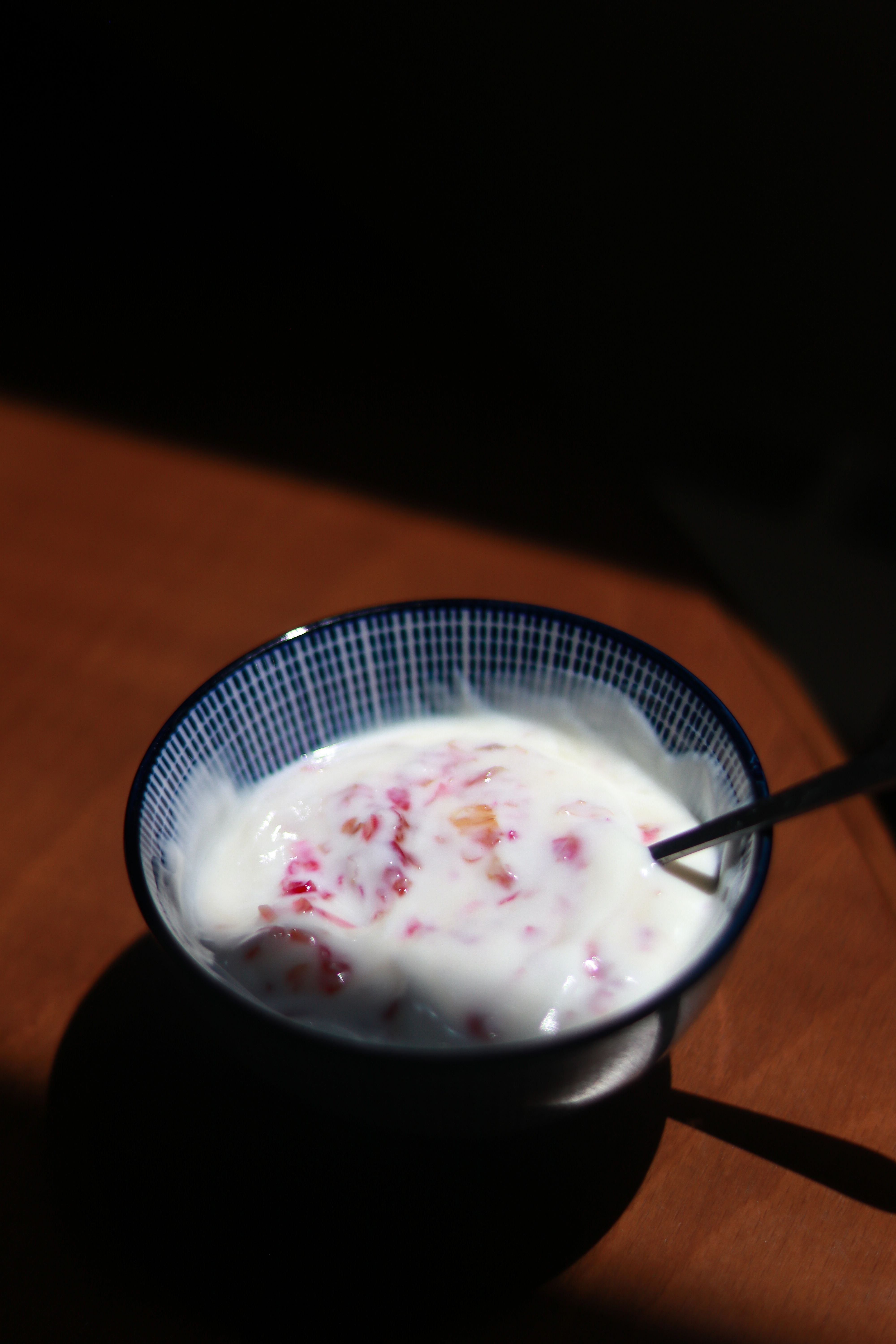
Photo: Golboo Maghooli / Pexels
The diets react (see scores below)
Common Ingredients
- water chestnuts
- palm sugar
- coconut cream
- shaved ice
- tapioca pearls
- pandan extract
- salt
Specific recipes may vary.
Incompatible with 10 of 11 diets
Diet Ratings
Tub Tim Krob is a Thai dessert that is fundamentally incompatible with a ketogenic diet. It contains multiple high-carb ingredients that collectively make ketosis impossible: palm sugar is a concentrated sugar source with nearly 100% carbs; tapioca pearls are pure starch with essentially zero fiber, delivering extremely high net carbs; water chestnuts are starchy vegetables with moderate-to-high net carbs; and shaved ice, while carb-free itself, serves as a base for a sugar-laden syrup. Even a small serving would likely exceed the entire daily net carb allowance of 20-50g. The only marginally keto-friendly ingredient is coconut cream, which provides healthy fats, but it cannot redeem the dish.
Tub Tim Krob is a traditional Thai dessert consisting entirely of plant-based ingredients. Water chestnuts coated in tapioca flour form the ruby-red 'jewels,' served in coconut cream sweetened with palm sugar, colored and flavored with pandan extract. Every listed ingredient is plant-derived: water chestnuts (aquatic vegetable), tapioca pearls (cassava starch), coconut cream (pressed coconut flesh), pandan extract (screwpine leaf), palm sugar (palm tree sap), and salt. No animal products are present. The dish scores highly as it is largely whole-food in nature, though palm sugar and palm-derived products introduce a minor ethical debate within the vegan community regarding environmental impact.
Some ethical vegans flag palm sugar and coconut cream due to environmental concerns — palm cultivation drives deforestation, while some coconut farming practices involve exploited monkeys for harvesting; a minority of environmentally-focused vegans avoid these ingredients on ethical grounds, though they remain botanically plant-based.
Tub Tim Krob contains multiple non-paleo ingredients that disqualify it. Tapioca pearls, while derived from cassava (a tuber), are a highly processed starch product that contradicts paleo philosophy. Salt is excluded under strict paleo rules as an added refined mineral. Pandan extract is likely a processed flavoring additive rather than a whole food. Palm sugar, while natural, is a concentrated refined sugar that falls into the avoid category rather than the cautious natural sweetener zone. The combination of processed starch, refined sugar, added salt, and likely artificial extract makes this dish clearly non-compliant. Coconut cream and water chestnuts are individually paleo-friendly, but they cannot redeem a dish with this many violations.
Tub Tim Krob is a Thai dessert that conflicts with core Mediterranean diet principles on multiple fronts. Palm sugar is a significant source of added sugar, which the Mediterranean diet explicitly minimizes. Coconut cream is high in saturated fat and is not a traditional Mediterranean fat source — extra virgin olive oil is the canonical fat, not tropical oils. Tapioca pearls are a refined starch with minimal nutritional value. Shaved ice adds no nutritional benefit. While water chestnuts are a plant food, the overall dish is essentially a high-sugar, high-saturated-fat dessert snack built around ingredients entirely outside the Mediterranean dietary tradition.
Tub Tim Krob is a Thai dessert composed entirely of plant-derived and processed ingredients. Water chestnuts, palm sugar, coconut cream, tapioca pearls, and pandan extract are all plant-based foods explicitly excluded from the carnivore diet. There are zero animal-derived ingredients in this dish. The palm sugar adds significant processed sugar, tapioca pearls are a starchy grain-like product, and pandan extract is a plant flavoring. This dish is completely incompatible with any tier of the carnivore diet.
Tub Tim Krob contains two clearly excluded ingredients. First, palm sugar is an added sugar — it is a real, caloric sweetener explicitly prohibited on Whole30, regardless of whether it is 'natural.' Second, tapioca pearls are derived from cassava starch and, while cassava root itself is allowed, tapioca pearls in this context are a processed starch product used to recreate a dessert/junk food treat. More critically, this dish as a whole is a sweet dessert snack designed to satisfy sugar cravings, which directly conflicts with the program's core purpose of resetting your relationship with sugar and sweet foods. Even if tapioca were debatable, palm sugar alone makes this dish non-compliant.
Tub Tim Krob (Ruby Water Chestnuts) contains several ingredients worth analyzing individually. Water chestnuts are low-FODMAP at standard servings (Monash approved). Tapioca pearls are low-FODMAP as tapioca starch is FODMAP-free. Pandan extract is low-FODMAP. Salt is fine. The two ingredients that create concern are coconut cream and palm sugar. Coconut cream is low-FODMAP at 1/2 cup (125ml) but becomes high-FODMAP at larger servings due to sorbitol content — a standard Thai dessert serving often contains more than this threshold. Palm sugar is less well-tested by Monash, but sugar in general (sucrose) is low-FODMAP; palm sugar's fructose-to-glucose ratio is roughly balanced, making it generally safer than honey or HFCS, though it is not definitively Monash-certified. The practical risk comes from the coconut cream serving size — Thai dessert portions can easily exceed the safe 125ml threshold, pushing this into moderate-FODMAP territory. At controlled, smaller portions this dish could be considered low-FODMAP, but standard restaurant servings introduce meaningful risk.
Monash University rates coconut cream as low-FODMAP at ≤125ml, but clinical FODMAP practitioners often caution that Thai desserts are served in volumes that routinely exceed this threshold, making coconut cream-based dishes a practical concern during the strict elimination phase. Palm sugar lacks specific Monash testing, adding minor uncertainty.
Tub Tim Krob is a Thai dessert that conflicts with multiple core DASH diet principles. Coconut cream is a tropical oil-based product high in saturated fat, which DASH explicitly limits. Palm sugar, while less refined than white sugar, is still a significant source of added sugar — DASH recommends limiting sweets and added sugars to 5 or fewer servings per week at low quantities. The combination of coconut cream and palm sugar creates a high saturated fat plus high added sugar profile. Tapioca pearls are refined starch with minimal nutritional value (low fiber, low potassium, low magnesium). While water chestnuts are a DASH-friendly vegetable and pandan extract is benign, they cannot offset the dominant problematic ingredients. The dish provides essentially none of the nutrients DASH emphasizes — potassium, calcium, magnesium, or fiber — in meaningful amounts, and delivers significant saturated fat and added sugar in a single snack serving.
Tub Tim Krob is a Thai dessert that is fundamentally incompatible with Zone Diet principles. The dish is dominated by high-glycemic, high-sugar ingredients with virtually no protein and an unfavorable fat profile. Palm sugar is a concentrated sugar source with a high glycemic impact, directly spiking insulin — the very hormonal response the Zone Diet is designed to prevent. Tapioca pearls are high-glycemic refined starch with negligible fiber, making them 'unfavorable' carbs by Zone standards. Coconut cream contributes primarily saturated fat with no monounsaturated fat benefit, and provides no protein. Water chestnuts are actually a relatively low-glycemic vegetable and the one redeeming ingredient, but they are a minor component overwhelmed by the sugar and starch load. The dish contains zero lean protein, no monounsaturated fat, and no low-glycemic carbohydrate foundation. The macronutrient ratio is approximately 80-90% carbohydrate (mostly high-glycemic) with significant saturated fat — essentially the inverse of a Zone-favorable meal. There is no practical way to portion this dish into a Zone block framework without eliminating most of its defining ingredients.
Tub Tim Krob is a Thai dessert whose ingredient profile raises significant anti-inflammatory concerns. Palm sugar is a concentrated source of added sugar, and while it has a slightly lower glycemic index than refined white sugar and contains trace minerals, it still drives blood glucose spikes and promotes inflammatory signaling (NF-κB pathway, AGE formation) when consumed regularly. Coconut cream is high in saturated fat (predominantly lauric acid), which is debated but generally flagged as something to limit in anti-inflammatory frameworks. Tapioca pearls are a refined, high-glycemic starch with essentially no fiber or micronutrient value, contributing to the overall glycemic load. Shaved ice is nutritionally neutral but serves as a vehicle for the sugary syrup. Water chestnuts are the one bright spot — they provide modest fiber and some flavonoids — but their anti-inflammatory contribution is minimal relative to the dish's sugar and saturated fat load. Pandan extract and salt are benign. The dish's core profile — high added sugar (palm sugar syrup), high saturated fat (coconut cream), and refined starch (tapioca) — makes it a clear pro-inflammatory choice consistent with the 'avoid' category. It is an occasional indulgence at best, not aligned with anti-inflammatory eating principles.
Tub Tim Krob is a Thai dessert built almost entirely around sugar and refined starches with no meaningful protein, negligible fiber, and high-glycemic ingredients. Palm sugar is the primary sweetener, tapioca pearls are pure refined starch, and coconut cream adds saturated fat — a combination that delivers empty calories, a rapid blood sugar spike, and potential nausea/bloating from the fat content. For GLP-1 patients eating far fewer calories overall, this snack provides almost no nutritional return: no protein to protect muscle mass, no fiber to support digestion or satiety, and a fat profile that can worsen gastric side effects. The shaved ice base does contribute hydration, but that is the only meaningful positive. This is precisely the category of food — high sugar, high saturated fat, zero protein, low fiber — that is counterproductive on a GLP-1 regimen.
*See how scores were generated at our methodology page.
Nutritional profile
Six traits that cut across every diet.
Fiber & Plants
How much whole-plant food and fiber it delivers.
Healthy Fats
The quality of its fats (unsaturated, omega-3).
Whole / Unprocessed
How close it is to its natural, unprocessed form.
Gut Gentle
How easy it is on digestion (low FODMAP, few irritants).
Low Glycemic
How little it spikes your blood sugar.
Protein Density
How much protein it packs per calorie.
Controversy Index
Higher controversy = more disagreement between diets.
Diet-Specific Tips
 Vegan — 8/10
View tips
- All ingredients are fully plant-derived
- Water chestnuts and tapioca are whole/minimally processed plant foods
- Coconut cream is a standard vegan ingredient
- Palm sugar is plant-based but palm products raise environmental concerns for some vegans
- Pandan extract is a natural plant flavoring
- No animal products, dairy, eggs, or animal-derived additives present