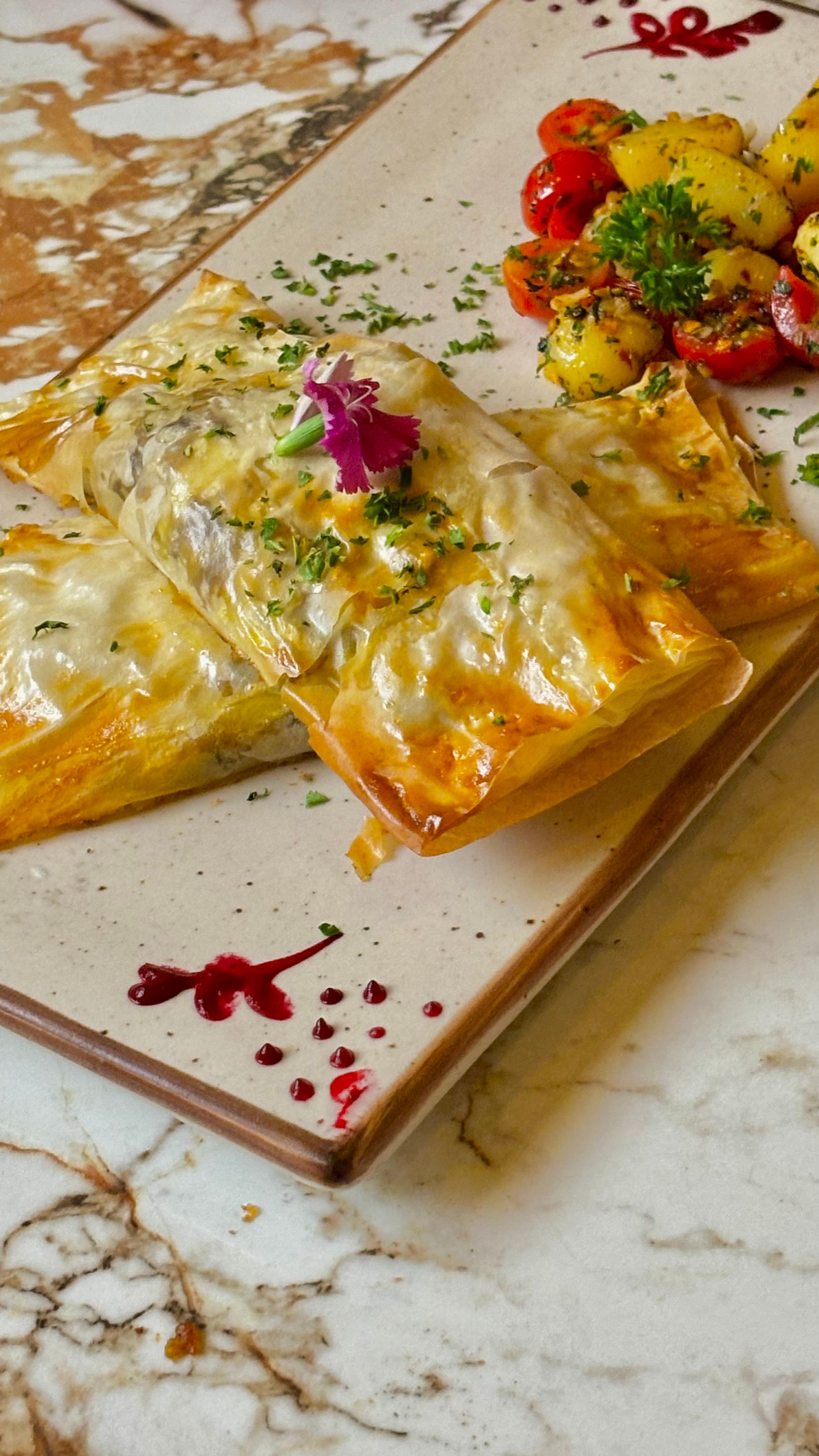
Photo: jitin arora / Pexels
The diets react (see scores below)
Common Ingredients
- malsouka pastry
- egg
- tuna
- parsley
- capers
- onion
- harissa
- oil
Specific recipes may vary.
Incompatible with 6 of 11 diets
Diet Ratings
Brik is a Tunisian pastry where the primary wrapper is malsouka (warqa) pastry — a thin, crepe-like dough made from semolina or flour. This pastry shell is the defining element of the dish and is fundamentally a grain-based, high-carb ingredient. A single brik pastry sheet adds approximately 20-30g of net carbs on its own, which can single-handedly exhaust or exceed the entire daily keto carb budget. While the fillings (egg, tuna, capers, parsley, onion, harissa, oil) are largely keto-compatible, the malsouka wrapper makes this dish incompatible with ketosis in its traditional form. The dish cannot be meaningfully modified while retaining its identity as brik.
Brik contains multiple animal-derived ingredients that are strictly excluded from a vegan diet. Eggs are a direct animal product, and tuna is fish — both are fundamental violations of vegan principles. The remaining ingredients (malsouka pastry, parsley, capers, onion, harissa, oil) are plant-based, but the presence of egg and tuna makes this dish clearly non-vegan with no ambiguity.
Brik is fundamentally incompatible with the paleo diet. The defining element of this dish is malsouka (also called warka), a thin pastry sheet made from wheat flour — a grain that is strictly excluded from paleo. The pastry wrapper is not a minor ingredient but the structural foundation of the dish. The remaining ingredients are largely paleo-friendly: eggs are approved, tuna is an excellent paleo protein, parsley is a permitted herb, onion is a paleo vegetable, and harissa (a chili-based paste) is generally acceptable if free of additives. Capers are paleo-compatible. The unspecified 'oil' raises a secondary concern — if it is a seed oil (sunflower or vegetable oil, common in Tunisian cooking), that adds a second violation. Even if the oil were compliant, the wheat-based pastry alone is sufficient to place this dish firmly in the avoid category. There is no meaningful paleo adaptation possible without completely deconstructing the dish and eliminating its defining characteristic.
Brik is a traditional Tunisian street food with several Mediterranean-friendly components: tuna (an excellent Mediterranean protein), egg (moderate dairy/egg category), capers, onion, parsley, and harissa all align well with Mediterranean principles. However, the malsouka (thin pastry wrapper) is a refined grain product similar to phyllo, and deep-frying in oil (typically not extra virgin olive oil in street-food contexts) introduces concerns about processing and fat quality. The dish is not inherently unhealthy and reflects authentic North African Mediterranean culinary tradition, but the refined pastry shell and frying method temper its score. If baked or pan-fried lightly in olive oil, it would score higher.
Traditional Tunisian and broader North African Mediterranean cuisine regularly includes thin-pastry snacks like brik as part of a balanced dietary pattern. Some Mediterranean diet scholars who emphasize traditional regional diversity (including the work of researchers documenting North African eating patterns) would argue that occasional brik, especially when made with quality tuna and olive oil, fits comfortably within Mediterranean principles rather than warranting caution.
Brik is fundamentally incompatible with the carnivore diet. While it contains carnivore-friendly ingredients (egg, tuna), the dish is built around malsouka pastry — a thin wheat-based dough that is entirely plant-derived and grain-based, making it a strict exclusion. Beyond the pastry, the dish includes multiple additional plant-based ingredients: parsley (herb), capers (plant), onion (vegetable), harissa (chili-based plant condiment), and plant oil. The only carnivore-compatible components are the egg and tuna, but they are completely overwhelmed by the plant-based foundation of the dish. No adaptation short of a complete reformulation would make this carnivore-compatible.
Brik is a Tunisian pastry where a thin sheet of malsouka (also called warka or brik pastry) is wrapped around a filling and fried. The malsouka pastry itself is made from wheat flour, making it a grain-based wrapper that is explicitly excluded on Whole30. Beyond the grain violation, brik falls squarely into the 'no recreating baked goods/junk food' rule — it is a pastry/wrap/crepe-style item explicitly listed as non-compliant in spirit and form. The remaining ingredients (egg, tuna, parsley, capers, onion, harissa, oil) are largely Whole30-compatible on their own, but the defining element of this dish — the pastry shell — makes it entirely non-compliant.
Brik contains multiple high-FODMAP ingredients that make it unsuitable during the elimination phase. The most problematic are: (1) malsouka pastry, which is a thin wheat-based dough (similar to brick/warka pastry) and therefore high in fructans — this is the primary wrapper and unavoidable; (2) onion, one of the highest-FODMAP foods, rich in fructans even in small quantities; (3) harissa, which typically contains garlic and sometimes onion, both high-fructan ingredients. While several other ingredients are low-FODMAP — egg, tuna (canned in oil or water), parsley, capers, and oil are all safe — the combination of wheat pastry, onion, and harissa creates a dish with multiple significant FODMAP sources stacked together. Substituting gluten-free pastry, omitting onion, and using a garlic/onion-free harissa would theoretically make this low-FODMAP, but as traditionally prepared, Brik is not suitable for the elimination phase.
Some FODMAP practitioners acknowledge that wheat pastry used in very thin sheets (like malsouka/warka) may contribute fewer fructans per serving than thicker wheat products, and that a small amount of harissa paste may contain only trace garlic. However, Monash University testing consistently rates wheat-based products as high-FODMAP due to fructan content, and onion remains unequivocally high-FODMAP at any standard culinary quantity, making elimination-phase approval difficult to justify for this dish as traditionally made.
Brik is a Tunisian deep-fried or pan-fried pastry that presents a mixed DASH profile. On the positive side, it contains several DASH-friendly ingredients: egg (lean protein), tuna (omega-3-rich lean fish), parsley (nutrient-dense herb), onion (vegetable), and small amounts of beneficial components. However, several concerns arise: (1) The malsouka/warka pastry is a refined white flour dough, not a whole grain. (2) Deep-frying in oil significantly increases total fat content and caloric density. (3) Capers are very high in sodium — a single tablespoon can contain 250–500mg sodium. (4) Harissa paste typically contains moderate to high sodium depending on preparation and quantity used. (5) Canned tuna, the most common preparation, adds additional sodium. The combination of fried refined pastry, capers, harissa, and likely canned tuna can push sodium levels well above DASH thresholds per serving. The dish is not inherently categorized in NIH DASH guidelines, requiring inference from component analysis.
NIH DASH guidelines don't specifically address Brik; a conservative interpretation would flag the fried refined pastry, capers, and harissa as collectively disqualifying for regular consumption. However, updated clinical DASH interpretations might note that if made with minimal oil (baked version), low-sodium tuna, rinsed capers, and homemade low-sodium harissa, the dish could be a reasonable occasional protein-rich snack given its egg and fish content.
Brik is a Tunisian fried pastry that presents a mixed Zone profile. The filling ingredients — egg, tuna, parsley, capers, onion, and harissa — are largely Zone-friendly. Tuna and egg together provide lean, quality protein with favorable omega-3 content (especially from tuna), and parsley, capers, and onion contribute polyphenols and low-glycemic carbohydrates. Harissa, made from peppers, also adds polyphenol value. However, the malsouka (or warka) pastry wrapper is a refined, high-glycemic starch with minimal fiber, making it an 'unfavorable' Zone carbohydrate. Additionally, brik is typically deep-fried in oil, adding a significant and uncontrolled fat load that is likely omega-6 heavy depending on the oil used, skewing the fat profile away from the monounsaturated ideal. The deep-frying also makes portion-based fat control very difficult. The dish could theoretically be adapted — baked rather than fried, with a smaller pastry portion — to bring it closer to Zone ratios, but in its traditional form, the refined pastry shell and frying method make it challenging to fit neatly into Zone blocks. As a snack, it likely delivers too many unfavorable carbs and uncontrolled fat for a single Zone block snack.
Some Zone practitioners would note that tuna and egg are excellent Zone protein sources, and that the pastry portion in a single brik is relatively small — perhaps one carb block or slightly over. If baked rather than fried in olive oil, the fat profile improves substantially. In this interpretation, a single brik could be a reasonable 1-block Zone snack with modest adjustments, pushing the rating toward a 6. The anti-inflammatory value of the tuna's omega-3s, capers, and harissa polyphenols is also notable in the context of Sears' later Zone writings emphasizing inflammation control.
Brik is a Tunisian fried pastry with a mixed anti-inflammatory profile. On the positive side, tuna is an excellent source of omega-3 fatty acids (EPA/DHA), which are among the most potent anti-inflammatory nutrients. Harissa contains chili pepper (capsaicin) and often garlic, both of which have meaningful anti-inflammatory properties. Capers are rich in quercetin and rutin, powerful anti-inflammatory flavonoids. Parsley provides antioxidants (luteolin, apigenin, vitamin C). Onion contributes quercetin. Eggs are a moderate protein source with some anti-inflammatory components (choline, selenium). However, the dish has notable drawbacks: malsouka (or warka) pastry is a refined white flour product — a refined carbohydrate with minimal fiber and a high glycemic impact. More significantly, brik is traditionally deep-fried in oil — typically a vegetable or seed oil — which is a concern under anti-inflammatory guidelines both due to omega-6 content and the generation of oxidation products at frying temperatures. The frying method transforms what could be a reasonably anti-inflammatory filling into a less favorable preparation. If baked or air-fried, the score would rise. The tuna and spice components are genuine positives, but the refined pastry shell and deep-frying prevent an 'approve' rating.
The type of oil used matters significantly and is debated. If fried in extra virgin olive oil (traditional in some Tunisian households), anti-inflammatory authorities like Dr. Weil would view the frying fat more favorably due to oleocanthal content — though EVOO's low smoke point makes high-heat frying suboptimal. Mainstream nutritionists may rate this dish higher given the omega-3-rich tuna filling and vegetable components, viewing occasional fried dishes within a predominantly plant-rich diet as acceptable.
Brik is a traditional Tunisian fried pastry filled with egg, tuna, parsley, capers, onion, and harissa. The filling has genuine nutritional merit — egg and tuna together provide a solid protein base (roughly 15-20g per piece), and capers, parsley, and onion add micronutrients without significant calories. However, the dish has several meaningful drawbacks for GLP-1 patients. First, the malsouka pastry is deep-fried in oil, making this a high-fat, fried preparation — exactly the category that worsens GLP-1 side effects including nausea, bloating, and reflux due to slowed gastric emptying. The oil used for frying adds significant saturated or refined fat depending on type. Second, harissa is a moderately spicy condiment that may worsen reflux or nausea in GLP-1 patients who are already sensitive to GI irritants. Third, the refined pastry shell offers negligible fiber and is nutritionally empty relative to its calorie contribution. The protein-to-fat ratio of the overall dish is unfavorable once frying is factored in. The filling concept is good; the preparation method disqualifies it from approval.
Some GLP-1-focused dietitians may note that if brik is baked rather than fried — a common home modification — the fat content drops substantially and the dish becomes more acceptable, with the egg-and-tuna filling providing a genuinely protein-dense, portion-friendly snack. The harissa concern also varies significantly by individual GI tolerance, and some clinicians consider small amounts of spice a non-issue for patients who tolerated it well before starting medication.
*See how scores were generated at our methodology page.
Nutritional profile
Six traits that cut across every diet.
Fiber & Plants
How much whole-plant food and fiber it delivers.
Healthy Fats
The quality of its fats (unsaturated, omega-3).
Whole / Unprocessed
How close it is to its natural, unprocessed form.
Gut Gentle
How easy it is on digestion (low FODMAP, few irritants).
Low Glycemic
How little it spikes your blood sugar.
Protein Density
How much protein it packs per calorie.
Controversy Index
Higher controversy = more disagreement between diets.
Diet-Specific Tips
 Mediterranean — 5/10
View tips
- Tuna is a Mediterranean-approved protein source eaten multiple times weekly
- Egg is an acceptable moderate-consumption food
- Malsouka pastry is a refined grain, not a whole grain
- Traditional preparation involves deep-frying, which is not the Mediterranean ideal
- Capers, onion, parsley, and harissa are all Mediterranean-compatible ingredients
- Dish authentically represents North African Mediterranean culinary tradition
 DASH — 4/10
View tips
- Deep-fried or pan-fried in oil — significantly increases total fat content
- Malsouka pastry is refined white flour, not a whole grain
- Capers are very high in sodium (250–500mg per tablespoon)
- Harissa adds additional sodium depending on preparation
- Canned tuna (most common form) contributes further sodium
- Egg and tuna provide quality lean protein aligned with DASH
- Parsley and onion are DASH-friendly vegetable components
- Overall sodium load from combined ingredients likely exceeds DASH per-meal targets
 Zone — 5/10
View tips
- Malsouka pastry is a refined, high-glycemic, low-fiber carbohydrate — classified as 'unfavorable' in Zone terminology
- Tuna and egg together provide lean, Zone-favorable protein with beneficial omega-3 content
- Traditional deep-frying adds uncontrolled omega-6-heavy fat, disrupting the 30% fat target and anti-inflammatory goals
- Capers, parsley, onion, and harissa contribute polyphenols and low-glycemic carbs, aligning with Sears' anti-inflammatory focus
- As a snack, portion size matters — a single brik may approximate 1-2 Zone blocks but with unfavorable carb and fat sources
- Adaptation potential is high (baking instead of frying, reducing pastry) but traditional preparation is not Zone-optimized
 Anti-Inflammatory — 5/10
View tips
- Tuna provides valuable omega-3 fatty acids (EPA/DHA) — a strong anti-inflammatory positive
- Capers are rich in quercetin and rutin, potent anti-inflammatory flavonoids
- Harissa (chili pepper, garlic) contributes capsaicin and organosulfur anti-inflammatory compounds
- Malsouka pastry is a refined carbohydrate — pro-inflammatory due to high glycemic load and low fiber
- Deep-frying in seed/vegetable oil introduces excess omega-6 fatty acids and oxidation products
- Parsley and onion contribute additional antioxidants and polyphenols
- Eggs are a moderate protein source with mixed but generally acceptable anti-inflammatory profile
- Cooking method (deep-frying) significantly degrades the anti-inflammatory potential of the filling ingredients
 GLP-1 Friendly — 4/10
View tips
- Deep-fried preparation significantly increases fat content and worsens GLP-1 GI side effects
- Egg and tuna filling provides meaningful protein (est. 15-20g) — a genuine positive
- Refined malsouka pastry shell adds calories with minimal fiber or micronutrient value
- Harissa may exacerbate nausea or reflux in GLP-1-sensitive patients
- High fat from frying slows gastric emptying further beyond GLP-1 effect, increasing discomfort risk
- Baking instead of frying would substantially improve the rating