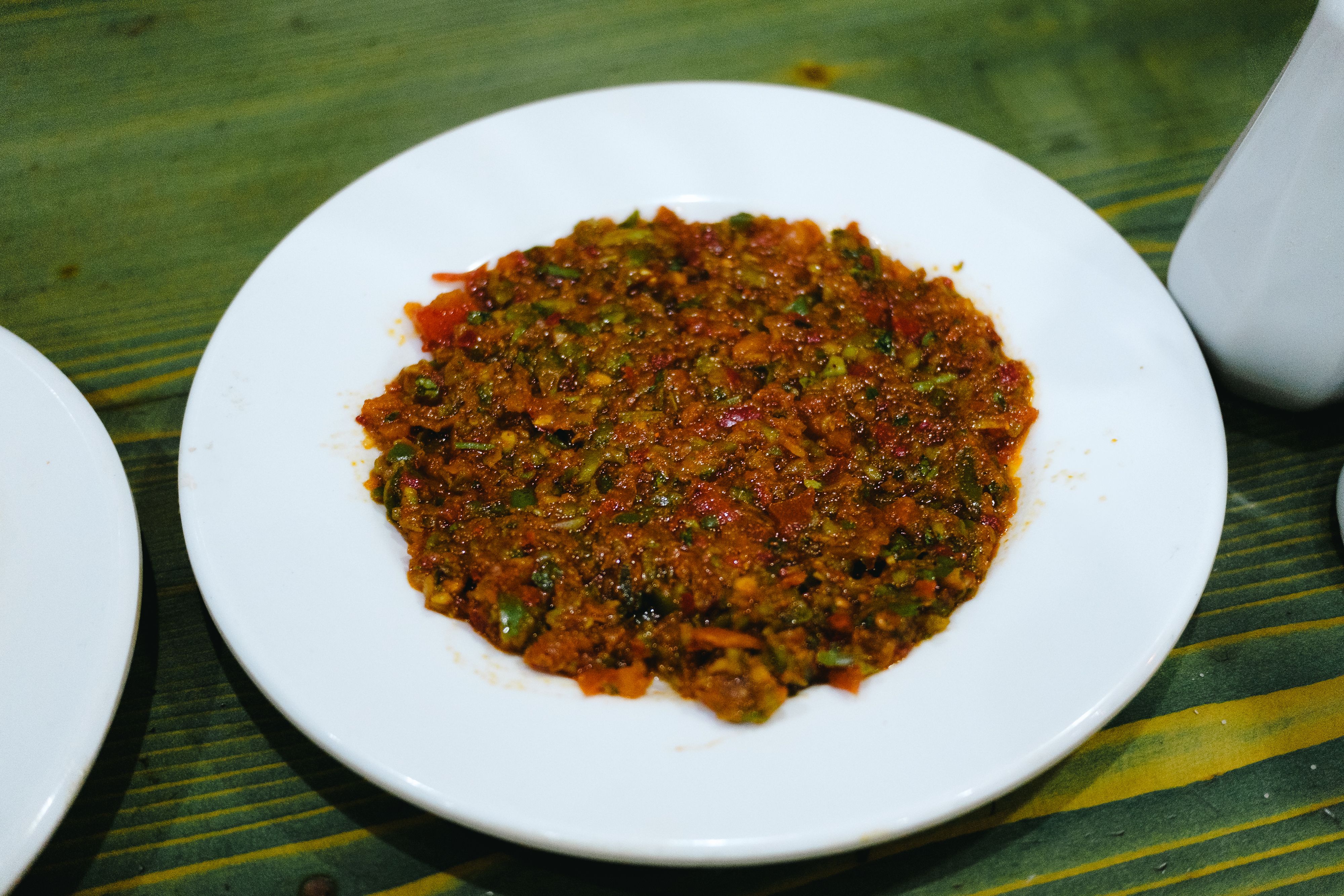
Photo: Markus Winkler / Pexels
The diets react (see scores below)
Common Ingredients
- dried red chiles
- garlic
- caraway
- coriander
- cumin
- olive oil
- salt
Specific recipes may vary.
Incompatible with 4 of 11 diets
Diet Ratings
Harissa is a chili-based condiment made from dried red chiles, garlic, spices, and olive oil. The primary concern for keto is the dried red chiles, which are more carb-concentrated than fresh peppers — roughly 4-6g net carbs per tablespoon depending on preparation. Used as a condiment in small amounts (1 tsp to 1 tbsp), harissa can fit within a keto framework, but liberal use or larger portions could meaningfully contribute to daily carb limits. The olive oil base is a keto positive, and the spices add negligible carbs. Garlic adds a small carb load but is minimal at condiment quantities. Most keto practitioners allow harissa in controlled portions as a flavor enhancer.
Some strict keto practitioners flag harissa due to the cumulative carb load of dried chiles and garlic, arguing that concentrated chile pastes are easy to over-consume and that even small daily additions can erode carb budgets, particularly for those targeting the lower 20g net carb threshold.
Harissa is a traditional Tunisian chili paste made entirely from plant-based ingredients: dried red chiles, garlic, caraway, coriander, cumin, olive oil, and salt. Every component is a whole food of plant origin with no animal products or animal-derived ingredients whatsoever. It is also minimally processed — essentially ground and blended whole spices and peppers — which aligns well with whole-food plant-based principles. This is a straightforward, unambiguous vegan approval.
Harissa is disqualified primarily by two ingredients: salt and olive oil aside, the central problem is added salt, which is explicitly excluded from the paleo framework as a processed/refined additive. Beyond that, while dried red chiles, garlic, caraway, coriander, cumin, and olive oil are all individually paleo-compliant, the inclusion of added salt pushes this condiment into avoid territory. The spice blend itself is exemplary paleo — all whole, unprocessed herbs and spices available to pre-agricultural humans — and olive oil is a preferred paleo fat. However, salt as a deliberate additive is considered a non-paleo ingredient by mainstream paleo authorities including Loren Cordain, who argues Paleolithic humans obtained sodium naturally from whole foods rather than extracted mineral salt. The overall dish cannot be approved when a core ingredient violates paleo rules.
Harissa is a quintessential North African/Mediterranean condiment that aligns excellently with Mediterranean diet principles. It is made entirely from whole, minimally processed plant-based ingredients: dried red chiles, garlic, and aromatic spices, all bound together with extra virgin olive oil. There are no refined grains, added sugars, or unhealthy fats. Garlic is a celebrated Mediterranean staple with well-documented health benefits, and the spices (caraway, coriander, cumin) contribute antioxidants and anti-inflammatory compounds. Extra virgin olive oil as the fat base is the canonical Mediterranean fat. Harissa is a traditional Tunisian condiment with deep roots in Mediterranean culinary culture, used to enhance vegetables, legumes, fish, and grain dishes — all core Mediterranean diet foods.
Harissa is a 100% plant-based condiment with zero animal-derived ingredients. Every component — dried red chiles, garlic, caraway, coriander, cumin, and olive oil — is explicitly excluded from the carnivore diet. Chiles and garlic are plant foods, the three spices are seeds/fruits of plants, and olive oil is a plant-derived oil. Salt is the only carnivore-compatible ingredient. There is no ambiguity here under any tier of carnivore eating, including the most lenient 'animal-based' approaches.
Harissa in this homemade form contains only dried red chiles, garlic, caraway, coriander, cumin, olive oil, and salt — all of which are explicitly permitted on the Whole30. Chiles are vegetables, garlic is a vegetable, all the spices are natural and allowed, olive oil is a compliant natural fat, and salt is explicitly permitted. There are no excluded ingredients whatsoever. This is a straightforward, whole-food condiment with no added sugar, no grains, no legumes, no dairy, and no disallowed additives.
Harissa contains garlic as a primary ingredient, which is one of the highest-FODMAP foods tested by Monash University due to its very high fructan content. Even small amounts of garlic (a fraction of a clove) push a dish into high-FODMAP territory. While the other ingredients — dried red chiles, caraway, coriander, cumin, olive oil, and salt — are generally low-FODMAP (spices like caraway, coriander, and cumin are low-FODMAP at typical serving sizes, and olive oil contains no FODMAPs), the garlic content makes traditional harissa unsuitable during the elimination phase. Dried chiles can also be a minor concern at very large quantities but are generally fine in condiment amounts. The disqualifying factor here is unambiguously the garlic.
Harissa is a North African chili paste with generally DASH-compatible ingredients — dried red chiles, garlic, and spices (caraway, coriander, cumin) are all encouraged on DASH. Olive oil is a heart-healthy unsaturated fat aligned with DASH principles. The primary concern is sodium: commercial and homemade harissa typically contains significant added salt, and as a condiment it is often used in concentrated amounts. A tablespoon of store-bought harissa can contain 100–300mg sodium, and liberal use can contribute meaningfully to daily sodium limits. As a condiment used in small quantities with attention to sodium, it is acceptable on DASH; the base ingredients are otherwise nutritionally favorable. The most common commercial form warrants caution due to sodium, whereas a low-sodium homemade version with minimal salt could approach approval.
NIH DASH guidelines do not specifically address harissa, but emphasize limiting sodium from all sources including condiments. Some DASH-oriented dietitians note that when used as a flavor-enhancer in small amounts, the sodium impact is minimal and the capsaicin, garlic, and spice profile may offer cardiovascular benefits — in this interpretation, homemade low-salt harissa would be fully compatible with DASH goals.
Harissa is an excellent Zone-compatible condiment. Its primary ingredients — dried red chiles, garlic, anti-inflammatory spices (caraway, coriander, cumin), and olive oil — align well with Zone Diet principles. The olive oil provides monounsaturated fat, which is the preferred fat source in the Zone. The spices and chiles contribute polyphenols and anti-inflammatory compounds that Sears emphasizes heavily in his later work. As a condiment, harissa is used in small quantities, so its carbohydrate contribution from the chiles is minimal and low-glycemic. Garlic is a Zone-favorable food with polyphenol benefits. There are no high-glycemic ingredients, no refined sugars, no trans fats, and no problematic omega-6 seed oils. It functions as a flavor enhancer that adds essentially no glycemic load while delivering monounsaturated fat and anti-inflammatory phytonutrients. This is the type of condiment that can make Zone meals more palatable and nutritionally dense without disrupting macronutrient ratios.
Harissa is an excellent example of an anti-inflammatory condiment. Its core ingredients are almost universally praised in anti-inflammatory nutrition: dried red chiles provide capsaicin, which has well-documented anti-inflammatory and analgesic properties and has been shown to reduce NF-κB signaling; garlic contains allicin and organosulfur compounds that suppress pro-inflammatory cytokines including TNF-α and IL-6; cumin, coriander, and caraway are all spices rich in antioxidant phenolic compounds; and olive oil delivers oleocanthal, a natural COX inhibitor functionally similar to ibuprofen at the molecular level. There are no processed additives, refined sugars, or inflammatory seed oils. As a condiment used in small quantities, any concerns about nightshade-related lectins or solanine in the chiles are minimal. This is a whole-food, herb-and-spice-forward preparation with no significant pro-inflammatory components.
The primary point of debate is the nightshade classification of chiles. Mainstream anti-inflammatory authorities including Dr. Weil consider nightshade vegetables (peppers, tomatoes) beneficial due to their antioxidant content. However, Autoimmune Protocol (AIP) practitioners and researchers like Dr. Tom O'Bryan argue that solanine and capsaicin can aggravate intestinal permeability and trigger flares in individuals with autoimmune conditions — in that context, harissa would be excluded entirely. For the general population, this concern is not broadly supported.
Harissa is a concentrated chili paste built around dried red chiles, making it an intensely spicy condiment. For GLP-1 patients, very spicy foods are a known trigger for worsened nausea, acid reflux, and GI irritation — side effects that are already elevated due to slowed gastric emptying. While harissa does contain beneficial ingredients (olive oil for unsaturated fat, garlic, anti-inflammatory spices like cumin, coriander, and caraway), the dominant factor is the high capsaicin load from the chile base. Used in even small amounts, it can provoke significant GI distress in patients whose gastric motility is already compromised. It provides no protein, negligible fiber in typical condiment-sized servings, and its only nutritional upside (spices, trace olive oil) can be obtained through non-irritating alternatives. As a condiment it is portion-sensitive, but the very property that defines it — intense heat — is what makes it problematic regardless of serving size.
Some GLP-1-experienced dietitians note that highly spice-tolerant individuals may use harissa in very small amounts (a half-teaspoon as a flavor accent rather than a sauce base) without triggering symptoms, and that capsaicin has been studied for mild appetite-suppressing and metabolic effects. However, the majority of GLP-1 clinical nutrition guidance explicitly lists very spicy foods as a category to avoid due to reflux and nausea risk, particularly in the first months of treatment when GI side effects peak.
*See how scores were generated at our methodology page.
Nutritional profile
Six traits that cut across every diet.
Fiber & Plants
How much whole-plant food and fiber it delivers.
Healthy Fats
The quality of its fats (unsaturated, omega-3).
Whole / Unprocessed
How close it is to its natural, unprocessed form.
Gut Gentle
How easy it is on digestion (low FODMAP, few irritants).
Low Glycemic
How little it spikes your blood sugar.
Protein Density
How much protein it packs per calorie.
Controversy Index
Higher controversy = more disagreement between diets.
Diet-Specific Tips
 Keto — 5/10
View tips
- Dried red chiles are carb-concentrated compared to fresh peppers — portion control critical
- Olive oil base is keto-favorable
- Garlic and spices contribute minimal but non-zero net carbs
- Typical condiment serving (1 tsp–1 tbsp) is manageable within keto limits
- No added sugars or grains in traditional preparation
- Liberal use could compromise daily carb budget
 Vegan — 9/10
View tips
- All ingredients are 100% plant-derived
- Whole-food, minimally processed preparation
- No animal-derived additives or hidden non-vegan ingredients
- Olive oil is uncontested in vegan diets
- Traditional recipe with no non-vegan variants in its standard form
 Mediterranean — 9/10
View tips
- Extra virgin olive oil as the primary fat — ideal Mediterranean fat source
- All ingredients are whole, minimally processed plant-based foods
- Garlic is a celebrated Mediterranean dietary staple
- Spices provide antioxidants and anti-inflammatory phytonutrients
- No added sugars, refined grains, or saturated fats
- Authentic Tunisian/North African Mediterranean culinary tradition
- Typically used as a condiment, so consumed in small quantities — sodium from salt is not a concern at normal serving sizes
 Whole30 — 9/10
View tips
- Dried red chiles are compliant whole vegetables
- Garlic, caraway, coriander, and cumin are all compliant spices/aromatics
- Olive oil is an explicitly approved natural fat
- Salt is explicitly allowed on Whole30
- No excluded ingredients present in this homemade preparation
- Commercial harissa may contain added sugar or other non-compliant additives — label reading required for store-bought versions
 DASH — 5/10
View tips
- Sodium content is the main concern — commercial harissa can be high in salt
- Olive oil is a DASH-approved unsaturated fat
- Dried chiles, garlic, and spices (caraway, coriander, cumin) are DASH-compatible flavor agents
- Used as a condiment in small quantities, overall sodium contribution may be manageable
- Low-sodium homemade version would score significantly higher (7–8)
- No saturated fat, no added sugar, no refined grains — ingredients are otherwise clean
 Zone — 8/10
View tips
- Olive oil is the primary fat source — ideal monounsaturated fat for Zone
- Dried chiles and garlic provide polyphenols supporting Zone's anti-inflammatory focus
- Used as a condiment in small quantities — negligible impact on macronutrient blocks
- No refined sugars, seed oils, or trans fats
- Spices (cumin, coriander, caraway) are Zone-neutral and anti-inflammatory
- Low glycemic load — chiles in condiment portions add minimal net carbs
- Enhances palatability of Zone meals without disrupting 40/30/30 ratios
 Anti-Inflammatory — 8/10
View tips
- Capsaicin from dried red chiles reduces NF-κB-mediated inflammatory signaling
- Garlic's organosulfur compounds (allicin) suppress pro-inflammatory cytokines IL-6 and TNF-α
- Olive oil provides oleocanthal, a natural COX-1/COX-2 inhibitor
- Cumin, coriander, and caraway contribute antioxidant phenolic compounds
- No refined sugars, seed oils, artificial additives, or trans fats
- Nightshade classification of chiles may be a concern for autoimmune-sensitive individuals under AIP protocols
- Used as a condiment in small quantities, limiting any potential downside from concentrated compounds