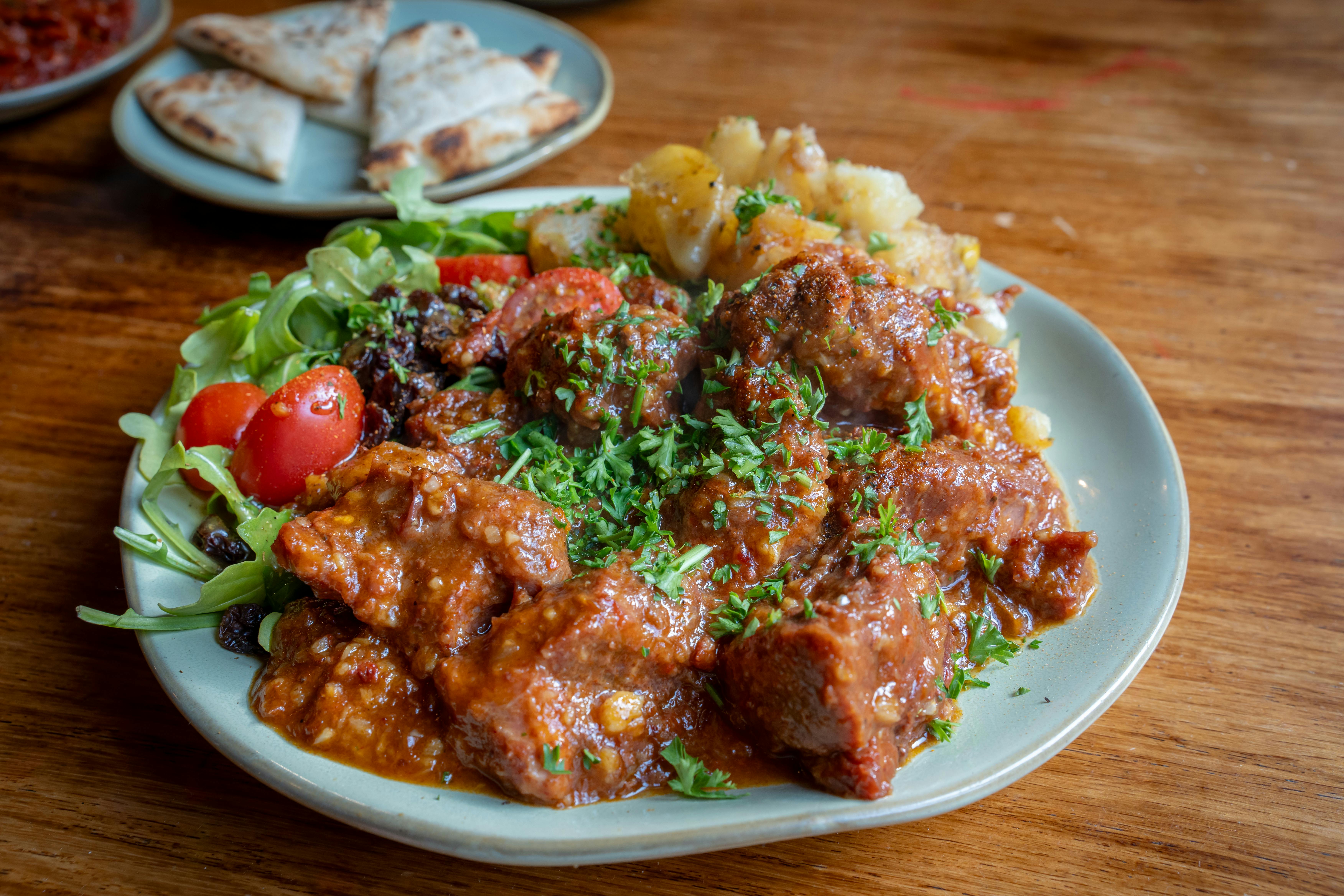
Photo: Connor Scott McManus / Pexels
The diets react (see scores below)
Common Ingredients
- beef liver
- cumin
- garlic
- tomato paste
- harissa
- olive oil
- bay leaf
Specific recipes may vary.
Incompatible with 5 of 11 diets
Diet Ratings
Kamounia is a Tunisian liver stew built around beef liver, cumin, garlic, tomato paste, harissa, and olive oil. Most ingredients are keto-friendly: olive oil is ideal, garlic and spices add negligible carbs, and harissa in typical amounts is low-carb. The main concerns are beef liver and tomato paste. Beef liver is nutritionally dense but contains roughly 4-5g net carbs per 100g serving — notably higher than muscle meats — due to its glycogen content. A standard 150-200g serving could contribute 6-10g net carbs from liver alone. Tomato paste is concentrated and adds another 3-5g net carbs per tablespoon used. Together, a standard serving of Kamounia may push 10-15g net carbs, which fits within a 20-50g daily budget but leaves limited room for other meals. It is consumable with portion control and is far from a high-carb dish, but it is not a freely eaten keto staple.
Some strict keto and carnivore-adjacent practitioners flag organ meats like liver for their glycogen-derived carb content and advise limiting portions to 100g or less per sitting. Conversely, many nutrient-dense keto advocates actively encourage liver as a weekly superfood, treating its modest carb load as negligible given its exceptional micronutrient profile.
Kamounia contains beef liver as its primary protein, which is an animal organ meat and therefore completely incompatible with a vegan diet. All other ingredients (cumin, garlic, tomato paste, harissa, olive oil, bay leaf) are plant-based, but the presence of beef liver is an absolute disqualifier. There is no vegan version of this dish in its traditional form.
Kamounia is a Tunisian beef liver stew that aligns well with paleo principles. Beef liver is a nutrient-dense organ meat highly prized in paleo circles. Cumin, garlic, bay leaf, and olive oil are all unprocessed, paleo-approved ingredients. The main concern is harissa and tomato paste: harissa is typically made from chili peppers, garlic, olive oil, and spices — all paleo-compliant — but commercial versions often contain added salt or preservatives. Similarly, commercial tomato paste frequently contains added salt. The dish scores well overall, but the processed/commercial forms of these condiments introduce a mild caution. Evaluated in its most traditional homemade form, this dish is solidly paleo-friendly.
Strict paleo adherents following Loren Cordain's original framework would flag commercial harissa and tomato paste for added salt and potential preservatives, which are explicitly excluded. Home-prepared versions of both ingredients would resolve this concern entirely.
Kamounia is a traditional Tunisian dish centered on beef liver, an organ meat that falls under the red meat category in Mediterranean diet guidelines. Red meat, including organ meats, is restricted to a few times per month at most. While beef liver is nutrient-dense (rich in iron, B12, and zinc), its high saturated fat content and classification as red meat place it firmly in the 'avoid' or 'limit heavily' category. The supporting ingredients — olive oil, garlic, cumin, harissa (chili-based), bay leaf, and tomato paste — are all Mediterranean-friendly, aromatic, and plant-based, which partially redeem the dish. However, the primary protein remains the determining factor, and beef liver cannot be considered a regular part of a Mediterranean dietary pattern.
Some Mediterranean diet scholars note that organ meats have deep roots in traditional North African and Southern European cuisines as nose-to-tail eating practices, consumed in small portions occasionally. A few modern practitioners argue that nutrient-dense organ meats in small, infrequent servings align better with traditional Mediterranean eating than modern ultra-processed alternatives, and should be evaluated differently from muscle red meat.
While beef liver is an excellent carnivore food — one of the most nutrient-dense animal products available — Kamounia is heavily plant-forward in its preparation. The dish contains cumin, garlic, tomato paste, harissa (a chili paste), olive oil, and bay leaf, all of which are plant-derived and strictly excluded on a carnivore diet. The tomato paste and harissa in particular contribute significant plant compounds, carbohydrates, and potential anti-nutrients. Olive oil is a plant-extracted oil, also excluded. The sheer volume and centrality of plant ingredients means this dish cannot be considered carnivore-compatible in any meaningful way — the liver is present, but it is cooked in and surrounded by avoided foods. No adaptation short of stripping the dish down to just the liver would make it carnivore-appropriate.
Kamounia is a Tunisian beef liver stew seasoned with cumin, garlic, tomato paste, harissa, olive oil, and bay leaf. All core ingredients are individually Whole30-compliant: organ meat (liver) is explicitly encouraged, cumin and garlic are allowed spices, olive oil is a compliant fat, bay leaf is a compliant herb, and tomato paste is generally compliant. The two ingredients warranting label-checking are harissa and tomato paste. Harissa pastes and canned tomato pastes can contain added sugar, sulfites (now allowed per 2024 rules), or other excluded ingredients depending on the brand. Homemade harissa with compliant ingredients (chili peppers, spices, olive oil, vinegar) is fine. As long as compliant versions of harissa and tomato paste are used, this dish is Whole30-approved. The caution rating reflects the need for careful label-reading on these processed condiments rather than any inherent non-compliance in the dish itself.
Official Whole30 guidelines allow harissa and tomato paste in principle, but the community notes that many commercial versions contain added sugar or non-compliant additives, making label verification essential. Some practitioners advocate making harissa from scratch to eliminate any ambiguity.
Kamounia contains two high-FODMAP ingredients that make it unsuitable during the elimination phase. Garlic is one of the highest-fructan foods tested by Monash University and must be avoided entirely during elimination — even small amounts are problematic. Harissa, a chili paste, typically contains garlic as a core ingredient, adding a second significant source of fructans. Tomato paste is also a concern, as it is a concentrated tomato product that becomes high-FODMAP at typical serving quantities (Monash rates it as high-FODMAP at 2 tablespoons/40g due to excess fructose). Beef liver itself is low-FODMAP, as is olive oil, cumin (at normal culinary amounts), and bay leaf. However, the combination of garlic and harissa makes this dish a clear avoid during the strict elimination phase regardless of portion size.
Kamounia features beef liver as its primary protein, which presents a mixed profile for DASH. On the positive side, beef liver is exceptionally rich in iron, B vitamins, and potassium, and the dish uses DASH-friendly ingredients like olive oil, garlic, and tomatoes. However, beef liver is high in dietary cholesterol and is categorized as red meat offal, which DASH generally limits. Harissa and tomato paste can contribute meaningful sodium depending on preparation and quantities used. Cumin and garlic are positive flavor-building spices that reduce reliance on salt. The dish is not fried and uses olive oil, which aligns with DASH's preference for vegetable oils. Overall, this is an organ meat dish with some redeeming nutritional qualities but notable concerns around cholesterol content and potential sodium load from harissa and tomato paste.
NIH DASH guidelines categorize red meat and organ meats as foods to limit due to saturated fat and cholesterol content. However, updated clinical interpretations note that beef liver's extraordinarily high micronutrient density (iron, B12, zinc, folate) and relatively modest saturated fat content compared to fatty cuts may make it acceptable occasionally within a DASH framework, particularly for individuals without hypercholesterolemia — some DASH-oriented dietitians permit organ meats in small portions given the 2020-2025 Dietary Guidelines' removal of the strict cholesterol cap.
Kamounia is a Tunisian braised beef liver dish flavored with cumin, garlic, tomato paste, harissa, olive oil, and bay leaf. From a Zone perspective, this dish has several strengths and one notable concern. Beef liver is a dense protein source, but it is classified as an 'unfavorable' Zone protein due to its high cholesterol content and relatively high fat content compared to lean proteins like skinless chicken or fish — though it is still usable in controlled portions. The fat profile of liver includes some saturated fat, which early Zone writings cautioned against. On the positive side, olive oil is an ideal Zone monounsaturated fat, and the aromatics (garlic, cumin, tomato paste, harissa) are low-glycemic, polyphenol-rich, and anti-inflammatory in nature — fully compatible with Zone principles. The dish lacks a meaningful carbohydrate block, meaning it would need to be paired with low-glycemic vegetables (e.g., a large salad or steamed greens) to achieve the 40/30/30 ratio. The harissa adds a favorable spice element (anti-inflammatory capsaicin), and cumin may offer modest metabolic benefits. Overall, this is a nutritionally dense dish that can fit into a Zone meal with portion control and proper carb pairing, but the liver protein source and saturated fat content prevent a full approval.
Some Zone practitioners and later Sears writings (particularly his post-2010 anti-inflammatory framework) are more accepting of organ meats like liver due to their extraordinarily high micronutrient density (vitamin A, B12, iron, zinc, CoQ10) and argue that the overall anti-inflammatory load of a meal matters more than avoiding cholesterol in food. Under this view, small portions of liver combined with olive oil and polyphenol-rich spices like cumin, garlic, and harissa could be seen as a more favorable Zone choice. Conversely, strict early Zone adherents would rank liver lower due to its 'unfavorable' protein classification and cholesterol load.
Kamounia is a Tunisian beef liver stew with a genuinely mixed anti-inflammatory profile. On the positive side, the dish is built around a powerful spice foundation: cumin has documented anti-inflammatory properties (antioxidant thymoquinone-related compounds), garlic contains allicin and quercetin with well-established anti-inflammatory effects, and harissa typically contains chili peppers rich in capsaicin, a potent inflammation modulator. Olive oil is a cornerstone anti-inflammatory fat (oleocanthal mimics ibuprofen's mechanism). Tomato paste is a concentrated source of lycopene, a carotenoid associated with reduced CRP. The spice-and-olive-oil base is strongly anti-inflammatory. However, beef liver is organ meat from red meat, placing it in the 'limit' category. While liver is extraordinarily nutrient-dense — exceptionally high in B12, iron, zinc, copper, vitamin A, and CoQ10 — it also contains significant arachidonic acid (a pro-inflammatory omega-6 precursor) and saturated fat. Some anti-inflammatory protocols flag organ meats similarly to red muscle meat, while others treat liver's micronutrient density as partially offsetting its fatty acid profile. The net result is a dish with a strong anti-inflammatory spice/fat base constrained by its organ-meat protein, landing firmly in the 'caution' zone. Appropriate occasionally rather than as a dietary staple.
Some anti-inflammatory nutrition researchers (including ancestral health advocates like Dr. Paul Saladino and Weston A. Price Foundation adherents) argue that organ meats like liver are among the most nutrient-dense foods available and that their anti-inflammatory micronutrient profile — particularly B vitamins, copper, and CoQ10 — outweighs arachidonic acid concerns. Conversely, mainstream anti-inflammatory frameworks (Dr. Weil's pyramid, IF Rating system) categorize red meat and organ meats as foods to limit due to saturated fat and arachidonic acid content, regardless of micronutrient density.
Kamounia is a Tunisian braised beef liver dish seasoned heavily with cumin, garlic, tomato paste, harissa, and olive oil. While beef liver is genuinely nutrient-dense — high in protein (~20-26g per 100g), iron, B12, and folate — it presents several compounding problems for GLP-1 patients. First, liver is high in cholesterol and moderately high in fat, which can worsen nausea and GI discomfort given slowed gastric emptying. Second, harissa is a concentrated chili paste that is very spicy, a known trigger for reflux, nausea, and upper GI irritation in GLP-1 patients whose gastric emptying is already delayed. Third, beef liver has a rich, intense flavor and dense texture that many patients on GLP-1s find difficult to tolerate even in small portions. The combination of organ meat density, high spice level, and moderate fat content creates a high risk of triggering or worsening GLP-1 side effects. The olive oil adds unsaturated fat which is acceptable in principle, but in a braised dish the total fat content per serving can be significant. The tomato paste, garlic, and cumin are nutritionally fine, but they do not offset the core concerns. This dish is not recommended for GLP-1 patients, particularly those in early treatment phases or experiencing active GI symptoms.
Some GLP-1-focused dietitians note that beef liver's exceptional micronutrient density — especially B12, iron, and folate, which can become depleted during calorie restriction — makes it worth considering in small, infrequent servings for patients who tolerate organ meats well. The disagreement centers on whether the spice level and fat content are disqualifying or manageable with portion control; individual tolerance to harissa and organ meats varies considerably across patients.
*See how scores were generated at our methodology page.
Nutritional profile
Six traits that cut across every diet.
Fiber & Plants
How much whole-plant food and fiber it delivers.
Healthy Fats
The quality of its fats (unsaturated, omega-3).
Whole / Unprocessed
How close it is to its natural, unprocessed form.
Gut Gentle
How easy it is on digestion (low FODMAP, few irritants).
Low Glycemic
How little it spikes your blood sugar.
Protein Density
How much protein it packs per calorie.
Controversy Index
Higher controversy = more disagreement between diets.
Diet-Specific Tips
 Keto — 5/10
View tips
- Beef liver contains ~4-5g net carbs per 100g due to stored glycogen — higher than muscle meat
- Tomato paste adds concentrated carbs (~3-5g net carbs per tablespoon)
- Olive oil base is ideal for keto macros
- Harissa and spices (cumin, garlic, bay leaf) are low-carb
- Standard serving may contribute 10-15g net carbs total — fits keto budget but requires tracking
- Liver is a keto-approved organ meat in moderate portions due to superior micronutrient density
 Paleo — 8/10
View tips
- Beef liver is an organ meat — highly approved in paleo as a nutrient-dense whole food
- Cumin, garlic, and bay leaf are natural herbs and spices — fully paleo-compliant
- Olive oil is a preferred paleo fat source
- Harissa in traditional homemade form (chilies, garlic, olive oil, spices) is paleo-compliant; commercial versions may contain added salt or additives
- Tomato paste is often commercially processed with added salt — homemade or no-salt-added versions preferred
- No grains, legumes, dairy, or seed oils present
 Whole30 — 6/10
View tips
- Beef liver is a Whole30-encouraged organ meat
- Cumin, garlic, olive oil, and bay leaf are all compliant
- Harissa requires label-checking — many commercial brands contain added sugar
- Tomato paste requires label-checking for added sugar or non-compliant additives
- Homemade versions of both harissa and tomato paste are fully compliant
- No grains, dairy, legumes, or other excluded categories present
 DASH — 4/10
View tips
- Beef liver is an organ meat/red meat, which DASH guidelines advise limiting
- High dietary cholesterol in beef liver raises concerns under traditional DASH interpretation
- Harissa and tomato paste add potentially significant sodium — low-sodium versions would improve the score
- Olive oil is a DASH-approved fat source
- Garlic, cumin, and bay leaf are sodium-free flavor enhancers compatible with DASH
- Beef liver provides exceptional micronutrients (iron, B12, potassium) aligned with DASH nutritional goals
- No added saturated fats beyond what is naturally present in liver; no full-fat dairy or tropical oils
 Zone — 5/10
View tips
- Beef liver is an 'unfavorable' Zone protein — higher cholesterol and saturated fat than lean protein sources like chicken or fish
- Olive oil is an ideal Zone monounsaturated fat and a core Zone building block
- Garlic, cumin, tomato paste, and harissa are low-glycemic, polyphenol-rich, and anti-inflammatory — fully Zone-compatible
- Dish is carbohydrate-deficient on its own and must be paired with low-glycemic vegetables to achieve 40/30/30 balance
- Liver's exceptional micronutrient density (B12, iron, vitamin A) is a nutritional positive not captured by Zone's block system
- Harissa contributes capsaicin, an anti-inflammatory compound aligned with Sears' later writings
- No high-glycemic carbs, refined sugars, or processed ingredients — the dish is whole-food based
 Anti-Inflammatory — 5/10
View tips
- Beef liver: organ meat high in arachidonic acid and saturated fat — anti-inflammatory frameworks recommend limiting red meat and organ meat
- Cumin: strong anti-inflammatory spice with antioxidant and anti-inflammatory phytochemicals
- Garlic: well-documented anti-inflammatory properties via allicin and quercetin
- Harissa (chili peppers): capsaicin is a potent anti-inflammatory compound
- Olive oil: oleocanthal-rich, a cornerstone anti-inflammatory fat
- Tomato paste: concentrated lycopene, a carotenoid linked to reduced inflammatory markers
- Bay leaf: contains linalool and other anti-inflammatory volatile compounds
- Net profile: powerful anti-inflammatory spice and fat base partially offset by pro-inflammatory organ meat protein source