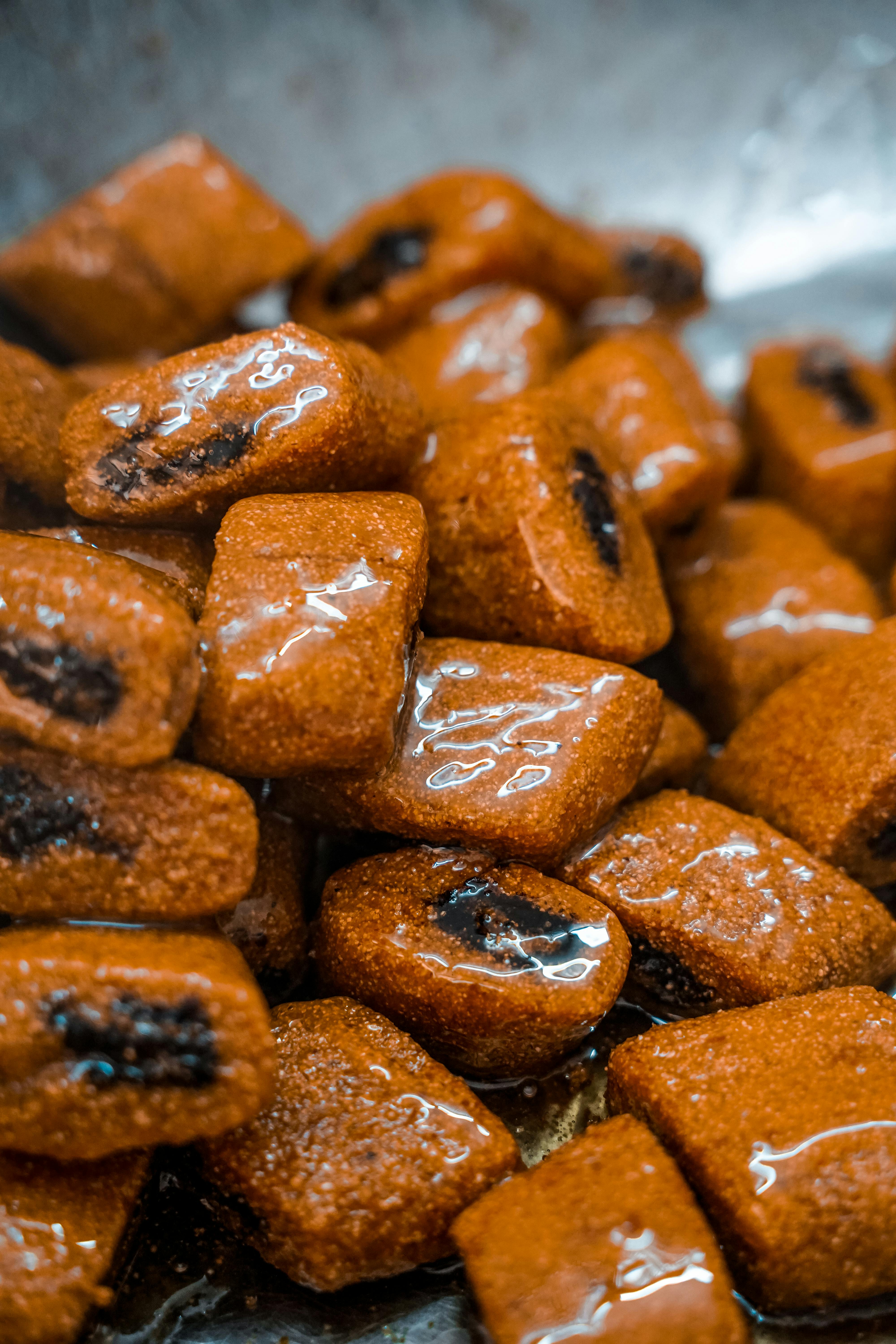
Photo: Louai Fatmi / Pexels
The diets react (see scores below)
Common Ingredients
- semolina
- dates
- honey
- olive oil
- orange blossom water
- cinnamon
- sesame seeds
Specific recipes may vary.
Incompatible with 7 of 11 diets
Diet Ratings
Makroudh is a traditional Tunisian semolina pastry filled with dates and drizzled with honey — a triple threat of keto-incompatible ingredients. Semolina is a refined grain with extremely high net carbs (~70g per 100g). Dates are one of the highest-sugar fruits (~63g sugar per 100g). Honey adds even more pure sugar. Together, a single piece of Makroudh could contain 40-60g of net carbs, instantly breaking ketosis on its own. The small amounts of olive oil, cinnamon, orange blossom water, and sesame seeds offer no meaningful mitigation. This dessert is fundamentally built around carbohydrate-dense and sugar-dense ingredients with no pathway to keto compatibility.
Makroudh is almost entirely plant-based: semolina, dates, olive oil, orange blossom water, cinnamon, and sesame seeds are all unambiguously vegan. The sole contested ingredient is honey, which most major vegan organizations (Vegan Society, PETA) exclude as an animal-derived product produced by bees. Because honey is a core ingredient in the traditional recipe rather than a trace additive, the dish cannot be rated 'approve' under mainstream vegan standards. However, a vegan version is easily achievable by substituting agave syrup or date syrup for honey, which would raise the score to 8-9. The remaining ingredients are whole or minimally processed plant foods, so no further concerns apply.
A minority of plant-based eaters argue that honey is an ethically acceptable plant-adjacent food because bees are not slaughtered in its production and their welfare is not meaningfully harmed by responsible beekeeping; from this perspective, Makroudh with honey would be fully acceptable.
Makroudh is fundamentally incompatible with the paleo diet. The primary ingredient, semolina, is a refined grain (durum wheat) — one of the clearest violations of paleo principles. Grains are categorically excluded from the paleo diet due to their anti-nutrient content (gluten, lectins, phytic acid) and their association with the agricultural revolution. The remaining ingredients are more paleo-friendly: dates and honey are natural sweeteners (caution-level), olive oil is approved, orange blossom water and cinnamon are acceptable, and sesame seeds are generally allowed. However, the foundational grain-based structure of this pastry makes it impossible to approve or even caution — the dish cannot exist without its core non-paleo ingredient.
Makroudh is a traditional Tunisian semolina pastry filled with dates, fried in oil, and soaked in honey. It contains several Mediterranean-friendly ingredients — olive oil, dates, sesame seeds, and aromatic spices like cinnamon and orange blossom water — but is problematic from a Mediterranean diet standpoint due to the use of refined semolina (not a whole grain), significant added honey (concentrated sugar), and the traditional deep-frying method. Dates provide natural sugars and fiber, and olive oil is the canonical Mediterranean fat, but the overall dish is high in sugar and refined carbohydrates, placing it in the 'treat' category rather than a daily staple. Enjoyed occasionally in small portions, it aligns with the Mediterranean tradition of simple, ingredient-honest sweets, but its sugar and refined grain content prevents a full approval.
Some Mediterranean diet scholars note that traditional North African sweets like Makroudh use whole-food ingredients without artificial additives, and that honey and dates have been consumed in the Mediterranean basin for millennia. From a traditional Tunisian and broader MENA Mediterranean perspective, occasional inclusion of such culturally significant pastries is consistent with the dietary pattern's emphasis on enjoyment and whole-food ingredients over strict macronutrient targets.
Makroudh is a traditional Tunisian pastry made entirely from plant-based ingredients. Every single component — semolina (grain), dates (fruit), honey (debated but plant-derived nectar), olive oil (plant oil), orange blossom water (plant extract), cinnamon (spice), and sesame seeds (seeds) — is excluded on a carnivore diet. There is no animal product whatsoever in this dish. Even the most permissive 'animal-based' carnivore frameworks would reject this as a primary food, as it is essentially a grain-and-sugar confection with zero animal content. This is about as far from carnivore-compatible as a food can get.
Makroudh contains multiple excluded ingredients that make it clearly non-compliant with Whole30. First, semolina is a wheat-based grain product, which is explicitly excluded from the Whole30 program. Second, honey is an added sugar and is explicitly excluded. Third, even if those two ingredients were removed, Makroudh is a fried pastry/cookie — a classic example of junk food recreation using otherwise-compliant ingredients, which violates Rule 4 of the program. The dates, olive oil, orange blossom water, cinnamon, and sesame seeds are all individually compliant, but the dish as a whole fails on multiple fronts.
Makroudh contains multiple high-FODMAP ingredients that make it problematic during the elimination phase. Semolina is made from durum wheat, which is high in fructans — a primary FODMAP concern. Dates are high in excess fructose and polyols (sorbitol) and are rated high-FODMAP by Monash at typical serving sizes (safe only at 1 Medjool date or ~3g dried dates per serve). Honey is high in excess fructose and is a clear avoid during elimination. The combination of wheat-based semolina, dates, and honey in a single pastry makes this dish essentially unavoidable as a FODMAP trigger, regardless of portion size. Olive oil, orange blossom water, cinnamon (small amounts), and sesame seeds are generally low-FODMAP and do not add concern.
Monash University rates individual dates and honey as high-FODMAP at standard servings, but some FODMAP practitioners acknowledge that very small portions of a dessert item might stay below threshold triggers — however, given the density of FODMAPs across three separate high-FODMAP ingredients (semolina, dates, honey), even a single piece of Makroudh would very likely exceed safe thresholds through stacking effects.
Makroudh is a Tunisian semolina pastry filled with dates and fried or baked, then soaked in honey. It contains several DASH-compatible ingredients: semolina (a whole-grain-adjacent grain, though refined), dates (rich in potassium and fiber), olive oil (heart-healthy unsaturated fat aligned with DASH), sesame seeds (magnesium and calcium source), and cinnamon. However, the dish is high in added sugar via honey and the concentrated natural sugars in dates, and when traditionally prepared is deep-fried in olive oil — significantly increasing caloric density and total fat. DASH limits sweets and added sugars, and the combination of honey plus dates makes this a high-sugar confection. Semolina is typically refined (not whole grain), which is less preferred under DASH. The overall nutritional profile — high sugar, high caloric density, minimal protein or fiber relative to sugar load — places this as an occasional treat rather than a DASH staple. Low sodium is a positive factor. A baked version with portion control is more acceptable than the traditional fried version.
NIH DASH guidelines broadly limit sweets and added sugars, categorizing honey-soaked pastries as foods to minimize. However, some updated DASH-aligned clinicians note that dates provide genuine potassium and fiber benefits, olive oil is explicitly encouraged, and a single small piece of a baked (not fried) Makroudh in the context of an otherwise DASH-compliant diet may be acceptable as a moderate sweet — aligning with the DASH allowance of 5 or fewer servings of sweets per week.
Makroudh is a traditional Tunisian pastry built almost entirely from high-glycemic, high-sugar ingredients that are fundamentally incompatible with Zone Diet principles. Semolina is a refined grain with a high glycemic index — one of the carbohydrate sources Dr. Sears explicitly discourages. Dates are among the highest-sugar fruits available, classified as 'unfavorable' carbs in Zone terminology due to their very high glycemic load and density. Honey is essentially pure sugar and is an 'avoid' carbohydrate in Zone. Together, semolina + dates + honey create a carbohydrate-dominant, high-glycemic payload with virtually no protein to balance the macro ratio. Olive oil is a Zone-favorable fat and sesame seeds offer modest monounsaturated fat with some protein, but these constitute a tiny fraction of the dish's calories and cannot salvage the macro imbalance. There is no lean protein component whatsoever. As a snack, a Zone snack should still hit roughly the 40/30/30 ratio in miniature — Makroudh would land closer to 70–80% carbohydrates, ~5–10% protein, and 10–20% fat, making it essentially impossible to incorporate as a Zone-compliant food without so radically reducing portion size that the 'dish' is no longer meaningful. This is one of the clearest 'avoid' cases in Zone assessment: a high-glycemic dessert pastry with no protein, primarily refined carbohydrates and simple sugars.
Makroudh is a traditional Tunisian semolina pastry filled with dates and fried or baked, then soaked in honey. The ingredient profile is genuinely mixed from an anti-inflammatory perspective. On the positive side: dates are rich in polyphenols and fiber; cinnamon is a well-documented anti-inflammatory spice; olive oil provides oleocanthal and monounsaturated fats; sesame seeds offer lignans and some omega-3 content; and orange blossom water contributes minor flavonoid compounds. However, the dish is high in refined carbohydrates (semolina is processed wheat with a high glycemic index), added sugars (both honey and dates contribute significant sugar load), and is traditionally deep-fried in oil — the frying process and high sugar content are meaningfully pro-inflammatory concerns. The honey, while marginally better than refined sugar due to trace antioxidants, still represents a concentrated sugar source. If baked rather than fried and consumed in small portions, the anti-inflammatory ingredients (olive oil, cinnamon, dates) provide real value, but the refined semolina and sugar load prevent this from being a net anti-inflammatory food. Best treated as an occasional treat rather than a dietary staple.
Some anti-inflammatory nutritionists would rate this more favorably if prepared baked with olive oil rather than fried, arguing that dates + cinnamon + olive oil together represent a genuinely anti-inflammatory core — Dr. Weil's framework emphasizes whole fruits and beneficial fats over strict sugar restriction. Conversely, stricter anti-inflammatory and low-glycemic protocols (such as those emphasizing glycemic load) would rate this closer to 'avoid' given the compounding effect of semolina, dates, and honey creating a high-sugar, high-GI load.
Makroudh is a traditional Tunisian semolina pastry filled with dates and sweetened with honey, then fried in oil. It is essentially the opposite of what GLP-1 patients need: negligible protein (no meaningful protein source listed), high sugar load from dates and honey, refined semolina as the primary carbohydrate, and typically deep-fried — a combination that worsens nausea, bloating, and reflux, which are already common GLP-1 side effects. The olive oil used in frying adds significant fat per serving. Dates and honey spike blood sugar rapidly with no protein or fiber buffer to slow absorption. Sesame seeds and cinnamon contribute minimal nutritional benefit at the quantities used. Orange blossom water is benign. The overall nutritional profile is high-calorie, high-sugar, high-fat, low-protein, and low-fiber per calorie — the worst possible pattern for a GLP-1 patient eating smaller portions where every calorie must deliver nutritional value.
*See how scores were generated at our methodology page.
Nutritional profile
Six traits that cut across every diet.
Fiber & Plants
How much whole-plant food and fiber it delivers.
Healthy Fats
The quality of its fats (unsaturated, omega-3).
Whole / Unprocessed
How close it is to its natural, unprocessed form.
Gut Gentle
How easy it is on digestion (low FODMAP, few irritants).
Low Glycemic
How little it spikes your blood sugar.
Protein Density
How much protein it packs per calorie.
Controversy Index
Higher controversy = more disagreement between diets.
Diet-Specific Tips
 Vegan — 5/10
View tips
- Honey is excluded by most vegan organizations (Vegan Society, PETA) as an animal-derived ingredient
- All other ingredients — semolina, dates, olive oil, orange blossom water, cinnamon, sesame seeds — are unambiguously plant-based
- Honey is a core ingredient, not a trace additive, so it materially affects the verdict
- An easy vegan substitution (agave or date syrup) exists to make the dish fully compliant
- No other animal-derived ingredients detected
 Mediterranean — 5/10
View tips
- Refined semolina rather than whole grain flour reduces nutritional quality
- High added sugar content from honey soaking is a concern
- Dates provide natural sweetness, fiber, and micronutrients
- Olive oil use aligns with Mediterranean fat principles
- Traditional frying method adds caloric density
- Sesame seeds and cinnamon are Mediterranean-approved ingredients
- Best consumed as an occasional treat, not a daily snack
 DASH — 4/10
View tips
- High added sugar from honey and concentrated date sugars exceeds DASH sweets guidelines
- Traditionally deep-fried, significantly increasing fat and calorie content
- Olive oil is DASH-compatible; baked preparation preferred over fried
- Dates contribute potassium and fiber, supporting DASH nutrient goals
- Semolina is typically refined grain, less preferred than whole grain under DASH
- Sesame seeds provide magnesium and calcium aligned with DASH micronutrient targets
- Very low sodium — a positive factor
- Best treated as an occasional small-portion treat within DASH's limited sweets allowance
 Anti-Inflammatory — 5/10
View tips
- Semolina is a refined carbohydrate with high glycemic index — pro-inflammatory at scale
- Dates provide polyphenols, fiber, and natural sweetness but also concentrated sugar
- Honey adds antioxidants but represents added sugar — pro-inflammatory in large amounts
- Cinnamon is a well-established anti-inflammatory spice
- Olive oil is a cornerstone anti-inflammatory fat (oleocanthal)
- Sesame seeds contribute lignans and beneficial fats
- Traditional frying method significantly increases pro-inflammatory potential
- Overall sugar load from dates + honey is the primary concern
- Baked version is substantially better than fried