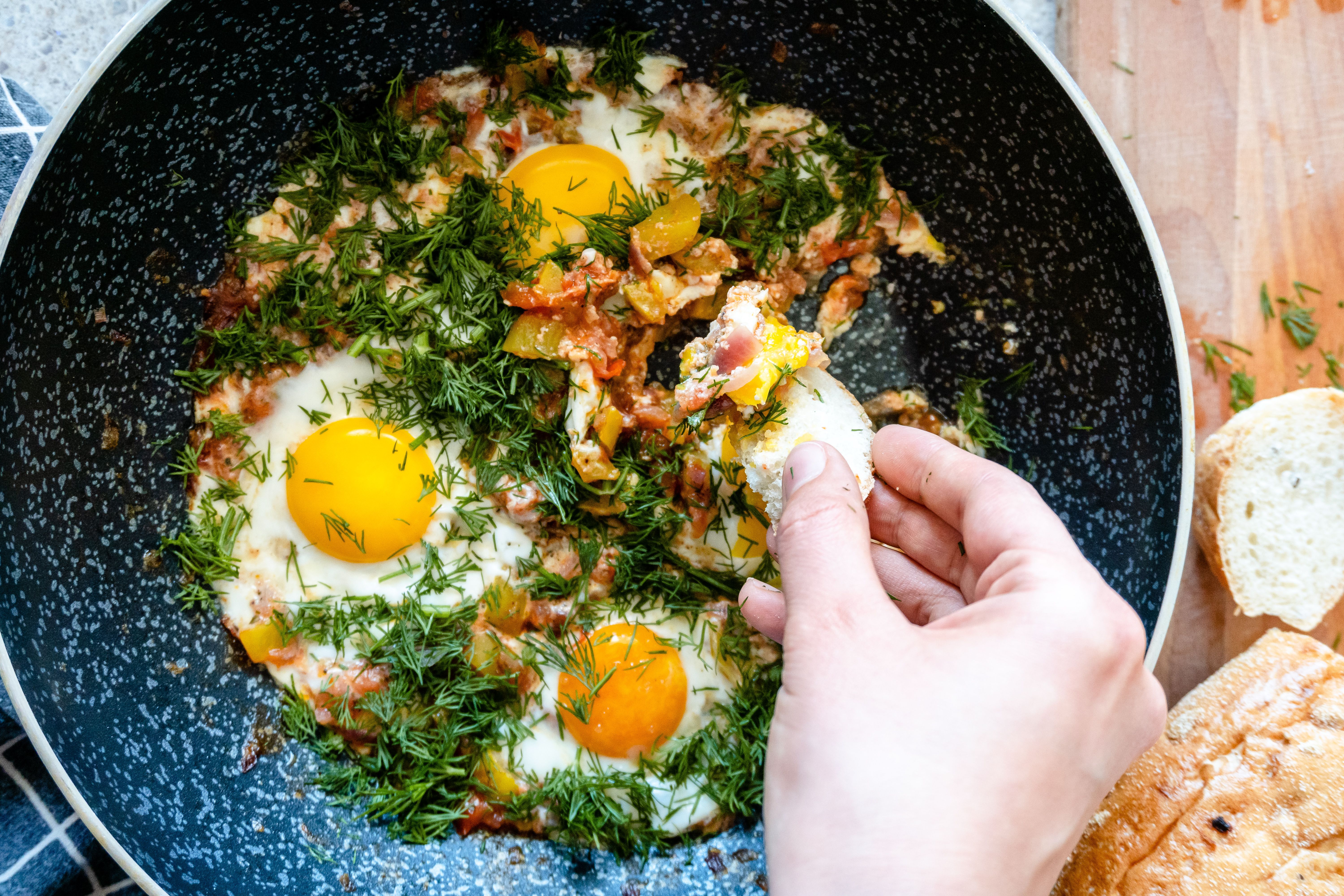
The diets react (see scores below)
Common Ingredients
- eggs
- tomato
- green peppers
- harissa
- garlic
- olive oil
- caraway
- merguez
Specific recipes may vary.
Incompatible with 3 of 11 diets
Diet Ratings
Ojja is a Tunisian egg-based dish with several keto-friendly elements: eggs and merguez sausage provide quality protein and fat, olive oil adds healthy fat, and spices like garlic, caraway, and harissa are low-carb in typical amounts. The main concern is tomatoes and green peppers, which add moderate net carbs (tomatoes ~3-4g net carbs per 100g, green peppers ~3g net carbs per 100g). A standard serving with 1-2 tomatoes and a couple of peppers could push net carbs to 10-15g, which is manageable within a daily keto budget but requires portion awareness. Harissa paste can also contain small amounts of added sugar depending on the brand. Merguez is generally keto-friendly but some commercial versions include fillers. Overall, a moderate-carb dish that fits keto with careful portioning but isn't a free-eat staple.
Stricter keto practitioners may flag this dish due to the cumulative carb load from tomatoes and peppers together, arguing that combined vegetable carbs can easily crowd out the daily 20g net carb limit, leaving no room for other vegetables throughout the day. They would recommend replacing tomatoes with lower-carb alternatives or drastically reducing quantity.
Ojja contains two animal-derived ingredients that disqualify it from a vegan diet: eggs (a direct animal product) and merguez (a spiced lamb or beef sausage, sometimes made with a blend of both). The base of tomato, green peppers, harissa, garlic, olive oil, and caraway is fully plant-based, but the protein components — eggs and merguez — are unambiguously non-vegan. There is no meaningful debate within the vegan community about either of these ingredients.
Ojja is a Tunisian egg dish that is largely paleo-compatible, but one key ingredient — merguez — introduces uncertainty. Eggs, tomato, green peppers, garlic, olive oil, and caraway are all clearly paleo-approved whole foods. Harissa is typically made from chili peppers, garlic, olive oil, and spices, which is paleo-friendly in its traditional form, though commercial versions may contain added salt or preservatives. The main concern is merguez: this North African sausage is a processed meat product that typically contains added salt and sometimes other curing agents or fillers depending on preparation. Even when made with paleo-compliant meats (lamb or beef) and spices, the processing and added salt place it in the 'avoid' or at best 'caution' category under strict paleo guidelines. If merguez is homemade with only meat and spices and no added salt or fillers, the dish would score higher, but the standard commercial product is processed enough to pull the overall rating down.
Some paleo practitioners, particularly those following a more pragmatic or ancestral health approach (such as Chris Kresser or the Primal Blueprint), argue that minimally processed sausages made from quality meats and whole spices are acceptable, especially when the only additive concern is salt — which many modern paleo frameworks no longer strictly exclude.
Ojja is a traditional Tunisian egg-based dish with a strong Mediterranean foundation: extra virgin olive oil as the cooking fat, tomatoes, green peppers, garlic, and aromatic spices like harissa and caraway are all plant-forward, Mediterranean-compatible ingredients. Eggs are an accepted moderate-consumption protein in the Mediterranean diet. However, the inclusion of merguez — a spiced lamb/beef sausage — introduces red meat and processed meat into the dish, which the Mediterranean diet recommends limiting to a few times per month. The merguez component is the primary concern, as processed/cured meats are considered one of the least compatible food categories. Without merguez, this dish would score solidly in the approve range.
In traditional North African and Tunisian Mediterranean cuisine, small amounts of merguez in a vegetable-and-egg-dominant dish like ojja are considered culturally authentic and acceptable, as the meat serves as a flavoring rather than a primary protein. Some Mediterranean diet researchers who incorporate regional Maghrebi traditions may view this as consistent with the diet's flexible, whole-food ethos when consumed occasionally.
Ojja is fundamentally incompatible with the carnivore diet. While it contains eggs and merguez (both animal-derived), the dish is built around a base of tomatoes, green peppers, harissa (a chili pepper paste), garlic, olive oil (plant oil), and caraway (a plant spice). The majority of ingredients and the structural foundation of the dish are plant-derived. Tomatoes, peppers, and harissa are all nightshades and plant foods explicitly excluded from carnivore. Olive oil is a plant-derived oil, and caraway is a plant spice. Even the most permissive carnivore practitioners who allow spices and coffee would not accept a dish where plant vegetables form the primary bulk of the meal. The egg and merguez components are entirely overwhelmed by plant ingredients.
Ojja is a Tunisian egg dish that is largely Whole30-compatible in its base form: eggs, tomato, green peppers, garlic, olive oil, and caraway are all fully compliant. Harissa is typically made from chili peppers, garlic, olive oil, and spices — compliant in its pure form — but many commercial harissa products contain added sugar or sulfites, requiring careful label-reading. The critical concern is merguez sausage. Merguez is a spiced lamb or beef sausage common in North African cuisine, but virtually all commercial versions contain added sugars, preservatives, and potentially non-compliant fillers or binders. A homemade or carefully sourced sugar-free, additive-free merguez could be compliant, but as merguez commonly exists in stores, it likely contains excluded ingredients. The dish earns a 'caution' rather than 'avoid' because the base dish without merguez (or with a verified-compliant version) is fully approvable, and compliant versions of all components do exist.
Some Whole30 practitioners would rate this 'avoid' outright given that commercial merguez almost universally contains added sugar and non-compliant additives, making a truly compliant version of this dish as commonly prepared unlikely. Official Whole30 guidance emphasizes that processed sausages require thorough label scrutiny and are a frequent hidden source of non-compliant ingredients.
Ojja contains multiple high-FODMAP ingredients that make it unsuitable during the elimination phase. Garlic is one of the highest-FODMAP foods tested by Monash University, rich in fructans, and even small amounts cooked into a dish are problematic. Harissa, a chili paste central to this dish, almost universally contains garlic as a primary ingredient, compounding the fructan load significantly. Merguez sausage is another major concern — traditional merguez is heavily spiced with garlic and onion, both high-FODMAP fructan sources. Green peppers are low-FODMAP in moderate servings, eggs are low-FODMAP, olive oil is low-FODMAP, tomatoes are low-FODMAP in standard servings, and caraway is used in small spice quantities making it generally acceptable. However, the combination of garlic (direct), garlic in harissa, and garlic/onion in merguez creates a cumulative fructan burden that firmly places this dish in the avoid category. There is no realistic way to prepare traditional Ojja without triggering high-FODMAP status unless the recipe is substantially modified (garlic-infused oil instead of garlic, harissa reformulated without garlic, and merguez replaced or omitted).
Ojja contains a mix of DASH-friendly and DASH-problematic ingredients. On the positive side, tomatoes, green peppers, garlic, and olive oil are excellent DASH foods — rich in potassium, fiber, and heart-healthy monounsaturated fats. Eggs are acceptable in moderation under most current DASH interpretations. However, two ingredients significantly limit this dish's DASH compatibility: (1) Merguez is a highly processed, fatty lamb/beef sausage with high sodium content (typically 600-900mg per 100g) and significant saturated fat — exactly the type of red/processed meat DASH advises limiting. (2) Harissa, while made from peppers and spices, is typically quite high in sodium in its commercial form. Together, the merguez and harissa can push this dish well above DASH sodium targets for a single meal. The dish could be made substantially more DASH-compatible by omitting or reducing merguez and using homemade or low-sodium harissa.
NIH DASH guidelines explicitly limit processed red meats like merguez due to saturated fat and sodium content. However, some updated DASH-aligned clinicians note that eggs are now more accepted (the 2020-2025 Dietary Guidelines removed the cholesterol cap), and that a small amount of merguez for flavoring rather than as the primary protein, combined with abundant vegetables, could fit within a broader DASH-consistent dietary pattern if overall daily sodium remains controlled.
Ojja is a Tunisian egg-based dish (similar to shakshuka) combining eggs simmered in a spiced tomato-pepper sauce with olive oil, garlic, harissa, and merguez sausage. From a Zone perspective, this dish has both favorable and problematic elements. On the positive side: eggs provide moderate lean protein (though whole eggs include saturated fat from yolks), tomatoes and green peppers are favorable low-glycemic carbohydrates, olive oil is the ideal Zone fat source (monounsaturated), and garlic and caraway are anti-inflammatory polyphenol-rich spices. However, merguez is a fatty lamb/beef sausage with significant saturated fat content, which conflicts with Zone's preference for lean proteins and limited saturated fat. The protein ratio is also mixed — eggs plus merguez together likely push saturated fat above Zone-ideal levels. Harissa is fine (spice paste, negligible macros). The carbohydrate contribution from tomatoes and peppers is modest and low-glycemic, which is favorable, but the overall dish may be protein-heavy and fat-heavy relative to the carbohydrate portion, requiring added low-GI vegetables to hit 40/30/30. With portion adjustment (reducing merguez, adding more vegetables, using 2-3 whole eggs or supplementing with egg whites), Ojja can be shaped into a reasonable Zone meal, but as traditionally prepared it skews toward excess saturated fat.
A strict Zone practitioner following Sears' early writings (Enter the Zone) would likely rate this lower (score 4) due to the merguez sausage's saturated fat content, which Sears explicitly discouraged in favor of lean proteins. However, Sears' later anti-inflammatory framework acknowledges that the polyphenol-rich ingredients (harissa, tomatoes, peppers, garlic, olive oil) and the omega-3 contribution from eggs provide meaningful anti-inflammatory benefit, which could push this toward a more favorable assessment if merguez is minimized or omitted.
Ojja is a Tunisian egg-based stew with a notably mixed anti-inflammatory profile. On the positive side, olive oil is a cornerstone anti-inflammatory fat rich in oleocanthal; tomatoes provide lycopene and vitamin C; green peppers are rich in antioxidants including vitamin C and beta-carotene; garlic has well-documented anti-inflammatory properties (allicin); harissa combines chili peppers (capsaicin) with garlic and spices — all potent anti-inflammatory ingredients. Caraway seeds offer anti-inflammatory volatile oils and antioxidants. Eggs are debated but generally acceptable in moderation. The significant drag on this dish is merguez — a spiced lamb or beef sausage that is a processed red meat, high in saturated fat, and often containing preservatives. Merguez qualifies as a processed red meat, a category the anti-inflammatory framework recommends limiting or avoiding. It pulls what could have been a solid anti-inflammatory dish down to the caution zone. If prepared without merguez or with a modest amount, the dish would rate considerably higher (7-8). As typically prepared with merguez as a featured ingredient, the dish is mixed.
Some anti-inflammatory practitioners, particularly those following Dr. Weil's less restrictive approach, would note that if merguez is used in a small supporting quantity, the overall dish — dominated by vegetables, olive oil, eggs, and anti-inflammatory spices — could still trend net positive. Conversely, stricter protocols (e.g., autoimmune protocol) would flag eggs, nightshade vegetables (tomatoes, peppers), and processed red meat simultaneously, potentially rating this dish lower.
Ojja is a Tunisian egg-based dish with a tomato and pepper sauce that offers meaningful protein from eggs and beneficial nutrients from tomatoes and green peppers. However, the inclusion of merguez sausage significantly raises the saturated fat content, and harissa introduces significant spice that can worsen GLP-1 side effects such as reflux and nausea. The olive oil adds unsaturated fat, which is preferred but still contributes to overall fat load. Eggs are a strong GLP-1-friendly protein source, and the tomato-pepper base provides fiber, lycopene, and hydration. Caraway may actually be mildly beneficial for GI comfort. The dish is not inherently fried or ultra-processed, but merguez and harissa are meaningful concerns. A modified version without merguez and with reduced harissa would score considerably higher (7-8), but the traditional preparation as described lands in caution territory.
Some GLP-1-focused dietitians would rate this more favorably, arguing that eggs as the primary protein anchor the dish well and that spice tolerance is highly individual — patients who tolerate harissa without reflux gain anti-inflammatory benefits from capsaicin. Others would rate it more cautiously, emphasizing that merguez fat content and harissa-induced GI irritation are particularly problematic on GLP-1s, where gastric emptying is already slowed and the GI tract is more sensitive.
*See how scores were generated at our methodology page.
Nutritional profile
Six traits that cut across every diet.
Fiber & Plants
How much whole-plant food and fiber it delivers.
Healthy Fats
The quality of its fats (unsaturated, omega-3).
Whole / Unprocessed
How close it is to its natural, unprocessed form.
Gut Gentle
How easy it is on digestion (low FODMAP, few irritants).
Low Glycemic
How little it spikes your blood sugar.
Protein Density
How much protein it packs per calorie.
Controversy Index
Higher controversy = more disagreement between diets.
Diet-Specific Tips
 Keto — 5/10
View tips
- Eggs and merguez provide solid fat and protein foundation
- Tomatoes and green peppers add 10-15g net carbs per serving — portion control required
- Olive oil and spices (harissa, caraway, garlic) are keto-compatible
- Commercial harissa may contain added sugar — check labels
- Merguez can have grain-based fillers in some commercial varieties
- Dish is naturally grain-free and sugar-free in traditional form
 Paleo — 5/10
View tips
- Eggs: fully paleo-approved
- Tomato, green peppers, garlic: whole vegetables, fully approved
- Olive oil: approved paleo fat
- Caraway: whole spice, fully approved
- Harissa: paleo-compatible in traditional homemade form; commercial versions may contain added salt or preservatives
- Merguez: processed sausage with likely added salt and potential fillers — the primary concern dragging the score down
- Dish is otherwise a strong paleo candidate if merguez is replaced or made from scratch with clean ingredients
 Mediterranean — 5/10
View tips
- Eggs are a moderate-consumption protein, compatible but not a daily staple in strict Mediterranean guidelines
- Olive oil as primary fat is highly Mediterranean-compatible
- Tomatoes, green peppers, and garlic provide strong plant-based foundation
- Harissa and caraway are traditional North African spices with no dietary concern
- Merguez is a processed red meat sausage, which the Mediterranean diet limits significantly
- Overall dish is vegetable-rich but the merguez inclusion lowers the score
 Whole30 — 5/10
View tips
- Eggs, tomato, green peppers, garlic, olive oil, and caraway are all fully Whole30-compliant
- Merguez sausage commonly contains added sugar and non-compliant additives — label verification or homemade is essential
- Commercial harissa may contain added sugar or other excluded ingredients — a compliant version must be used
- The base egg-and-vegetable dish is compliant; the sausage addition introduces significant compliance risk
- Homemade merguez with compliant spices and no fillers or sugar would make this dish approvable
 DASH — 4/10
View tips
- Merguez sausage is high in sodium and saturated fat — a processed red meat DASH recommends limiting
- Harissa (commercial) adds significant sodium, potentially pushing meal above DASH single-meal sodium targets
- Tomatoes, green peppers, and garlic are excellent DASH-aligned vegetables rich in potassium and fiber
- Olive oil is the recommended fat in DASH guidelines
- Eggs are acceptable in moderation under current DASH interpretations
- Caraway is a sodium-free spice with no DASH concerns
- Dish could score 7-8 if merguez is removed and low-sodium harissa is used
 Zone — 5/10
View tips
- Eggs provide moderate protein but whole eggs include saturated fat — egg whites or 2-egg-plus-whites ratio would be more Zone-optimal
- Merguez sausage is high in saturated fat, conflicting with Zone's lean protein preference — the primary Zone concern with this dish
- Tomatoes and green peppers are favorable low-glycemic Zone carbohydrates
- Olive oil is an ideal Zone fat (monounsaturated)
- Harissa, garlic, and caraway contribute anti-inflammatory polyphenols with negligible macronutrient impact
- Dish is carbohydrate-light as prepared — needs additional vegetables to achieve 40% carbohydrate ratio
- Portioning down merguez and boosting vegetable volume would significantly improve Zone compatibility
 Anti-Inflammatory — 5/10
View tips
- Olive oil: strong anti-inflammatory base fat (oleocanthal, polyphenols)
- Tomatoes and green peppers: antioxidant-rich nightshades (lycopene, vitamin C, beta-carotene)
- Garlic: well-documented anti-inflammatory allicin content
- Harissa and caraway: anti-inflammatory spice blend (capsaicin, antioxidants)
- Merguez (processed red meat): high saturated fat, likely preservatives — significant pro-inflammatory concern
- Eggs: moderately debated, acceptable in moderation for general population
- Dish is net caution due to merguez; core vegetable-spice base is strongly anti-inflammatory
 GLP-1 Friendly — 5/10
View tips
- Eggs provide good-quality complete protein with moderate fat — strong GLP-1 protein source
- Merguez sausage adds saturated fat and processed meat concerns, diluting protein quality per calorie
- Harissa is very spicy and likely to worsen reflux, nausea, or GI discomfort in GLP-1 patients
- Tomato and green pepper base adds fiber, hydration, and micronutrients — positive contribution
- Olive oil fat is unsaturated and preferred, but adds to overall fat load in a dish already containing eggs and merguez
- Caraway is a carminative spice that may mildly support GI comfort — minor positive
- Dish is not fried and is home-cooked style — easier to digest than fast food equivalents
- Portion sensitivity: a small serving with 1-2 eggs and minimal merguez improves the profile substantially