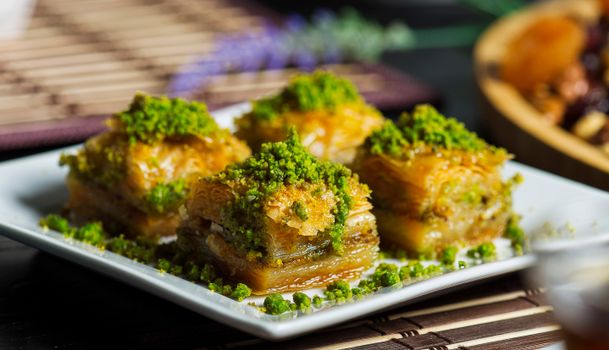
Photo: Jacob Yavin / Pexels
The diets react (see scores below)
Common Ingredients
- phyllo dough
- pistachios
- walnuts
- butter
- sugar
- water
- lemon juice
Specific recipes may vary.
Incompatible with 11 of 11 diets
Diet Ratings
Baklava is one of the most keto-incompatible foods imaginable. It is built on phyllo dough — a refined grain product delivering dense, rapid-digesting carbohydrates — and is drenched in a heavy sugar syrup made from sugar, water, and lemon juice. A single standard piece (roughly 30-40g) contains approximately 25-35g of net carbs, meaning even one piece can exceed an entire day's keto carb budget. The sugar syrup alone constitutes a massive glycemic spike. While pistachios and walnuts are individually keto-friendly, their contribution is completely overwhelmed by the phyllo dough and sugar syrup. There is no realistic portion size that makes baklava compatible with ketosis.
This baklava recipe contains butter, which is a dairy product derived from animal milk. Butter is a clear animal-derived ingredient and is firmly excluded under all vegan frameworks. The remaining ingredients — phyllo dough, pistachios, walnuts, sugar, water, and lemon juice — are plant-based. However, the butter alone disqualifies this dish. Note that vegan baklava can easily be made by substituting butter with a plant-based alternative such as vegan margarine or coconut oil, which is common in vegan adaptations of this dish.
Baklava is fundamentally incompatible with the Paleo diet. The dish is built on phyllo dough, which is made from refined wheat flour — a grain that is categorically excluded from Paleo. Refined sugar is added both within the layers and in the syrup, which is another hard exclusion. Butter is a dairy product, also excluded under strict Paleo principles. While pistachios and walnuts are fully Paleo-approved, and lemon juice and water are neutral, the non-compliant ingredients (phyllo dough, refined sugar, butter) are structural and foundational to the dish — not incidental or minor. There is no version of baklava that removes these elements and remains recognizable as baklava. This is not a gray-area food; it is a grain-based, dairy-containing, refined-sugar-laden dessert with no realistic Paleo adaptation.
Baklava is a traditional Turkish and broader Eastern Mediterranean sweet, but it significantly contradicts core Mediterranean diet principles. It is made with refined phyllo dough (refined grain), large amounts of added sugar (syrup), and butter (saturated fat) rather than olive oil. While it contains beneficial nuts (pistachios and walnuts), these are heavily outweighed by the refined and high-sugar components. The Mediterranean diet discourages sweets and added sugars, recommending they be consumed only occasionally and in very small amounts. Baklava as a regular snack is incompatible with the dietary pattern.
Some Mediterranean diet scholars acknowledge that traditional sweets like baklava are part of the authentic cultural food heritage of Eastern Mediterranean regions (Turkey, Greece, Lebanon) and argue that enjoying them very occasionally in small portions — as they were historically consumed, at festivals or celebrations — is consistent with the spirit of the diet. The nuts provide real nutritional value, and moderate indulgence is preferable to ultra-processed modern alternatives.
Baklava is entirely incompatible with the carnivore diet. It is a plant-based pastry dessert containing phyllo dough (wheat flour), pistachios, walnuts, sugar, water, and lemon juice — all of which are explicitly excluded on carnivore. The only animal-derived ingredient is butter, which constitutes a minor portion of the dish. There is no meaningful animal protein or fat source here, and the dish is dominated by grains, nuts, and sugar — three of the most problematic categories on carnivore.
Baklava contains multiple Whole30-excluded ingredients: phyllo dough is a grain-based product (wheat flour), butter is excluded dairy, and sugar is a prohibited added sweetener. Even setting aside individual ingredients, baklava is a classic pastry/baked good that falls squarely into the 'no recreating baked goods/junk food' prohibition. There is no compliant version of this dish possible, as its very structure depends on excluded ingredients.
Baklava contains multiple high-FODMAP ingredients that make it problematic during the elimination phase. Phyllo dough is made from wheat flour, which is high in fructans — a primary FODMAP concern. Pistachios are high-FODMAP at standard serving sizes (Monash rates them as high-FODMAP at 28g/~30 pistachios due to fructans and GOS). Walnuts are low-FODMAP at small portions (10 walnut halves), but in baklava they are typically present in larger quantities. The sugar syrup (sugar, water, lemon juice) is low-FODMAP, and butter is low-FODMAP. However, the wheat-based phyllo dough alone is enough to make a standard serving of baklava high-FODMAP due to fructans, and the pistachio filling compounds this significantly. Even one or two pieces of baklava would likely exceed safe fructan thresholds from the phyllo dough alone, and the pistachio content adds GOS and additional fructans.
Monash University has not specifically tested baklava as a composite dish. Some FODMAP practitioners might argue that the thin layers of phyllo dough mean fructan content per piece is lower than a full slice of wheat bread, and that a single small piece might be tolerable — however, most clinical FODMAP dietitians would advise avoidance during strict elimination due to the combined fructan load from both phyllo and pistachios.
Baklava is a heavily sweetened dessert pastry that conflicts with DASH diet principles on multiple fronts. It is very high in added sugars (from the sugar syrup) and saturated fat (from generous amounts of butter used between phyllo layers), both of which DASH explicitly limits. While pistachios and walnuts are DASH-friendly nuts in their natural form, the overall nutritional profile of baklava is dominated by refined carbohydrates, added sugar, and saturated fat. DASH guidelines specifically advise limiting sweets and foods high in added sugars, and butter is a saturated fat source the diet discourages. A typical serving can contain 25-35g of sugar and significant saturated fat, making it incompatible with DASH eating patterns as a regular snack.
Baklava is one of the clearest 'avoid' cases in Zone Diet methodology. It is essentially a confection built around high-glycemic refined carbohydrates (phyllo dough, sugar syrup) with saturated fat (butter) and no lean protein whatsoever. The macronutrient profile is the near-opposite of the Zone 40/30/30 target: it is overwhelmingly carbohydrate and fat, with negligible protein. The carbohydrates are high-glycemic — refined white flour phyllo dough and sugar — exactly the type Sears categorizes as 'unfavorable' or outright problematic because they spike insulin rapidly. The fat is primarily saturated (butter), not the monounsaturated fat Zone favors (olive oil, avocado, almonds). While pistachios and walnuts do contribute some beneficial fats and a small amount of protein, they are present in quantities too small to rescue the overall macronutrient ratio. There is no realistic way to portion baklava into a Zone-compliant meal or snack without consuming a negligible amount that provides no satiety value. Even a single small piece (roughly 30g) delivers ~15g refined carbs, ~8g fat (mostly saturated), and only ~1-2g protein — hopelessly imbalanced. This is a treat that falls squarely into the category Zone reserves for foods that are genuinely hard to incorporate into any balanced block meal.
Baklava is a highly pro-inflammatory dessert by anti-inflammatory standards. The dish is dominated by refined phyllo dough (refined carbohydrates with negligible fiber), large amounts of added sugar in the syrup, and generous quantities of butter (saturated fat). While it does contain pistachios and walnuts — both genuinely anti-inflammatory foods rich in omega-3s, polyphenols, and healthy fats — these nuts are present in quantities that are overwhelmed by the inflammatory load of the surrounding ingredients. The syrup is essentially a concentrated sugar solution, and refined sugar is one of the primary drivers of inflammatory markers like CRP and IL-6. Butter adds saturated fat, which anti-inflammatory frameworks consistently recommend limiting. Refined white flour phyllo provides rapidly digested carbohydrates that spike blood glucose, another inflammatory trigger. The lemon juice is a minor positive. Occasional consumption as a true treat is unlikely to cause lasting harm for a healthy individual, but as a snack category item it represents a poor fit for anti-inflammatory eating patterns.
Baklava is a poor fit for GLP-1 patients on virtually every relevant dimension. It is extremely high in sugar (syrup-soaked layers of refined dough), high in saturated fat from generous amounts of butter, and made with refined phyllo dough that offers negligible fiber. It provides no meaningful protein. The combination of high fat and high sugar in a dense, syrup-saturated format is precisely what worsens GLP-1 side effects — nausea, bloating, and reflux — while contributing empty calories at a time when every bite must count nutritionally. The small portion size of a single piece does not rescue it, because even one piece delivers a concentrated hit of sugar and fat with almost no redeeming nutritional value. The nuts (pistachios, walnuts) do contain healthy unsaturated fats and trace protein, but they are present in quantities too small relative to butter and sugar to shift the overall profile meaningfully.
*See how scores were generated at our methodology page.
Nutritional profile
Six traits that cut across every diet.
Fiber & Plants
How much whole-plant food and fiber it delivers.
Healthy Fats
The quality of its fats (unsaturated, omega-3).
Whole / Unprocessed
How close it is to its natural, unprocessed form.
Gut Gentle
How easy it is on digestion (low FODMAP, few irritants).
Low Glycemic
How little it spikes your blood sugar.
Protein Density
How much protein it packs per calorie.
Controversy Index
Higher controversy = more disagreement between diets.