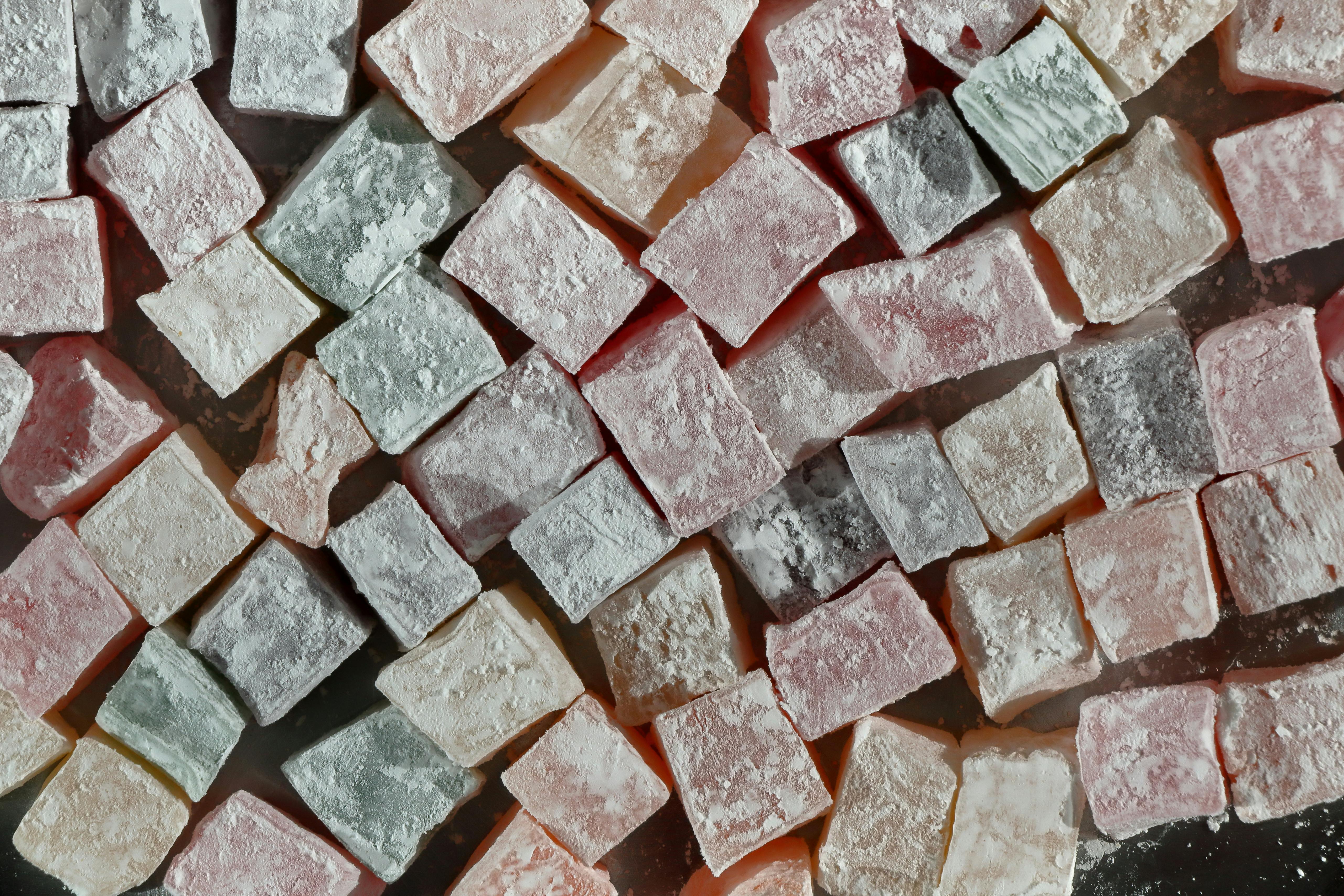
Photo: Mustafa Akın / Pexels
Turkish
Turkish Delight
The diets react (see scores below)
Common Ingredients
- cornstarch
- sugar
- water
- rose water
- powdered sugar
- pistachios
- lemon juice
Specific recipes may vary.
Incompatible with 9 of 11 diets
Diet Ratings
Turkish Delight is essentially pure sugar and cornstarch — two of the most keto-incompatible ingredients possible. A single piece contains roughly 20-25g of net carbs, which can single-handedly exceed the entire daily carb limit for strict keto. Sugar is the primary ingredient, providing zero nutritional benefit for keto practitioners, and cornstarch is a high-glycemic refined starch. The small amount of pistachios does not meaningfully alter the macronutrient profile. This confection would immediately spike blood glucose and disrupt ketosis entirely. There is no realistic portion size at which Turkish Delight becomes compatible with a ketogenic diet.
Turkish Delight as formulated here is entirely plant-based. The core ingredients — cornstarch, sugar, water, rose water, powdered sugar, pistachios, and lemon juice — are all derived from plants or are non-animal in origin. There are no dairy, egg, gelatin, or other animal-derived ingredients. Traditional Turkish Delight sometimes uses gelatin as a setting agent, but this version uses cornstarch instead, making it fully vegan-compliant. The sugar used is not specified as bone-char filtered, but the food itself as an ingredient is considered vegan. It is a moderately processed confection, which keeps the score from reaching the highest tier, but it contains no nutritionally void or heavily industrialized components — pistachios even add a whole-food element with healthy fats and protein.
Turkish Delight is fundamentally incompatible with the Paleo diet. The dish is built on cornstarch (a grain-derived processed starch) and refined sugar (powdered and granulated), both of which are explicitly excluded from Paleo eating. These two ingredients form the structural base of the confection, meaning there is no Paleo-compliant version of this dish as traditionally made. Rose water and lemon juice are innocuous, and pistachios are Paleo-approved, but they are minor components that cannot redeem a recipe whose foundation is anti-Paleo. This is a heavily processed confection with zero resemblance to anything a hunter-gatherer would have consumed.
Turkish Delight is essentially a confection made predominantly of refined sugar and cornstarch, with powdered sugar coating — a trifecta of added sugars and refined carbohydrates that directly contradicts Mediterranean diet principles. While pistachios are a Mediterranean-approved nut, they appear in small quantities and cannot offset the dominant sugar and starch base. The Mediterranean diet explicitly minimizes added sugars and highly processed sweets, reserving them for rare, occasional treats.
Traditional Mediterranean and Middle Eastern culinary heritage does include small amounts of sweets like Turkish Delight (lokum) as part of hospitality culture, and some Mediterranean diet authorities acknowledge that modest portions of traditional confections — particularly those containing nuts — are culturally acceptable on rare occasions rather than a strict prohibition.
Turkish Delight is entirely plant-derived and contains no animal products whatsoever. It is made from cornstarch (grain-derived starch), sugar (processed plant carbohydrate), rose water (plant extract), powdered sugar, pistachios (nuts), and lemon juice (fruit). Every single ingredient violates carnivore diet principles. It is essentially pure sugar and starch — the exact macronutrient profile the carnivore diet eliminates entirely. There is no debate within the carnivore community about this food; it is unequivocally incompatible.
Turkish Delight contains multiple excluded ingredients. Sugar (added sugar) is explicitly prohibited on Whole30, and cornstarch is also explicitly listed as an excluded ingredient. Powdered sugar is another form of added sugar. These are not edge cases or ambiguous items — they are clearly and directly excluded by the official Whole30 program rules. The dish is essentially a sugar-and-starch confection with no compliant pathway.
Turkish Delight is primarily made from cornstarch, sugar, water, and rose water — all of which are low-FODMAP ingredients. Lemon juice is low-FODMAP at standard amounts. However, pistachios are the key FODMAP concern: Monash University rates pistachios as high-FODMAP at servings above 15 nuts (approximately 15g) due to fructans and GOS. Traditional Turkish Delight with pistachios can contain a meaningful quantity of nuts per piece, and eating multiple pieces could push pistachio intake into high-FODMAP territory. Plain Turkish Delight without nuts would score higher (8-9), but the pistachio-studded version requires portion caution. Additionally, large total sugar loads are generally well-tolerated on low-FODMAP as sucrose is not a FODMAP, but some individuals with IBS may still react to high sugar intake.
Monash University approves pistachios at 15 nuts per serving, and a typical piece of Turkish Delight may contain only a few pistachios — making one or two pieces potentially safe. However, clinical FODMAP practitioners often advise caution with pistachio-containing foods during strict elimination because portion estimation is difficult and cumulative FODMAP load across a meal can tip the balance.
Turkish Delight is essentially a confection made almost entirely of sugar and cornstarch, with powdered sugar coating. Added sugar is one of the primary categories DASH explicitly limits. While the pistachios provide some beneficial nutrients (magnesium, healthy fats, protein), they are a minor ingredient that does not offset the overwhelming sugar content. The dish provides no meaningful potassium, calcium, magnesium, or fiber relative to its caloric load. NIH/NHLBI DASH guidelines explicitly advise limiting sweets and added sugars to 5 or fewer servings per week, and a serving of Turkish Delight would consume a significant portion of that weekly allowance in a single snack. There is no redeeming nutritional profile — no lean protein, no whole grains, no vegetables or fruits, and no low-fat dairy.
Turkish Delight is essentially pure sugar and cornstarch — two of the highest-glycemic, nutritionally empty carbohydrate sources possible. The primary ingredients are sugar and cornstarch, both of which Dr. Sears explicitly categorizes as unfavorable or outright disqualifying in Zone methodology. There is virtually no protein, no meaningful fat (the small amount of pistachios contributes negligibly), and no fiber to moderate the glycemic impact. This confection would spike insulin dramatically, directly opposing the Zone's core goal of controlling eicosanoid balance through insulin regulation. There is no practical way to incorporate Turkish Delight into a Zone-balanced meal or snack — it cannot be portioned down to a reasonable carb block without consuming a trivially small, unsatisfying amount, and it contributes nothing to protein or fat blocks. Even within the Zone's ratio-based flexibility, this food offers no pathway to a 40/30/30 balance as a snack component.
Turkish Delight is essentially a confection built on a foundation of refined sugar and cornstarch — two ingredients that are directly at odds with anti-inflammatory principles. Sugar is a primary driver of inflammatory signaling, elevating CRP and IL-6, promoting glycation end products (AGEs), and fueling oxidative stress. Cornstarch is a refined, high-glycemic carbohydrate with no fiber or micronutrient value. The powdered sugar coating adds further refined sugar load. Lemon juice and rose water contribute negligible anti-inflammatory benefit at the quantities used in flavoring. Pistachios are the one genuinely positive ingredient — they contain healthy monounsaturated fats, polyphenols, and fiber — but they appear in small amounts relative to the dominant sugar-starch matrix. As a snack, this offers very high glycemic impact with essentially no compensating anti-inflammatory nutrition. There is no meaningful ambiguity here: a candy composed primarily of sugar and refined starch is incompatible with anti-inflammatory eating principles.
Turkish Delight is essentially pure sugar and cornstarch with negligible protein, negligible fiber, and no meaningful micronutrients. The primary ingredients are sugar and refined starch — two of the clearest 'avoid' categories for GLP-1 patients. It delivers empty calories with no satiety value, no protein to protect muscle mass, and no fiber to support digestion or blood sugar stability. The high glycemic load from concentrated sugar and refined cornstarch is particularly counterproductive for GLP-1 patients, who are often managing insulin resistance or type 2 diabetes. The small amount of pistachios contributes trivially to protein and healthy fat but not enough to meaningfully change the nutritional profile. For patients eating significantly fewer calories overall, there is no room for foods that deliver calories without nutritional return.
*See how scores were generated at our methodology page.
Nutritional profile
Six traits that cut across every diet.
Fiber & Plants
How much whole-plant food and fiber it delivers.
Healthy Fats
The quality of its fats (unsaturated, omega-3).
Whole / Unprocessed
How close it is to its natural, unprocessed form.
Gut Gentle
How easy it is on digestion (low FODMAP, few irritants).
Low Glycemic
How little it spikes your blood sugar.
Protein Density
How much protein it packs per calorie.
Controversy Index
Higher controversy = more disagreement between diets.
Diet-Specific Tips
 Vegan — 6/10
View tips
- Cornstarch used as setting agent instead of gelatin — fully vegan
- All listed ingredients are plant-derived
- Pistachios add a whole-food nutritional element
- Traditional versions may contain gelatin, so this formulation is notably vegan-friendly
- Sugar source (bone-char processing) is not a concern at the ingredient level by mainstream vegan standards
 Low-FODMAP — 4/10
View tips
- Pistachios are high-FODMAP above 15 nuts due to fructans and GOS — a key risk ingredient
- Cornstarch, sugar, water, and rose water are all low-FODMAP
- Lemon juice is low-FODMAP at standard culinary amounts
- Powdered sugar is low-FODMAP (sucrose is not a FODMAP)
- FODMAP safety depends heavily on pistachio quantity per serving and number of pieces consumed
- Plain Turkish Delight (without nuts) would be considered low-FODMAP