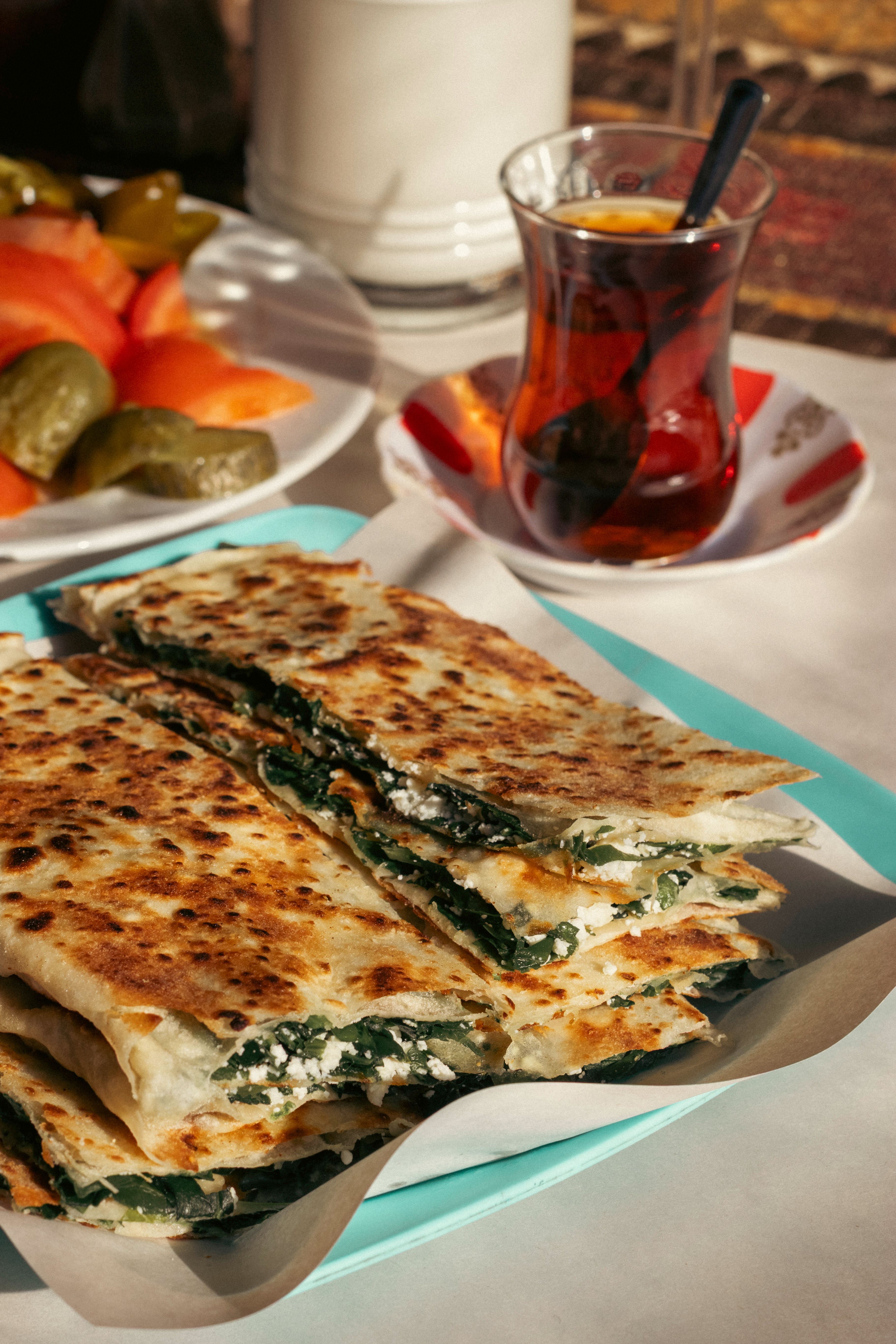
Photo: Efe Burak Baydar / Pexels
The diets react (see scores below)
Common Ingredients
- flour
- feta
- spinach
- parsley
- onion
- butter
- yogurt
- salt
Specific recipes may vary.
Incompatible with 6 of 11 diets
Diet Ratings
Gozleme is a Turkish flatbread dish where wheat flour dough forms the structural base, making it fundamentally incompatible with keto. A single gozleme typically uses 60-80g of wheat flour per piece, contributing roughly 40-55g of net carbs from the dough alone — far exceeding the entire daily keto carb budget in one serving. While the filling ingredients (feta, spinach, parsley, onion, butter, yogurt) are largely keto-friendly or borderline acceptable in moderate portions, the grain-based wrapper is a hard disqualifier. There is no meaningful way to consume traditional gozleme within ketogenic macros.
Gozleme as described contains multiple animal-derived ingredients that disqualify it from a vegan diet. Feta cheese is a dairy product made from sheep's or goat's milk, butter is an animal fat derived from dairy, and yogurt is a fermented dairy product. All three are clear violations of vegan dietary rules. The dish could theoretically be made vegan by substituting plant-based feta, vegan butter, and dairy-free yogurt, but the traditional recipe as presented is not vegan-compatible. The plant-based components — flour, spinach, parsley, onion, and salt — are fully vegan-compliant, but they cannot offset the presence of three distinct animal products.
Gozleme is fundamentally incompatible with the Paleo diet. The dish is built on a wheat flour flatbread (dough), which is a grain and one of the most clearly excluded foods in all paleo frameworks. Beyond the flour, feta cheese is a dairy product, yogurt is dairy, butter is dairy, and salt is an excluded additive — meaning four additional ingredients independently violate paleo principles. The only compliant ingredients are spinach, parsley, and onion. With the two core structural components (flour dough and dairy cheese) both being hard avoids, this dish cannot be modified into a paleo-compatible form without ceasing to be gozleme entirely.
Gozleme is a traditional Turkish flatbread filled with spinach, feta, parsley, and onion — several ingredients align well with Mediterranean principles (leafy greens, herbs, legume-adjacent vegetables, and feta as a traditional dairy). However, the dish uses refined white flour for the flatbread rather than whole grains, and butter as the cooking fat rather than extra virgin olive oil. Dairy (feta and yogurt) is acceptable in moderation. The spinach-and-herb filling is genuinely Mediterranean-friendly, but the refined flour base and butter push this away from core Mediterranean diet ideals. Overall, it is an acceptable occasional snack rather than a dietary staple.
Some Mediterranean diet practitioners — particularly those drawing on traditional Turkish and Eastern Mediterranean culinary heritage — would view gozleme more favorably, noting that feta, spinach, and yogurt are deeply traditional regional foods and that handmade flatbreads have a long place in these food cultures. Swapping butter for olive oil and using whole wheat flour would bring it closer to modern clinical guidelines.
Gozleme is fundamentally incompatible with the carnivore diet. The dish is built on a flour-based flatbread dough, which is a grain product and strictly excluded. The filling contains spinach, parsley, and onion — all plant foods that are completely off-limits. While feta cheese, butter, and yogurt are animal-derived dairy products, they are minor components surrounded by multiple plant-based ingredients that cannot be separated out. Even the most permissive 'animal-based' carnivore practitioners would reject this dish due to the grain base and multiple plant vegetables. There is no version of gozleme that can be made carnivore-compliant without fundamentally changing what the dish is.
Gozleme contains multiple Whole30-excluded ingredients. Flour (wheat grain) is explicitly excluded. Feta cheese and yogurt are dairy products, both explicitly excluded. Butter (regular, not ghee or clarified butter) is also excluded dairy. Even if those dairy items were substituted, the flour alone makes this dish non-compliant. Additionally, gozleme is a flatbread/wrap, which falls directly into the 'no recreating baked goods/junk food/wraps/tortillas' rule — even if made with compliant ingredients, this format is explicitly prohibited.
Gozleme contains multiple high-FODMAP ingredients that make it unsuitable during the elimination phase. The primary issue is wheat flour, which is high in fructans — a major FODMAP trigger. Onion is one of the highest-FODMAP foods tested by Monash University, rich in fructans, and problematic even in small quantities. Yogurt contains lactose (a disaccharide FODMAP), and feta cheese, while lower in lactose than many cheeses, still contributes some lactose load. Spinach is low-FODMAP at standard servings, parsley is low-FODMAP, butter is low-FODMAP (fat, negligible lactose), and salt is FODMAP-free — but the combination of wheat flour, onion, and yogurt creates a dish that is clearly high-FODMAP overall. There is no realistic modification that makes traditional gozleme low-FODMAP without substituting several core ingredients.
Gozleme presents a mixed DASH profile. The spinach, parsley, and onion filling are excellent DASH-aligned ingredients, rich in potassium, magnesium, and fiber. However, several components raise concerns. Feta cheese is high in sodium (around 316-400mg per ounce) and saturated fat, and a typical gozleme uses a meaningful quantity. Butter adds saturated fat, which DASH limits. The flour used is typically refined (not whole grain), missing the fiber benefit of whole grains. Yogurt is a positive DASH element if low-fat. Overall sodium content from feta and added salt is likely elevated, potentially pushing a single serving toward 600-900mg+ sodium. The dish is not inherently off-limits but requires significant portion control and ideally ingredient modification (reduced feta, no added salt, whole wheat flour, minimal butter) to fit within DASH guidelines comfortably.
NIH DASH guidelines explicitly limit sodium and saturated fat, making feta-heavy, butter-cooked flatbreads a borderline food. However, some DASH-oriented clinicians note that when the filling is predominantly spinach-based with modest feta and the dish is home-prepared with whole wheat flour and minimal butter, it can fit within DASH's overall dietary pattern — particularly for individuals targeting the 2,300mg (rather than 1,500mg) sodium limit.
Gozleme is a Turkish flatbread filled with cheese, vegetables, and herbs. From a Zone perspective, it presents a mixed picture. The filling has genuine Zone-friendly elements: spinach and parsley are excellent low-glycemic, polyphenol-rich carb sources; feta provides protein (though it's moderately high in saturated fat); and yogurt adds some lean protein value. However, the flatbread (refined flour dough) is the central problem — it's a high-glycemic carbohydrate that counts as an 'unfavorable' carb block and will spike insulin, disrupting the Zone's eicosanoid balance. Butter adds saturated fat rather than the preferred monounsaturated fat (olive oil). The overall macro ratio skews heavily toward carbohydrates from the flour wrap with insufficient lean protein relative to that carb load, and the fat profile leans saturated. With careful portioning (a smaller portion, emphasis on the filling over the dough, treating it as one zone block equivalent), gozleme could be incorporated into a Zone meal, but as typically prepared and served it falls short of Zone ideals. It is not an 'avoid' food — the vegetable-rich filling and moderate protein content keep it in caution territory.
Some Zone practitioners, particularly those following Sears' later, more flexible framework, might argue that if gozleme is made with a thin dough, the carb block from flour can be managed by keeping the portion small (half a gozleme) and pairing it with additional lean protein on the side. The spinach and onion filling does contribute favorable carbs and polyphenols. However, Sears' original 'Enter the Zone' and 'Mastering the Zone' clearly classify refined flour products as unfavorable carbohydrates that should be minimized, supporting the caution rating.
Gozleme is a Turkish flatbread dish with a mixed anti-inflammatory profile. On the positive side, spinach is an excellent source of antioxidants, vitamins K and C, and anti-inflammatory carotenoids (lutein, beta-carotene). Parsley contributes flavonoids (apigenin, luteolin) and vitamin C. Onion provides quercetin, a well-studied anti-inflammatory polyphenol. Yogurt (especially full-fat, traditional-style) contains probiotics that support gut health and may modulate inflammatory pathways. Feta is a lower-fat cheese compared to many alternatives, and sheep/goat-milk feta may have a marginally better fatty acid profile. However, the dish has several anti-inflammatory concerns: refined white flour (the standard gozleme base) provides little fiber and has a high glycemic load, contributing to post-meal glucose spikes associated with inflammatory signaling. Butter is a saturated fat source, flagged as 'limit' under anti-inflammatory guidelines. Feta, while moderate in fat, is high in sodium and contains saturated fat. The dish is cooked on a griddle with butter, adding additional saturated fat load. Overall, the anti-inflammatory positives of spinach, parsley, and onion are real but partially offset by the refined flour base and butter. This is a 'caution' food — acceptable occasionally, especially if whole wheat or spelt flour is substituted and butter is minimized.
Some anti-inflammatory practitioners, particularly those following Mediterranean-aligned frameworks (such as Dr. Weil's approach), would view gozleme more favorably given its vegetable-rich filling, fermented dairy component (yogurt), and traditional whole-food preparation without processed additives or industrial seed oils — placing it closer to the 'approve' threshold. Conversely, stricter anti-inflammatory protocols that emphasize low glycemic load and minimal saturated fat would push this dish toward a lower caution score, flagging the refined flour and butter as meaningful concerns.
Gozleme is a Turkish flatbread typically made with unleavened or yeasted dough (refined flour), filled with feta cheese, spinach, parsley, and onion, then cooked in butter. The spinach and parsley contribute useful fiber, micronutrients, and some plant-based protein, and feta provides moderate protein and flavor intensity in small amounts. However, the dish has several GLP-1 drawbacks: the base is a refined flour flatbread (low fiber, high glycemic, low nutrient density per calorie), feta is a relatively high-sodium, moderate-fat cheese with limited protein density compared to lean proteins, and butter used for cooking adds saturated fat that can worsen nausea and GI discomfort. Overall protein per serving is modest — likely 8–12g depending on portion — falling short of the 15–30g per meal target. Yogurt listed as an ingredient (likely a dough component or side) is a positive element if present. The dish is not fried and is relatively easy to digest compared to heavier pastries, which prevents a lower score. It is portion-sensitive: a small piece as a snack is more acceptable than a full serving as a meal.
Some GLP-1-focused dietitians accept gozleme in small portions as a palatable, vegetable-containing snack that supports adherence, particularly for patients from Turkish or Mediterranean backgrounds where food culture matters for long-term compliance. Others flag the refined flour base and butter cooking method as consistently problematic for patients experiencing nausea or blood sugar variability, recommending a whole-wheat version with a lean protein addition (e.g., egg or grilled chicken) to make it nutritionally adequate.
*See how scores were generated at our methodology page.
Nutritional profile
Six traits that cut across every diet.
Fiber & Plants
How much whole-plant food and fiber it delivers.
Healthy Fats
The quality of its fats (unsaturated, omega-3).
Whole / Unprocessed
How close it is to its natural, unprocessed form.
Gut Gentle
How easy it is on digestion (low FODMAP, few irritants).
Low Glycemic
How little it spikes your blood sugar.
Protein Density
How much protein it packs per calorie.
Controversy Index
Higher controversy = more disagreement between diets.
Diet-Specific Tips
 Mediterranean — 5/10
View tips
- Spinach and parsley are strongly Mediterranean-aligned vegetables
- Feta is a traditional Mediterranean dairy, acceptable in moderation
- Refined white flour flatbread is not a whole grain — contradicts core principles
- Butter used as cooking fat rather than extra virgin olive oil
- Yogurt is a traditional fermented dairy, acceptable in moderation
- No red meat, added sugars, or highly processed ingredients
 DASH — 4/10
View tips
- Feta cheese is high in sodium (~316-400mg/oz) and saturated fat, conflicting with DASH sodium and fat limits
- Spinach, parsley, and onion are excellent DASH vegetables rich in potassium, magnesium, and fiber
- Refined flour lacks whole grain fiber benefit; substituting whole wheat flour would improve DASH alignment
- Butter adds saturated fat, which DASH recommends limiting
- Added salt compounds sodium concern alongside already-salty feta
- Yogurt (if low-fat) is a positive DASH dairy component
- High portion-control dependency — smaller servings reduce sodium and saturated fat impact
- Overall sodium per serving likely 600-900mg+, substantial within a 1,500-2,300mg daily budget
 Zone — 4/10
View tips
- Refined flour flatbread is a high-glycemic, unfavorable carbohydrate source in Zone terminology
- Spinach, parsley, and onion are excellent Zone-favorable vegetables providing low-glycemic carbs and polyphenols
- Feta cheese provides protein but is higher in saturated fat — not an ideal Zone protein source
- Butter adds saturated fat instead of preferred monounsaturated fats (olive oil, avocado)
- Macro ratio is carbohydrate-heavy as typically served, making the 40/30/30 balance difficult to achieve
- Yogurt in the dough is a minor positive, adding some protein
- Portion control can partially rescue this dish — a small serving with extra protein on the side is a workable Zone strategy
 Anti-Inflammatory — 5/10
View tips
- Spinach provides anti-inflammatory carotenoids (lutein, beta-carotene) and vitamin K
- Parsley contributes apigenin and luteolin flavonoids
- Onion is a strong source of quercetin, a well-researched anti-inflammatory polyphenol
- Yogurt offers probiotics that support gut-immune axis and may reduce inflammatory markers
- Refined white flour base has high glycemic load, associated with post-meal inflammatory signaling
- Butter is a saturated fat and listed as a 'limit' food in anti-inflammatory guidelines
- Feta adds beneficial protein but also saturated fat and high sodium
- No processed additives, trans fats, or industrial seed oils — a positive
- Whole wheat flour substitution would significantly improve anti-inflammatory score
 GLP-1 Friendly — 4/10
View tips
- Refined flour flatbread base is low in fiber and nutrient density per calorie
- Feta provides moderate protein but falls well short of the 15–30g per meal target
- Spinach and parsley add useful fiber, folate, and micronutrients
- Butter cooking method adds saturated fat — a GLP-1 side effect risk factor
- Moderate portion sensitivity — small snack portion is more tolerable than a full meal serving
- Not fried and relatively easy to digest — avoids worst GLP-1 GI triggers
- High sodium from feta warrants attention for patients with cardiovascular considerations
- Whole-wheat flour substitution and adding a lean protein would meaningfully improve the rating