Photo: Merve Gülhan / Pexels
Turkish
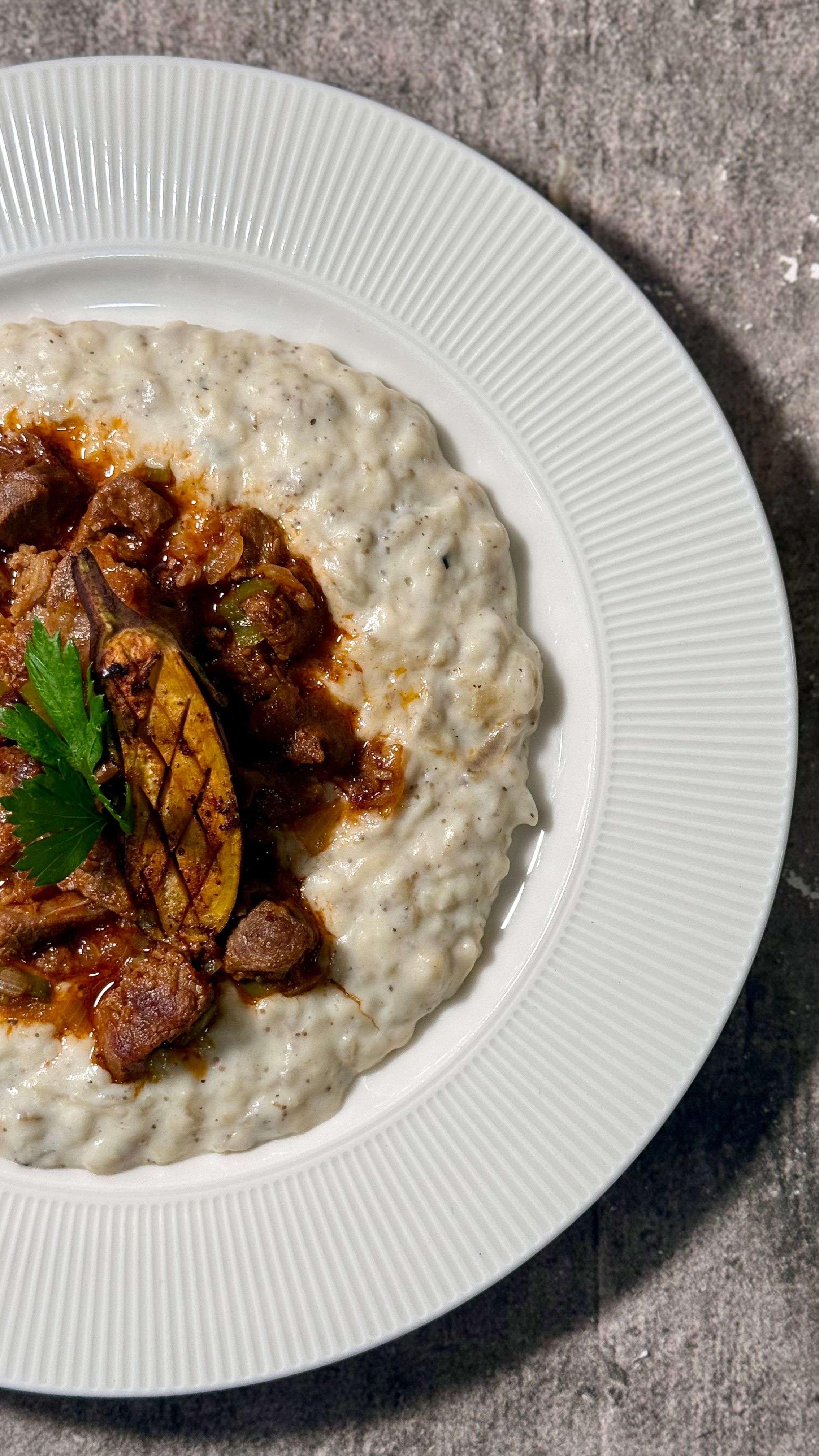
Hunkar Begendi
The diets react (see scores below)
Common Ingredients
- lamb
- eggplant
- milk
- butter
- flour
- kashar cheese
- tomato paste
- onion
Specific recipes may vary.
Incompatible with 8 of 11 diets
Diet Ratings
Hunkar Begendi is a classic Turkish dish featuring lamb stew over a creamy eggplant bechamel. The core problem is the bechamel base, which is made with wheat flour — a grain that is outright incompatible with ketogenic eating. Even a modest serving of flour-based bechamel can push net carbs well above the daily keto threshold. Additionally, tomato paste adds concentrated carbs, and the milk in the bechamel contributes lactose-based carbs. While the lamb, eggplant, butter, and kashar cheese are individually keto-friendly, the dish as traditionally prepared cannot be considered keto-compatible due to the flour. A modified version replacing flour with almond flour or cream cheese could be acceptable, but the standard preparation must be avoided.
Hunkar Begendi is a classic Ottoman Turkish dish that is fundamentally incompatible with a vegan diet. It contains multiple animal products: lamb as the primary protein, and a béchamel-style eggplant purée made with milk, butter, and kashar cheese (a Turkish dairy cheese). Every major component of the dish — the braised lamb stew and the creamy eggplant base — relies on animal-derived ingredients. There is no plant-based version of this dish that could be called authentic Hunkar Begendi.
Hunkar Begendi is a classic Turkish dish featuring lamb stewed in tomato sauce served over a creamy eggplant purée. While the lamb, eggplant, tomato paste, and onion are all paleo-compliant, the eggplant base (bekri meze/begendi) is traditionally made with a béchamel-style sauce incorporating milk, butter, flour, and kashar cheese. Flour is a grain product — a core paleo exclusion — and both milk and kashar cheese are dairy, which are excluded from the paleo diet. The combination of three non-paleo ingredients (flour, milk, and cheese) as foundational components of the dish — not incidental additions — makes this dish firmly in the avoid category. It cannot be considered paleo in its traditional form.
Hünkar Beğendi is a classic Ottoman-Turkish dish featuring braised lamb served over a smoked eggplant and cheese béchamel purée. While eggplant, tomato paste, and onion are genuinely Mediterranean-friendly ingredients, the dish is dominated by problematic elements from a Mediterranean diet standpoint: lamb is a red meat that should be eaten only a few times per month, the béchamel base relies on butter and refined flour rather than olive oil and whole grains, and kashar cheese adds saturated fat on top of an already rich sauce. The combination of red meat, butter, and refined flour in a single dish stacks multiple 'limit or avoid' components together, pushing this firmly into the 'avoid' category despite its vegetable components.
Some Mediterranean diet researchers acknowledge that traditional Levantine and Eastern Mediterranean cuisines, including Ottoman-derived dishes, do use lamb as a culturally central protein, and argue that occasional consumption within an otherwise plant-forward dietary pattern is acceptable. The eggplant base could theoretically be prepared with olive oil instead of butter, which would shift the dish closer to Mediterranean principles.
Hunkar Begendi is fundamentally incompatible with the carnivore diet. While the lamb component is carnivore-approved, the dish is built around a béchamel-style eggplant purée base containing multiple plant foods and processed ingredients. Eggplant is a plant vegetable (nightshade), flour is a grain-based thickener, tomato paste is a plant-derived ingredient, and onion is a plant food. These plant-based components are not minor seasonings — they form the structural backbone of the dish. The milk, butter, and kashar cheese are dairy (debated but accepted by many carnivore practitioners), but they are undermined entirely by the surrounding plant ingredients. No reasonable carnivore adaptation of this dish exists without fundamentally deconstructing it into an entirely different preparation.
Hunkar Begendi is a classic Turkish dish of lamb stew served over a creamy eggplant purée (béchamel-style sauce). The dish contains multiple excluded ingredients: milk (dairy), butter (regular butter, not ghee — dairy), flour (grain), and kashar cheese (dairy). These are all explicitly excluded on Whole30. The lamb, eggplant, tomato paste, and onion are compliant, but the foundational eggplant béchamel base is built entirely on excluded ingredients, making this dish incompatible in its traditional form.
Hunkar Begendi is a classic Turkish dish of braised lamb served over a smoky eggplant and cheese béchamel. It contains multiple high-FODMAP ingredients that make it unsuitable during the elimination phase. Onion is one of the highest-FODMAP foods (fructans) and is a primary flavoring ingredient in the lamb stew — there is no safe serving size. The béchamel base uses regular wheat flour (fructans) and cow's milk (lactose), both problematic. Kashar cheese, a semi-hard stretched-curd cheese, contains moderate lactose depending on aging — less aged versions can be significant. Eggplant is low-FODMAP at small servings (75g) but is used in large quantities as the base purée. Tomato paste is low-FODMAP at small amounts (28g/2 tbsp) but can be used in larger quantities in stews. Butter is low-FODMAP. Plain lamb is low-FODMAP. However, onion and wheat flour alone are sufficient to classify this dish as high-FODMAP — both are unavoidable structural components of the recipe at any standard serving.
Hunkar Begendi is a classic Turkish dish of braised lamb served over a smoked eggplant and béchamel-style purée. It has both DASH-friendly and DASH-problematic components. On the positive side, eggplant is an excellent DASH vegetable (rich in potassium and fiber), onion and tomato paste add beneficial micronutrients and lycopene, and lamb provides complete protein. However, several ingredients conflict with core DASH principles: lamb is red meat, which DASH limits due to saturated fat content; the béchamel base uses butter (saturated fat) and whole milk; kashar cheese adds saturated fat and sodium; and the dish as traditionally prepared is relatively high in overall fat and saturated fat. The combination of red meat plus a rich, butter-and-cheese-laden sauce creates a cumulative saturated fat load that exceeds DASH recommendations. It is not categorically excluded but requires significant modification — substituting lean lamb or reducing portion size, using low-fat milk, reducing butter, and choosing lower-sodium cheese — to fit within a DASH eating plan.
NIH DASH guidelines explicitly limit red meat and full-fat dairy, making this dish a clear caution at best. However, some updated DASH-aligned clinicians note that the eggplant base provides meaningful fiber and potassium, and that moderate portions of lean lamb with modified béchamel (low-fat milk, reduced butter) could fit within a DASH framework, especially for non-hypertensive individuals following the less restrictive 2,300mg sodium target.
Hunkar Begendi is a classic Ottoman dish featuring braised lamb served over a creamy eggplant-cheese bechamel puree. From a Zone perspective, this dish has several challenges. The protein source — lamb — is higher in saturated fat than Zone-preferred lean proteins like skinless chicken or fish, though it is still a complete protein and usable in controlled portions. The bechamel base is made with butter, flour (a higher-glycemic refined carb), and milk, creating a fat-heavy, carb-present sauce dominated by saturated fat rather than the preferred monounsaturated fat. Kashar cheese adds additional saturated fat. The flour thickener contributes unfavorable glycemic carbs. On the positive side, eggplant is a Zone-favorable low-glycemic vegetable, tomato paste provides polyphenols, and onion is a reasonable Zone carb source. The dish is not nutritionally empty — it contains real food with meaningful protein and vegetables — but the macro ratio skews toward saturated fat and refined carbs in the bechamel, making it difficult to hit a clean 40/30/30 without significant modification. Reducing butter and flour, increasing eggplant, and using a leaner cut of lamb would improve Zone compatibility. As served traditionally, it requires caution and careful portioning.
Some Zone practitioners following Sears' later anti-inflammatory framework (Toxic Fat, The Mediterranean Zone) would note that lamb, especially grass-fed, contains some beneficial omega-3s and CLA, and that traditional Mediterranean-adjacent dishes like this one align reasonably with the spirit of the Mediterranean Zone approach. The eggplant base is genuinely Zone-favorable. A smaller portion of the bechamel paired with a generous lamb serving could approximate Zone blocks, making it a workable meal rather than one to strongly avoid.
Hünkar Beğendi is a classic Ottoman dish pairing braised lamb with a rich smoked eggplant and cheese béchamel. The ingredient list creates a genuinely mixed anti-inflammatory profile. On the positive side, eggplant (especially roasted/charred) is a colorful vegetable rich in nasunin and chlorogenic acid — meaningful antioxidants. Tomato paste is concentrated in lycopene, a potent anti-inflammatory carotenoid. Onion supplies quercetin and other flavonoids. However, the dish is anchored in several ingredients that the anti-inflammatory framework flags: lamb is red meat (to be limited, not avoided, but it is the primary protein and likely present in significant quantity); butter contributes saturated fat; full-fat kashar cheese (a hard yellow cheese) adds more saturated fat and is considered 'full-fat dairy' to limit; and a flour-based roux is a refined carbohydrate. The combination of red meat + butter + full-fat cheese in a single dish stacks pro-inflammatory saturated fat load beyond what any of these individually would warrant. The dish is not a processed food and does contain genuinely beneficial ingredients, so it avoids the 'avoid' category, but its profile is more inflammatory than neutral for regular consumption.
Some anti-inflammatory practitioners (following Dr. Weil's more Mediterranean-inclusive approach) would argue that occasional red meat within a diet otherwise rich in plants is acceptable, and that the eggplant, tomato, and onion base meaningfully offset the saturated fat load — particularly if the lamb is grass-fed and the portion is modest. Those following stricter anti-inflammatory or AIP-style protocols would rate this closer to 'avoid' due to the red meat + full-fat dairy combination and the refined flour roux.
Hunkar Begendi is a classic Turkish dish of braised lamb served over a rich eggplant-béchamel purée (smoked eggplant blended with butter, milk, flour, and melted kashar cheese). While it offers meaningful protein from the lamb and some fiber and nutrients from the eggplant, the overall nutritional profile is problematic for GLP-1 patients. The béchamel-cheese base is high in saturated fat and total fat per serving, which worsens GLP-1 side effects including nausea, bloating, and reflux — particularly because slowed gastric emptying means fatty foods sit in the stomach much longer. Lamb itself is a fattier red meat compared to lean proteins like chicken breast or fish. The combination of fatty meat plus a cream-and-cheese sauce in a single dish creates a high-fat, heavy, difficult-to-digest meal that conflicts with multiple core GLP-1 dietary priorities simultaneously. Portion size is also not easily managed here since the sauce and meat are integrated. There is no significant fiber contribution beyond the eggplant. This dish scores low despite its cultural richness and the presence of protein.
Some GLP-1-focused dietitians note that lamb provides complete protein and that eggplant contributes potassium and antioxidants, so a small portion of Hunkar Begendi is not categorically forbidden — individual GI tolerance varies, and patients further along in treatment with stabilized side effects may tolerate it occasionally. However, the consensus concern about high saturated fat worsening gastric-emptying-related nausea and reflux leads most clinicians to recommend avoiding this dish, especially in the early months of GLP-1 therapy.
*See how scores were generated at our methodology page.
Nutritional profile
Six traits that cut across every diet.
Fiber & Plants
How much whole-plant food and fiber it delivers.
Healthy Fats
The quality of its fats (unsaturated, omega-3).
Whole / Unprocessed
How close it is to its natural, unprocessed form.
Gut Gentle
How easy it is on digestion (low FODMAP, few irritants).
Low Glycemic
How little it spikes your blood sugar.
Protein Density
How much protein it packs per calorie.
Controversy Index
Higher controversy = more disagreement between diets.
Diet-Specific Tips
 DASH — 4/10
View tips
- Red meat (lamb) — DASH limits red meat due to saturated fat; occasional small portions are allowed but not encouraged
- Butter in béchamel — adds saturated fat, conflicting with DASH fat guidelines
- Kashar cheese — contributes saturated fat and sodium
- Whole milk in sauce — DASH specifies low-fat or fat-free dairy
- Eggplant — DASH-positive vegetable, rich in fiber and potassium
- Tomato paste and onion — DASH-friendly, rich in potassium and antioxidants
- High overall saturated fat load from combined red meat + dairy-based sauce
- Portion control critical — smaller servings with lean lamb and modified sauce can partially align with DASH
 Zone — 4/10
View tips
- Lamb is a higher saturated fat protein, less preferred than chicken or fish in Zone methodology
- Bechamel sauce uses butter and white flour — both unfavorable Zone ingredients contributing saturated fat and high-glycemic carbs
- Kashar cheese adds further saturated fat load
- Eggplant is a Zone-favorable low-glycemic vegetable and forms the base of the dish
- Tomato paste and onion provide polyphenols and favorable Zone carbs
- Overall macro ratio skews toward saturated fat rather than Zone's preferred monounsaturated fat profile
- Dish can be modified (less butter/flour, leaner lamb cut) to improve Zone compatibility
- No trans fats or highly processed ingredients — real food components throughout
 Anti-Inflammatory — 4/10
View tips
- Lamb as primary protein — red meat is limited on anti-inflammatory diets due to saturated fat and arachidonic acid content
- Butter in the béchamel — saturated fat source flagged for limitation
- Kashar cheese (full-fat dairy) — additional saturated fat load
- Refined flour roux — refined carbohydrate, minimal nutritional value
- Eggplant — rich in nasunin and chlorogenic acid, anti-inflammatory antioxidants
- Tomato paste — concentrated lycopene, strong anti-inflammatory carotenoid
- Onion — quercetin and flavonoids with anti-inflammatory activity
- Stacking of multiple pro-inflammatory ingredients (red meat + butter + full-fat cheese) in one dish elevates concern beyond any single ingredient alone