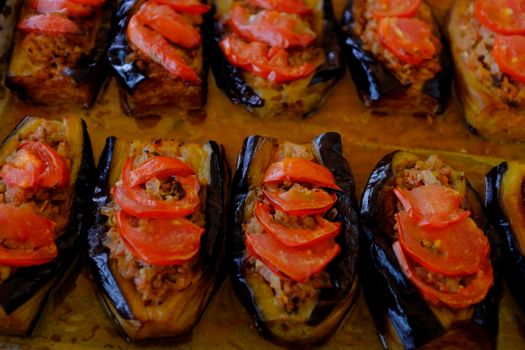
Photo: Yesim G. Ozdemir / Pexels
The diets react (see scores below)
Common Ingredients
- eggplant
- ground beef
- tomatoes
- green peppers
- onion
- garlic
- parsley
- olive oil
Specific recipes may vary.
Incompatible with 3 of 11 diets
Diet Ratings
Karniyarik is a Turkish stuffed eggplant dish with ground beef, tomatoes, peppers, onion, and olive oil — all ingredients that are individually manageable on keto. Eggplant is a relatively low-carb vegetable (~3g net carbs per 100g), and the ground beef filling is keto-friendly with good fat and protein content. However, the cumulative carb load from eggplant (a whole eggplant per serving can be 150-200g), tomatoes, onion, and green peppers adds up to roughly 15-20g net carbs per serving, placing it at the upper boundary of a single keto meal's carb allowance. Traditional recipes sometimes include a small amount of rice or sugar in the filling, but the listed ingredients here do not include those additions. With portion control and no added rice or sugar, this dish can fit into a daily keto budget, but it leaves little room for other carb sources throughout the day.
Strict keto practitioners may flag this dish due to the combination of onion, tomatoes, and eggplant pushing net carbs uncomfortably high for a single meal, particularly for those following clinical or therapeutic keto protocols where the daily limit is closer to 20g. They would recommend deconstructing the dish — eating the beef filling only, or using minimal eggplant.
Karniyarik is a traditional Turkish stuffed eggplant dish whose defining characteristic is a ground beef filling. Ground beef is an animal product (mammal flesh), making this dish incompatible with a vegan diet. All other ingredients — eggplant, tomatoes, green peppers, onion, garlic, parsley, and olive oil — are fully plant-based, but the primary protein ingredient disqualifies the dish entirely. A vegan version could be made by substituting the ground beef with lentils, walnuts, or a plant-based mince, but as traditionally prepared and as listed here, it is not vegan.
Karniyarik is an excellent paleo match. Every ingredient — eggplant, ground beef, tomatoes, green peppers, onion, garlic, parsley, and olive oil — is fully compliant with paleo principles. The dish is built around whole, unprocessed vegetables and a quality animal protein, cooked in olive oil, a preferred paleo fat. There are no grains, legumes, dairy, refined sugars, seed oils, or processed additives in the traditional preparation. This is essentially a hunter-gatherer-friendly stuffed vegetable dish, and it aligns naturally with the paleo template without requiring any substitutions.
Karniyarik is a traditional Turkish dish of eggplant stuffed with ground beef, tomatoes, peppers, onion, garlic, and parsley cooked in olive oil. The ingredient profile is largely Mediterranean-friendly: eggplant is a celebrated vegetable in Eastern Mediterranean and Middle Eastern cooking, and the aromatic base of tomatoes, peppers, onion, garlic, parsley, and olive oil aligns well with Mediterranean diet principles. However, the primary protein is ground beef, which is red meat — a category the Mediterranean diet restricts to a few times per month. The dish is not heavily processed and contains no refined grains or added sugars, which is a positive. The relatively small proportion of meat to vegetables partially mitigates the concern, but the red meat component prevents a full approval. Enjoyed occasionally (a few times per month), this dish fits within Mediterranean eating patterns; consumed frequently, it conflicts with the guideline to limit red meat.
Some Mediterranean diet interpretations, particularly those rooted in traditional Levantine and Eastern Mediterranean culinary traditions, treat small amounts of ground meat as a flavoring agent within largely vegetable-based dishes rather than a primary protein source. In this view, Karniyarik's dominant vegetable content and olive oil base could qualify it for a higher rating, especially when portion sizes keep actual meat consumption modest.
Karniyarik is a traditional Turkish stuffed eggplant dish that is fundamentally incompatible with the carnivore diet. While it contains ground beef as a protein component, the dish is built around eggplant (a plant food) and includes numerous other plant-derived ingredients: tomatoes, green peppers, onion, garlic, parsley, and olive oil. The majority of this dish's volume and character comes from plant foods. Even the cooking fat is plant-based (olive oil). On a carnivore diet, all plant foods are strictly excluded regardless of whether animal protein is also present. The ground beef component alone would be approved, but it cannot redeem a dish so thoroughly composed of excluded ingredients.
Karniyarik is a traditional Turkish stuffed eggplant dish consisting entirely of Whole30-compliant ingredients. Eggplant, ground beef, tomatoes, green peppers, onion, garlic, parsley, and olive oil are all whole, unprocessed foods explicitly allowed on the Whole30 program. There are no grains, legumes, dairy, added sugars, alcohol, or any other excluded ingredients in this dish as described. It is a savory, whole-food meal that aligns perfectly with the spirit and rules of the program.
Karniyarik contains multiple high-FODMAP ingredients that make it unsuitable during the elimination phase. Onion and garlic are among the highest-FODMAP foods tested by Monash University, both being significant sources of fructans. Even small amounts of these ingredients cooked into a dish are problematic because fructans leach into the cooking medium (in this case, olive oil and tomato juices), making the entire dish high-FODMAP. Eggplant is low-FODMAP at a standard serving (up to 182g per Monash), but the combination of onion and garlic — both used in substantial quantities in traditional Karniyarik — is disqualifying on its own. Green peppers and tomatoes are low-FODMAP, ground beef is low-FODMAP, parsley is low-FODMAP, and olive oil is low-FODMAP, but the fructan load from onion and garlic makes this dish a clear avoid during elimination.
Karniyarik is a Turkish stuffed eggplant dish featuring many DASH-friendly ingredients: eggplant (a potassium-rich vegetable), tomatoes, green peppers, onion, garlic, parsley, and olive oil all align well with DASH principles. However, ground beef is a red meat, which DASH explicitly limits due to its saturated fat content. The olive oil used for frying the eggplant (a traditional preparation method) can add significant total fat and calories, especially since eggplant absorbs oil readily. With portion control and lean ground beef (90%+ lean), this dish can fit into a DASH pattern, but the red meat and oil-heavy cooking method prevent a full approval. Sodium is not a major concern if prepared at home without added salt. The vegetable-forward profile and Mediterranean-style ingredients are positives, but the red meat component is a meaningful DASH limitation.
NIH DASH guidelines categorize red meat as a limited food (no more than a few servings per week), favoring poultry, fish, and plant proteins instead. However, updated clinical interpretations note that lean ground beef used in modest portions within an otherwise vegetable-rich dish like Karniyarik may be acceptable, and some DASH-oriented dietitians focus more on overall dietary pattern quality than strict exclusion of individual red meat servings.
Karniyarik is an excellent Zone Diet candidate. Eggplant is a low-glycemic, high-fiber vegetable that counts as a favorable Zone carbohydrate, while ground beef provides a solid protein source. The dish is built on olive oil, the gold standard monounsaturated fat in Zone methodology. Tomatoes, green peppers, onion, garlic, and parsley are all favorable Zone carbohydrates — colorful, polyphenol-rich vegetables that Dr. Sears actively encourages. The primary concern is that ground beef carries more saturated fat than skinless chicken or fish, but lean ground beef (90%+ lean) keeps this manageable. Portion control is key: the eggplant and vegetable base provides the carbohydrate block, the ground beef provides the protein block, and olive oil provides the fat block — making this dish naturally close to Zone ratios without heavy manipulation. The anti-inflammatory profile is strong given the polyphenol density from eggplant (nasunin), tomatoes (lycopene), olive oil (oleocanthal), and garlic.
Karniyarik is a traditional Turkish stuffed eggplant dish with a genuinely mixed anti-inflammatory profile. On the positive side, eggplant is rich in nasunin (a potent antioxidant anthocyanin) and chlorogenic acid; olive oil provides oleocanthal and monounsaturated fats with well-established anti-inflammatory properties; tomatoes supply lycopene and vitamin C; garlic, onion, parsley, and green peppers are all antioxidant-rich aromatics consistently supported in anti-inflammatory nutrition. The Mediterranean-style vegetable base is exemplary. The limiting factor is ground beef, which introduces saturated fat and arachidonic acid — both associated with pro-inflammatory signaling when consumed in excess. Anti-inflammatory guidelines classify red meat as 'limit' rather than 'avoid,' and in this dish the beef is used as a filling rather than the sole focus, moderating the overall impact. The ratio of vegetables to meat is favorable. If prepared with lean ground beef and generous olive oil (not over-fried eggplant absorbing excessive oil), this dish sits at the upper end of 'caution.' Cooking method matters: oven-roasting or pan-searing the eggplant in moderate olive oil is preferable to deep-frying. The dish aligns reasonably well with Mediterranean and Dr. Weil-style anti-inflammatory principles, just held back by the red meat component.
Some anti-inflammatory practitioners would score this higher, noting that the dish closely resembles Mediterranean diet staples validated for reducing CRP and IL-6 — the vegetable and olive oil base may be sufficient to offset modest red meat inclusion. Conversely, strict autoimmune protocol (AIP) followers would flag both nightshade vegetables (eggplant, tomatoes, peppers) for potential solanine/lectin sensitivity and red meat for arachidonic acid load, potentially rating it 'avoid' for sensitive individuals.
Karniyarik is a Turkish stuffed eggplant dish with a mixed nutritional profile for GLP-1 patients. On the positive side, ground beef provides meaningful protein (though a typical serving may deliver only 15-20g depending on portion size and beef-to-eggplant ratio), and the vegetable base — eggplant, tomatoes, green peppers, onion, garlic — contributes fiber, micronutrients, and water content. Olive oil is a preferred unsaturated fat. However, eggplant is traditionally fried or heavily oiled before stuffing in the classic preparation, which significantly raises fat content and can worsen GLP-1 side effects like nausea and bloating. Slowed gastric emptying means a rich, oily dish sits heavily in the stomach. Ground beef, depending on fat percentage, can be moderate-to-high in saturated fat. If made with lean ground beef (90%+ lean) and the eggplant is baked rather than fried, the dish improves considerably. As traditionally prepared, the fat load is the primary concern.
Some GLP-1-focused dietitians view dishes like this favorably because the whole-food ingredient list — lean meat, vegetables, olive oil — represents a nutrient-dense Mediterranean-style meal that supports satiety in small portions. Others flag the typical preparation method (frying the eggplant) and ground beef fat content as meaningful GLP-1 risk factors for GI side effects, recommending modified versions only.
*See how scores were generated at our methodology page.
Nutritional profile
Six traits that cut across every diet.
Fiber & Plants
How much whole-plant food and fiber it delivers.
Healthy Fats
The quality of its fats (unsaturated, omega-3).
Whole / Unprocessed
How close it is to its natural, unprocessed form.
Gut Gentle
How easy it is on digestion (low FODMAP, few irritants).
Low Glycemic
How little it spikes your blood sugar.
Protein Density
How much protein it packs per calorie.
Controversy Index
Higher controversy = more disagreement between diets.
Diet-Specific Tips
 Keto — 5/10
View tips
- Eggplant is moderate in net carbs; a full serving (1 whole eggplant) can contribute 10-15g net carbs alone
- Onion and tomatoes add additional net carbs (3-5g combined per serving)
- Ground beef and olive oil are keto-friendly and provide healthy fats and protein
- No grains, added sugar, or rice in the listed ingredients — a key positive
- Total net carbs per serving estimated at 15-20g, consuming most of the daily keto allowance
- Portion control is critical — half a stuffed eggplant may be more manageable
- Whole, unprocessed ingredients align with clean keto principles
 Paleo — 9/10
View tips
- Ground beef is a clean, unprocessed animal protein — fully approved
- Eggplant, tomatoes, green peppers, onion, and garlic are all whole vegetables with no paleo objections
- Olive oil is a preferred paleo cooking fat
- Parsley is a compliant herb
- No grains, legumes, dairy, or processed ingredients in the traditional recipe
- Simple, whole-food preparation consistent with paleo philosophy
 Mediterranean — 5/10
View tips
- Eggplant as the dominant ingredient is a Mediterranean staple strongly encouraged in the diet
- Olive oil, tomatoes, garlic, onion, parsley, and peppers are all core Mediterranean ingredients
- Ground beef is red meat, restricted to a few times per month in Mediterranean guidelines
- No processed ingredients, refined grains, or added sugars present
- Traditional Eastern Mediterranean dish with deep regional roots
- Meat-to-vegetable ratio is relatively favorable, reducing overall red meat load per serving
 Whole30 — 9/10
View tips
- All ingredients are whole, unprocessed foods
- Ground beef is a compliant protein
- Eggplant, tomatoes, peppers, onion, and garlic are all compliant vegetables
- Olive oil is a compliant natural fat
- Parsley is a compliant herb
- No grains, dairy, legumes, or added sugars present
- Dish represents a genuine cultural recipe, not a junk food recreation
 DASH — 6/10
View tips
- Ground beef is a red meat, limited by DASH guidelines due to saturated fat
- Eggplant, tomatoes, peppers, onion, garlic, and parsley are all DASH-approved vegetables
- Olive oil is a preferred DASH fat, but frying eggplant increases total fat substantially
- No high-sodium ingredients; home preparation allows sodium control
- Dish is vegetable-forward and Mediterranean-style, consistent with DASH spirit
- Lean ground beef and baking/broiling instead of frying would improve DASH compatibility
 Zone — 8/10
View tips
- Eggplant is a low-glycemic, high-fiber favorable Zone carbohydrate
- Olive oil is the ideal Zone monounsaturated fat source
- Tomatoes, green peppers, onion, and garlic are all favorable Zone vegetables rich in polyphenols
- Ground beef adds saturated fat — use 90%+ lean for best Zone compliance
- Macro ratio is naturally close to 40/30/30 with appropriate portioning
- No high-glycemic carbohydrates or refined ingredients in the dish
- Strong anti-inflammatory profile supports Sears' broader health principles
 Anti-Inflammatory — 6/10
View tips
- Eggplant provides nasunin and chlorogenic acid — potent antioxidants
- Extra virgin olive oil is a cornerstone anti-inflammatory fat (oleocanthal)
- Garlic, onion, parsley, and green peppers add polyphenols and antioxidants
- Tomatoes supply lycopene (especially when cooked)
- Ground beef is classified 'limit' in anti-inflammatory guidelines due to saturated fat and arachidonic acid
- Favorable vegetable-to-meat ratio moderates the beef's inflammatory impact
- Nightshades (eggplant, tomatoes, peppers) may be problematic for autoimmune-sensitive individuals
- Cooking method (olive oil roasting vs. deep frying) significantly affects final inflammatory load
 GLP-1 Friendly — 5/10
View tips
- Eggplant is typically fried or heavily oiled in traditional preparation, increasing fat load
- Ground beef fat percentage is highly variable — 80/20 ground beef adds significant saturated fat
- Baked preparation with lean ground beef and minimal oil would improve the score to 6-7
- Vegetable-heavy base provides fiber, water content, and micronutrients
- Protein per serving is moderate but may fall short of the 15-30g per meal target depending on portion
- Olive oil is a preferred fat source but quantity matters
- Small GLP-1 portion sizes may limit total protein intake from this dish
- Garlic, onion, and green peppers are well-tolerated and nutritionally positive