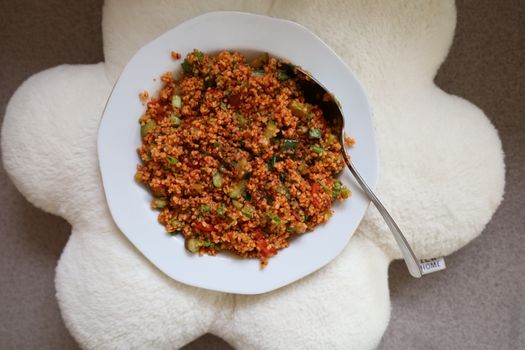
The diets react (see scores below)
Common Ingredients
- bulgur
- tomato paste
- pepper paste
- parsley
- scallions
- cucumber
- lemon juice
- pomegranate molasses
Specific recipes may vary.
Incompatible with 5 of 11 diets
Diet Ratings
Kisir is fundamentally incompatible with a ketogenic diet. The primary ingredient, bulgur, is a whole grain with approximately 25-30g of net carbs per half-cup serving — far exceeding the daily keto limit on its own. Pomegranate molasses adds concentrated sugar (roughly 16g sugar per tablespoon). Together, these two ingredients alone would easily surpass the entire daily net carb allowance of 20-50g in a single serving. The remaining ingredients (parsley, scallions, cucumber, lemon juice, tomato paste, pepper paste) are relatively low-carb and would otherwise be acceptable, but they cannot offset the core carbohydrate load from bulgur and pomegranate molasses. There is no meaningful way to modify this dish while retaining its identity.
Kisir is a traditional Turkish bulgur wheat salad that is entirely plant-based. Every ingredient — bulgur, tomato paste, pepper paste, parsley, scallions, cucumber, lemon juice, and pomegranate molasses — is derived from plants with no animal products or animal-derived ingredients present. It is a minimally processed whole-food dish built around a nutritious whole grain base with fresh vegetables and herbs, making it an excellent fit for a vegan diet. The score is high rather than perfect only because tomato paste and pepper paste are lightly processed, though this is entirely standard and raises no vegan concern.
Kisir is a Turkish bulgur wheat salad, and its primary ingredient — bulgur — is a processed whole grain (cracked wheat) that is explicitly excluded from the paleo diet. Grains are one of the clearest 'avoid' categories in paleo, as they were not part of the Paleolithic diet and contain anti-nutrients like lectins, phytates, and gluten. The remaining ingredients (parsley, scallions, cucumber, lemon juice) are paleo-friendly, and pomegranate molasses would be a caution item on its own due to added sugar content, but the dish is fundamentally disqualified by bulgur as its base. There is no paleo substitution that preserves the identity of this dish.
Kisir is a Turkish bulgur wheat salad that aligns excellently with Mediterranean diet principles. Bulgur is a whole grain — a staple of the Mediterranean diet — and the dish is built entirely around plant-based ingredients. Fresh vegetables (cucumber, scallions, parsley), lemon juice, and tomato paste are all core Mediterranean components. Pomegranate molasses adds concentrated fruit-derived sweetness and acidity with antioxidant value. Pepper paste is a traditional Turkish condiment made from peppers, which is minimally processed and plant-based. There is no red meat, refined grain, or added sugar of concern. The dish is high in fiber, micronutrients, and phytonutrients. The slight confidence reduction from 'high' stems from pomegranate molasses, which is a concentrated fruit product with higher sugar content than whole fruit, and pepper paste, which can vary in salt and additive content depending on preparation.
Some modern clinical Mediterranean diet guidelines emphasize minimizing concentrated sweeteners including fruit-based syrups like pomegranate molasses due to their high sugar density; traditionalists, however, recognize this as an authentic Levantine and Anatolian ingredient used in small quantities as a flavor accent rather than a primary ingredient.
Kisir is a Turkish bulgur wheat salad that is entirely plant-based and contains zero animal products. Every single ingredient — bulgur (a processed grain), tomato paste, pepper paste, parsley, scallions, cucumber, lemon juice, and pomegranate molasses — is explicitly excluded on the carnivore diet. Bulgur is a grain, which violates one of the most fundamental carnivore rules. The dish also contains fruit-derived ingredients (lemon juice, pomegranate molasses), vegetables, and herbs. There is no animal-derived component whatsoever, making this completely incompatible with any tier of the carnivore diet, including the most lenient 'animal-based' approach.
Kisir is a traditional Turkish bulgur wheat salad. Bulgur is a processed whole wheat grain, and grains (including wheat in all forms) are explicitly excluded on the Whole30 program. This is the primary disqualifying ingredient. Additionally, pomegranate molasses commonly contains added sugar, and pepper paste may contain added sugar or other non-compliant additives. Even if those secondary ingredients were compliant, the bulgur alone makes this dish a clear avoid.
Kisir is a Turkish bulgur salad that contains several high-FODMAP ingredients during the elimination phase. Bulgur wheat is the primary concern — it is high in fructans and is high-FODMAP at standard serving sizes (Monash rates bulgur as high-FODMAP at 3/4 cup cooked, and a typical Kisir serving would exceed the low-FODMAP threshold of about 1/4 cup). Scallions (spring onions) contain fructans in the green AND white parts, though the green tops alone are low-FODMAP — traditional Kisir typically uses the whole scallion. Pomegranate molasses is concentrated pomegranate juice and may contain excess fructose at typical serving amounts, with limited Monash data. Tomato paste is moderate-FODMAP at larger amounts (>2 tablespoons) due to fructans concentrating during cooking. Cucumber, parsley, lemon juice, and pepper paste are generally low-FODMAP. The combination of bulgur wheat (high fructans) as the primary ingredient makes this dish unsuitable during elimination phase regardless of other ingredients.
Monash University rates bulgur as low-FODMAP only at very small portions (around 1/4 cup cooked), which is far less than a standard Kisir serving. Some FODMAP practitioners note that the dish could theoretically be adapted with a gluten-free grain substitute (e.g., rice or millet), but as traditionally prepared with bulgur, most clinical FODMAP dietitians would advise avoidance during elimination.
Kisir is a Turkish bulgur wheat salad with strong DASH-compatible elements: bulgur is a whole grain rich in fiber and magnesium, and the vegetable components (parsley, scallions, cucumber) plus lemon juice align well with DASH principles. Pomegranate molasses adds potassium and antioxidants but also concentrated sugar, which DASH limits. The primary concern is the tomato paste and especially the pepper paste (biber salçası), which are commonly high in sodium — Turkish pepper paste can contribute 400–800mg sodium per 2-tablespoon serving depending on brand and preparation. If these pastes are used generously, the dish can push toward or exceed DASH sodium thresholds in a single serving. Homemade or low-sodium versions of these pastes would significantly improve the profile. The dish has no saturated fat, no red meat, and no added sugars beyond the molasses, making it far better than most caution-range foods.
NIH DASH guidelines approve whole grains, vegetables, and legume-based dishes broadly, which would suggest approval for a grain-vegetable salad like this. However, updated clinical interpretation among DASH practitioners flags that the sodium load from commercial tomato and pepper pastes is a meaningful variable — the verdict could shift to 'approve' (score 7-8) if made with low-sodium or homemade pastes, or if portion size is moderate.
Kisir is a Turkish bulgur salad that presents a mixed Zone profile. Bulgur is the dominant ingredient and is classified as an 'unfavorable' carbohydrate in Zone terminology — it is a whole grain with a moderate glycemic index, and Zone limits whole grains to 0-1 servings per day. A typical serving of kisir will be carbohydrate-heavy with no significant protein source, making it difficult to hit the 40/30/30 ratio on its own. The dish is also completely protein-absent, which is a structural problem for Zone balance. On the positive side, the vegetable ingredients (parsley, scallions, cucumber) are favorable low-glycemic Zone carbs, and lemon juice is an excellent Zone carb source. Tomato paste and pepper paste add polyphenols and anti-inflammatory value, which aligns with Sears' later anti-inflammatory emphasis. Pomegranate molasses is a concern — it is concentrated sugar and raises the glycemic load meaningfully. The dish contains essentially no fat, so fat blocks would need to come entirely from elsewhere (e.g., olive oil drizzled in, which is common in some preparations). As a standalone dish, Kisir fails Zone balance badly (heavy carbs, no protein, no fat). As a side component in a Zone meal paired with a lean protein and monounsaturated fat source, a small portion (~1 carb block worth of bulgur) can be incorporated with careful measurement.
Some Zone practitioners, drawing on Sears' later writings emphasizing polyphenol-rich foods and anti-inflammatory eating, would note that kisir's tomato paste, pomegranate molasses, parsley, and pepper paste deliver a significant polyphenol payload that Sears increasingly valorized. They might rate this more favorably as a polyphenol vehicle if bulgur is kept to a modest portion. However, purists following 'Enter the Zone' would flag bulgur as an unfavorable grain and pomegranate molasses as a concentrated sugar, keeping this firmly in caution territory.
Kisir is a highly anti-inflammatory Turkish bulgur salad with an impressive ingredient profile. Bulgur is a whole grain with a low glycemic index, providing fiber and resistant starch that support gut health and reduce inflammatory markers. Parsley is exceptionally rich in flavonoids (apigenin, luteolin) and vitamin C, with documented anti-inflammatory properties. Scallions and cucumber add polyphenols and hydration. Lemon juice provides vitamin C, which helps reduce oxidative stress. Pomegranate molasses is rich in punicalagins and ellagic acid — among the most potent antioxidant compounds in nutrition research, with strong evidence for reducing CRP and IL-6. Tomato paste is a concentrated source of lycopene, a carotenoid that significantly reduces inflammatory markers and whose bioavailability is enhanced by cooking. Pepper paste similarly contributes capsaicin and antioxidant carotenoids. The dish contains no refined sugars, no pro-inflammatory oils, no processed additives, and no red meat or high-fat dairy. The one minor consideration is the glycemic load of bulgur, but as a whole grain it is far preferable to refined grains and is explicitly included in anti-inflammatory dietary frameworks. Overall, Kisir represents an excellent combination of whole grain, polyphenol-rich produce, and anti-inflammatory spice elements.
Kisir is a fiber-rich Turkish bulgur salad with meaningful nutritional strengths but a critical gap for GLP-1 patients: it contains virtually no protein. Bulgur is a whole grain that provides good dietary fiber (roughly 4-5g per cup cooked), easy digestibility relative to other grains, and a low fat profile. The vegetable ingredients — parsley, scallions, cucumber — add micronutrients, hydration support, and additional fiber with minimal calories, which fits the nutrient-density requirement well. Tomato paste and pepper paste contribute antioxidants and flavor without significant fat or sugar burden. Pomegranate molasses adds some sugar and acidity; in typical recipe quantities (1-2 tsp) it is unlikely to be problematic, but it should be noted. Lemon juice is well-tolerated and may even help with nausea. The primary concern is that kisir has essentially no protein, which is the #1 dietary priority for GLP-1 patients who need 100-120g daily to prevent muscle loss during rapid weight loss. Eaten as a standalone dish, it does nothing to advance that goal. It is best treated as a side dish paired with a high-protein main (grilled chicken, fish, legumes, eggs). As a side, its fiber content, hydration support, easy digestibility, and low fat profile are genuinely GLP-1-friendly. As a primary dish, it falls short.
Some GLP-1-focused dietitians would rate bulgur-based dishes more favorably because bulgur has a modest protein contribution (~5-6g per cup cooked) and a low glycemic impact relative to refined grains, making it acceptable as a carbohydrate vehicle when paired correctly. Others would caution that any grain-forward dish without a deliberate protein source should be flagged more strongly given how critical protein preservation is during GLP-1-driven caloric restriction.
*See how scores were generated at our methodology page.
Nutritional profile
Six traits that cut across every diet.
Fiber & Plants
How much whole-plant food and fiber it delivers.
Healthy Fats
The quality of its fats (unsaturated, omega-3).
Whole / Unprocessed
How close it is to its natural, unprocessed form.
Gut Gentle
How easy it is on digestion (low FODMAP, few irritants).
Low Glycemic
How little it spikes your blood sugar.
Protein Density
How much protein it packs per calorie.
Controversy Index
Higher controversy = more disagreement between diets.
Diet-Specific Tips
 Vegan — 9/10
View tips
- Bulgur is a whole-grain plant food with no animal derivatives
- Tomato paste and pepper paste are plant-derived, minimally processed condiments
- Pomegranate molasses is a fruit-based syrup with no animal ingredients
- All aromatics and fresh produce (parsley, scallions, cucumber) are fully plant-based
- Lemon juice is a plant-derived acidulant
- No hidden animal-derived ingredients typical in Turkish cuisine (e.g., yogurt, butter) are present in this formulation
 Mediterranean — 9/10
View tips
- Bulgur is a whole grain, a Mediterranean diet staple
- Entirely plant-based with no meat, dairy, or refined grains
- Rich in fresh vegetables and herbs (cucumber, parsley, scallions)
- Lemon juice and tomato paste are core Mediterranean flavors
- Pomegranate molasses is a concentrated fruit product — moderate sugar concern
- Pepper paste is traditional but sodium content varies by preparation
- No olive oil listed, though typically added — a minor omission
 DASH — 6/10
View tips
- Bulgur is a DASH-approved whole grain, high in fiber and magnesium
- Pepper paste (biber salçası) is typically high in sodium — a key DASH concern
- Tomato paste also contributes sodium, though generally less than pepper paste
- Pomegranate molasses adds concentrated sugar, which DASH limits
- No saturated fat, no red meat, no full-fat dairy — all positives
- Parsley, scallions, cucumber are DASH-friendly vegetables
- Low-sodium homemade paste versions would likely shift verdict to 'approve'
 Zone — 5/10
View tips
- Bulgur is an 'unfavorable' Zone carbohydrate — a whole grain limited to 0-1 servings/day
- No protein source present — dish cannot achieve 40/30/30 ratio on its own
- No fat source present — requires pairing with monounsaturated fat (olive oil) to complete Zone balance
- Pomegranate molasses adds concentrated sugar, raising glycemic load
- Favorable Zone elements: parsley, cucumber, scallions, lemon juice are low-glycemic carbs
- High polyphenol content from tomato paste, pepper paste, and pomegranate molasses aligns with Sears' anti-inflammatory focus
- Usable as a small side component (~1 carb block) when paired with lean protein and healthy fat
 Anti-Inflammatory — 8/10
View tips
- Bulgur is a whole grain with low glycemic index and high fiber — explicitly approved in anti-inflammatory frameworks
- Pomegranate molasses is exceptionally rich in punicalagins and ellagic acid, among the most potent anti-inflammatory antioxidants documented in research
- Tomato paste provides concentrated lycopene, a well-researched carotenoid that reduces CRP and other inflammatory markers
- Parsley is high in apigenin and luteolin — flavonoids with documented NF-κB inhibitory (anti-inflammatory) activity
- Pepper paste contributes capsaicin and carotenoids, both with anti-inflammatory properties
- No pro-inflammatory ingredients: no refined oils, no added sugars, no processed additives, no saturated fat
- Lemon juice adds vitamin C, an antioxidant that reduces oxidative stress and supports immune regulation
 GLP-1 Friendly — 5/10
View tips
- High fiber from bulgur and vegetables supports digestion and helps prevent GLP-1-related constipation
- No meaningful protein source — critical gap for GLP-1 patients requiring 100-120g protein daily
- Low fat profile reduces risk of nausea, bloating, and reflux — a GLP-1 side effect advantage
- Pomegranate molasses adds modest sugar; acceptable in small recipe quantities but worth monitoring
- High water-content vegetables (cucumber, parsley) support hydration, important given reduced thirst on GLP-1s
- Easy digestibility of bulgur (especially fine-ground) suits slowed gastric emptying
- Should be served as a side dish alongside a high-protein main, not as a standalone meal
- Lemon juice and herbs are well-tolerated and may buffer nausea