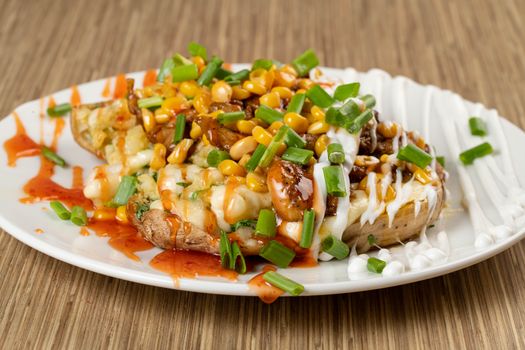
Photo: mohamed abdelghaffar / Pexels
The diets react (see scores below)
Common Ingredients
- potatoes
- butter
- kashar cheese
- corn
- olives
- pickles
- sausage
- mayonnaise
Specific recipes may vary.
Incompatible with 10 of 11 diets
Diet Ratings
Kumpir is centered on a large baked potato, which is one of the most carbohydrate-dense foods available. A single medium-to-large baked potato contains roughly 30-50g of net carbs on its own, immediately blowing past the daily keto limit before any toppings are added. Corn is another high-carb ingredient (~15-20g net carbs per serving), compounding the problem further. Together, the potato and corn base make this dish fundamentally incompatible with ketosis regardless of the keto-friendly toppings (butter, cheese, olives, mayonnaise, sausage). There is no meaningful portion adjustment that could make the core of this dish acceptable for keto.
Kumpir as described contains multiple clear animal-derived ingredients: butter (dairy), kashar cheese (dairy), sausage (meat), and mayonnaise (eggs). This dish is unambiguously non-vegan. At least four of the nine listed ingredients are animal products, making it incompatible with a vegan diet in its traditional form. While the base potato and toppings like corn, olives, and pickles are plant-based, the core preparation and several key toppings disqualify it entirely.
Kumpir is a Turkish street food dish that is fundamentally incompatible with the paleo diet. Nearly every component violates core paleo principles: kashar cheese is dairy, corn is a grain, mayonnaise typically contains seed oils (soybean or canola), butter is dairy, sausage is typically a processed meat with additives and preservatives, and pickles often contain added salt and preservatives. Even the base — a baked potato — is debated within paleo. With multiple clear violations across dairy, grains, processed meats, and seed oils, this dish is a comprehensive avoid.
Kumpir as prepared here significantly contradicts Mediterranean diet principles. While the base potato is a whole food, the dish is loaded with butter (instead of olive oil), processed sausage (a red/processed meat), mayonnaise (a processed, high-fat condiment), and kashar cheese in likely heavy quantities. The combination of processed meat, saturated fat from butter, and mayonnaise makes this a high-calorie, processed snack that aligns poorly with Mediterranean dietary patterns. The olives and pickles are the only Mediterranean-friendly components. This is a street food optimized for indulgence rather than health.
Kumpir is a Turkish baked potato dish that is fundamentally incompatible with the carnivore diet. The base is potatoes — a starchy plant food that is strictly excluded. The toppings compound the problem: corn and olives are plant foods, pickles are plant-derived, and mayonnaise typically contains plant oils (soybean or canola) and is therefore not carnivore-compliant. While butter, kashar cheese (a dairy product), and sausage are animal-derived, they are minor components in a dish that is overwhelmingly plant-based. No modification of this dish would make it carnivore-compatible — the entire concept revolves around a potato base.
Kumpir contains multiple Whole30-excluded ingredients. Butter (regular, not ghee) is dairy and excluded. Kashar cheese is dairy and excluded. Corn is a grain and excluded. Sausage commonly contains added sugar, nitrates, and other non-compliant additives. Mayonnaise typically contains soy oil, soy lecithin, or other non-compliant ingredients. Even setting aside the problematic toppings, the core dish as traditionally prepared is fundamentally incompatible with Whole30.
Kumpir is a Turkish stuffed baked potato loaded with toppings. The base ingredients require careful analysis: Potatoes are low-FODMAP at moderate servings (1 medium potato is fine). Butter is low-FODMAP. Corn is low-FODMAP at small servings (½ cup canned, drained). Olives are low-FODMAP. Pickles are generally low-FODMAP in small amounts. Mayonnaise is low-FODMAP at standard serving sizes. However, the problematic ingredients are kashar cheese and sausage. Kashar (kaşar) is a semi-hard aged cheese similar to yellow cheddar — aged hard cheeses are low-FODMAP due to minimal lactose, so kashar in reasonable amounts should be fine. The sausage is the key concern: Turkish sausage (sucuk) and many processed sausages contain garlic, onion powder, and other high-FODMAP ingredients as seasonings, making them high in fructans. Additionally, the cumulative FODMAP load from multiple toppings in a generous street-food portion is a real concern — the dish is loaded with multiple ingredients simultaneously. The practical street-food serving is large, and the sausage ingredient almost certainly contains garlic/onion making it a significant FODMAP trigger. Without control over sausage ingredients, this dish is risky during elimination phase.
Monash University rates individual ingredients like potatoes, corn, olives, and aged cheese as low-FODMAP, but clinical FODMAP practitioners would flag the sausage (almost universally containing garlic and onion) and the cumulative load of multiple toppings in a generous street-food portion as high-risk during the elimination phase. Requesting sausage-free kumpir or verifying sausage ingredients would be essential.
Kumpir is a Turkish stuffed baked potato loaded with multiple DASH-unfriendly ingredients. While the potato base itself is a DASH-compatible vegetable, the combination of butter (saturated fat), kashar cheese (full-fat, high sodium), sausage (processed meat, high sodium and saturated fat), olives (very high sodium), pickles (extremely high sodium), and mayonnaise (high fat, often high sodium) makes this dish incompatible with DASH principles. The cumulative sodium load from pickles, olives, sausage, and cheese likely exceeds 1,500–2,000mg in a single serving. Saturated fat is contributed by butter, cheese, sausage, and mayonnaise simultaneously. Processed sausage falls into the 'red/processed meat' category explicitly limited by DASH. This dish hits nearly every DASH restriction at once.
Kumpir is a Turkish street food built around a large baked potato as its base — one of the foods Dr. Sears explicitly lists as 'unfavorable' and effectively off-limits in Zone methodology due to its very high glycemic index. The potato alone would consume an enormous number of carb blocks while spiking blood sugar and insulin rapidly. Beyond the potato, the toppings compound the problem: butter and mayonnaise add saturated fat and omega-6-heavy fat with essentially no Zone-balancing benefit, kashar cheese adds more saturated fat, corn is another high-glycemic carb flagged as unfavorable in Zone, and processed sausage brings saturated fat and likely trans fats or additives. The dish has no lean protein source, no low-glycemic vegetables, and no monounsaturated fat to speak of. The macro ratio is wildly skewed toward high-glycemic carbohydrates and saturated/omega-6 fats, with virtually no Zone-favorable protein. Even with aggressive portioning, the potato base makes it nearly impossible to construct a Zone-balanced meal from this dish without fundamentally deconstructing it.
Kumpir is a Turkish stuffed baked potato loaded with several pro-inflammatory ingredients. Butter and kashar cheese contribute saturated fat, which at the quantities used in kumpir (butter is mashed generously into the potato) falls firmly in the 'limit to avoid' category of anti-inflammatory eating. Sausage is a processed red meat high in saturated fat, sodium, and often containing nitrates and artificial additives — a clear pro-inflammatory food. Mayonnaise (standard commercial variety) is typically made with refined seed oils (soybean or canola) high in omega-6 fatty acids, adding further inflammatory load. The potato base is a refined starchy carbohydrate with a high glycemic index when baked and mashed, promoting blood sugar spikes associated with inflammatory markers. Olives are the one genuinely anti-inflammatory component (healthy monounsaturated fats, polyphenols), and pickles are neutral to mildly beneficial (probiotics if naturally fermented). Corn adds refined starch with minimal anti-inflammatory benefit. Overall, the combination of butter, high-fat cheese, processed sausage, and mayonnaise creates a dish dominated by saturated fat, omega-6 oils, processed meat additives, and glycemic load — multiple simultaneous drivers of inflammation. The beneficial ingredients (olives) are too minimal to offset this profile.
Kumpir is a Turkish stuffed baked potato loaded with butter, kashar cheese, mayonnaise, and processed sausage — a combination that is high in saturated fat, high in calories, and low in protein density relative to its caloric load. The base is a large starchy potato, which is a high-glycemic refined carbohydrate with minimal fiber per calorie in this prepared form. Butter and mayonnaise together contribute substantial saturated and unsaturated fat in quantities that are strongly associated with worsening GLP-1 side effects including nausea, bloating, and reflux. Processed sausage adds saturated fat and sodium with low-quality protein. Corn, olives, and pickles add negligible protein or fiber at these serving proportions. The dish is essentially calorie-dense, fat-heavy, and nutritionally empty relative to GLP-1 dietary priorities. It fails on nearly every criterion: low protein density, low fiber, high fat, poor digestibility due to fat load, and large portion requirement for any satiety. This is not a borderline case.
*See how scores were generated at our methodology page.
Nutritional profile
Six traits that cut across every diet.
Fiber & Plants
How much whole-plant food and fiber it delivers.
Healthy Fats
The quality of its fats (unsaturated, omega-3).
Whole / Unprocessed
How close it is to its natural, unprocessed form.
Gut Gentle
How easy it is on digestion (low FODMAP, few irritants).
Low Glycemic
How little it spikes your blood sugar.
Protein Density
How much protein it packs per calorie.
Controversy Index
Higher controversy = more disagreement between diets.
Diet-Specific Tips
 Low-FODMAP — 4/10
View tips
- Potatoes are low-FODMAP at standard serving sizes
- Kashar cheese is an aged semi-hard cheese — low in lactose and generally low-FODMAP
- Sausage almost certainly contains garlic and/or onion as seasonings — high in fructans
- Corn is low-FODMAP at ½ cup but portions in kumpir may exceed this
- Olives, pickles, butter, and mayonnaise are individually low-FODMAP
- Cumulative FODMAP load from multiple toppings in a generous street-food serving is a practical concern
- Dish is highly customizable — removing sausage would significantly improve safety