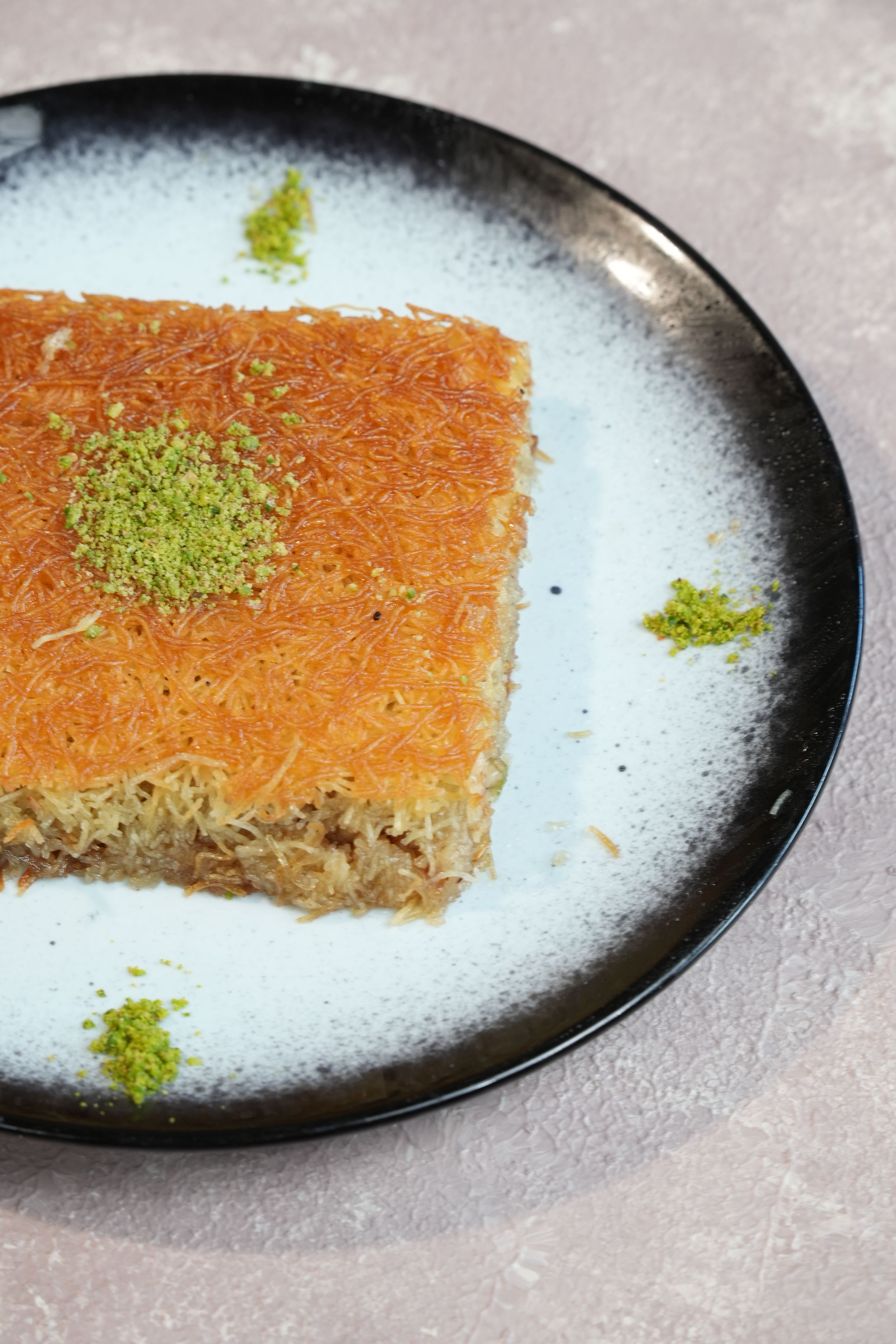
Photo: Murat Bilgin / Pexels
The diets react (see scores below)
Common Ingredients
- kadayif
- unsalted cheese
- butter
- sugar
- water
- lemon juice
- pistachios
Specific recipes may vary.
Incompatible with 11 of 11 diets
Diet Ratings
Kunefe is fundamentally incompatible with a ketogenic diet. Its primary base is kadayif (shredded wheat/filo dough), which is a grain-based product loaded with carbohydrates. The dish is then soaked in a sugar syrup made from sugar, water, and lemon juice, adding a massive sugar load on top of the already high-carb base. A single serving of kunefe easily contains 60-90g of net carbs, far exceeding the entire daily keto allowance of 20-50g. While the unsalted cheese filling and butter are keto-friendly components, they are completely overwhelmed by the grain and sugar content. Pistachios add additional carbs. There is no practical way to make this dish keto-compatible without fundamentally replacing its core ingredients.
Kunefe contains two clear animal-derived ingredients: unsalted cheese (a dairy product) and butter (also dairy). Both are excluded under all vegan definitions. The dish is a traditional Turkish dessert built around a molten cheese core and butter-soaked shredded wheat pastry, making animal products structurally central rather than incidental. The remaining ingredients — kadayif dough, sugar, water, lemon juice, and pistachios — are plant-based, but the presence of dairy makes the dish as traditionally prepared entirely incompatible with a vegan diet. A vegan version could theoretically be made using plant-based cheese and vegan butter, but the default dish is non-vegan.
Kunefe is fundamentally incompatible with the paleo diet. The dish's two primary components — kadayif (shredded wheat/filo dough) and cheese — are both strictly excluded. Kadayif is a grain-based product made from wheat, which is one of the clearest avoid foods in paleo. Cheese is a dairy product, also firmly excluded. The sugar syrup (sugar + water + lemon juice) adds refined sugar, another avoid category. While butter is debated in paleo circles, and pistachios are paleo-approved, the core structure of this dish is built entirely on non-paleo ingredients. There is no realistic modification that could make kunefe paleo while remaining kunefe.
Kunefe is a traditional Turkish dessert that conflicts with several core Mediterranean diet principles. The dish is built on kadayif (shredded wheat pastry, a refined grain), large amounts of added sugar in the syrup, and butter as the primary fat — directly displacing olive oil. While the unsalted cheese provides some dairy protein and pistachios are a Mediterranean-friendly nut, these positives are overwhelmed by the refined grain base, high sugar content, and saturated fat from butter. This is an occasional celebratory dessert at best, not a food compatible with regular Mediterranean eating patterns.
Some Mediterranean diet scholars note that traditional Middle Eastern and Eastern Mediterranean cuisines, including Turkish and Levantine food cultures, have historically included nut-studded pastries and cheese desserts on festive occasions. The presence of pistachios and fresh cheese could be viewed as regionally authentic ingredients, and moderate, infrequent consumption of traditional sweets is arguably more aligned with the Mediterranean lifestyle philosophy than rigid exclusion.
Kunefe is almost entirely plant-based and incompatible with the carnivore diet. The primary ingredient, kadayif (shredded wheat/semolina dough), is a grain-based product and strictly forbidden. Sugar and water form a syrup that is entirely non-animal. Lemon juice is a plant-derived ingredient. Pistachios are nuts, completely excluded on carnivore. The only animal-derived components are the unsalted cheese and butter, which are present but minor relative to the overall dish composition. Even if one were to set aside the dairy debate, the dominant plant-based ingredients (kadayif, sugar syrup, pistachios, lemon juice) make this dish a clear avoid with no meaningful carnivore-compatible adaptation possible without fundamentally deconstructing it.
Kunefe contains multiple excluded ingredients that make it clearly non-compliant with Whole30. Kadayif is shredded wheat/filo pastry dough — a grain-based product explicitly excluded. Sugar is a direct excluded ingredient (added sugar). Butter (not ghee or clarified butter) is a dairy product excluded from the program. The unsalted cheese is also dairy, which is excluded. Even setting aside the spirit-of-the-program rule against recreating baked goods and desserts, this dish fails on at least four distinct excluded ingredients: grains (kadayif), added sugar (syrup), butter (dairy), and cheese (dairy).
Kunefe contains multiple high-FODMAP ingredients that make it problematic during the elimination phase. Kadayif (shredded wheat/kataifi pastry) is made from wheat flour, which is high in fructans — a major FODMAP. The unsalted fresh cheese typically used (such as Hatay-style unsalted melting cheese or fresh mozzarella-like cheese) has varying lactose content; unsalted fresh cheeses are generally moderate-to-high in lactose, unlike aged cheeses. Pistachios, while low-FODMAP at small servings (~10 kernels per Monash), are often used in generous quantities as a topping and become high-FODMAP at larger amounts due to fructans and GOS. Sugar, water, lemon juice, and butter are all low-FODMAP. However, the combination of wheat-based kadayif (high fructans) and likely-lactose-containing fresh cheese alone is sufficient to classify this as a high-FODMAP dish at any standard serving size.
If the fresh cheese used is confirmed to be very low in lactose (e.g., a well-drained, low-lactose variant), the cheese component could be borderline acceptable. However, the wheat-based kadayif remains a definitive high-FODMAP ingredient due to fructans, and Monash University has not tested kadayif specifically — some clinical FODMAP practitioners may debate portion thresholds, but no realistic serving of kadayif would be considered safe during strict elimination.
Kunefe is a traditional Turkish dessert that conflicts with core DASH principles on multiple fronts. The dish is built on kadayif (shredded wheat pastry) soaked in a heavy sugar syrup, combined with full-fat unsalted cheese and generous amounts of butter. While the pistachios offer some DASH-friendly nutrients (magnesium, potassium, healthy fats), they are a garnish and do not offset the overall nutritional profile. The primary concerns are: (1) very high added sugar from the sugar syrup — DASH explicitly limits sweets and added sugars; (2) high saturated fat from both butter and full-fat cheese — DASH calls for low-fat dairy and limits saturated fat; (3) high caloric density with minimal fiber relative to portion size; and (4) negligible contribution of vegetables, fruits, or whole grains despite using a wheat-based pastry (kadayif is refined, not whole grain). This is a dessert designed for indulgence, not cardiovascular health. The NIH/NHLBI DASH guidelines directly discourage sweets, full-fat dairy, and high saturated fat foods, placing Kunefe clearly in the 'avoid' category.
Kunefe is a traditional Turkish dessert that is fundamentally incompatible with Zone Diet principles. The dish is built around shredded wheat dough (kadayif) soaked in heavy sugar syrup — a combination of high-glycemic refined carbohydrates and pure sugar that would cause a dramatic insulin spike. The macronutrient ratio is wildly off-Zone: it is overwhelmingly carbohydrate and fat (from butter and cheese) with minimal lean protein contribution from the cheese relative to its fat and carb load. The sugar syrup alone disqualifies it as a Zone-compatible food in any reasonable portion. Butter adds saturated fat rather than the monounsaturated fat Zone favors. While pistachios are a Zone-favorable ingredient, they are a minor garnish here and cannot redeem the dish. Even a small serving would be almost entirely unfavorable carbohydrates and saturated fat with essentially no path to achieving a 40/30/30 block balance. This is a dessert optimized for flavor and indulgence, not macronutrient balance, and it represents exactly the type of high-glycemic, insulin-spiking food Dr. Sears designed the Zone Diet to avoid.
Kunefe is a traditional Turkish dessert whose ingredient profile is almost entirely at odds with anti-inflammatory principles. The dish is built around refined shredded wheat pastry (kadayif), which is a refined carbohydrate with minimal fiber. It is soaked in a heavy sugar syrup (sugar + water + lemon juice), delivering a concentrated dose of added sugar — one of the most well-established drivers of inflammatory markers like CRP and IL-6. Butter is the primary cooking fat, contributing saturated fat, which anti-inflammatory guidelines consistently recommend limiting. The unsalted cheese adds full-fat dairy and additional saturated fat. The only redemptive element is the pistachio garnish, which provides some healthy fats, polyphenols, and antioxidants — but in the typical small quantity used as a topping, its anti-inflammatory contribution is negligible against the overall inflammatory load of the dish. The combination of refined carbohydrates, heavy added sugars, saturated fat from both butter and full-fat cheese, with no significant source of omega-3s, fiber, or meaningful phytonutrients, makes this a firmly pro-inflammatory food.
Kunefe is a high-sugar, high-fat Turkish dessert that conflicts with nearly every GLP-1 dietary priority. The dish is built on a sugar syrup base (sugar, water, lemon juice) that saturates the shredded wheat pastry (kadayif), making it extremely high in simple carbohydrates and added sugars. Butter contributes significant saturated fat, which worsens GLP-1 side effects including nausea, bloating, and reflux. While the unsalted cheese provides some protein, the protein-to-calorie ratio is poor — the dish is calorie-dense with minimal nutritional payoff per bite. The heavy, syrup-soaked texture and high fat content are exactly the profile that slows already-delayed gastric emptying further on GLP-1 medications, significantly increasing risk of nausea and GI distress. Pistachios add a small amount of healthy fat and protein but do not meaningfully offset the overall nutritional profile. This is not a small-portion-friendly food — satisfaction typically requires a full serving, which delivers a large sugar and fat load. As a snack category item, it offers essentially no fiber, no lean protein density, and is composed largely of empty calories from sugar and refined starch.
*See how scores were generated at our methodology page.
Nutritional profile
Six traits that cut across every diet.
Fiber & Plants
How much whole-plant food and fiber it delivers.
Healthy Fats
The quality of its fats (unsaturated, omega-3).
Whole / Unprocessed
How close it is to its natural, unprocessed form.
Gut Gentle
How easy it is on digestion (low FODMAP, few irritants).
Low Glycemic
How little it spikes your blood sugar.
Protein Density
How much protein it packs per calorie.
Controversy Index
Higher controversy = more disagreement between diets.