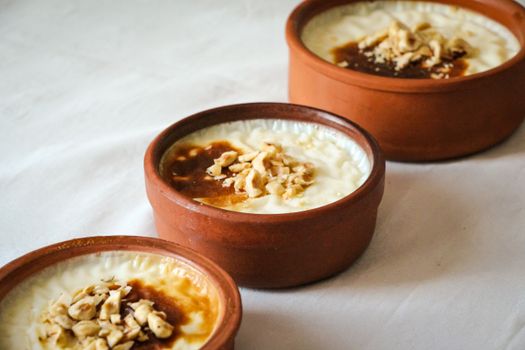
Photo: Serra Nur Çevikdal / Pexels
The diets react (see scores below)
Common Ingredients
- rice
- milk
- sugar
- rice flour
- vanilla
- egg yolk
- cinnamon
Specific recipes may vary.
Incompatible with 8 of 11 diets
Diet Ratings
Sutlac is a Turkish rice pudding that is fundamentally incompatible with a ketogenic diet. Its primary ingredients — rice, rice flour, and sugar — are all high-carb, keto-hostile foods. A single serving easily contains 40-60g of net carbs, far exceeding the entire daily keto carb budget. Rice is a starchy grain, rice flour is a refined grain product, and added sugar provides pure glucose. There is no meaningful fat content to offset the carb load, and the overall macronutrient profile is the opposite of what keto requires.
Sütlaç is a traditional Turkish rice pudding that contains multiple animal-derived ingredients. Milk is a dairy product, and egg yolk is an animal product — both are explicitly excluded under vegan dietary rules. There is no ambiguity here: this dish cannot be considered vegan in its traditional form. Plant-based versions could theoretically be made using non-dairy milk (e.g., oat or almond milk) and egg substitutes, but the default recipe as listed is not vegan.
Sutlac (Turkish rice pudding) is fundamentally incompatible with the paleo diet. It contains multiple core paleo-excluded ingredients: rice (a grain), milk (dairy), sugar (refined sweetener), and rice flour (a grain-based flour). These are not edge cases or debated items — they are clearly prohibited under all mainstream paleo frameworks. The only paleo-friendly components are vanilla, egg yolk, and cinnamon, which are entirely insufficient to redeem the dish. This is a grain-and-dairy-based dessert with refined sugar at its core, making it one of the most paleo-incompatible dish types possible.
Sutlac is a Turkish rice pudding made primarily from white rice, milk, and added sugar — a combination that conflicts with core Mediterranean diet principles. The dish is high in refined carbohydrates (white rice, rice flour) and added sugars, with no whole grains, legumes, vegetables, or healthy fats present. While dairy (milk, egg yolk) is acceptable in moderation on the Mediterranean diet, it is not the primary concern here. The main issue is that this is essentially a dessert built on refined starch and sugar, which the Mediterranean diet explicitly discourages. Occasional traditional sweets are tolerated in Mediterranean cultures, but not as a regular snack category item.
Some Mediterranean diet scholars acknowledge that traditional desserts like rice pudding, consumed occasionally and in small portions as part of a culturally rich eating pattern, are not categorically banned. The Oldways Mediterranean diet pyramid allows for occasional sweets, and in traditional Turkish and broader Ottoman-influenced Mediterranean cuisine, sutlac would be an infrequent treat rather than a daily indulgence.
Sutlac is a Turkish rice pudding that is fundamentally incompatible with the carnivore diet. The dish is predominantly plant-based: rice (grain), rice flour (grain), sugar (processed plant-derived sweetener), vanilla (plant spice), and cinnamon (plant spice) make up the bulk of the recipe. While it does contain milk and egg yolk — both animal-derived ingredients — these are minor components within an overwhelmingly plant-based dessert. No carnivore framework, even the most lenient 'animal-based' approach, would permit grains, refined sugar, or plant spices. This dish is essentially a grain-and-sugar dessert with trace animal products.
Sutlac (Turkish rice pudding) contains multiple excluded ingredients: rice (a grain), milk (dairy), and sugar (added sugar). Rice flour is also a grain product. Every core ingredient except egg yolk, vanilla, and cinnamon violates Whole30 rules. This dish cannot be made compliant without fundamentally changing its nature.
Sutlac (Turkish rice pudding) contains several individually manageable ingredients, but milk is the primary concern. Regular cow's milk is high in lactose, and a standard serving of rice pudding typically uses a significant quantity of milk per portion, making lactose the dominant FODMAP issue. Rice and rice flour are low-FODMAP staples, sugar (sucrose) is low-FODMAP in normal amounts, vanilla extract is low-FODMAP, egg yolk is low-FODMAP, and cinnamon is low-FODMAP at typical culinary amounts. The dish could be made low-FODMAP by substituting lactose-free milk, but as traditionally prepared with regular milk, a standard serving (roughly 150-200ml of milk per portion) would likely exceed the low-FODMAP lactose threshold of approximately 1 cup (250ml) only marginally — however, the cumulative lactose across the full dessert serving is a real concern. The dish sits in 'caution' territory: not inherently disqualifying at a very small portion, but a standard dessert serving would likely contain enough lactose to trigger symptoms in lactose-sensitive IBS sufferers.
Monash University rates small amounts of regular milk (up to ~100ml) as low-FODMAP, but clinical FODMAP practitioners often advise avoiding regular milk entirely during the elimination phase due to practical difficulty controlling lactose load in cooked dishes like rice pudding. Using lactose-free milk would shift this dish to a clear 'approve'.
Sutlac (Turkish rice pudding) is a dessert/sweet snack made primarily of rice, milk, sugar, rice flour, vanilla, egg yolk, and cinnamon. From a DASH perspective, this dish presents a mixed profile. On the positive side, it is low in sodium, contains no saturated-fat-heavy ingredients like full-fat cream or butter, and uses whole milk which provides calcium. The cinnamon may offer modest cardiovascular benefit. However, the dish is high in added sugar, which DASH explicitly limits, and uses white rice (refined grain) rather than a whole grain. Egg yolks contribute dietary cholesterol, though the amount per serving is moderate. The overall nutritional profile—a sugar-forward dessert with refined carbohydrates and limited fiber, potassium, or magnesium—places it outside DASH core food categories. It can be consumed occasionally in small portions but is not an encouraged DASH food. A modified version using less sugar, low-fat milk, and brown rice would score higher.
NIH DASH guidelines emphasize limiting sweets and added sugars categorically; however, some updated clinical interpretations note that small portions of low-sodium, low-saturated-fat desserts like rice pudding can fit within an overall balanced DASH pattern, particularly when made with low-fat milk, as the dairy component contributes beneficial calcium and protein.
Sutlac (Turkish rice pudding) is a dessert composed almost entirely of high-glycemic, Zone-unfavorable ingredients. Rice and rice flour are high-glycemic carbohydrates that Sears explicitly classifies as unfavorable. Added sugar compounds the glycemic problem dramatically. The dish provides virtually no protein (egg yolk and milk contribute minor amounts but are far below the 25g/meal target), no favorable fat source, and no low-glycemic carbohydrates. The macronutrient profile is wildly skewed toward carbohydrates — likely 70-80% of calories — with the carbs being predominantly high-glycemic. There is no practical way to portion this dish into a Zone-balanced meal without reducing the serving to a negligibly small amount, at which point it provides no meaningful nutritional contribution. It is essentially a concentrated sugar-starch delivery vehicle with minimal redeeming Zone-compatible components.
Sütlaç is a Turkish rice pudding made primarily of white rice, milk, sugar, rice flour, vanilla, egg yolk, and cinnamon. From an anti-inflammatory perspective, this dish is mixed. On the positive side, cinnamon is a well-recognized anti-inflammatory spice with polyphenols that can reduce oxidative stress, and vanilla contains small amounts of antioxidants. Egg yolks provide choline and some beneficial nutrients. Milk in moderate amounts is considered neutral to mildly pro-inflammatory depending on the individual. However, the core profile is problematic: white rice and rice flour are refined carbohydrates with a high glycemic index, which can spike blood glucose and promote inflammatory cytokines when consumed regularly. Added sugar is a direct concern — anti-inflammatory guidelines consistently flag added sugars as pro-inflammatory due to their role in elevating CRP and promoting AGE (advanced glycation end-products) formation. The overall dish is calorie-dense, carbohydrate-heavy, and sugar-forward, with limited fiber, omega-3s, or meaningful phytonutrient density. The saving grace is that the portions are typically small (a dessert/snack), and cinnamon's glycemic-moderating effects may partially offset some blood sugar impact. Occasional consumption is acceptable, but regular eating conflicts with anti-inflammatory principles.
Sutlac is a Turkish rice pudding made primarily from rice, milk, sugar, and rice flour, with minimal protein from egg yolk and milk. It is low in protein (roughly 4-6g per serving), low in fiber, and high in simple carbohydrates and added sugar. For GLP-1 patients, this is largely empty calories — the reduced appetite window means every meal and snack must deliver strong protein and fiber value, and sutlac fails on both counts. It is easy to digest and low in fat, which are positives, and the small portion size typical of this dessert slightly softens the impact. However, as a snack category item, it competes directly with far more nutritionally valuable options. It is not a hard avoid in the way that fried or very high-fat foods are, but it scores near the bottom of the caution range given its negligible protein, negligible fiber, and high sugar load.
*See how scores were generated at our methodology page.
Nutritional profile
Six traits that cut across every diet.
Fiber & Plants
How much whole-plant food and fiber it delivers.
Healthy Fats
The quality of its fats (unsaturated, omega-3).
Whole / Unprocessed
How close it is to its natural, unprocessed form.
Gut Gentle
How easy it is on digestion (low FODMAP, few irritants).
Low Glycemic
How little it spikes your blood sugar.
Protein Density
How much protein it packs per calorie.
Controversy Index
Higher controversy = more disagreement between diets.
Diet-Specific Tips
 DASH — 4/10
View tips
- High added sugar content — DASH explicitly limits sweets and sugary foods
- Refined white rice and rice flour — not a whole grain as emphasized by DASH
- Low sodium — a positive attribute aligned with DASH goals
- Milk provides calcium, supporting DASH's emphasis on dairy-derived minerals
- Egg yolk contributes dietary cholesterol — moderate concern under conservative DASH interpretations
- No significant source of potassium, magnesium, or dietary fiber
- Small portion dessert role may be acceptable occasionally within an otherwise DASH-compliant diet
 Anti-Inflammatory — 4/10
View tips
- High in added sugar — directly pro-inflammatory, raises CRP and AGEs
- White rice and rice flour are refined carbohydrates with high glycemic index
- Low fiber content — lacks the gut-health and anti-inflammatory benefits of whole grains
- Cinnamon is a notable anti-inflammatory spice that partially offsets the profile
- Milk is neutral to mildly pro-inflammatory depending on individual tolerance
- No omega-3 fatty acids, antioxidant-rich vegetables, or significant phytonutrients
- Small portion size (snack/dessert) limits overall inflammatory burden if eaten occasionally
 GLP-1 Friendly — 5/10
View tips
- Very low protein (~4-6g per serving) — fails the #1 GLP-1 dietary priority
- Negligible fiber — fails the #2 priority and does not support constipation prevention
- High added sugar and refined carbohydrates from rice, rice flour, and sugar
- Easy to digest and low in fat — minor positives that prevent a score of 1-2
- Small typical portion size slightly limits glycemic and caloric damage
- As a snack, it displaces high-protein, high-fiber alternatives that GLP-1 patients critically need