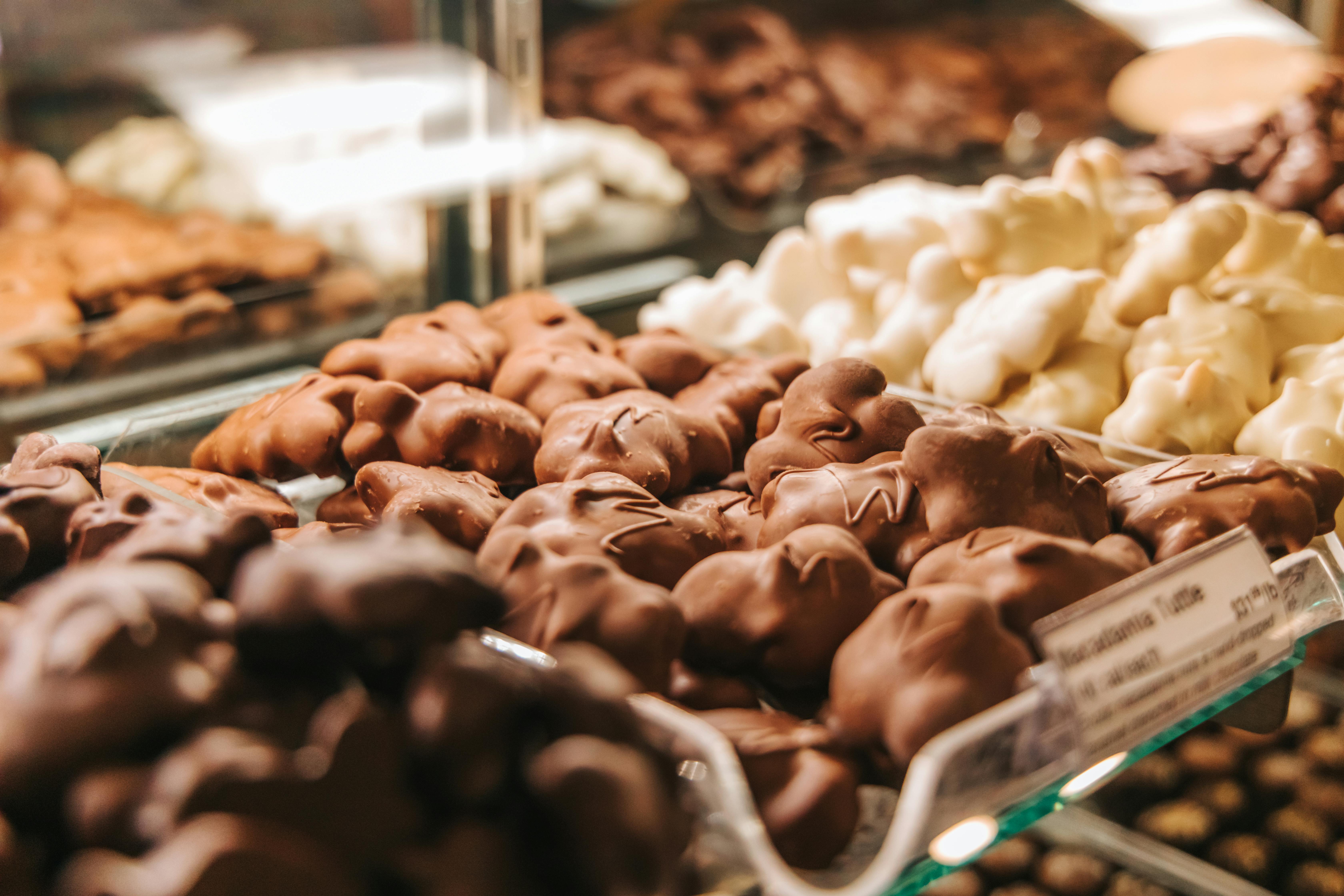
Photo: Henry Becerra / Pexels
American
Turtle Candy
The diets react (see scores below)
Common Ingredients
- pecans
- caramel
- chocolate
- butter
- sugar
Specific recipes may vary.
Incompatible with 11 of 11 diets
Diet Ratings
Turtle Candy is fundamentally incompatible with ketogenic eating. The core ingredients — caramel (made from sugar and butter), chocolate (typically milk chocolate with added sugar), and additional sugar — create an extremely high net carb load. A single piece of turtle candy can contain 15-25g of net carbs, meaning even one or two pieces could exceed a full day's keto carb allowance. While pecans are keto-friendly and butter is fine, they are minor components overwhelmed by massive sugar content. Caramel is essentially pure sugar syrup, and standard chocolate used in candy is loaded with sugar. There is no meaningful way to consume traditional turtle candy within ketogenic limits.
Turtle Candy contains butter, which is an animal-derived dairy product, making it non-vegan. Traditional caramel is also typically made with butter and heavy cream (dairy), compounding the issue. Chocolate in the standard recipe often contains milk or milk solids. While pecans and sugar are plant-based, the majority of ingredients in this classic American confection are animal-derived. Vegan versions can theoretically be made using plant-based butter, dairy-free caramel (coconut milk or oat milk based), and dark vegan chocolate, but the traditional dish as listed is not vegan-compliant.
Turtle Candy is a highly processed confection that violates multiple core paleo principles simultaneously. Caramel is made from refined sugar and typically dairy (cream, butter); chocolate in this context refers to conventional milk or semi-sweet chocolate containing refined sugar, dairy, and often soy lecithin; and added sugar appears explicitly as an ingredient. While pecans are paleo-approved and butter occupies a gray area, the dominant ingredients — refined sugar, caramel (sugar + dairy), and processed chocolate — make this dish unambiguously non-paleo. This is a processed candy product with no meaningful hunter-gatherer analog.
Turtle Candy is a confection built almost entirely on ingredients that contradict Mediterranean diet principles. Caramel and sugar represent significant added sugars, butter contributes saturated fat in place of the preferred extra virgin olive oil, and chocolate in candy form adds further sugar and processed ingredients. While pecans are a Mediterranean-friendly nut, they are overwhelmed by the surrounding candy matrix. This is a highly processed American sweet treat with no meaningful place in the Mediterranean dietary pattern.
Turtle Candy is entirely incompatible with the carnivore diet. Every ingredient violates carnivore principles: pecans are plant-based nuts, caramel is made from sugar and often plant-based additives, chocolate is derived from cacao (a plant), and sugar is a plant-derived sweetener. While butter is an animal product, it is a minor component in a dish that is fundamentally a plant-based, high-sugar confection. There is no animal protein and no nutritional profile that aligns with carnivore eating. This is a processed sugar-laden snack with zero carnivore-compatible value.
Turtle Candy contains multiple Whole30-excluded ingredients. Sugar is explicitly excluded as an added sugar. Caramel is made from sugar (and often dairy). Chocolate typically contains sugar and dairy. Butter is excluded dairy. Additionally, even if somehow all ingredients were compliant, this is clearly a candy/confection — exactly the type of junk food recreation the Whole30 program prohibits. There is no path to making this dish Whole30-compliant while retaining its identity as turtle candy.
Turtle candy contains pecans, caramel, chocolate, butter, and sugar. Pecans are low-FODMAP at a standard serving (~20 halves or ~30g). Dark or milk chocolate is low-FODMAP in small portions (~30g dark chocolate is safe; milk chocolate has lactose concerns at larger amounts). Butter is low-FODMAP (very low lactose). Plain sugar (sucrose) is low-FODMAP. The main concern is caramel: traditional caramel is typically made with cream and butter, and cream in small amounts is low-FODMAP, but some commercial caramel recipes include high-fructose corn syrup or large amounts of lactose-containing dairy which can push FODMAP levels up. A single turtle candy (roughly 20-30g total) is likely borderline safe, but eating 2-3 pieces — a normal snacking portion — raises the cumulative lactose and possibly excess fructose load. The candy is not inherently high-FODMAP in strict single-piece terms, but in realistic serving quantities the caramel's dairy content and potential HFCS in commercial versions creates meaningful risk.
Monash University has not specifically tested turtle candy as a composite food. Clinical FODMAP practitioners often caution that commercial caramel confections frequently contain HFCS or cream in quantities that push lactose and excess fructose into problematic territory, especially at typical multi-piece servings; strict elimination phase guidance would suggest limiting to one small piece or avoiding commercial versions entirely.
Turtle Candy is a confection built almost entirely from ingredients that DASH explicitly discourages: added sugars (caramel, sugar, chocolate), saturated fat (butter, chocolate), and while pecans offer some heart-healthy unsaturated fats, they are a minor nutritional bright spot drowned out by the candy's overall composition. The dish is high in added sugar, saturated fat, and calories with virtually no fiber, potassium, magnesium, or calcium relative to its caloric load. DASH guidelines clearly limit sweets and foods with high added sugar content, placing this firmly in the 'avoid' category.
Turtle candy is a confection composed almost entirely of high-glycemic, nutritionally empty carbohydrates (caramel and sugar/chocolate) combined with saturated fat (butter, chocolate) and no protein whatsoever. The macro profile is essentially the opposite of the Zone's 40/30/30 target — it is dominated by fast-burning sugars and fat with zero lean protein to balance the hormonal response. Caramel and sugar are among the highest-glycemic ingredients possible, triggering a massive insulin spike that directly contradicts Zone methodology. While pecans do provide some monounsaturated fat and are Zone-friendly in isolation, they are a minor component here overwhelmed by sugar and caramel. There is no practical portion size at which turtle candy can be incorporated into a Zone-balanced meal or snack without severely distorting the block ratios. It contains no favorable Zone carbohydrates (vegetables, low-GI fruit), no lean protein, and its fat profile is skewed toward saturated fat rather than monounsaturated. This falls squarely in the category of foods Dr. Sears explicitly identifies as unfavorable and disruptive to eicosanoid balance.
Turtle Candy is a confection built almost entirely around ingredients that are pro-inflammatory or neutral at best. Caramel is essentially cooked sugar and butter — delivering high added sugar and saturated fat, both well-established drivers of inflammatory markers (CRP, IL-6). Butter contributes saturated fat, which at these quantities exceeds the 'moderate' threshold in anti-inflammatory frameworks. The chocolate, unless specified as dark (>70% cacao), is likely milk chocolate or semi-sweet with significant added sugar and dairy — losing the polyphenol benefits of true dark chocolate. Sugar (added, refined) is a central ingredient and is unambiguously pro-inflammatory across all anti-inflammatory nutrition authorities. Pecans are the one redeeming element — they contain omega-3 ALA, monounsaturated fats, polyphenols, and magnesium, all with anti-inflammatory properties. However, the quantity of pecans relative to the sugar, caramel, and butter load is insufficient to offset the overall inflammatory profile. This is a treat food with no meaningful anti-inflammatory benefit as formulated.
Turtle candy is a high-sugar, high-fat confection with virtually no redeeming nutritional value for GLP-1 patients. The combination of caramel (concentrated sugar), chocolate (sugar plus saturated fat from cocoa butter), butter (saturated fat), and added sugar delivers dense empty calories with negligible protein and minimal fiber. While pecans provide some unsaturated fat and trace nutrients, they do not meaningfully offset the sugar load or caloric density. High sugar content spikes blood glucose and undermines the metabolic goals GLP-1 medications support. The high fat content — particularly saturated fat from butter and chocolate — is likely to worsen GLP-1 side effects including nausea, bloating, and reflux, given slowed gastric emptying. The caloric density is extremely high relative to nutritional return, which is especially harmful when total intake is already reduced. This food scores against nearly every GLP-1 dietary priority: zero protein, low fiber, high saturated fat, high sugar, poor digestibility in the context of delayed gastric emptying, and zero nutrient density per calorie.
*See how scores were generated at our methodology page.
Nutritional profile
Six traits that cut across every diet.
Fiber & Plants
How much whole-plant food and fiber it delivers.
Healthy Fats
The quality of its fats (unsaturated, omega-3).
Whole / Unprocessed
How close it is to its natural, unprocessed form.
Gut Gentle
How easy it is on digestion (low FODMAP, few irritants).
Low Glycemic
How little it spikes your blood sugar.
Protein Density
How much protein it packs per calorie.
Controversy Index
Higher controversy = more disagreement between diets.