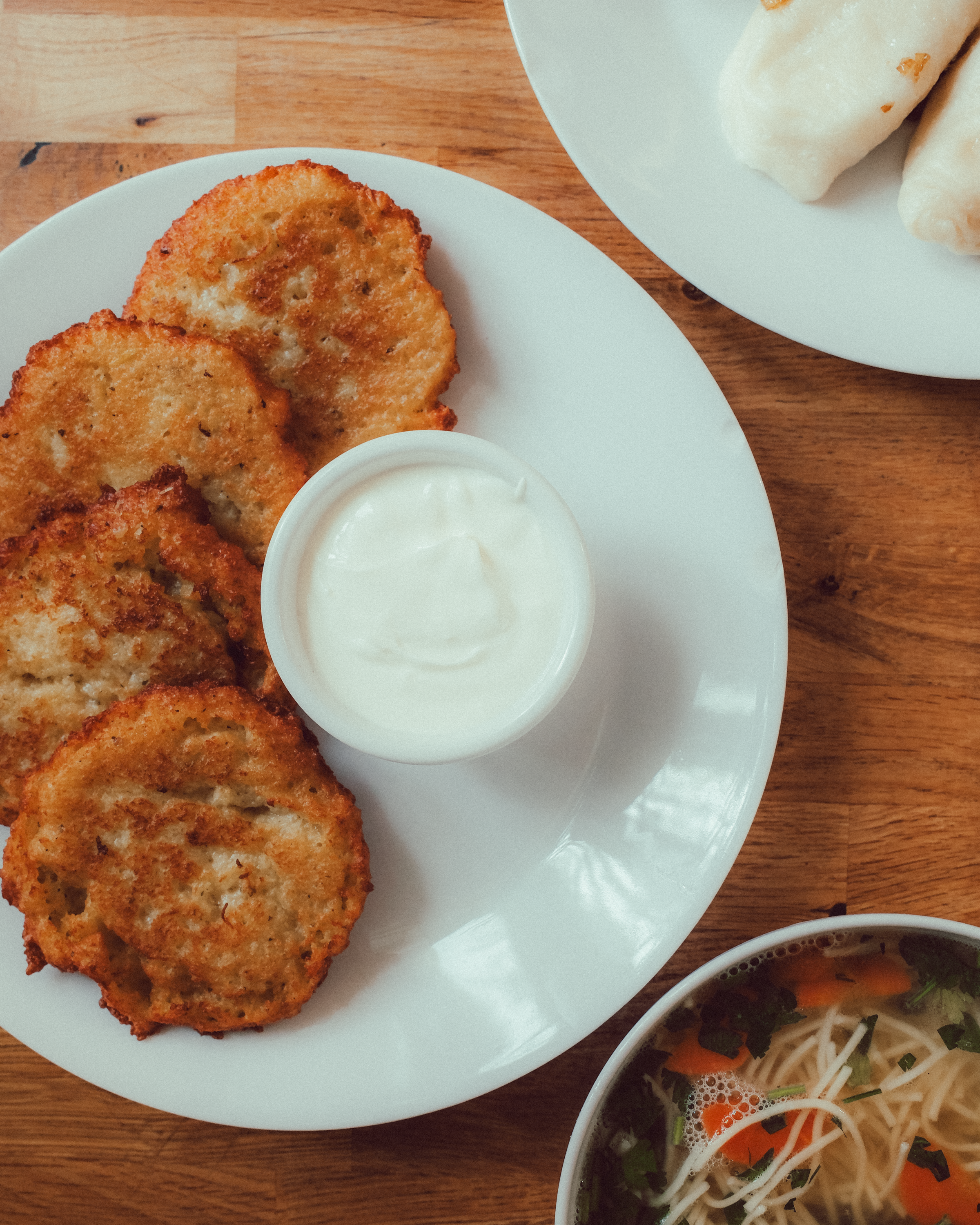
Photo: Anh Nguyen / Pexels
The diets react (see scores below)
Common Ingredients
- potatoes
- onion
- eggs
- flour
- salt
- pepper
- oil
- sour cream
Specific recipes may vary.
Incompatible with 8 of 11 diets
Diet Ratings
Deruny (Ukrainian potato pancakes) are fundamentally incompatible with ketogenic diets. The primary ingredient is potatoes, which are extremely high in net carbs — a single medium potato contains roughly 30-35g of net carbs. Combined with flour as a binding agent (another high-carb ingredient), a standard serving of deruny would easily exceed the entire daily carb allowance for ketosis (20-50g). The eggs, oil, and sour cream are keto-friendly, but they are minor components that cannot offset the massive carb load from the potatoes and flour. This dish is a classic starchy side dish with no realistic portion size that would keep it keto-compatible.
Deruny (Ukrainian potato pancakes) contain multiple animal-derived ingredients that disqualify them from a vegan diet. Eggs are a direct animal product used as a binder, and sour cream is a dairy product typically served as a topping or mixed into the batter. These are not trace contaminants but core, functional ingredients in the traditional recipe. The dish could theoretically be made vegan by substituting flax eggs or aquafaba for eggs and using plant-based sour cream, but the traditional version as listed is not vegan-compliant.
Deruny (Ukrainian potato pancakes) contain multiple non-paleo ingredients that make this dish incompatible with the paleolithic diet. Flour is a grain derivative and strictly excluded. Salt is a processed additive excluded from paleo. Sour cream is a dairy product, also excluded. The oil used is unspecified but traditionally a seed oil (sunflower is standard in Ukrainian cooking), which is excluded. White potatoes are themselves debated or discouraged. With at least four clearly non-paleo ingredients — flour, salt, sour cream, and likely seed oil — this dish is firmly in the avoid category regardless of how one resolves the potato debate.
Deruny are Ukrainian potato pancakes made from grated potatoes, onion, eggs, flour, and served with sour cream. While potatoes are a whole vegetable and onions are Mediterranean-friendly, this dish has several concerns from a Mediterranean diet perspective. The dish is typically fried in oil (ideally olive oil, but often neutral oils), uses refined flour as a binder, and is served with sour cream — a moderate-fat dairy product. The overall composition is starchy and calorie-dense with limited nutritional breadth. Eggs and sour cream place this in the 'moderation' category for dairy/eggs. If fried in extra virgin olive oil, it aligns somewhat better, but the refined flour, absence of vegetables beyond potato and onion, and sour cream topping make this a peripheral rather than core Mediterranean food. Acceptable occasionally as a side dish, but not a staple.
Some Mediterranean diet interpreters would note that potato-based dishes fried in olive oil, accompanied by small amounts of dairy, are not dramatically different from traditional Spanish tortilla or Greek potato dishes, suggesting this could be eaten more freely if olive oil is used and portions are modest. However, the sour cream accompaniment and refined flour binder distinguish it from those closer Mediterranean analogues.
Deruny (Ukrainian potato pancakes) are almost entirely plant-based. The primary ingredient is potatoes, a starchy tuber, accompanied by onion, flour, and plant oil — all strictly forbidden on the carnivore diet. While the dish contains eggs and sour cream (animal-derived), these are minor components in a recipe that is fundamentally built on plant foods. There is no meaningful animal protein source. This dish is incompatible with the carnivore diet in any of its forms.
Deruny (Ukrainian potato pancakes) contain multiple excluded ingredients. Flour is a grain product, which is explicitly excluded on Whole30. Sour cream is dairy, also explicitly excluded. Additionally, even if these two ingredients were removed, the dish is essentially a potato pancake — a form of pancake/fritter that falls squarely under the 'no recreating baked goods/junk food' rule (Rule 4), which explicitly lists pancakes as a prohibited food form regardless of ingredient compliance.
Deruny (Ukrainian potato pancakes) contains two high-FODMAP ingredients that make it unsuitable during the elimination phase. Onion is one of the highest-FODMAP foods tested by Monash University, containing significant fructans even in small quantities — there is no safe serving size of onion during elimination. Sour cream is high in lactose and is rated high-FODMAP at standard serving sizes (Monash rates it as high-FODMAP at 2 tablespoons/40g). Flour, if wheat-based, adds fructans. Potatoes, eggs, salt, pepper, and oil are all low-FODMAP. However, the combination of onion and sour cream makes this dish a clear avoid during the elimination phase without significant recipe modification.
Deruny (Ukrainian potato pancakes) are made primarily from potatoes, which are a DASH-friendly vegetable rich in potassium. However, the dish is typically pan-fried in oil, which increases fat content significantly. The added salt raises sodium concerns, and the traditional sour cream topping is full-fat dairy, which DASH guidelines discourage. The frying method and sour cream together push this dish into 'caution' territory — it contains some DASH-compatible ingredients (potatoes, onion, eggs) but the preparation method and accompaniments undermine its nutritional profile. Portion control and preparation modifications (baking instead of frying, using low-fat sour cream or plain low-fat yogurt) would meaningfully improve its DASH compatibility.
NIH DASH guidelines emphasize low-fat dairy and limited added fats, which would flag the frying oil and full-fat sour cream. However, updated clinical interpretations note that potatoes are a potassium-rich DASH staple, eggs are now generally accepted in moderation post-2020 Dietary Guidelines revision, and small amounts of unsaturated cooking oil align with DASH principles — some DASH clinicians would consider a baked or lightly pan-fried version with low-fat yogurt as a reasonable DASH side dish.
Deruny (Ukrainian potato pancakes) are fundamentally incompatible with Zone Diet principles. The primary ingredient — potatoes — is explicitly listed by Dr. Sears as a high-glycemic, unfavorable carbohydrate to avoid. Potatoes have a high glycemic index and glycemic load, causing rapid insulin spikes that directly oppose the Zone's core goal of hormonal control. The dish is then compounded by refined white flour (another high-GI carb), frying in oil (likely omega-6-heavy vegetable oil), and serving with full-fat sour cream (saturated fat). Critically, there is no lean protein present, making the macronutrient ratio wildly skewed — this dish is almost entirely carbohydrates and fat with negligible protein, the polar opposite of the 40/30/30 Zone target. The small amount of egg provides minimal protein but nowhere near the 7g per block needed to balance even a modest carb serving. Even with aggressive portion control, the potato base makes it nearly impossible to construct a balanced Zone block from this dish without fundamentally changing its character.
Deruny (Ukrainian potato pancakes) present a mixed anti-inflammatory profile. On the positive side, potatoes contain vitamin C, potassium, and resistant starch (especially when cooled), and onions provide quercetin, a meaningful anti-inflammatory flavonoid. Eggs contribute choline and selenium with some anti-inflammatory benefit. However, the dish is fundamentally a refined-starch, fried food: grated potatoes have a high glycemic index, white flour adds refined carbohydrates, and frying in oil (typically sunflower or vegetable oil, common in Ukrainian cooking) introduces a significant omega-6 load and oxidation potential. Sour cream, a full-fat dairy topping, adds saturated fat — a category to limit on anti-inflammatory frameworks. The preparation method (pan-frying) rather than baking further tips the balance toward a neutral-to-mildly-inflammatory profile. This dish is not inherently harmful in occasional consumption but lacks meaningful anti-inflammatory benefits and carries several features (high-GI starch, frying oil, full-fat dairy) that anti-inflammatory frameworks flag. Substituting extra virgin olive oil for frying, using whole-grain flour, and swapping sour cream for a small amount of Greek yogurt would improve the profile.
Some integrative nutrition practitioners note that whole potatoes (before processing into ultra-refined forms) contain anti-inflammatory compounds including chlorogenic acid and have a place in traditional whole-food diets. Dr. Weil's framework does not categorically exclude potatoes or eggs, and critics of strict anti-inflammatory scoring argue that traditional whole-food dishes like deruny are far preferable to processed convenience foods sharing a similar macronutrient profile. The frying oil choice is pivotal: if prepared with extra virgin olive oil, the inflammatory concern drops considerably.
Deruny are Ukrainian potato pancakes that are fried in oil — a preparation method that disqualifies them on multiple GLP-1 criteria simultaneously. The base is starchy, refined potato with minimal fiber per serving, virtually no meaningful protein (eggs and flour contribute small amounts, but not enough to matter at typical serving sizes), and the frying process adds substantial fat that worsens nausea, bloating, and reflux — the core GI side effects of GLP-1 medications. Sour cream as a topping adds saturated fat and minimal nutritional value. The dish is calorie-dense relative to its nutrient contribution, making it a poor use of the reduced appetite window GLP-1 patients are working within. As a side dish with no primary protein, it provides little to justify its caloric and fat load.
*See how scores were generated at our methodology page.
Nutritional profile
Six traits that cut across every diet.
Fiber & Plants
How much whole-plant food and fiber it delivers.
Healthy Fats
The quality of its fats (unsaturated, omega-3).
Whole / Unprocessed
How close it is to its natural, unprocessed form.
Gut Gentle
How easy it is on digestion (low FODMAP, few irritants).
Low Glycemic
How little it spikes your blood sugar.
Protein Density
How much protein it packs per calorie.
Controversy Index
Higher controversy = more disagreement between diets.
Diet-Specific Tips
 Mediterranean — 4/10
View tips
- Potatoes are a whole vegetable but starchy and calorie-dense
- Refined flour binder reduces whole-grain alignment
- Sour cream is a moderate dairy fat, acceptable in small amounts but not core
- Frying method and oil type are critical — olive oil improves compatibility
- Eggs are acceptable in moderation per Mediterranean guidelines
- Dish lacks the vegetable diversity and plant-forward emphasis of Mediterranean staples
- No legumes, whole grains, or seafood — low nutritional breadth
 DASH — 4/10
View tips
- Potatoes are potassium-rich and DASH-approved vegetables
- Pan-frying in oil significantly increases total fat content
- Full-fat sour cream conflicts with DASH low-fat dairy recommendation
- Added salt increases sodium load — preparation-dependent
- Onion and eggs are acceptable DASH ingredients in moderation
- Baking instead of frying and substituting low-fat yogurt for sour cream would improve DASH score
- Refined white flour offers minimal fiber benefit
 Anti-Inflammatory — 4/10
View tips
- High glycemic index from grated potatoes and white flour — refined carbohydrates raise blood glucose and can promote inflammatory markers
- Frying oil (typically sunflower or vegetable oil in traditional recipes) is high in omega-6 fatty acids and prone to oxidation at high heat
- Sour cream topping adds saturated fat from full-fat dairy, a category to limit in anti-inflammatory frameworks
- Onions provide quercetin, a well-researched anti-inflammatory flavonoid — a genuine positive
- Eggs contribute choline and selenium with moderate anti-inflammatory support
- Pan-frying preparation method increases overall inflammatory potential compared to baking or steaming
- Potatoes contain vitamin C, potassium, and chlorogenic acid — modest but real anti-inflammatory contributions