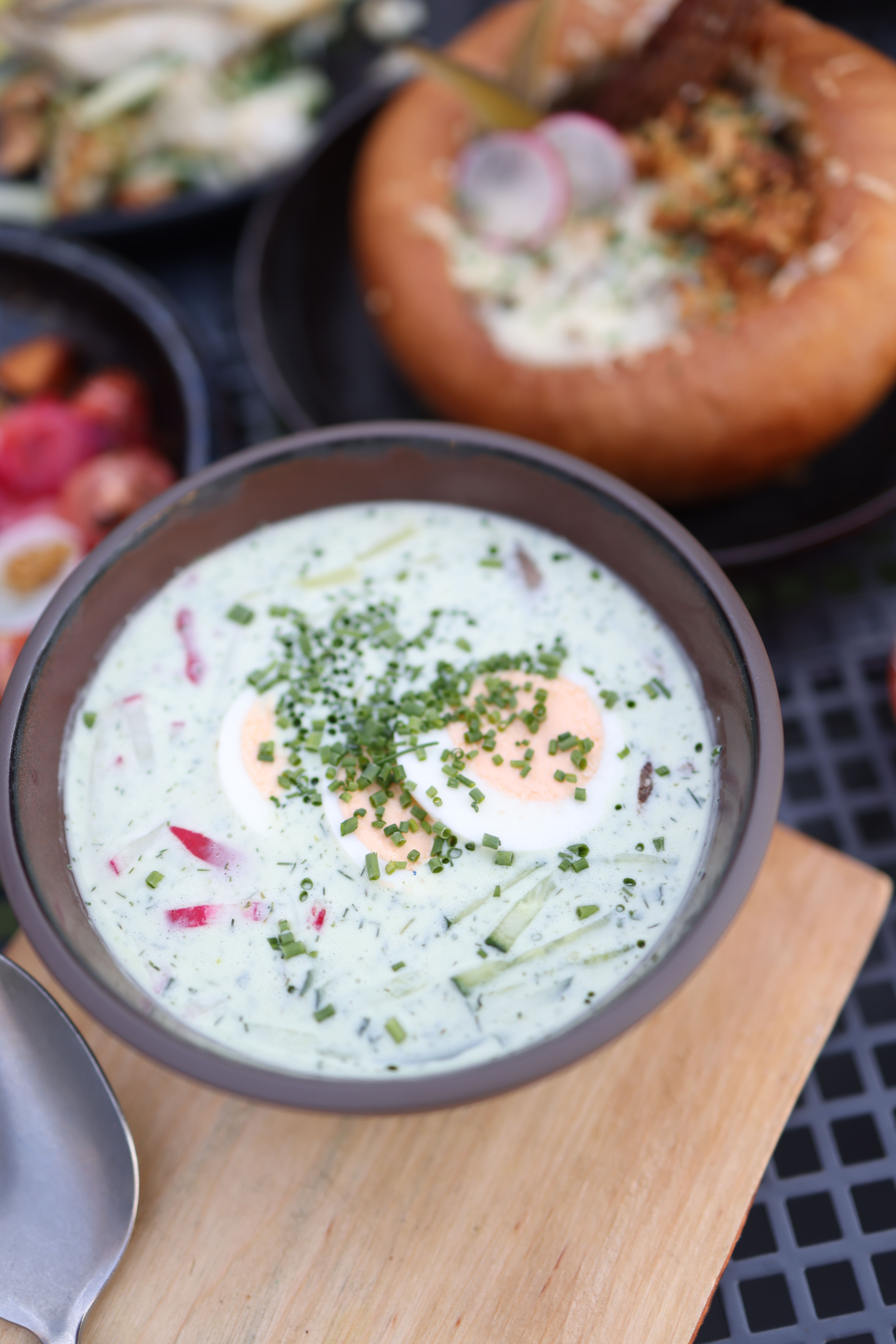
Photo: Valeria Boltneva / Pexels
The diets react (see scores below)
Common Ingredients
- kvass
- cucumbers
- radishes
- eggs
- potatoes
- dill
- green onions
- sour cream
Specific recipes may vary.
Incompatible with 6 of 11 diets
Diet Ratings
Okroshka is fundamentally incompatible with a ketogenic diet due to two major ingredients: kvass and potatoes. Kvass is a fermented beverage made from bread (rye), containing significant carbohydrates and residual sugars — it is grain-derived and sugar-laden. Potatoes are a high-starch vegetable, with a medium potato containing roughly 30g of net carbs alone, which could single-handedly exceed a strict keto daily limit. Together, these two ingredients make the dish a keto non-starter. The remaining ingredients — cucumbers, radishes, eggs, dill, green onions, and sour cream — are individually keto-friendly or borderline acceptable, but they cannot offset the core incompatibility of the dish's base and starchy component.
Okroshka as described contains multiple animal-derived ingredients that disqualify it from a vegan diet. Eggs are a direct animal product (excluded under Rule 1), and sour cream is a dairy product also excluded under Rule 1. These are core components of this traditional Ukrainian cold soup, not optional garnishes. The remaining ingredients — kvass, cucumbers, radishes, potatoes, dill, and green onions — are all plant-based and would be perfectly vegan-compatible. However, the presence of two distinct animal products makes the dish clearly non-vegan. A vegan version could theoretically be prepared by substituting eggs with tofu or chickpeas and replacing sour cream with a plant-based alternative (e.g., cashew cream or vegan sour cream), but the dish as listed cannot be approved.
Okroshka contains multiple non-paleo ingredients that make it clearly incompatible with the Paleolithic diet. Kvass is a fermented beverage made from rye bread or other grains, placing it firmly in the excluded grains/processed category. Sour cream is dairy, which is excluded under paleo guidelines. Potatoes are debated at best, but even granting them, they cannot redeem a dish anchored by two hard-avoid ingredients. The paleo-compliant elements — cucumbers, radishes, eggs, dill, and green onions — are outnumbered and outweighed by the core structural components (kvass as the soup base, sour cream as the dressing) that violate fundamental paleo principles. This is not a borderline case.
Okroshka is a cold Ukrainian soup with a mixed Mediterranean diet profile. The vegetable-heavy base (cucumbers, radishes, green onions, dill) and eggs align reasonably well with Mediterranean principles. Potatoes are acceptable whole-food carbohydrates. However, kvass (a fermented rye bread drink) acts as a refined/fermented grain base rather than a whole grain, and sour cream replaces the preferred olive oil as the fat source. Eggs are acceptable in moderation (a few per week). The dish lacks olive oil entirely and centers on dairy fat and a non-traditional grain liquid. Overall it is a moderately acceptable dish—nutritious and whole-food oriented—but it diverges from Mediterranean fat and grain priorities.
Some Mediterranean diet interpreters would view the fermented kvass base favorably for its probiotic qualities and the dish's abundance of raw vegetables, rating it more positively. Others following stricter clinical guidelines (e.g., those aligned with the PREDIMED study framework) would note the absence of olive oil and over-reliance on dairy fat as meaningful departures from core Mediterranean principles.
Okroshka is a traditional cold Ukrainian soup that is almost entirely plant-based and incompatible with the carnivore diet. The base is kvass, a fermented grain beverage (plant-derived), and the dish is loaded with vegetables: cucumbers, radishes, potatoes, dill, and green onions — all strictly excluded plant foods. Eggs and sour cream are the only animal-derived ingredients, but they represent a minor fraction of the dish. The overwhelming majority of this recipe consists of foods that violate every tier of the carnivore diet, including the most lenient versions. There is no meaningful way to adapt this dish while retaining its identity.
Okroshka contains two clearly excluded ingredients: kvass and sour cream. Kvass is a fermented beverage made from bread (typically rye), making it both an alcohol-containing drink and a grain-derived product — both categories are excluded on Whole30. Sour cream is dairy, which is explicitly excluded on Whole30 (ghee and clarified butter are the only dairy exceptions). The remaining ingredients — cucumbers, radishes, eggs, potatoes, dill, and green onions — are all Whole30-compliant, but the dish as traditionally prepared cannot be made compliant without fundamentally changing its character, since kvass is the defining base liquid of okroshka.
Okroshka contains multiple high-FODMAP ingredients that make it problematic during the elimination phase. Kvass (fermented rye/bread-based drink) is high in fructans due to its rye and wheat base — this is the primary liquid component and a major FODMAP concern. Green onions (the white/bulb parts) are high in fructans, though the green tops are low-FODMAP; traditional recipes typically use the whole onion. Sour cream contains lactose and is high-FODMAP at standard serving sizes (a dollop in soup would exceed the low-FODMAP threshold of ~2 tbsp). The remaining ingredients — cucumbers, radishes (in moderate amounts), eggs, potatoes, and dill — are individually low-FODMAP. However, the combination of kvass as the base liquid, green onions, and sour cream creates a dish that is high-FODMAP as traditionally prepared. Substitutions (lactose-free sour cream, green onion tops only, and a low-FODMAP kvass alternative) would be required to make this dish compliant.
Monash University has not specifically tested kvass, creating uncertainty about its exact FODMAP load — some fermentation processes reduce fructan content significantly, so a long-fermented kvass might be lower in FODMAPs than assumed. Clinical FODMAP practitioners would still advise avoiding kvass during elimination given its rye/wheat base, and the lactose in sour cream alone makes standard okroshka unsuitable without modification.
Okroshka is a cold Ukrainian soup with a mix of DASH-friendly and DASH-concerning ingredients. The vegetables (cucumbers, radishes, green onions, dill) and eggs are generally acceptable on DASH. Potatoes provide potassium and are acceptable in moderation. However, kvass — the fermented bread-based liquid base — can contain moderate to significant sodium and added sugars depending on preparation, and sour cream introduces saturated fat (full-fat dairy is limited on DASH). The combination of sour cream and kvass pulls this dish away from ideal DASH alignment. If sour cream were replaced with low-fat plain yogurt and low-sodium kvass or a low-sodium kefir base were used, this dish would score considerably higher. As commonly prepared, it sits in the caution zone due to saturated fat from sour cream and variable sodium from kvass.
NIH DASH guidelines explicitly limit full-fat dairy and emphasize low-sodium foods, which flags sour cream and traditional kvass as concerns. However, updated clinical interpretations note that recent evidence does not consistently link moderate full-fat fermented dairy consumption to worse cardiovascular outcomes, and some DASH-oriented practitioners would permit small amounts of sour cream as a garnish while focusing on the dish's overall vegetable density and potassium content from cucumbers, radishes, and potatoes.
Okroshka presents a mixed Zone Diet profile. On the positive side, cucumbers, radishes, dill, and green onions are excellent low-glycemic Zone-favorable vegetables, and eggs provide a reasonable lean protein source. However, several ingredients create challenges: (1) Kvass, the fermented rye bread drink base, is relatively high-glycemic and contains sugars from fermentation, making it an 'unfavorable' carbohydrate source that spikes the glycemic load of the dish. (2) Potatoes are explicitly listed as an 'unfavorable' high-glycemic carbohydrate in Dr. Sears' Zone framework and should be avoided or drastically minimized. (3) Sour cream contributes saturated fat rather than the preferred monounsaturated fat, and adds caloric fat without Zone-favorable lipid profiles. The combination of kvass and potatoes in a single dish makes achieving a 40/30/30 block balance very difficult without significant modification — essentially removing or replacing two core ingredients. The protein from eggs is Zone-compatible but the overall dish skews carb-heavy with unfavorable glycemic sources and lacks lean protein density sufficient for a proper Zone meal without supplementation.
Some Zone practitioners, particularly those following Sears' later anti-inflammatory writings, might argue that if potatoes are used in very small quantities and kvass is consumed in a modest portion, the vegetable-rich base (cucumbers, radishes, green onions, dill) provides meaningful polyphenols and fiber that align with Sears' emphasis on anti-inflammatory eating. A modified okroshka replacing kvass with kefir or low-fat buttermilk (which Sears sometimes recommends as a protein-containing liquid base) and omitting potatoes could be elevated to a moderate Zone meal.
Okroshka is a traditional Eastern European cold soup with a mixed anti-inflammatory profile. On the positive side, cucumbers provide hydration and anti-inflammatory flavonoids, radishes contain glucosinolates and antioxidants, dill and green onions offer quercetin and polyphenols, and eggs provide choline and selenium with some anti-inflammatory benefit. These vegetable components align well with anti-inflammatory principles. However, the dish has several limiting factors: potatoes are a starchy refined-carbohydrate-adjacent vegetable with moderate glycemic impact; sour cream is a full-fat dairy product that falls in the 'limit' category due to saturated fat; and kvass — a fermented bread-based beverage — contains refined grain derivatives, small amounts of alcohol, and added sugars depending on preparation, though fermentation does introduce some beneficial organic acids and probiotics. Eggs are a moderately contested food in anti-inflammatory contexts. Overall, the dish is not strongly pro-inflammatory, but it lacks the omega-3s, deep-colored antioxidants, and anti-inflammatory spices that would elevate it. The sour cream and kvass base are the primary concerns.
Some anti-inflammatory practitioners would rate this more favorably, emphasizing the fermented kvass base (with probiotic-adjacent organic acids), the diversity of fresh vegetables, and the moderate egg content — aligning with Dr. Weil's acceptance of eggs and low-fat dairy in moderation. Conversely, stricter AIP-leaning practitioners might flag both the full-fat sour cream (dairy) and the fermented grain-based kvass as problematic, pushing this closer to 'avoid' for individuals with autoimmune sensitivities.
Okroshka is a cold Ukrainian soup with a mixed nutritional profile for GLP-1 patients. The base is kvass — a fermented bread beverage that is lightly carbonated and contains a small amount of alcohol, both of which are problematic: carbonation can worsen bloating and nausea. Sour cream adds saturated fat with limited protein payoff. On the positive side, eggs provide meaningful protein, cucumbers and radishes are high-water-content, easy-to-digest vegetables that support hydration, and dill and green onions are nutrient-dense aromatics. Potatoes add digestible carbohydrates and some fiber but are starchy with limited protein. The overall protein density of the dish is low relative to GLP-1 targets (15–30g per meal), and the kvass base is the most significant concern. A modified version using kefir or plain low-fat yogurt as the base instead of kvass — a common regional variation — would significantly improve the rating by eliminating carbonation and alcohol while boosting protein and probiotics.
Some GLP-1-aware dietitians may consider a small portion acceptable given the high water content, vegetable diversity, and easy digestibility of most ingredients — particularly for patients experiencing nausea who need gentle, cold foods. However, the kvass base is a consistent concern due to carbonation and alcohol content, and most obesity medicine guidance would recommend modifying or avoiding that component specifically.
*See how scores were generated at our methodology page.
Nutritional profile
Six traits that cut across every diet.
Fiber & Plants
How much whole-plant food and fiber it delivers.
Healthy Fats
The quality of its fats (unsaturated, omega-3).
Whole / Unprocessed
How close it is to its natural, unprocessed form.
Gut Gentle
How easy it is on digestion (low FODMAP, few irritants).
Low Glycemic
How little it spikes your blood sugar.
Protein Density
How much protein it packs per calorie.
Controversy Index
Higher controversy = more disagreement between diets.
Diet-Specific Tips
 Mediterranean — 5/10
View tips
- Good variety of raw vegetables (cucumbers, radishes, green onions, dill) supports plant-forward emphasis
- Eggs are acceptable in moderation but are not a Mediterranean staple protein
- Kvass is a fermented grain beverage, not a Mediterranean whole grain carbohydrate
- Sour cream provides saturated dairy fat instead of the preferred extra virgin olive oil
- Potatoes are a whole-food carbohydrate but not a Mediterranean dietary staple
- No olive oil present in the dish
- Dish is minimally processed and free of added sugars
 DASH — 5/10
View tips
- Kvass base may contain moderate sodium and added sugars depending on preparation
- Sour cream is full-fat dairy, limited on DASH
- Cucumbers, radishes, dill, and green onions are DASH-approved low-sodium vegetables
- Eggs are acceptable in moderation on DASH
- Potatoes provide potassium but should be portion-controlled
- Dish is vegetable-forward, which aligns with DASH principles
- Low-fat yogurt substitution for sour cream and low-sodium kvass would significantly improve DASH compatibility
 Zone — 4/10
View tips
- Kvass is a fermented, sugar-containing, high-glycemic liquid base — classified as an unfavorable Zone carbohydrate
- Potatoes are explicitly 'unfavorable' in Zone terminology due to high glycemic index
- Cucumbers, radishes, dill, and green onions are Zone-favorable low-glycemic vegetables
- Eggs provide lean protein compatible with Zone blocks (~7g protein per egg)
- Sour cream contributes saturated fat rather than preferred monounsaturated fat
- Overall dish is carbohydrate-heavy with poor glycemic quality, making 40/30/30 balance difficult
- Dish lacks sufficient lean protein density for a standalone Zone meal without modification
 Anti-Inflammatory — 5/10
View tips
- Cucumbers, radishes, green onions, and dill provide anti-inflammatory polyphenols and antioxidants
- Sour cream (full-fat dairy) contributes saturated fat — in the 'limit' category
- Kvass (fermented bread drink) introduces refined grain carbohydrates and trace alcohol, though fermentation adds mild benefit
- Potatoes are a moderate-glycemic starchy vegetable — acceptable but not anti-inflammatory
- Eggs have a mixed anti-inflammatory profile — moderate and context-dependent
- No omega-3-rich foods, no deep-pigmented antioxidant sources, no anti-inflammatory spices like turmeric or ginger
- Overall macronutrient and phytonutrient profile is neutral to mildly mixed rather than clearly beneficial or harmful
 GLP-1 Friendly — 4/10
View tips
- Kvass base is lightly carbonated — worsens GLP-1 bloating and nausea
- Kvass contains trace alcohol
- Low protein density per serving — eggs help but insufficient alone to meet 15–30g per meal target
- Sour cream adds saturated fat with low protein return
- Cucumbers and radishes are high-water-content and support hydration — a GLP-1 benefit
- Potatoes are easily digestible but starchy with minimal protein
- Overall nutrient density per calorie is moderate, not high
- Kefir-based variation would be significantly more GLP-1 appropriate