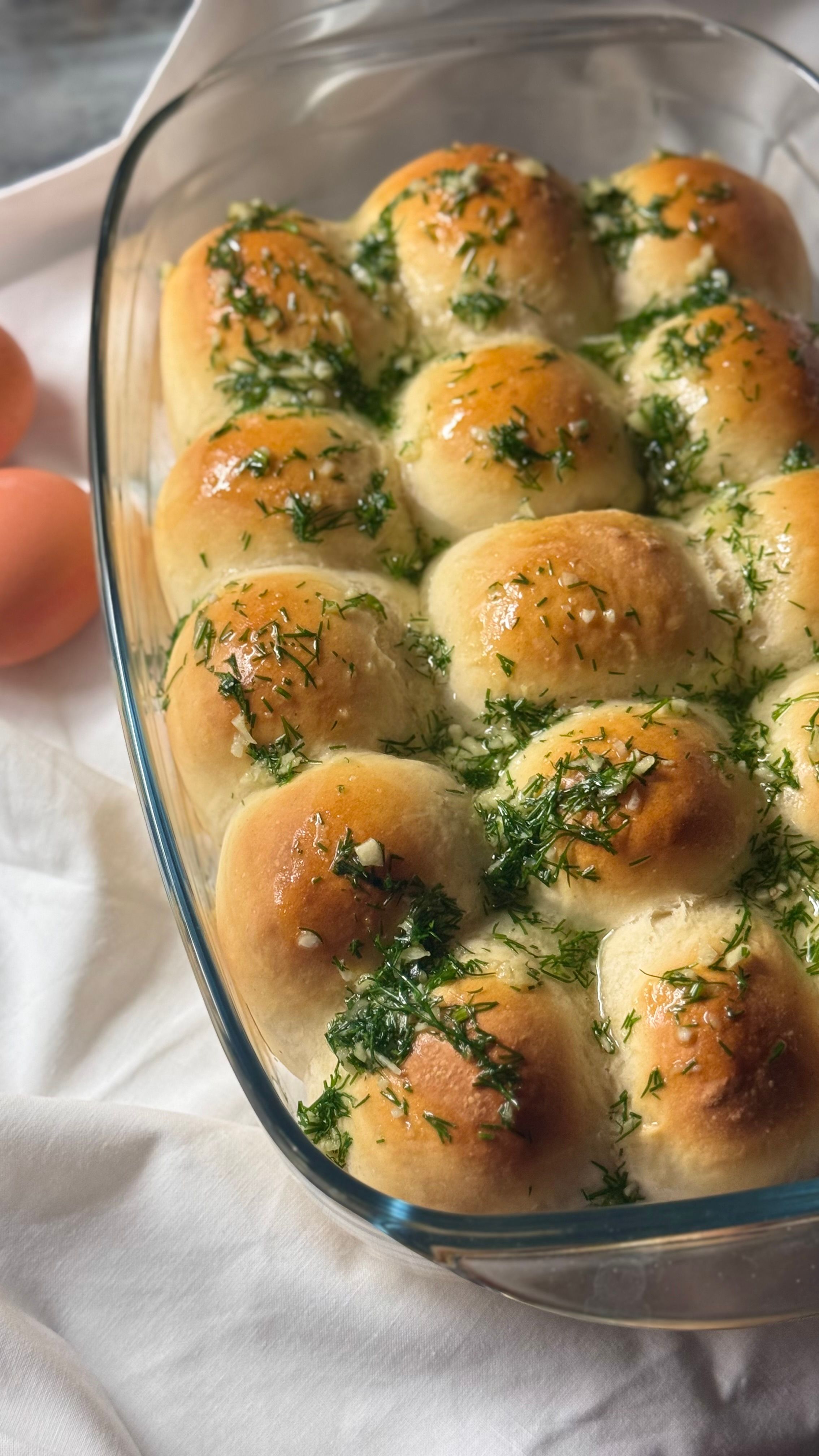
Photo: Alena Evseenko / Pexels
The diets react (see scores below)
Common Ingredients
- flour
- yeast
- eggs
- milk
- garlic
- oil
- parsley
- salt
Specific recipes may vary.
Incompatible with 7 of 11 diets
Diet Ratings
Pampushky are traditional Ukrainian garlic bread rolls made primarily from wheat flour and yeast, making them fundamentally incompatible with a ketogenic diet. A single roll contains approximately 25-30g of net carbs from refined wheat flour alone, which could exceed an entire day's carb allowance on strict keto. The remaining ingredients (eggs, garlic, oil, parsley, salt) are keto-friendly, but they are entirely overshadowed by the dominant grain-based flour component. There is no portion size small enough to make this dish compatible with maintaining ketosis.
Pampushky are traditional Ukrainian garlic bread rolls that contain both eggs and milk — two clear animal-derived ingredients that make this dish incompatible with a vegan diet. The eggs provide structure and richness to the dough, while the milk adds moisture and flavor. All other ingredients (flour, yeast, garlic, oil, parsley, salt) are fully plant-based. A vegan version is achievable by substituting plant-based milk (oat, soy, almond) and a flax egg or commercial egg replacer, but the traditional recipe as listed cannot be considered vegan.
Pampushky are Ukrainian garlic bread rolls made primarily from wheat flour and yeast, which are strictly excluded from the paleo diet. The dish also contains milk (dairy) and salt (added), both of which are non-paleo. While eggs, garlic, parsley, and oil (depending on type) could be paleo-compatible, the foundational ingredients — wheat flour, yeast-leavened bread, and dairy — make this dish fundamentally incompatible with paleo principles. There is no meaningful paleo adaptation possible without completely reconstructing the dish.
Pampushky are soft Ukrainian garlic bread rolls made primarily from refined white flour, which classifies them as a refined grain product — something the Mediterranean diet discourages in favor of whole grains. While several ingredients are Mediterranean-friendly (garlic, parsley, eggs, and oil), the foundation of the dish is a white flour yeast roll, akin to white bread. The use of milk and eggs adds moderate dairy and protein, but these are secondary to the dominant refined carbohydrate base. The garlic and parsley are positive elements, but insufficient to offset the refined grain concern. This is not a staple or encouraged food in Mediterranean eating patterns.
Some Mediterranean diet interpretations allow white bread or rolls in small portions as part of a balanced meal, noting that traditional Mediterranean cultures (e.g., Italian, Greek) do consume white bread regularly. In that context, pampushky with garlic and olive-style oil could be seen as a 'caution' item rather than strictly avoided, especially if consumed occasionally alongside vegetable-rich dishes.
Pampushky are Ukrainian garlic bread rolls that are fundamentally incompatible with the carnivore diet. The dish is almost entirely plant-based: flour (grain), yeast, garlic, oil (plant-based), and parsley are all excluded foods. While eggs and milk appear in the ingredients, they are minor components in a bread product whose primary base is wheat flour — a grain that is strictly forbidden on carnivore. There is no meaningful animal protein or fat driving this dish; it is essentially a baked good with plant-derived carbohydrates as the foundation.
Pampushky are Ukrainian garlic bread rolls made primarily with flour, which is a grain and explicitly excluded on Whole30. Beyond the grain violation, milk (dairy) is also excluded. Even if we set aside the individual excluded ingredients, pampushky are bread rolls — a baked good explicitly listed as a prohibited food category under Whole30's 'no recreating baked goods' rule. This dish fails on multiple counts: grains (flour), dairy (milk), and the bread/baked good prohibition.
Pampushky are Ukrainian garlic bread rolls made primarily with wheat flour, which is high in fructans — a key FODMAP that must be avoided during the elimination phase. Additionally, the recipe includes whole garlic (not garlic-infused oil), which is one of the highest-FODMAP foods known, containing significant fructans even in very small amounts. Milk also contributes lactose. These three high-FODMAP ingredients (wheat flour, garlic, milk) make this dish unsuitable during elimination. The remaining ingredients — yeast, eggs, oil, parsley, and salt — are low-FODMAP, but they cannot offset the primary offenders.
Pampushky are Ukrainian garlic rolls made from refined white flour, yeast, eggs, milk, oil, garlic, parsley, and salt. From a DASH perspective, several factors create a mixed picture. The refined white flour is not a whole grain, which DASH emphasizes; garlic and parsley are DASH-friendly ingredients with cardiovascular benefits; eggs and milk add modest protein and calcium but eggs carry some saturated fat debate; oil (vegetable) is acceptable in moderation per DASH. The primary concern is sodium from added salt and the use of refined rather than whole-grain flour, which reduces fiber and nutrient density. Portion size is critical — one or two small rolls can fit into a DASH plan, but the bread is not a core DASH food. If made with whole wheat flour and minimal salt, the score would rise. As commonly prepared with white flour and salted, this lands in 'caution' territory.
NIH DASH guidelines emphasize whole grains and would not highlight refined white bread rolls as a recommended food; however, some DASH-oriented clinicians note that homemade bread with garlic, minimal oil, and controlled salt is far preferable to commercially processed bread products, and may be incorporated occasionally within DASH's allowance for discretionary grain servings.
Pampushky are Ukrainian garlic bread rolls made primarily from white flour and yeast, making them a high-glycemic refined carbohydrate food. The dominant ingredient — white flour — is classified as an 'unfavorable' carbohydrate in Zone terminology due to its high glycemic index and low fiber content, which triggers rapid insulin spikes contrary to Zone principles. While eggs and milk contribute small amounts of protein and fat, and garlic/parsley add beneficial polyphenols, the dish is fundamentally a starchy bread roll with no meaningful lean protein source and a carbohydrate profile that is nearly impossible to Zone-balance as a side dish. A single roll could easily consume 2-3 carb blocks of unfavorable, high-GI carbs, with minimal offsetting protein or favorable fat. The garlic and parsley are Zone-friendly components but negligible in macro contribution. As a side dish with no protein, it creates a severe macronutrient imbalance. It scores at the low end of 'caution' rather than 'avoid' only because it is not pure sugar and contains trace protein/fat from eggs and milk, and could theoretically be consumed in very small quantities as part of a carefully constructed Zone meal.
Pampushky are traditional Ukrainian garlic rolls made primarily from refined white flour, which is a refined carbohydrate that the anti-inflammatory framework consistently flags as problematic due to its high glycemic index, lack of fiber, and potential to raise inflammatory markers like CRP. The dish does contain several genuinely anti-inflammatory elements: garlic is well-established for its anti-inflammatory and antimicrobial properties (allicin, quercetin), parsley contributes antioxidants and vitamin C, and eggs provide some beneficial nutrients. The oil used is unspecified — if extra virgin olive oil, this would be a positive; if a refined seed oil (sunflower is common in Ukrainian cooking), this would be a mild negative. Milk and eggs are moderate-category foods. Overall, the dish is not aggressively pro-inflammatory — it lacks trans fats, added sugars, processed additives, or high-fat dairy — but the refined flour base is the dominant ingredient and represents its primary anti-inflammatory weakness. This positions it firmly in the 'caution' category: acceptable occasionally, but not a food to emphasize in an anti-inflammatory eating pattern. Substituting whole wheat or spelt flour would meaningfully improve the profile.
Pampushky are soft Ukrainian garlic rolls made from enriched yeast dough (flour, eggs, milk, oil) and topped with garlic-herb oil. They are a refined-grain bread product with minimal protein, low fiber, and moderate fat from the egg and oil enrichment. While they are soft and easy to digest — a mild positive for GLP-1 patients dealing with GI side effects — they are essentially empty calories relative to the reduced appetite these patients experience. A single roll offers little nutritional return: negligible protein (2-3g), minimal fiber (<1g), and primarily refined carbohydrates. The garlic topping in small amounts is fine and poses no GI concern for most patients. The main problem is opportunity cost: on a GLP-1 diet where every bite must count, a garlic bread roll crowds out protein and fiber-rich foods. Acceptable occasionally as a small accompaniment to a protein-rich main, but not a food that earns its place on the plate.
*See how scores were generated at our methodology page.
Nutritional profile
Six traits that cut across every diet.
Fiber & Plants
How much whole-plant food and fiber it delivers.
Healthy Fats
The quality of its fats (unsaturated, omega-3).
Whole / Unprocessed
How close it is to its natural, unprocessed form.
Gut Gentle
How easy it is on digestion (low FODMAP, few irritants).
Low Glycemic
How little it spikes your blood sugar.
Protein Density
How much protein it packs per calorie.
Controversy Index
Higher controversy = more disagreement between diets.
Diet-Specific Tips
 DASH — 5/10
View tips
- Refined white flour — not a whole grain, reduces fiber and nutrient density compared to DASH recommendations
- Added salt increases sodium load; amount varies by recipe but is a concern
- Garlic and parsley are cardiovascular-friendly, antioxidant-rich ingredients aligned with DASH
- Eggs and milk contribute protein and calcium; eggs have evolving guidance in DASH context
- Vegetable oil is acceptable under DASH guidelines in moderate amounts
- No significant potassium, magnesium, or calcium density beyond milk contribution
- Portion control essential — 1 small roll is manageable; multiple rolls add refined carbs and sodium
- Whole wheat flour substitution would meaningfully improve DASH compatibility
 Zone — 5/10
View tips
- Primary ingredient is white flour — a high-glycemic, 'unfavorable' Zone carbohydrate
- No significant lean protein source — listed as 'none' for primary protein
- Yeast-leavened bread rolls are explicitly unfavorable in Zone block system
- Garlic and parsley are Zone-positive polyphenol sources but nutritionally negligible in macro terms
- Eggs and milk provide minimal protein/fat that does not offset the high carb load
- As a side dish, it worsens the macronutrient ratio of any meal it accompanies
- Oil component could be favorable if olive oil, but insufficient to balance the dish
 Anti-Inflammatory — 4/10
View tips
- Refined white flour is the dominant ingredient — raises blood glucose rapidly and may elevate inflammatory markers with regular consumption
- Garlic is a well-supported anti-inflammatory ingredient (allicin, quercetin, organo-sulfur compounds)
- Parsley provides antioxidants, vitamin C, and flavonoids
- Oil type is unspecified — EVOO would be beneficial, refined sunflower oil (common in Ukrainian cooking) would be mildly negative
- Eggs are a moderate food on the anti-inflammatory spectrum
- No trans fats, added sugars, artificial additives, or high-fat dairy
- No omega-3 sources present
 GLP-1 Friendly — 4/10
View tips
- Refined grain, low fiber — does not support the 25-30g daily fiber target
- Negligible protein — does not contribute to the 100-120g daily protein goal
- Moderate fat from egg and milk enrichment plus oil topping — manageable but not lean
- Soft texture and easy digestibility are mild positives for GLP-1 GI sensitivity
- Small serving size is feasible but nutritional return remains poor regardless of portion
- Garlic in small amounts is tolerated by most patients