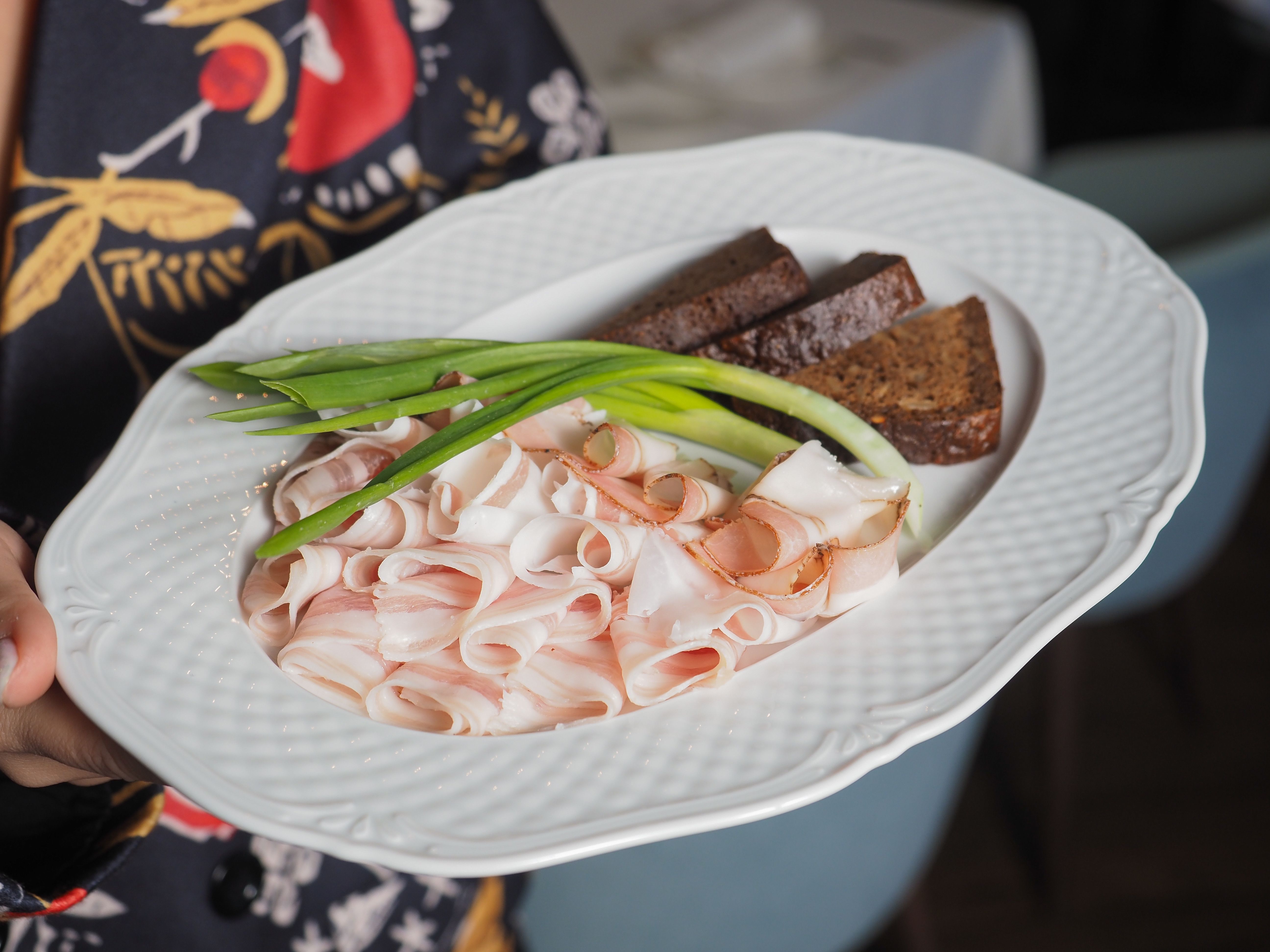
The diets react (see scores below)
Common Ingredients
- pork fatback
- garlic
- salt
- black pepper
- bay leaf
Specific recipes may vary.
Incompatible with 7 of 11 diets
Diet Ratings
Salo is cured pork fatback — essentially pure animal fat with negligible carbohydrates. The ingredients (pork fatback, garlic, salt, black pepper, bay leaf) contain virtually zero net carbs. Pork fatback is one of the most keto-ideal foods available, consisting almost entirely of fat with trace protein and zero carbs. Even the garlic used for curing contributes only a trivial amount of carbohydrate given the small quantity typically used. This dish is a nearly perfect keto snack, delivering high-quality saturated animal fat with no sugar, no grains, and no starchy ingredients.
Salo is a traditional Ukrainian dish consisting primarily of cured pork fatback. Pork is an animal product, making this dish entirely incompatible with a vegan diet. There is no ambiguity here — the primary and defining ingredient is animal-derived fat from a pig. The seasoning ingredients (garlic, salt, black pepper, bay leaf) are all plant-based, but they are incidental to a dish that is fundamentally built around animal flesh and fat.
Salo is cured pork fatback that relies on added salt as a primary preserving and flavoring agent. While pork fat itself is paleo-approved, the curing process with added salt classifies this as a processed/preserved food, which falls outside strict paleo guidelines. Salt is explicitly excluded under the 'added salt' rule, and the curing method itself represents the kind of food processing that paleo principles reject. Garlic, black pepper, and bay leaf are all paleo-compliant aromatics, but they cannot redeem a dish whose preparation is fundamentally built around salt curing. The other ingredients (pork fatback, garlic, black pepper, bay leaf) are all individually paleo-friendly, but the dish as prepared — a salt-cured product — is not.
Salo is cured pork fatback, consisting almost entirely of saturated animal fat with no plant-based components beyond seasoning. It directly contradicts core Mediterranean diet principles: it is a processed/cured red meat product, extremely high in saturated fat, and represents exactly the type of food the Mediterranean diet limits to rare or no consumption. Red meat and pork products are already restricted to a few times per month, and pure fatback with no lean protein value is far outside even that limited allowance. The garlic and spices are negligible positives that do not offset the fundamental incompatibility of the dish.
Salo is cured pork fatback — an animal-derived food consisting primarily of pure animal fat with salt, which is highly carnivore-compatible. However, the inclusion of garlic, black pepper, and bay leaf introduces plant-derived spices and aromatics that are strictly excluded on a purist carnivore diet. The pork fatback itself is an excellent source of animal fat and would score 8-9 on its own. The spices drop the score into caution territory. Many carnivore practitioners pragmatically use small amounts of spices, but strict adherents avoid all plant compounds entirely. Garlic in particular contains notable plant compounds (allicin, fructans) that purists would flag. The food can be made carnivore-compliant by omitting all plant additions and curing with salt only.
Strict carnivore purists (aligned with Shawn Baker's 'meat and salt only' approach or the Lion Diet protocol) would exclude this preparation entirely due to garlic, black pepper, and bay leaf — all plant-derived ingredients containing antinutrients and plant compounds. A compliant version would use pork fatback and salt only.
Salo is traditional Ukrainian cured pork fatback, and the listed ingredients — pork fatback, garlic, salt, black pepper, and bay leaf — are all Whole30-compliant. There are no excluded ingredients: no added sugar, no grains, no dairy, no legumes, no alcohol, and no prohibited additives. All spices and aromatics used are natural and explicitly allowed. The dish is essentially a whole, minimally processed animal fat product seasoned with compliant herbs and spices. However, salo is a cured/preserved meat product, and the Whole30 program generally encourages participants to move away from relying heavily on processed or cured meats — though this is a spirit-of-the-program concern rather than a rules violation. As long as no sugar, nitrates from non-compliant sources, or other excluded curing agents are used (home-cured or traditionally prepared salo typically uses only salt and spices), this dish is compliant.
Official Whole30 guidelines allow compliant cured meats but Melissa Urban and the Whole30 community generally caution against over-reliance on cured and processed pork products, encouraging participants to focus on whole, unprocessed protein sources. Some practitioners might flag salo's status as a cured fat-forward snack as testing the spirit of the program, even when ingredients are technically compliant.
Salo (Ukrainian cured pork fatback) is primarily pure animal fat with no carbohydrates, making the fat itself completely FODMAP-free. However, the traditional preparation involves rubbing or embedding whole garlic cloves directly into the fatback, which is a critical concern. Garlic is one of the highest-FODMAP foods (fructans) and is rated 'avoid' with high confidence by Monash University. The key question is whether FODMAPs leach from garlic into the surrounding fat. Since FODMAPs are water-soluble and not fat-soluble, garlic's fructans should not transfer significantly into the fat tissue itself — similar to the principle behind garlic-infused oil. However, in practice, salo is often eaten with bits of garlic still embedded in the fat, or the garlic is in direct contact with any trace moisture or lean tissue. If the garlic is removed before eating and only the pure fat is consumed, salo is likely low-FODMAP. But as traditionally served (with garlic adhering or mixed in), there is meaningful risk of FODMAP exposure. Salt, black pepper (small amounts), and bay leaf are all low-FODMAP. The dish scores in caution territory due to the garlic preparation ambiguity.
Monash University has not specifically tested salo, and the fat-solubility principle (garlic FODMAPs not transferring into pure fat) is scientifically sound for garlic-infused oil — however, clinical FODMAP practitioners would likely advise avoiding traditionally prepared salo during elimination because garlic cloves are physically embedded in the meat and may be partially consumed, and even trace fructan exposure can provoke symptoms in sensitive individuals.
Salo is Ukrainian cured pork fatback — essentially pure animal fat, heavily salted. It is fundamentally incompatible with DASH diet principles on multiple levels. The primary ingredient is pork fatback, which is extremely high in saturated fat (the very type of fat DASH explicitly limits). The curing process introduces very high sodium levels, directly conflicting with DASH's sodium restriction of <2,300mg/day (and ideally <1,500mg/day for hypertensive individuals). There is no meaningful fiber, potassium, calcium, or magnesium content. It offers none of the nutritional profile DASH emphasizes. NIH/NHLBI DASH guidelines explicitly limit red meat, full-fat animal products, and high-sodium foods — Salo violates all three simultaneously. This is not a food that can be incorporated into a DASH eating plan even in small portions without undermining its core objectives.
Salo is essentially pure cured pork fatback — nearly 100% saturated and monounsaturated fat with virtually no protein and zero carbohydrates. While the Zone Diet is ratio-based rather than exclusion-based, salo fundamentally cannot serve as a Zone block building material because it contributes almost nothing to the 40/30/30 balance. It provides no protein (eliminating any chance of a proper protein block) and no carbohydrates, meaning consuming it as a snack destroys the macronutrient ratio entirely. The fat content is predominantly saturated fat from pork, which Dr. Sears explicitly discourages in favor of monounsaturated fats like olive oil and avocado. Even as a fat block component, its saturated fat profile makes it an unfavorable choice compared to Zone-approved fat sources. The garlic provides trace polyphenol benefit, but this is negligible in context. As a standalone snack, it is impossible to balance into Zone ratios without pairing it with substantial lean protein and low-glycemic carbohydrates — at which point salo itself becomes an incidental, problematic addition rather than a useful component.
Salo is essentially pure pork fatback — cured with salt, garlic, black pepper, and bay leaf. While garlic, black pepper, and bay leaf carry minor anti-inflammatory benefits, they are present in negligible quantities relative to the dominant ingredient. Pork fatback is almost entirely saturated fat, with very little unsaturated fat and essentially no omega-3 fatty acids. High saturated fat intake is consistently linked to elevated inflammatory markers including CRP and IL-6, and pork fatback sits at the extreme end of the saturated fat spectrum — it is one of the highest-fat, lowest-lean animal products available. Anti-inflammatory dietary frameworks (Weil's pyramid, IF Rating system, mainstream anti-inflammatory research) all place full-fat animal products high in saturated fat firmly in the 'limit' to 'avoid' category. The curing process also adds significant sodium, which at high intake levels is associated with endothelial inflammation. The garlic is a genuine positive — a well-established anti-inflammatory allium — but its contribution is overwhelmed by the primary ingredient's strongly pro-inflammatory fat profile. This is not a food that fits anti-inflammatory principles in any meaningful portion size.
Salo is cured pork fatback — essentially pure animal fat with minimal protein content. A typical 30g serving contains roughly 25-27g of fat (predominantly saturated) and less than 1g of protein, making it one of the worst possible foods for GLP-1 patients. High dietary fat is a primary driver of GLP-1 medication side effects including nausea, bloating, reflux, and vomiting, because slowed gastric emptying means high-fat foods sit in the stomach far longer than normal. Salo provides virtually no protein (failing Priority #1), no fiber (failing Priority #2), is entirely fat-based (failing Priority #3), is calorie-dense with near-zero micronutrient return (failing nutrient density), and works against easy digestibility in every way. The garlic, salt, pepper, and bay leaf seasoning are benign, but they cannot redeem the underlying ingredient. This is not a portion-sensitivity case — there is no meaningful serving size at which salo becomes appropriate for a GLP-1 patient.
*See how scores were generated at our methodology page.
Nutritional profile
Six traits that cut across every diet.
Fiber & Plants
How much whole-plant food and fiber it delivers.
Healthy Fats
The quality of its fats (unsaturated, omega-3).
Whole / Unprocessed
How close it is to its natural, unprocessed form.
Gut Gentle
How easy it is on digestion (low FODMAP, few irritants).
Low Glycemic
How little it spikes your blood sugar.
Protein Density
How much protein it packs per calorie.
Controversy Index
Higher controversy = more disagreement between diets.
Diet-Specific Tips
 Keto — 9/10
View tips
- Pork fatback is nearly 100% fat with zero net carbs
- No sugar, grains, or starchy ingredients present
- Garlic contributes negligible carbs in curing quantities
- Whole, minimally processed traditional food
- Ideal macronutrient profile for ketogenic diet (very high fat, minimal protein, zero carbs)
- Salt curing is a keto-compatible preservation method
 Carnivore — 6/10
View tips
- Pork fatback is pure animal fat — an excellent carnivore food on its own
- Salt-cured preparation is a traditional, minimally processed method
- Garlic is a plant-derived allium excluded on strict carnivore
- Black pepper and bay leaf are plant spices excluded by purists
- Many carnivore practitioners tolerate small amounts of spices in practice
- Can be made fully compliant by removing all plant ingredients
- Non-ruminant animal fat — acceptable to most but not prioritized by ruminant-focused practitioners
 Whole30 — 8/10
View tips
- Pork fatback is a whole animal product — compliant
- Garlic, salt, black pepper, and bay leaf are all explicitly allowed
- No sugar, grains, dairy, or legumes in the ingredient list
- Traditional preparation relies only on salt and spices — no excluded curing agents
- Cured/preserved meats occupy a gray area in program spirit
- Compliant as long as no added sugar or excluded additives are used in curing
 Low-FODMAP — 5/10
View tips
- Pork fatback is pure animal fat — zero FODMAPs, fully safe
- Garlic is high-FODMAP (fructans) and rated 'avoid' by Monash University
- FODMAPs are water-soluble, not fat-soluble — garlic fructans theoretically do not transfer into surrounding fat
- In practice, garlic is embedded in salo and may be partially ingested, creating real FODMAP risk
- Salt, black pepper, and bay leaf are all low-FODMAP at standard quantities
- Salo has not been specifically tested by Monash University
- Safety depends heavily on preparation and whether garlic is fully removed before eating