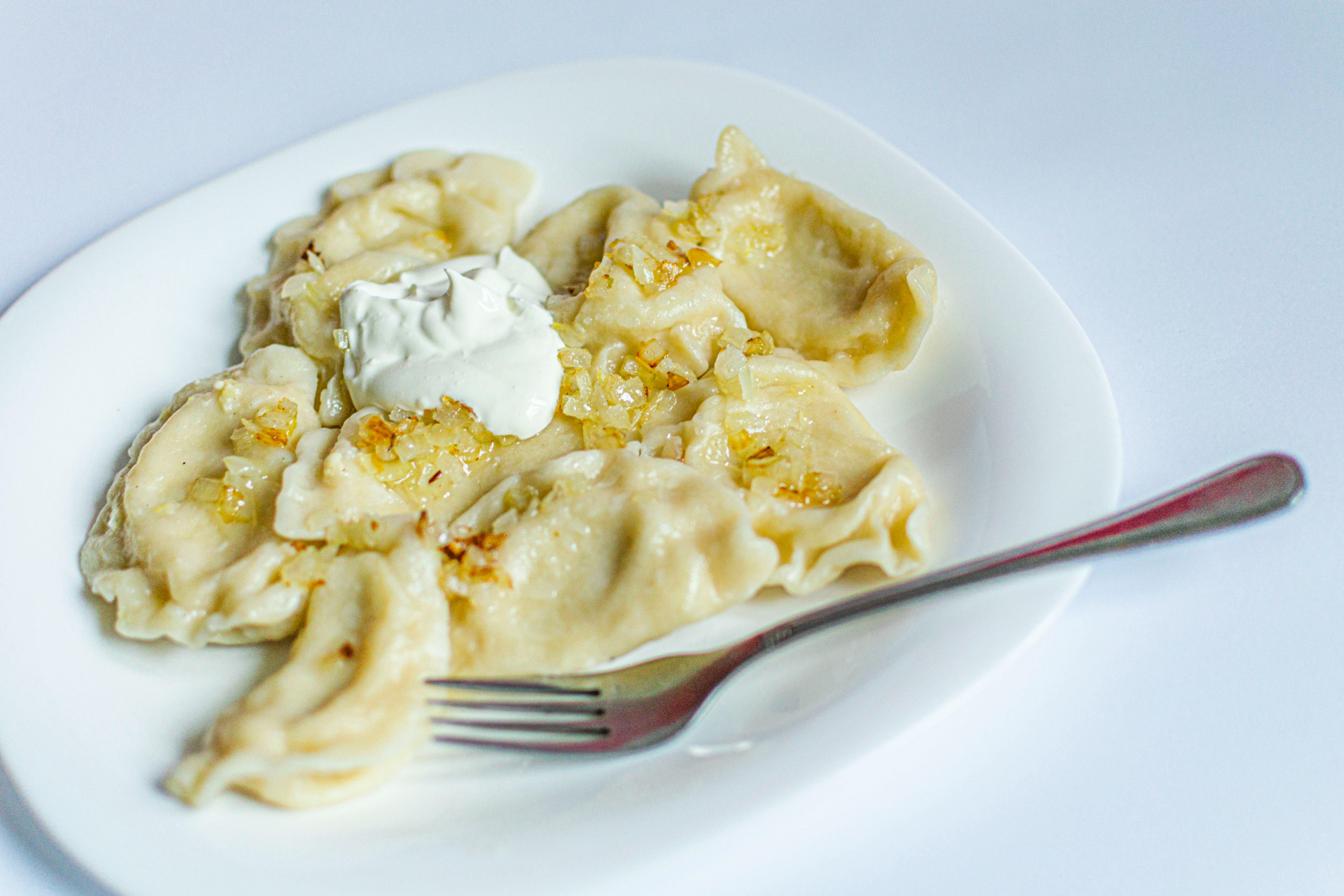
The diets react (see scores below)
Common Ingredients
- flour
- eggs
- potatoes
- farmer cheese
- onion
- butter
- sour cream
- salt
Specific recipes may vary.
Incompatible with 7 of 11 diets
Diet Ratings
Varenyky (Ukrainian dumplings) are fundamentally incompatible with a ketogenic diet. The dish is built on wheat flour dough, which is a high-carb grain product, and filled primarily with potatoes, another high-starch, high-net-carb ingredient. A standard serving of varenyky (5-6 pieces) could easily deliver 50-80g of net carbs from the dough and potato filling alone, far exceeding the entire daily keto carb allowance. While sour cream, butter, eggs, and farmer cheese are keto-friendly accompaniments, they cannot offset the massive carb load from the flour and potatoes that form the core of this dish.
Varenyky (Ukrainian dumplings) as described contain multiple animal-derived ingredients that are clearly incompatible with a vegan diet. Eggs are used in the dough, farmer cheese (a dairy product) and butter appear in the filling and/or topping, and sour cream is served as a condiment. This dish is thoroughly non-vegan. A vegan version could theoretically be made by substituting plant-based alternatives for all four animal ingredients, but the traditional recipe as listed is not vegan-compliant.
Varenyky (Ukrainian dumplings) are fundamentally incompatible with the Paleo diet. The dish is built on wheat flour dough, which is a grain and one of the most clearly prohibited foods in Paleo. The filling contains farmer cheese, a dairy product explicitly excluded. Sour cream is also dairy. Butter is a dairy derivative (debated but generally discouraged by strict paleo). Salt is listed as an added ingredient, also excluded. While eggs, potatoes, and onion have some paleo standing, the foundational components — wheat flour dough, farmer cheese, and sour cream — make this dish impossible to approve or even caution under any mainstream paleo framework. There is no version of traditional varenyky that avoids these core violations.
Varenyky are Ukrainian dumplings made from refined white flour dough filled with potatoes and/or farmer cheese, served with butter and sour cream. This dish conflicts with several Mediterranean diet principles: refined white flour is a refined grain discouraged in favor of whole grains; butter is a saturated fat rather than olive oil; and sour cream adds additional saturated dairy fat. The overall dish is carbohydrate-heavy with limited fiber, no olive oil, and no vegetables or legumes as primary components. While eggs and dairy (farmer cheese, sour cream) are individually acceptable in moderation, the combination with refined dough and butter creates a nutritional profile that sits well outside Mediterranean ideals. Onion is a positive element, and potatoes provide some nutrition, but they do not redeem the overall pattern.
Some Mediterranean diet interpreters note that traditional peasant cuisines across the Mediterranean also used simple doughs and modest dairy, and that occasional consumption of whole-food, home-cooked dishes like varenyky — with minimal processed ingredients — is preferable to ultra-processed foods. Substituting whole-wheat flour and olive oil for butter could bring this dish closer to Mediterranean principles.
Varenyky (Ukrainian dumplings) are fundamentally incompatible with the carnivore diet. The dish is built almost entirely on plant-based ingredients: flour (grain) forms the dough, potatoes (starchy vegetable) and onion (vegetable) fill it, and sour cream serves as a topping. While eggs and butter are animal-derived, they play minor supporting roles in a dish whose core structure is wheat and potato. No amount of the animal-derived components can redeem a dish that is primarily a grain-based, starchy carbohydrate vehicle. This is a classic high-carbohydrate comfort food with no meaningful animal protein as the primary component.
Varenyky (Ukrainian dumplings) contain multiple excluded ingredients that make them clearly non-compliant with Whole30. Flour is a grain product (wheat), which is explicitly excluded. Farmer cheese and sour cream are dairy products, both excluded. Butter (regular, not ghee or clarified butter) is also excluded dairy. Additionally, even if all ingredients were somehow compliant, varenyky are essentially pasta/dumplings — a category explicitly listed as excluded under the 'no recreating baked goods/junk food' rule (pasta or noodles). This dish fails on multiple fronts simultaneously.
Varenyky (Ukrainian dumplings) contain multiple high-FODMAP ingredients that make this dish unsuitable during the elimination phase. The wheat flour dough is the primary issue — wheat is high in fructans, making it a major FODMAP offender at any standard serving size. Onion is one of the highest-FODMAP foods tested by Monash University, containing significant fructans even in small quantities and is essentially unavoidable in traditional varenyky preparation. Farmer cheese (similar to quark or fresh curd cheese) is typically made from cow's milk and contains moderate-to-high lactose levels. Sour cream also contains lactose. The potato filling itself is low-FODMAP, eggs are low-FODMAP, and butter is low-FODMAP (fat does not carry FODMAPs). However, the combination of wheat dough + onion + lactose-containing dairy creates a triple FODMAP hit (fructans from wheat, fructans from onion, lactose from farmer cheese and sour cream) that makes this dish clearly incompatible with the elimination phase at any standard serving.
Varenyky (Ukrainian dumplings) present a mixed DASH profile. The dish combines refined white flour dough with fillings of potato and farmer cheese, topped with butter and sour cream — creating several concerns for DASH adherence. Refined flour lacks the fiber of whole grains emphasized by DASH. Butter is a saturated fat source that DASH explicitly limits. Sour cream is full-fat dairy, which DASH discourages in favor of low-fat or fat-free options. Farmer cheese varies widely but is often moderately high in sodium and saturated fat. Salt is added during preparation, contributing further sodium. On the positive side, potatoes provide potassium and magnesium, eggs contribute protein, and onion adds beneficial phytonutrients. The dish is not inherently high in sodium compared to processed foods, but the combination of refined carbs, saturated fat from butter and sour cream, and full-fat dairy keeps it in 'caution' territory. Modifications (whole wheat flour, reduced butter, low-fat cottage cheese substituted for farmer cheese, Greek yogurt instead of sour cream) would improve the score considerably.
NIH DASH guidelines emphasize avoiding full-fat dairy and saturated fats categorically, which would push varenyky toward a lower score. However, some updated DASH-aligned clinicians note that traditional home-cooked dishes like varenyky, when portioned appropriately, offer minimally processed whole-food ingredients and lower sodium than most packaged foods — and that the full-fat dairy concern is evolving given recent meta-analyses questioning the cardiovascular harm of full-fat dairy in moderate amounts.
Varenyky (Ukrainian dumplings) present significant Zone Diet challenges. The dish is dominated by two high-glycemic, unfavorable carbohydrates: refined white flour (dough) and potatoes (filling) — both explicitly categorized as unfavorable in Zone terminology due to their high glycemic load. The carbohydrate load is dense and rapid-digesting, making the 40/30/30 macro ratio extremely difficult to achieve. The primary protein source listed is 'none,' and while farmer cheese and eggs contribute some protein, they are minor relative to the carb mass. Fat comes primarily from butter and sour cream, which are saturated fats — not the preferred monounsaturated fats Sears recommends. The dish lacks lean protein, low-GI vegetables, or monounsaturated fat sources. While technically one could eat a very small portion alongside a large lean protein and vegetable side, the dish itself as served is fundamentally imbalanced for Zone purposes. It scores low within the 'caution' band (3) because although it is not a zero-nutrient food like candy, its core ingredients are almost entirely unfavorable Zone carbs combined with saturated fat and minimal lean protein.
Varenyky (Ukrainian dumplings) are a traditional comfort food with a largely neutral-to-mixed inflammatory profile. The dish is built on refined white flour dough, which lacks fiber and has a high glycemic load — a known driver of inflammatory markers like CRP when consumed regularly. The potato and farmer cheese filling provides some nutritional value (potassium, calcium, protein), but potatoes are a starchy, high-glycemic vegetable and farmer cheese is a full-fat dairy product. Butter and sour cream, both used as toppings, are sources of saturated fat, which anti-inflammatory guidelines recommend limiting. Eggs contribute some anti-inflammatory nutrients (selenium, choline) but in modest amounts here. Onion is a genuine positive — it contains quercetin, a potent anti-inflammatory flavonoid. Salt is neutral in this context. The dish is not aggressively pro-inflammatory (no trans fats, seed oils, processed additives, or added sugars), but its core composition — refined carbohydrates, saturated fat from butter/sour cream/cheese — places it firmly in the 'moderate with caution' category. Occasional consumption as part of an otherwise anti-inflammatory diet is acceptable, but it should not be a dietary staple.
Varenyky (Ukrainian stuffed dumplings) are a starch-heavy dish built primarily on refined wheat flour dough and a potato-farmer cheese filling, with butter, sour cream, and fried onions typically added on top. A standard serving (4-6 dumplings) delivers modest protein — farmer cheese contributes some, eggs in the dough add a little — but total protein per serving is low, roughly 8-12g, well short of the 15-30g per meal target for GLP-1 patients. The dish is predominantly refined carbohydrates and fat. Butter and sour cream add saturated fat, which can worsen GLP-1 side effects like nausea and bloating. Fiber content is low — potatoes and refined flour provide minimal dietary fiber. On the positive side, the dish is soft, easy to digest mechanically, and portion-friendly by nature (individual dumplings are small units). It is not fried, not spicy, and not carbonated, so it avoids the hardest disqualifiers. The caloric density is moderate but the nutrient density per calorie is poor for GLP-1 patients who are eating significantly less overall. Can be made more GLP-1-compatible by increasing farmer cheese filling relative to dough, reducing butter and sour cream toppings substantially, and pairing with a high-protein side like grilled chicken or Greek yogurt-based dip instead of sour cream.
Some GLP-1-focused dietitians would rate this more favorably for patients in an early nausea phase, as soft, bland, low-fat (when toppings are minimized) starchy foods are sometimes recommended for GI symptom management — similar to a BRAT-adjacent approach. Others would flag the refined carbohydrate load and near-absence of protein as a significant concern given muscle-preservation priorities, rating it avoid rather than caution outside of symptom-management contexts.
*See how scores were generated at our methodology page.
Nutritional profile
Six traits that cut across every diet.
Fiber & Plants
How much whole-plant food and fiber it delivers.
Healthy Fats
The quality of its fats (unsaturated, omega-3).
Whole / Unprocessed
How close it is to its natural, unprocessed form.
Gut Gentle
How easy it is on digestion (low FODMAP, few irritants).
Low Glycemic
How little it spikes your blood sugar.
Protein Density
How much protein it packs per calorie.
Controversy Index
Higher controversy = more disagreement between diets.
Diet-Specific Tips
 DASH — 4/10
View tips
- Refined white flour dough — DASH favors whole grains over refined grains
- Butter topping — saturated fat source explicitly limited by DASH
- Sour cream — full-fat dairy, not aligned with DASH low-fat dairy recommendation
- Farmer cheese — moderate saturated fat and variable sodium content
- Potatoes provide beneficial potassium and magnesium
- No added sugars or processed meats; home-cooked profile is a relative positive
- Sodium added during preparation — exact amount variable but controllable
- Whole wheat flour substitution and low-fat dairy swaps would significantly improve DASH compatibility
 Zone — 5/10
View tips
- White flour dough is a high-glycemic, unfavorable Zone carbohydrate with dense net carbs per serving
- Potato filling is explicitly listed by Dr. Sears as an unfavorable, high-glycemic carbohydrate to avoid or minimize
- No lean protein source listed; farmer cheese provides limited protein relative to carbohydrate mass
- Butter and sour cream are saturated fats, not the preferred monounsaturated fats (olive oil, avocado, almonds)
- Dish lacks low-GI vegetables or other Zone-favorable ingredients to help balance the macronutrient ratio
- As a main dish, the carbohydrate-to-protein ratio is severely skewed, making Zone block balancing impractical without radical portion reduction
 Anti-Inflammatory — 4/10
View tips
- Refined white flour dough: high glycemic index, low fiber, pro-inflammatory at regular intake
- Butter and sour cream: saturated fat sources, recommended to limit on anti-inflammatory diets
- Farmer cheese: full-fat dairy, moderate saturated fat content
- Potatoes: starchy, moderate-to-high glycemic vegetable
- Onion: positive — rich in quercetin and other anti-inflammatory flavonoids
- No trans fats, seed oils, artificial additives, or refined sugar
- Eggs contribute modest anti-inflammatory micronutrients (selenium, choline)
- Overall pattern: comfort food compatible with occasional consumption, not anti-inflammatory by design
 GLP-1 Friendly — 4/10
View tips
- Low protein per serving (approx 8-12g with farmer cheese and egg), below the 15-30g per meal target
- Predominantly refined carbohydrate base (wheat flour dough, potato filling) with low fiber
- Butter and sour cream toppings add saturated fat, increasing GLP-1 GI side effect risk
- Soft texture and small individual-unit format support easy digestibility and portion control
- Poor nutrient density per calorie — not suitable as a primary meal for GLP-1 patients without significant modification
- No fried components, not spicy, not carbonated — avoids the hardest disqualifiers
- Can be improved by minimizing toppings and pairing with a high-protein accompaniment