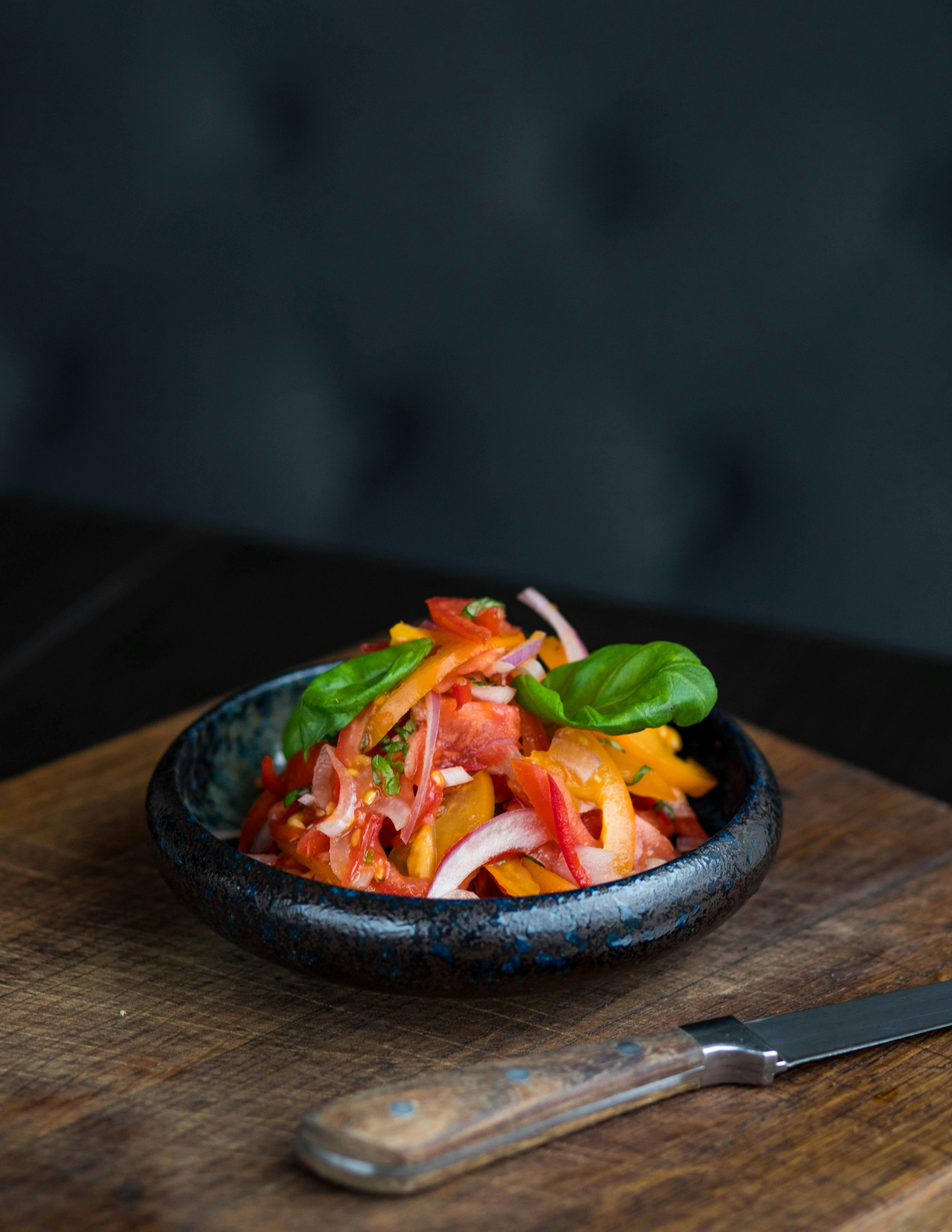
Photo: Valeria Boltneva / Pexels
The diets react (see scores below)
Common Ingredients
- tomatoes
- onions
- chili
- black pepper
- basil
- salt
Specific recipes may vary.
Incompatible with 3 of 11 diets
Diet Ratings
Achichuk is a simple Uzbek tomato and onion salad with chili, black pepper, basil, and salt. The primary carb concern comes from tomatoes (~3-4g net carbs per 100g) and onions (~7-8g net carbs per 100g). In a typical serving, the combined net carbs are moderate but manageable. A small portion (e.g., 100-150g total) can fit within daily keto limits, but the onion content pushes the carb count higher than pure leafy greens. There is no fat source in this dish, making it a side that must be paired with high-fat foods. With portion control, it can be incorporated into a keto day without breaking ketosis.
Some stricter keto practitioners consider onions too high in net carbs and sugars to include regularly, recommending they be avoided or swapped for scallion tops only; under these protocols, this salad would be flagged as avoid due to the onion base.
Achichuk is a traditional Uzbek fresh salad consisting entirely of whole plant foods: tomatoes, onions, chili, black pepper, basil, and salt. Every ingredient is unambiguously plant-derived with no animal products or animal-derived additives present. It is also a minimally processed, whole-food dish, placing it at the top of the vegan approval scale.
Achichuk is a simple Uzbek fresh salad made from tomatoes, onions, chili, black pepper, and basil — all of which are fully paleo-approved whole foods. However, the inclusion of added salt disqualifies this dish under strict paleo guidelines, which exclude added/refined salt as a processed additive not available in the form consumed today by Paleolithic humans. Without the salt, this dish would score a 9 and earn a clear approve. Because salt is a listed ingredient and paleo rules explicitly exclude added salt, the verdict must reflect the dish as prepared.
Achichuk is a simple Uzbek fresh salad made entirely of vegetables and herbs — tomatoes, onions, chili, black pepper, basil, and salt. Every single ingredient aligns perfectly with Mediterranean diet principles. Tomatoes and onions are foundational Mediterranean vegetables eaten daily; fresh herbs like basil are actively encouraged; chili and black pepper are wholesome spices. There are no processed ingredients, added sugars, refined grains, or animal products. The only minor note is that traditional Achichuk is served without olive oil, whereas a Mediterranean preparation might add a drizzle, but the dish as listed is entirely plant-based and whole-food — a natural fit.
Achichuk is a traditional Uzbek fresh salad composed entirely of plant-based ingredients: tomatoes, onions, chili, black pepper, basil, and salt. Every single ingredient except salt is plant-derived and explicitly excluded from the carnivore diet. There is no animal product present whatsoever — no meat, fish, eggs, or dairy. This dish is entirely incompatible with carnivore principles at any tier, including the most lenient 'animal-based' approaches.
Achichuk is a simple Uzbek tomato and onion salad made entirely from Whole30-compliant ingredients. Tomatoes, onions, chili, black pepper, basil, and salt are all whole, unprocessed foods explicitly allowed on the Whole30 program. There are no excluded ingredients whatsoever.
Achichuk is a simple Uzbek tomato and onion salad. While tomatoes, chili, black pepper, basil, and salt are all low-FODMAP ingredients, the critical problem is onions. Onions are one of the highest-FODMAP foods tested by Monash University, containing significant fructans at any reasonable serving size. Even small amounts of onion (as little as a quarter of a medium onion) can trigger symptoms in sensitive individuals. In a salad where onion is a primary ingredient — typically used in generous quantities — this dish is not safe during the FODMAP elimination phase. There is no realistic serving size of this dish as traditionally prepared that would keep onion intake within low-FODMAP thresholds.
Achichuk is a simple Uzbek tomato and onion salad with minimal processing. The core ingredients — tomatoes, onions, chili, basil, and black pepper — are all vegetables and herbs that are strongly encouraged on the DASH diet. Tomatoes are rich in potassium and lycopene; onions provide fiber and beneficial phytonutrients. The only concern is added salt, which can raise sodium content. However, the amount of salt used in a fresh salad like this is typically modest (home preparation allows easy control), and the dish contains no saturated fat, no added sugar, no processed ingredients, and no red meat. It aligns closely with DASH principles of emphasizing vegetables, fiber, potassium, and low saturated fat. The salt should be kept minimal to stay within DASH sodium limits (<2,300mg/day standard, <1,500mg/day low-sodium DASH).
Achichuk is a simple Uzbek fresh salad composed almost entirely of Zone-favorable vegetables and herbs. Tomatoes are a low-glycemic, polyphenol-rich carbohydrate source that Dr. Sears explicitly endorses. Onions are also favorable Zone carbs with a low glycemic index and noted anti-inflammatory properties. Chili peppers, basil, black pepper, and salt are essentially free foods in Zone accounting — negligible macros, and chili peppers in particular contribute beneficial polyphenols. There is no added fat, no protein, and no high-glycemic carbohydrate source. As a standalone dish, this salad lacks protein and fat blocks, meaning it cannot constitute a complete Zone meal on its own. However, as a carbohydrate component to accompany lean protein and a monounsaturated fat source (e.g., grilled chicken with a drizzle of olive oil), it is an excellent Zone-compatible side. The vegetable-only carb profile is precisely what Dr. Sears recommends — colorful, low-glycemic, anti-inflammatory vegetables forming the bulk of carbohydrate intake.
Achichuk is a simple Uzbek fresh salad composed almost entirely of anti-inflammatory ingredients. Tomatoes are rich in lycopene and vitamin C, both potent antioxidants that have been associated with reduced inflammatory markers. Onions provide quercetin, a well-studied anti-inflammatory flavonoid. Chili pepper contains capsaicin, which has documented anti-inflammatory effects and may reduce CRP levels. Basil contributes rosmarinic acid and other polyphenols with anti-inflammatory properties. Black pepper contains piperine, which can enhance absorption of other anti-inflammatory compounds like curcumin. Salt is the only ingredient without anti-inflammatory benefit, but in typical culinary amounts it is not a concern for the general population. There are no refined carbohydrates, added sugars, unhealthy fats, or processed ingredients. The dish is whole-food, plant-based, and aligns well with Dr. Weil's Anti-Inflammatory Food Pyramid emphasis on colorful vegetables, herbs, and spices. The confidence is medium rather than high due to the nightshade debate: tomatoes and chili peppers are nightshades, and while mainstream anti-inflammatory nutrition considers them beneficial, AIP protocols and some autoimmune-focused practitioners (e.g., Dr. Tom O'Bryan) flag solanine and lectins in nightshades as potentially problematic for sensitive individuals.
Mainstream anti-inflammatory nutrition (including Dr. Weil's pyramid) strongly endorses tomatoes and chili peppers for their lycopene, capsaicin, and antioxidant content. However, the Autoimmune Protocol (AIP) and practitioners like Dr. Tom O'Bryan exclude all nightshades, arguing that alkaloids such as solanine may promote intestinal permeability and trigger inflammation in individuals with autoimmune conditions or heightened gut sensitivity.
Achichuk is a simple Uzbek fresh salad of tomatoes, onions, chili, black pepper, basil, and salt. It is very low in fat, low in calories, and contains no protein, making it a nutrient-light side dish rather than a nutritionally complete one for GLP-1 patients. Tomatoes and onions provide fiber, vitamins C and K, potassium, and antioxidants, and the high water content of tomatoes supports hydration — a genuine benefit given that GLP-1 medications reduce thirst sensation. However, the dish has essentially no protein, which is the top dietary priority for GLP-1 patients. With reduced appetite, every meal and snack needs to deliver meaningful protein to prevent muscle loss; a zero-protein salad consumed in place of a more protein-dense option is a missed opportunity. The chili and black pepper content introduces a mild spice concern, as GLP-1 patients are more susceptible to reflux, nausea, and GI irritation — though typical Achichuk spice levels are moderate rather than extreme. As a side dish paired with a lean protein source (grilled chicken, fish, or legumes), it is a reasonable choice. As a standalone dish, it scores poorly against GLP-1 nutritional priorities.
Some GLP-1-focused dietitians would rate this more favorably, emphasizing its high water content, low calorie density, and micronutrient value as a side component of a balanced plate. Others would flag even moderate chili use as a potential GI irritant given heightened sensitivity to spice in some GLP-1 patients, particularly around dose escalation periods.
*See how scores were generated at our methodology page.
Nutritional profile
Six traits that cut across every diet.
Fiber & Plants
How much whole-plant food and fiber it delivers.
Healthy Fats
The quality of its fats (unsaturated, omega-3).
Whole / Unprocessed
How close it is to its natural, unprocessed form.
Gut Gentle
How easy it is on digestion (low FODMAP, few irritants).
Low Glycemic
How little it spikes your blood sugar.
Protein Density
How much protein it packs per calorie.
Controversy Index
Higher controversy = more disagreement between diets.
Diet-Specific Tips
 Keto — 5/10
View tips
- Tomatoes contribute ~3-4g net carbs per 100g — acceptable in small amounts
- Onions are the main carb concern at ~7-8g net carbs per 100g — portion control critical
- No fat source present; must be paired with high-fat foods to fit keto macros
- Chili, black pepper, basil, and salt are keto-friendly with negligible carbs
- Standard serving could fit within daily carb limits but leaves little room for other carb sources
- Whole, unprocessed ingredients align with keto food quality preferences
 Vegan — 10/10
View tips
- All ingredients are whole plant foods
- No animal products or animal-derived ingredients
- No processing concerns — raw salad
- Tomatoes and onions are the base, both clearly vegan
- Seasonings (chili, black pepper, basil, salt) are fully plant-based
 Mediterranean — 9/10
View tips
- All ingredients are whole, unprocessed plant foods
- Tomatoes and onions are core Mediterranean staples
- Fresh basil and spices are strongly encouraged
- No added sugars, refined grains, or processed components
- No protein source means it functions best as a side or starter
- Would benefit from extra virgin olive oil drizzle in a Mediterranean context, but is excellent as-is
 Whole30 — 10/10
View tips
- Tomatoes: whole vegetable, fully compliant
- Onions: whole vegetable, fully compliant
- Chili: fresh or dried spice, fully compliant
- Black pepper: spice, fully compliant
- Basil: herb, fully compliant
- Salt: explicitly allowed including iodized salt
- No added sugars, grains, legumes, dairy, or other excluded ingredients
 DASH — 8/10
View tips
- Tomatoes and onions are DASH-approved vegetables rich in potassium and fiber
- No saturated fat, no added sugar, no processed ingredients
- Chili and black pepper are DASH-neutral spices with no adverse cardiovascular impact
- Added salt is the primary concern — portion control of salt keeps this fully DASH-compatible
- Fresh preparation allows full sodium control, unlike canned or restaurant versions
- Basil adds flavor without sodium, supporting a low-salt approach
 Zone — 8/10
View tips
- Tomatoes and onions are Zone-favorable low-glycemic carbohydrates
- Rich in polyphenols and anti-inflammatory compounds, aligning with Sears' later anti-inflammatory emphasis
- No added fats, sugars, grains, or high-glycemic ingredients
- No protein or fat blocks present — must be paired with lean protein and monounsaturated fat to form a complete Zone meal
- Herbs and spices (basil, chili, black pepper) are nutritionally negligible in Zone block counting and add beneficial micronutrients
 Anti-Inflammatory — 8/10
View tips
- Tomatoes: rich in lycopene and vitamin C — potent antioxidants with anti-inflammatory evidence
- Onions: high in quercetin, a well-documented anti-inflammatory flavonoid
- Chili pepper: capsaicin has demonstrated anti-inflammatory and analgesic properties
- Basil: contains rosmarinic acid and eugenol, both with anti-inflammatory activity
- Black pepper: piperine has anti-inflammatory properties and enhances bioavailability of other compounds
- No refined carbohydrates, added sugars, or unhealthy fats
- Nightshade consideration: tomatoes and chili are excluded by AIP protocols for sensitive individuals
- Whole-food, plant-based composition with no processed ingredients
 GLP-1 Friendly — 5/10
View tips
- Zero protein — critical gap for GLP-1 patients who must prioritize muscle preservation
- High water content from tomatoes supports hydration, which is reduced appetite for fluids is a known GLP-1 effect
- Low fat — no saturated fat concerns, does not worsen nausea or reflux from fat load
- Moderate fiber from tomatoes and onions supports digestion and constipation prevention
- Chili and black pepper may irritate GI tract in patients with heightened GLP-1-related reflux or nausea sensitivity
- Very low calorie density — acceptable as a side dish but counterproductive as a main dish given the need for nutrient density per calorie
- Best used as a side paired with a high-protein main to complement rather than replace protein intake