Photo: Efe Burak Baydar / Pexels
The diets react (see scores below)
Common Ingredients
- wheat flour
- lamb
- onions
- cumin
- black pepper
- yogurt
- butter
- salt
Specific recipes may vary.
Incompatible with 7 of 11 diets
Diet Ratings
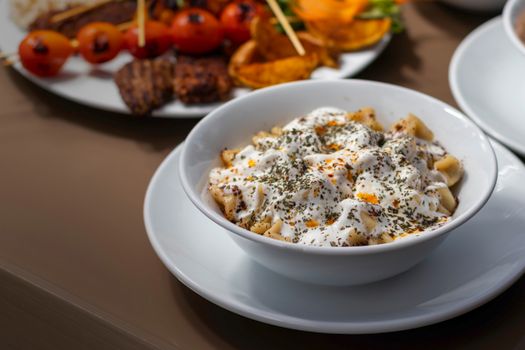
Manti are Uzbek steamed dumplings where wheat flour dough is the structural foundation of the dish — it cannot be removed or reduced without fundamentally changing what the dish is. Wheat flour dough is extremely high in net carbs (a standard serving of manti contains 40-60g of net carbs from the dough alone), which would immediately break ketosis. While the filling (lamb, onions, spices) and toppings (yogurt, butter) are keto-friendly or borderline acceptable, the grain-based wrapper is a hard disqualifier. This is not a portion-control situation — the dough is integral to the dish itself.
Uzbek manti contains multiple animal-derived ingredients that are strictly excluded from a vegan diet. Lamb is the primary protein and a direct animal product. Yogurt is a dairy product derived from animal milk. Butter is also a dairy product. These three ingredients independently disqualify this dish from vegan compliance. The wheat flour, onions, cumin, black pepper, and salt are plant-based, but the animal ingredients are central to the dish's identity and cannot be overlooked.
Manti is an Uzbek dumpling dish that contains multiple non-paleo ingredients, making it fundamentally incompatible with the paleo diet. The wheat flour dough wrapper is a grain product — one of the clearest exclusions in paleo. Yogurt and butter are dairy products, also explicitly excluded. Salt is added, which is discouraged. While the lamb, onions, cumin, and black pepper are paleo-approved, the foundational structure of the dish relies on grains and dairy. There is no version of traditional manti that can be considered paleo without a complete reconstruction of the recipe.
Manti is a Central Asian dumpling dish that conflicts with Mediterranean diet principles on multiple fronts. Lamb is a red meat that should be limited to only a few times per month, and it serves as the primary protein here. The dough wrapper is made from refined wheat flour, a refined grain that the Mediterranean diet discourages. Butter is used as a fat rather than extra virgin olive oil, adding saturated fat without the cardiovascular benefits of olive oil. The dish contains no vegetables, legumes, or plant-forward components beyond onions used as flavoring. While yogurt is an acceptable dairy component, it does not offset the other concerns. The overall nutritional profile — red meat-centered, refined grain wrapper, butter-based fat — runs contrary to the foundational principles of the Mediterranean dietary pattern.
Manti is a Central Asian dumpling dish that is fundamentally incompatible with the carnivore diet. The dish is built around a wheat flour dough wrapper, which is a plant-based grain product and one of the most excluded foods on carnivore. Beyond the dough, the filling contains onions (plant), cumin (plant spice), and black pepper (plant spice), all of which are excluded. The yogurt is a dairy product (debated but not the primary concern here), and the butter is generally accepted. However, the structural foundation of wheat flour dough alone makes this dish a clear avoid — there is no version of a traditional manti that is carnivore-compatible without completely deconstructing and reinventing the dish. The lamb itself is an excellent carnivore protein, but it is encased in and inseparable from the plant-based wrapper in this dish as presented.
Manti contains multiple excluded ingredients. Wheat flour is a grain and is explicitly prohibited on Whole30. Yogurt is a dairy product and is explicitly prohibited. Regular butter is also dairy and excluded (only ghee/clarified butter is permitted). This dish is fundamentally incompatible with Whole30 on three separate counts, and cannot be made compliant without completely changing its nature — wheat flour dumplings are the defining characteristic of manti.
Manti contains multiple high-FODMAP ingredients that make it unsuitable during the elimination phase. Wheat flour (fructans) forms the dumpling dough, onions (fructans) are a core filling ingredient, and yogurt (lactose) is a standard topping/sauce component. These three ingredients are each independently high-FODMAP at standard serving sizes and cannot be avoided when eating this dish as prepared. Lamb itself is low-FODMAP as a plain protein, and cumin, black pepper, butter, and salt are all low-FODMAP. However, the combination of wheat dough, onion filling, and yogurt sauce means virtually every component of the dish delivers significant FODMAP load.
Manti is a steamed dumpling dish that presents mixed DASH diet compatibility. The primary concerns are lamb (a red meat with significant saturated fat content, which DASH limits), butter (saturated fat), and salt (sodium). DASH guidelines explicitly limit red meat to ≤2 servings/week and recommend lean poultry or fish as preferred proteins. Lamb in particular tends to be higher in saturated fat than chicken or fish. Butter adds additional saturated fat. The yogurt component is positive if low-fat, as DASH encourages low-fat dairy, but full-fat yogurt (common in Uzbek cuisine) is less ideal. The wheat flour dough is refined rather than whole grain, providing little fiber benefit. Onions and spices like cumin and black pepper are DASH-friendly. The dish is steamed rather than fried, which is a preparation positive. Sodium from added salt is a concern depending on quantity used. Overall, Manti can be consumed occasionally in small portions but is not a core DASH food due to its red meat, saturated fat, and refined carbohydrate profile.
NIH DASH guidelines clearly limit red meat and saturated fat, placing lamb-based dishes in the caution-to-avoid range. However, some updated DASH-oriented clinicians note that when lamb is trimmed of visible fat and portions are controlled (e.g., 3 oz), the saturated fat load is manageable within a weekly DASH framework — particularly when paired with low-fat yogurt and the steamed preparation method reduces added fat versus fried alternatives.
Manti is a Central Asian steamed dumpling with multiple Zone challenges that make it difficult to balance without significant modification. The wheat flour dough wrapper is a refined, higher-glycemic carbohydrate that Zone methodology classifies as 'unfavorable.' Lamb, while a complete protein source, is relatively fatty compared to Zone-preferred lean proteins like skinless chicken or fish, and the addition of butter further increases saturated fat load — the opposite of Zone's monounsaturated fat preference. The onions and cumin are fine, and yogurt provides some protein benefit with moderate glycemic impact. As served traditionally, the macronutrient ratio skews heavily toward carbohydrates and saturated fat, with insufficient lean protein relative to the caloric load. That said, Manti is not categorically unworkable — a small serving (2-3 pieces) paired with extra yogurt (for protein) and a large vegetable side salad could approximate Zone ratios. The dish lands in 'caution' territory: usable occasionally with careful portioning and complementary foods, but structurally misaligned with Zone ideals.
Some Zone practitioners following Sears' later anti-inflammatory writings (e.g., 'The Mediterranean Zone') may view lamb in moderation more favorably than early Zone doctrine, and note that yogurt is a polyphenol-compatible food. They might argue that a small 2-3 piece serving with generous plain yogurt and a vegetable salad could constitute a rough Zone meal, pushing the score slightly higher. Early Zone (Enter the Zone) would be stricter about both the refined flour wrapper and the saturated fat from lamb and butter.
Manti is a traditional Uzbek steamed dumpling with a mixed anti-inflammatory profile. On the positive side, lamb contains some anti-inflammatory conjugated linoleic acid (CLA) and zinc, and the dish includes onions (quercetin, flavonoids) and cumin (anti-inflammatory terpenoids). Steaming is a gentle cooking method that doesn't generate the harmful advanced glycation end-products (AGEs) associated with high-heat methods. However, the dish has several pro-inflammatory elements: lamb is red meat, which anti-inflammatory guidelines recommend limiting due to saturated fat and arachidonic acid content; refined wheat flour dumplings are a refined carbohydrate with minimal fiber; butter adds saturated fat; and full-fat yogurt (as a sauce/topping) contributes additional saturated fat. The overall dish is predominantly refined carbohydrate wrapped around red meat with added saturated fat — a combination that sits squarely in the 'limit' category of anti-inflammatory eating. It lacks omega-3s, colorful antioxidant-rich vegetables, or significant polyphenol sources. Best treated as an occasional food rather than a regular dietary staple.
Manti are steamed lamb-filled dumplings served with yogurt and butter. The steamed preparation is a genuine positive — it avoids the fried-food penalty and is relatively easy to digest compared to pan-fried or deep-fried dumplings. Lamb provides real protein, and the yogurt topping adds a small protein and probiotic benefit. However, several factors pull this dish into caution territory for GLP-1 patients. Lamb is a fatty red meat — ground lamb used in traditional manti typically runs 15–20g of fat per 100g, much of it saturated, which can worsen nausea, bloating, and reflux. Butter as a finishing sauce adds additional saturated fat and empty calories. The wheat flour wrapper is a refined carbohydrate with minimal fiber. Portions are naturally large in traditional Uzbek serving sizes, which conflicts with the small-portion requirement. The yogurt is the brightest nutritional note — if served generously, it meaningfully boosts protein and supports digestion. Overall, manti is not a dish to avoid entirely, but it requires meaningful modification: leaner filling (substituting chicken or a lamb-chicken blend), minimizing butter, and eating a smaller portion focused on the protein filling over the wrapper.
Some GLP-1-focused dietitians would rate lamb-based dishes more leniently, noting that lamb provides complete protein with good iron and B12 density, and that saturated fat tolerance varies considerably among patients — those further from their injection day and with stable GI symptoms may tolerate a moderate lamb portion without issue. Others apply a stricter avoid-all-fatty-red-meat rule given how consistently high-fat meals worsen delayed gastric emptying symptoms in clinical practice.
*See how scores were generated at our methodology page.
Nutritional profile
Six traits that cut across every diet.
Fiber & Plants
How much whole-plant food and fiber it delivers.
Healthy Fats
The quality of its fats (unsaturated, omega-3).
Whole / Unprocessed
How close it is to its natural, unprocessed form.
Gut Gentle
How easy it is on digestion (low FODMAP, few irritants).
Low Glycemic
How little it spikes your blood sugar.
Protein Density
How much protein it packs per calorie.
Controversy Index
Higher controversy = more disagreement between diets.
Diet-Specific Tips
 DASH — 4/10
View tips
- Lamb is a red meat high in saturated fat — DASH limits red meat to ≤2 servings/week
- Butter adds saturated fat, compounding the concern
- Refined wheat flour dough offers minimal fiber vs. whole grain alternatives
- Steamed preparation is preferable to frying, reducing added fat
- Yogurt is DASH-friendly if low-fat; full-fat yogurt (traditional) is less ideal
- Salt quantity is a sodium wildcard — traditional recipes can be high-sodium
- Onions, cumin, and black pepper are DASH-compatible ingredients
- Portion control is critical — smaller servings reduce saturated fat and sodium exposure
 Zone — 4/10
View tips
- Refined wheat flour dough is a high-glycemic 'unfavorable' carbohydrate in Zone terminology
- Lamb is higher in saturated fat than Zone-preferred lean proteins (chicken, fish, tofu)
- Butter adds saturated fat, conflicting with Zone's monounsaturated fat preference
- Traditional serving size is carbohydrate-heavy, making 40/30/30 ratio difficult to achieve
- Yogurt is a Zone-compatible ingredient that adds protein and some beneficial bacteria
- Dish lacks vegetables as a component, requiring significant accompaniments to balance macros
- Can be partially rehabilitated with small portions, extra yogurt, and a large vegetable side
 Anti-Inflammatory — 4/10
View tips
- Lamb is a red meat — anti-inflammatory guidelines recommend limiting due to saturated fat and arachidonic acid
- Refined wheat flour wrapper contributes refined carbohydrates with low fiber
- Butter adds saturated fat
- Full-fat yogurt (common accompaniment) contributes additional saturated fat
- Steaming is a favorable, low-AGE cooking method
- Onions provide quercetin and flavonoids with anti-inflammatory properties
- Cumin provides anti-inflammatory terpenoids and antioxidants
- Dish lacks omega-3s, colorful vegetables, or significant polyphenol sources
 GLP-1 Friendly — 4/10
View tips
- Lamb is a high-saturated-fat protein source that can worsen GLP-1 GI side effects
- Steamed preparation is a positive — avoids fried-food penalty and aids digestibility
- Refined wheat flour wrapper adds carbohydrates with negligible fiber
- Butter topping adds saturated fat and empty calories with no protein or fiber benefit
- Yogurt topping is a positive — adds protein and supports gut comfort
- Traditional serving sizes are large and portion control is difficult with dumplings
- Low fiber content overall — no vegetables in the filling, no whole grains