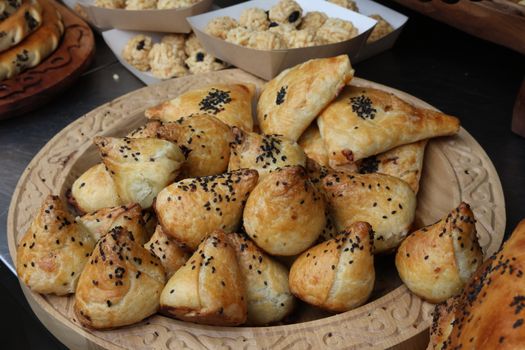
Photo: Tahir Xəlfəquliyev / Pexels
The diets react (see scores below)
Common Ingredients
- wheat flour
- lamb
- onions
- cumin
- butter
- sesame seeds
- black pepper
- salt
Specific recipes may vary.
Incompatible with 9 of 11 diets
Diet Ratings
Samsa is a baked pastry made with wheat flour dough, which is the primary and most disqualifying ingredient from a ketogenic perspective. Wheat flour is a high-glycemic grain that is fundamentally incompatible with ketosis, delivering a large dose of net carbs per serving. A typical samsa contains roughly 25-35g of net carbs per piece from the pastry shell alone, far exceeding what is acceptable even for a single snack on keto. While the filling — lamb, onions, cumin, butter — is relatively keto-friendly (lamb is high-fat protein, spices are negligible), the flour-based wrapper renders the entire dish a hard avoid. There is no meaningful portion adjustment that would make samsa compatible with ketosis.
Samsa contains multiple animal-derived ingredients that are strictly excluded from a vegan diet. Lamb is a direct animal flesh product, and butter is a dairy derivative. Both are unambiguously non-vegan. The remaining ingredients (wheat flour, onions, cumin, sesame seeds, black pepper, salt) are plant-based, but the presence of lamb and butter makes this dish entirely incompatible with vegan dietary principles.
Samsa is a baked pastry filled with lamb and onions, and its defining characteristic is the wheat flour dough shell — a grain-based ingredient that is explicitly excluded from the paleo diet. Wheat flour is one of the clearest 'avoid' foods in paleo, universally rejected by all major paleo authorities including Loren Cordain, Mark Sisson, and Robb Wolf. Additionally, the recipe includes added salt and sesame seeds (a seed oil precursor used here as a topping), and butter is a dairy product discouraged by strict paleo protocols. While the lamb, onions, cumin, and black pepper are paleo-approved, the foundational structure of this dish — a wheat pastry — makes it incompatible with paleo eating. There is no meaningful way to make a traditional Samsa paleo-compliant without fundamentally altering the dish.
Samsa is a baked pastry filled with lamb and onions, made with refined wheat flour and butter as the primary fat. It conflicts with Mediterranean diet principles on multiple levels: lamb is a red meat that should be consumed only a few times per month, butter replaces olive oil as the fat source, and the refined flour pastry shell constitutes a processed refined grain. The combination of saturated fat from both lamb and butter, along with the refined carbohydrate shell, makes this a poor fit for the Mediterranean dietary pattern.
Samsa is a baked pastry filled with lamb and onions, making it fundamentally incompatible with the carnivore diet. The dominant ingredient by volume is wheat flour, which forms the pastry shell — a grain-based, plant-derived food that is strictly excluded from any tier of carnivore eating. Additional plant-based ingredients include onions, cumin, and sesame seeds, all of which are excluded. While the lamb filling itself is carnivore-approved, it is encased in and inseparable from a wheat dough shell in this dish as prepared. The butter is acceptable, but it cannot redeem a dish whose structural base is a grain product. This is a classic mixed dish where the plant components are not optional garnishes but core structural elements.
Samsa is an Uzbek baked pastry (similar to a samosa) made with wheat flour dough encasing a lamb filling. Wheat flour is a grain and is explicitly excluded on the Whole30. Additionally, regular butter is excluded (only ghee/clarified butter is permitted). Even if those two ingredients were swapped for compliant alternatives, the dish would still violate Rule 4, which explicitly prohibits recreating baked goods, pastries, wraps, and similar grain-based comfort foods — even with compliant ingredients. Samsa is fundamentally a baked dough-wrapped snack, placing it squarely in the excluded 'baked goods/junk food' category.
Samsa contains two major high-FODMAP ingredients that make it unsuitable during the elimination phase. Wheat flour (the pastry shell) is high in fructans — one of the most problematic FODMAPs — and there is no realistic serving size of a wheat-flour pastry that falls within safe fructan limits during elimination. Onions are among the highest-FODMAP foods tested by Monash University, containing very high levels of fructans even in small quantities. These two ingredients alone are sufficient to classify this dish as high-FODMAP regardless of serving size. The remaining ingredients (lamb, cumin, butter, sesame seeds, black pepper, salt) are individually low-FODMAP and not problematic, but they cannot offset the wheat flour and onion content.
Samsa is a baked (or fried) pastry filled with fatty lamb and butter, making it problematic for the DASH diet on multiple fronts. Lamb is a red meat high in saturated fat, which DASH explicitly limits. Butter adds additional saturated fat. The refined wheat flour pastry provides minimal fiber compared to whole grains emphasized by DASH. Salt is a direct ingredient, and the combination of salted dough, seasoned filling, and butter likely pushes sodium well above DASH thresholds for a single snack. The overall nutritional profile — high saturated fat from lamb and butter, refined carbohydrates, and added salt — conflicts with DASH's core principles of limiting saturated fat, sodium, and red meat while emphasizing whole grains and lean proteins.
Samsa is a baked pastry filled with lamb and onions, and its Zone compatibility is challenged on multiple fronts. The wheat flour pastry shell is the primary carbohydrate source and is high-glycemic, refined, and 'unfavorable' in Zone terminology — exactly the type of carbohydrate Sears recommends minimizing. Lamb is a moderate protein choice but is fattier than lean Zone-preferred proteins like skinless chicken or fish, adding significant saturated fat. Butter in the pastry further increases saturated fat load. The overall macronutrient ratio skews heavily toward refined carbs and saturated fat, with insufficient lean protein relative to the caloric density. As a snack, the portion context makes it even harder to balance — the pastry casing alone delivers a high-glycemic carb bolus without the low-glycemic vegetable carbs Zone prioritizes. The onions and spices are Zone-friendly, but they are minor contributors. This dish is structurally difficult to fit into a Zone-compliant meal without major modification (e.g., removing the pastry shell entirely). It is not quite an 'avoid' because the lamb provides real protein and onions are favorable carbs, but in its traditional form it is a poor Zone snack.
Samsa is a baked Uzbek pastry with a mixed anti-inflammatory profile. On the positive side, onions provide quercetin (a notable anti-inflammatory flavonoid), cumin offers beneficial phytochemicals, and sesame seeds contribute lignans and some healthy fats. However, several ingredients work against anti-inflammatory goals: lamb is red meat, which is limited on anti-inflammatory frameworks due to saturated fat and potential to raise inflammatory markers like CRP; butter adds saturated fat, which is flagged under the 'limit' category; and the white wheat flour pastry shell is a refined carbohydrate offering little fiber or nutritional value. The dish is also baked, which is better than deep-frying, and the spice profile (cumin, black pepper) is modestly beneficial. Overall, this is an occasional food rather than a dietary staple for someone following anti-inflammatory principles — the refined flour and butter-enriched dough combined with lamb filling push it into caution territory rather than approve.
Samsa is a baked (sometimes fried) Uzbek pastry filled with fatty lamb, onions, and butter, enclosed in a wheat-flour dough. It fails on nearly every GLP-1 dietary criterion. The primary protein source is lamb, which is a fatty red meat with significant saturated fat content — particularly problematic given that GLP-1 medications slow gastric emptying, making high-fat meals sit heavily in the stomach and worsen nausea, bloating, and reflux. Butter is added both to the filling and often layered into the dough (similar to a laminated pastry), compounding the saturated fat load. The pastry shell is made from refined wheat flour, offering minimal fiber and low nutrient density per calorie. Sesame seeds add a small amount of healthy fat but do not meaningfully offset the overall fat profile. Protein content is present from the lamb but is delivered alongside a high caloric and fat load, making it a poor-quality protein source by GLP-1 standards. As a snack category item, it is not portion-compensating — even a single samsa represents a dense, heavy, greasy serving that is likely to trigger GI discomfort. Cumin and black pepper are generally well-tolerated, but they do not redeem the dish nutritionally.
*See how scores were generated at our methodology page.
Nutritional profile
Six traits that cut across every diet.
Fiber & Plants
How much whole-plant food and fiber it delivers.
Healthy Fats
The quality of its fats (unsaturated, omega-3).
Whole / Unprocessed
How close it is to its natural, unprocessed form.
Gut Gentle
How easy it is on digestion (low FODMAP, few irritants).
Low Glycemic
How little it spikes your blood sugar.
Protein Density
How much protein it packs per calorie.
Controversy Index
Higher controversy = more disagreement between diets.
Diet-Specific Tips
 Zone — 5/10
View tips
- Refined wheat flour pastry shell is high-glycemic and 'unfavorable' in Zone carbohydrate classification
- Lamb is higher in saturated fat than Zone-preferred lean proteins (chicken breast, fish, egg whites)
- Butter adds additional saturated fat, compounding the unfavorable fat profile
- Macronutrient ratio skews heavily toward refined carbs and saturated fat — far from 40/30/30
- Onions are Zone-favorable low-glycemic carbs, a minor positive
- Cumin and black pepper are anti-inflammatory polyphenol sources — negligible but consistent with Zone principles
- As a snack, the carb block is dominated by high-glycemic refined flour with no offsetting fiber-rich vegetables
- Could theoretically be made Zone-compliant with a cauliflower or whole grain shell and leaner meat, but traditional form does not fit
 Anti-Inflammatory — 4/10
View tips
- Lamb is red meat — limited on anti-inflammatory diets due to saturated fat content
- Butter in the dough adds saturated fat
- White wheat flour pastry is a refined carbohydrate with low fiber
- Onions provide quercetin, a well-researched anti-inflammatory flavonoid
- Cumin and black pepper offer modest anti-inflammatory phytochemicals
- Sesame seeds contribute lignans and healthy fats in small amounts
- Baked preparation is preferable to fried versions of similar pastries
- Overall caloric density and macronutrient profile is pro-inflammatory when consumed regularly