Photo: Nano Erdozain / Pexels
Venezuelan
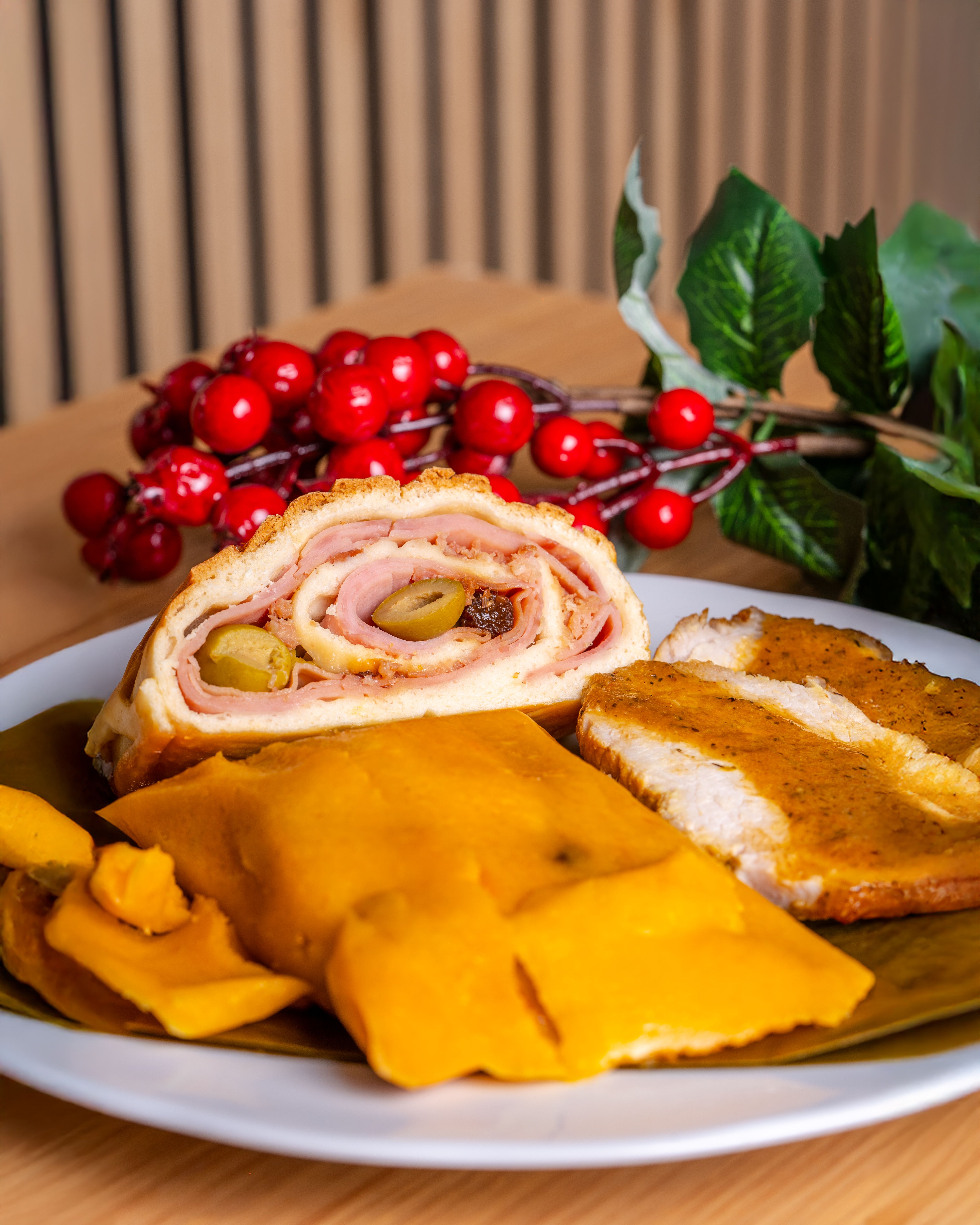
Pan de Jamon
The diets react (see scores below)
Common Ingredients
- wheat flour
- ham
- olives
- raisins
- bacon
- butter
- eggs
- sugar
Specific recipes may vary.
Incompatible with 11 of 11 diets
Diet Ratings
Pan de Jamon is a Venezuelan stuffed bread that is fundamentally built on wheat flour dough with added sugar, making it completely incompatible with a ketogenic diet. The base ingredient alone — wheat flour — delivers a massive carbohydrate load (roughly 70-75g net carbs per 100g of flour), and the added sugar in the dough compounds the problem. While some ingredients like ham, bacon, butter, and eggs are keto-friendly, they are encased in a high-carb bread shell that cannot be separated in any practical way. Raisins add additional sugar and carbs. There is no realistic portion size that would allow this dish to fit within the 20-50g daily net carb limit for ketosis.
Pan de Jamón contains multiple animal products that are clearly incompatible with a vegan diet. Ham and bacon are pork-derived meat products, butter is a dairy product, and eggs are an animal product. This dish is fundamentally built around animal ingredients, making it entirely unsuitable for vegans.
Pan de Jamón is a Venezuelan bread that is fundamentally built around wheat flour, a grain that is unambiguously excluded from the Paleo diet. Beyond the bread itself, the dish contains additional non-Paleo ingredients: butter (dairy), refined sugar, and bacon (processed meat with additives). While some individual ingredients are Paleo-compatible — eggs, olives, raisins, and ham in their unprocessed forms — the foundational ingredient (wheat flour) renders the entire dish incompatible. There is no meaningful way to adapt this dish within its traditional form, as the bread is the dish itself.
Pan de Jamon is a Venezuelan holiday bread that fundamentally conflicts with Mediterranean diet principles on multiple fronts. The base is refined wheat flour (not whole grain), enriched with butter and sugar — both discouraged. The primary protein is processed pork (ham and bacon), which combines red/processed meat with high saturated fat content. These processed meats are strongly discouraged even in small quantities under Mediterranean guidelines. The addition of sugar reinforces the avoid rating. While olives and eggs offer minor Mediterranean-friendly elements, they are overwhelmed by the overall nutritional profile of this dish, which is high in refined carbohydrates, added sugars, saturated fats, and processed meats.
Pan de Jamon is a Venezuelan stuffed bread that is fundamentally incompatible with the carnivore diet. The dish is built on wheat flour as its base, making it primarily a grain-based food. Additional plant-derived ingredients include olives, raisins, and sugar — all strictly excluded on carnivore. While it does contain animal-derived ingredients (ham, bacon, butter, eggs), these are incidental components within a heavily plant-based and processed carbohydrate structure. No amount of meat filling redeems a bread-based dish for carnivore purposes.
Pan de Jamon is a Venezuelan stuffed bread that is fundamentally incompatible with Whole30 on multiple levels. It contains wheat flour (an excluded grain), butter (excluded dairy — only ghee/clarified butter is allowed), and sugar (an excluded added sweetener). Even setting aside the spirit-of-the-program rule against recreating bread, the core ingredients themselves are explicitly prohibited. This dish cannot be made Whole30-compliant without a complete reconstruction that would no longer resemble Pan de Jamon.
Pan de Jamón is a Venezuelan holiday bread that is fundamentally incompatible with the low-FODMAP elimination diet. The primary issue is wheat flour, which is the main structural ingredient and is high in fructans — one of the most significant FODMAP triggers. There is no realistic serving size of this bread that would bring wheat flour into a low-FODMAP range. Additionally, raisins are high in excess fructose and polyols (fructans) at typical serving sizes, and olives can be a concern depending on processing and quantity. Ham and bacon are generally low-FODMAP, and butter and eggs are safe. However, the wheat flour alone is a definitive disqualifier for the elimination phase, making this dish a clear 'avoid' regardless of the other ingredients.
Pan de Jamon is a Venezuelan Christmas bread filled with ham, bacon, olives, raisins, and butter — a combination that directly conflicts with multiple core DASH diet principles. The primary proteins are processed pork products (ham and bacon), which are explicitly limited on DASH due to very high sodium content and saturated fat. Bacon is among the foods most categorically flagged by NIH/NHLBI DASH guidelines. The butter adds saturated fat, and the refined wheat flour with added sugar contributes to a low-nutrient-density carbohydrate profile. Olives, while containing healthy monounsaturated fats, are high in sodium. The cumulative sodium load from ham, bacon, and olives in a single serving could easily approach or exceed the entire daily DASH sodium limit (1,500–2,300mg). There are no meaningful DASH-friendly redemptive qualities — no whole grains, no significant potassium/magnesium/calcium, no fiber-rich components, and no lean protein. This dish is fundamentally incompatible with DASH eating patterns.
Pan de Jamón is a Venezuelan holiday bread that stacks multiple Zone-unfavorable elements into a single dish. The base is refined wheat flour (white bread dough), which is high-glycemic and an 'unfavorable' carb in Zone terminology. It is sweetened with sugar, adding further glycemic load. The raisins are explicitly called out by Dr. Sears as an unfavorable, high-sugar carb to avoid. The fat profile is dominated by butter (saturated fat) and bacon (saturated fat + sodium), both of which conflict with Zone's emphasis on monounsaturated fats and lean proteins. The protein source (ham and bacon) is fatty and processed, far from Zone's ideal of lean protein. There is virtually no low-glycemic vegetable content, no monounsaturated fat, and the carbohydrate fraction is almost entirely high-glycemic refined carbs and sugar. Even with extreme portioning, this dish cannot contribute meaningfully to a Zone-balanced meal — it would overwhelm any block system with unfavorable carbs and saturated fat simultaneously. Olives are the one Zone-friendly ingredient (monounsaturated fat, polyphenols), but they appear in negligible quantities relative to the dish's overall macro profile.
Pan de Jamon is a Venezuelan holiday bread that stacks multiple pro-inflammatory ingredients with very few redeeming anti-inflammatory properties. The base is refined wheat flour (high glycemic, stripped of fiber), enriched with butter (saturated fat) and sugar (added sugar promotes inflammatory markers like CRP). The protein components — processed ham and bacon — are cured, processed meats high in sodium, saturated fat, and nitrates/nitrites, all associated with increased systemic inflammation. Olives are the one genuinely anti-inflammatory ingredient, providing monounsaturated fats and polyphenols, but their quantity in this dish is minor relative to the overall profile. Raisins provide some polyphenols but also concentrated sugar. Eggs are neutral to mildly beneficial. Overall, this dish is a combination of refined carbohydrates, processed meats, saturated fat, and added sugar — a near-perfect convergence of the food categories that anti-inflammatory dietary frameworks most consistently flag as pro-inflammatory. Occasional consumption is a personal choice, but from an anti-inflammatory lens this dish offers minimal benefit and meaningful inflammatory load.
Pan de Jamón is a Venezuelan enriched bread filled with ham, bacon, olives, raisins, and butter — a combination that stacks multiple GLP-1 red flags. The dough is made with refined wheat flour, butter, eggs, and sugar, making it a calorie-dense, low-fiber, refined carbohydrate base with minimal protein density per calorie. The filling adds saturated fat from bacon and ham, and the raisins and sugar contribute simple sugars with negligible nutritional benefit. High fat content from butter and bacon will worsen GLP-1 side effects including nausea, bloating, and reflux. The bread format requires significant volume to deliver modest protein. As a side dish, it would consume a large share of a GLP-1 patient's reduced caloric budget while delivering little protein, high saturated fat, and almost no fiber — the opposite of nutrient density per calorie. This dish is not salvageable by portion reduction alone, as even small servings deliver the problematic fat and refined carb profile.
*See how scores were generated at our methodology page.
Nutritional profile
Six traits that cut across every diet.
Fiber & Plants
How much whole-plant food and fiber it delivers.
Healthy Fats
The quality of its fats (unsaturated, omega-3).
Whole / Unprocessed
How close it is to its natural, unprocessed form.
Gut Gentle
How easy it is on digestion (low FODMAP, few irritants).
Low Glycemic
How little it spikes your blood sugar.
Protein Density
How much protein it packs per calorie.
Controversy Index
Higher controversy = more disagreement between diets.