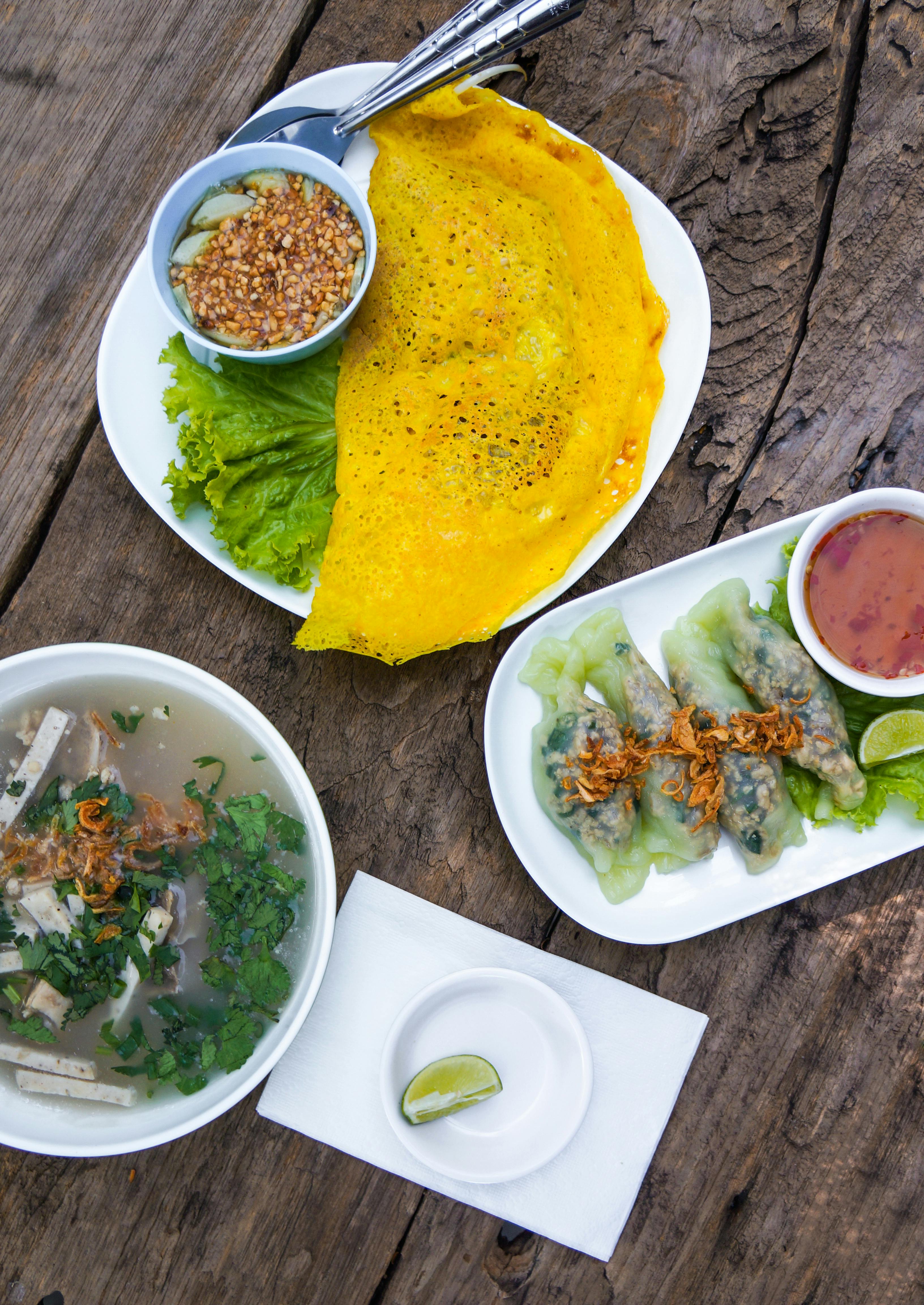
Photo: แหนมไทย ใจตะวัน / Pexels
The diets react (see scores below)
Common Ingredients
- rice flour
- turmeric
- coconut milk
- shrimp
- pork
- bean sprouts
- scallions
- lettuce
- herbs
- fish sauce
Specific recipes may vary.
Incompatible with 5 of 11 diets
Diet Ratings
Banh Xeo is a Vietnamese sizzling crepe whose batter is made primarily from rice flour, which is a refined grain with high net carbs. A single standard crepe can contain 30-50g of net carbs from the rice flour batter alone, easily exceeding the daily keto limit in one serving. While the fillings — shrimp, pork, bean sprouts, scallions, lettuce, herbs, fish sauce, and coconut milk — are largely keto-friendly, the rice flour base is the central, defining component of the dish and cannot be separated from it. The turmeric and coconut milk are fine, but they do not offset the fundamental carb load of the batter. This dish is structurally incompatible with ketosis in its traditional form.
Banh Xeo contains multiple animal products that are categorically excluded from a vegan diet. Shrimp and pork are animal flesh, fish sauce is derived from fermented fish, and coconut milk — while plant-based — cannot redeem a dish with three distinct animal-derived ingredients. There is no ambiguity here: this dish is fundamentally incompatible with vegan eating in its traditional form.
Banh Xeo is fundamentally incompatible with the paleo diet. The dish's signature crispy crepe batter is made from rice flour, a grain-derived product that is explicitly excluded from paleo. Bean sprouts (from mung beans) are a legume derivative, also excluded. Fish sauce, while traditionally just fermented fish and salt, typically contains added salt which is discouraged on strict paleo. The remaining ingredients — shrimp, pork, coconut milk, scallions, lettuce, and herbs — are paleo-friendly, but the two core structural ingredients (rice flour and bean sprouts) are clear paleo violations. This is not a borderline case; grains and legumes are among the most unambiguous exclusions in paleo dietary guidelines across all major authorities.
Banh Xeo is a mixed dish with both Mediterranean-compatible and less compatible elements. On the positive side, shrimp is an excellent Mediterranean protein, and the abundance of fresh vegetables, herbs, bean sprouts, lettuce, and scallions aligns well with plant-forward principles. Fish sauce adds umami with minimal caloric impact. However, the dish contains pork belly (typically fatty, approaching red meat territory in terms of saturated fat), and coconut milk as a fat source is not a Mediterranean staple — olive oil is the canonical fat. Rice flour is a refined grain, though used in moderate quantity as a batter. The overall dish is not heavily processed and relies on whole ingredients, keeping it from an 'avoid' rating. With modification (reducing pork, skipping coconut milk or minimizing it), it could score higher.
Some modern Mediterranean diet interpreters view coconut milk favorably as a plant-based fat and would not penalize it as harshly. Additionally, the small amount of pork relative to the generous vegetable and seafood content could be seen as acceptable within the 'occasional' red/processed meat allowance, pushing some assessors toward a higher caution or borderline approve rating.
Banh Xeo is a Vietnamese sizzling crepe that is fundamentally incompatible with the carnivore diet. The dish is built on a plant-based batter of rice flour and coconut milk with turmeric, forming the structural base of the entire dish. It is then filled with bean sprouts, scallions, lettuce, and herbs — all strictly excluded plant foods. While shrimp and pork are carnivore-approved ingredients, they are minor components surrounded by and cooked within a predominantly plant-based dish. Fish sauce is generally acceptable, but it cannot redeem a dish where the majority of ingredients, including the batter itself, are plant-derived. This dish cannot be modified into a carnivore-compatible form without being an entirely different dish.
Banh Xeo is a Vietnamese sizzling crepe made primarily with rice flour as its base. Rice flour is a grain-derived ingredient, making it excluded on Whole30. Beyond the grain issue, the dish itself is a crepe/wrap — explicitly listed in Whole30's 'no recreating baked goods/junk food' rule, which specifically calls out crepes and wraps as non-compliant even when made with otherwise compliant ingredients. The remaining ingredients (shrimp, pork, bean sprouts, scallions, lettuce, herbs, fish sauce, turmeric, coconut milk) are largely Whole30-compatible, but the foundational crepe structure built on rice flour makes this dish doubly non-compliant.
Banh Xeo is a Vietnamese sizzling crepe made primarily with rice flour and turmeric, which are both low-FODMAP. However, several ingredients introduce FODMAP concerns that require careful attention. Coconut milk is low-FODMAP at 1/2 cup (125ml) but becomes high-FODMAP at larger amounts due to sorbitol — the quantity used in the batter matters. Scallions (green onions) are safe only when using the green tops, as the white bulb portion is high in fructans; many recipes use both parts. Bean sprouts are generally low-FODMAP at standard servings (up to 1 cup). Fish sauce is low-FODMAP in small amounts. Shrimp and pork are protein sources with no FODMAPs. Herbs and lettuce are low-FODMAP. The primary risks are: (1) how much coconut milk is used per serving, (2) whether scallion whites are included, and (3) restaurant preparation where ingredient proportions are unknown. A carefully home-prepared version using green scallion tops only and moderate coconut milk could be acceptable, but restaurant versions are less predictable.
Monash University rates coconut milk as low-FODMAP at controlled portions and green scallion tops as safe, suggesting a modified Banh Xeo can fit elimination phase guidelines. However, clinical FODMAP practitioners often advise caution with restaurant versions of this dish since scallion whites and generous amounts of coconut milk are traditional, and it is difficult to verify preparation methods when eating out.
Banh Xeo (Vietnamese sizzling crepe) presents a mixed nutritional profile from a DASH perspective. On the positive side, it contains lean shrimp protein, abundant vegetables (bean sprouts, scallions, lettuce, fresh herbs), and is served with wrapping greens — all consistent with DASH principles. However, several ingredients raise concerns: coconut milk is a tropical oil-based product high in saturated fat, which DASH explicitly limits; fish sauce is very high in sodium (one tablespoon can contain 1,000–1,400mg sodium), making sodium control difficult; and pork belly or fatty pork cuts (commonly used) add saturated fat. The rice flour batter itself is refined carbohydrate with limited fiber. The combination of coconut milk and fish sauce in particular creates a dish that is structurally difficult to fit within standard DASH sodium and saturated fat targets without significant modification. Prepared at home with reduced fish sauce, low-sodium soy sauce substitution, and light coconut milk, the score could improve to the 6 range.
NIH DASH guidelines would flag both the coconut milk (saturated fat) and fish sauce (sodium) as problematic, recommending avoidance or strict limitation. However, some updated clinical interpretations note that the overall vegetable-forward composition and lean shrimp protein align with DASH goals, and that moderate portions with reduced fish sauce and light coconut milk can fit within a flexible DASH framework, particularly for non-hypertensive individuals on the 2,300mg sodium threshold.
Banh Xeo is a Vietnamese sizzling crepe that presents a mixed Zone profile. The batter (rice flour + coconut milk) is the primary concern: rice flour is a higher-glycemic, refined carbohydrate that Zone methodology classifies as 'unfavorable,' and coconut milk adds saturated fat rather than the preferred monounsaturated fats. Together, these push the dish away from Zone ideals. However, the filling ingredients are largely Zone-favorable: shrimp is an excellent lean protein source, bean sprouts are low-glycemic vegetables, scallions and herbs contribute polyphenols, and the traditional serving with lettuce wraps and fresh herbs actually aligns well with Zone's emphasis on vegetables and anti-inflammatory plant compounds. Pork adds some saturated fat depending on the cut used. Fish sauce is essentially sodium with negligible macros. The wrapping-in-lettuce format is a genuine Zone positive, as it reduces the crepe-to-filling ratio and adds favorable carbs. As a snack, portion size is critical — a small portion where the lettuce and filling dominate over the rice flour crepe can be made to work within Zone blocks, but a typical full serving would skew the carbohydrate block toward unfavorable, high-glycemic sources and likely exceed the fat target due to coconut milk.
Some Zone practitioners and Sears' later writings place greater emphasis on overall anti-inflammatory food quality over strict glycemic indexing. In this framework, Banh Xeo's rich polyphenol content from turmeric (a potent anti-inflammatory), fresh herbs, and the shrimp/vegetable filling could earn it more favorable treatment. Turmeric specifically aligns with Sears' post-Zone dietary philosophy emphasizing polyphenols. A practitioner focused on this angle might rate it more generously if the lettuce-wrap format is used to minimize rice flour intake.
Banh Xeo presents a mixed anti-inflammatory profile. On the positive side, turmeric (a core anti-inflammatory spice containing curcumin) is used in the batter, shrimp provides lean protein with some omega-3s, bean sprouts and fresh herbs/lettuce contribute antioxidants and fiber, and scallions offer quercetin and other anti-inflammatory polyphenols. Fish sauce, while high in sodium, is fermented and used in small amounts. The wrapping in lettuce with fresh herbs (typical Vietnamese eating style) adds meaningful phytonutrient value. However, coconut milk introduces saturated fat, which most anti-inflammatory frameworks recommend limiting. Pork (especially belly, as traditionally used) adds saturated fat and is considered a 'limit' food. Rice flour is a refined carbohydrate with a high glycemic index. The dish is typically pan-fried with oil, often a seed or vegetable oil, adding potential omega-6 concern depending on the cooking fat used. The overall dish is a blend of genuinely anti-inflammatory elements (turmeric, fresh vegetables, herbs, seafood) offset by less favorable ones (pork fat, coconut milk saturated fat, refined rice flour, frying oil). For someone following an anti-inflammatory diet, Banh Xeo eaten occasionally — with an emphasis on the herb/vegetable wrapping and shrimp — is acceptable but not exemplary.
Some anti-inflammatory practitioners following Dr. Weil's broader Mediterranean-Asian dietary model would view Banh Xeo more favorably, citing turmeric, seafood, and abundant fresh herbs as redeeming features that outweigh the moderate saturated fat from coconut milk and pork. Conversely, stricter anti-inflammatory or AIP-adjacent protocols would flag refined rice flour (high glycemic load), pork, coconut milk saturated fat, and likely frying oil as collectively problematic, potentially pushing this dish toward 'avoid.'
Banh Xeo is a Vietnamese sizzling crepe made with a rice flour and coconut milk batter, pan-fried until crispy. The coconut milk batter introduces moderate-to-high saturated fat, and the pan-frying process adds additional oil — both of which can worsen GLP-1 side effects like nausea, bloating, and reflux. The shrimp and pork fillings provide meaningful protein, but portion-for-portion the protein density is diluted by the large volume of rice flour crepe, which is a refined carbohydrate with low fiber. On the positive side, bean sprouts, scallions, fresh herbs, and lettuce wraps add fiber, water content, and micronutrients. The traditional serving method — wrapping pieces in lettuce with herbs — does improve digestibility and reduces the effective refined carb load per bite. The fish sauce is fine in small amounts. Overall, the fat content of the batter and frying method are the primary concerns for GLP-1 patients, though the dish is not as heavy as purely fried foods. A modified version with less coconut milk, minimal oil, and extra shrimp would score higher.
Some GLP-1-focused dietitians may be more permissive with Banh Xeo when eaten in small portions wrapped in lettuce, arguing the fresh vegetable components and shrimp protein make it nutritionally worthwhile as an occasional snack. Others would flag the coconut milk saturated fat and refined rice flour as problematic enough to recommend avoidance, particularly for patients experiencing active GI side effects.
*See how scores were generated at our methodology page.
Nutritional profile
Six traits that cut across every diet.
Fiber & Plants
How much whole-plant food and fiber it delivers.
Healthy Fats
The quality of its fats (unsaturated, omega-3).
Whole / Unprocessed
How close it is to its natural, unprocessed form.
Gut Gentle
How easy it is on digestion (low FODMAP, few irritants).
Low Glycemic
How little it spikes your blood sugar.
Protein Density
How much protein it packs per calorie.
Controversy Index
Higher controversy = more disagreement between diets.
Diet-Specific Tips
 Mediterranean — 5/10
View tips
- Shrimp is a Mediterranean-approved protein source
- Rich in fresh vegetables, herbs, and plant foods
- Pork adds saturated fat inconsistent with Mediterranean principles
- Coconut milk is not a traditional Mediterranean fat; olive oil is preferred
- Rice flour is a refined grain, though used sparingly as a batter
- No added sugars or highly processed ingredients
- Fish sauce is a whole, fermented condiment with minimal impact
 Low-FODMAP — 5/10
View tips
- Rice flour batter is low-FODMAP — no wheat/fructan concern
- Coconut milk is low-FODMAP at ≤1/2 cup but high-FODMAP at larger amounts; batter quantity per serving is uncertain
- Scallions are low-FODMAP (green tops only) but high-FODMAP if white bulbs are included — traditional recipes often use both
- Bean sprouts are low-FODMAP at ≤1 cup serving
- Shrimp and pork are FODMAP-free proteins
- Fish sauce is low-FODMAP at typical condiment amounts (2 tbsp)
- Lettuce and fresh herbs (mint, cilantro) are low-FODMAP
- Restaurant preparation makes ingredient proportions and scallion usage difficult to control
 DASH — 4/10
View tips
- Fish sauce is very high in sodium (~1,000–1,400mg per tablespoon), posing a major DASH compliance challenge
- Coconut milk is a tropical oil high in saturated fat, explicitly limited in DASH guidelines
- Pork (commonly fatty cuts) adds additional saturated fat
- Bean sprouts, scallions, lettuce, and fresh herbs are DASH-positive vegetables
- Shrimp is a lean, DASH-compatible protein
- Rice flour batter is refined grain with limited fiber
- Dish can be modified (light coconut milk, reduced/substituted fish sauce) to improve DASH compatibility
- Overall sodium content as typically prepared likely exceeds single-meal DASH targets
 Zone — 5/10
View tips
- Rice flour crepe is a higher-glycemic, 'unfavorable' Zone carbohydrate
- Coconut milk contributes saturated fat, not preferred monounsaturated fat
- Shrimp is an excellent lean Zone protein source (~7g protein per block easily portioned)
- Bean sprouts, scallions, lettuce, and herbs are all Zone-favorable low-glycemic vegetables
- Traditional lettuce-wrap serving style reduces crepe intake and improves Zone balance
- Turmeric provides anti-inflammatory polyphenols aligned with Sears' broader dietary philosophy
- Pork filling adds saturated fat depending on cut; leaner cuts (loin) preferred over belly
- As a snack category, portion control is more achievable than as a main meal
 Anti-Inflammatory — 5/10
View tips
- Turmeric in batter provides curcumin with established anti-inflammatory properties
- Shrimp is a lean protein with modest omega-3 content
- Fresh herbs, bean sprouts, and lettuce wrapping add antioxidants and polyphenols
- Coconut milk contributes saturated fat, a 'limit' category ingredient
- Pork adds additional saturated fat, also a 'limit' food in anti-inflammatory frameworks
- Rice flour is a refined carbohydrate with high glycemic index
- Pan-frying likely uses seed or vegetable oil, adding omega-6 concern
- Fish sauce is fermented and used in small quantities — minimal concern
 GLP-1 Friendly — 5/10
View tips
- Coconut milk batter adds saturated fat — can worsen nausea and reflux on GLP-1s
- Pan-fried preparation increases total fat load
- Rice flour base is a refined carbohydrate with low fiber
- Shrimp and pork provide protein but diluted by crepe volume
- Bean sprouts, herbs, and lettuce add fiber and water content — positive
- Lettuce-wrap serving method reduces portion size and refined carb intake per bite
- Fish sauce is acceptable in small amounts
- Not ideal for GLP-1 patients with active GI side effects