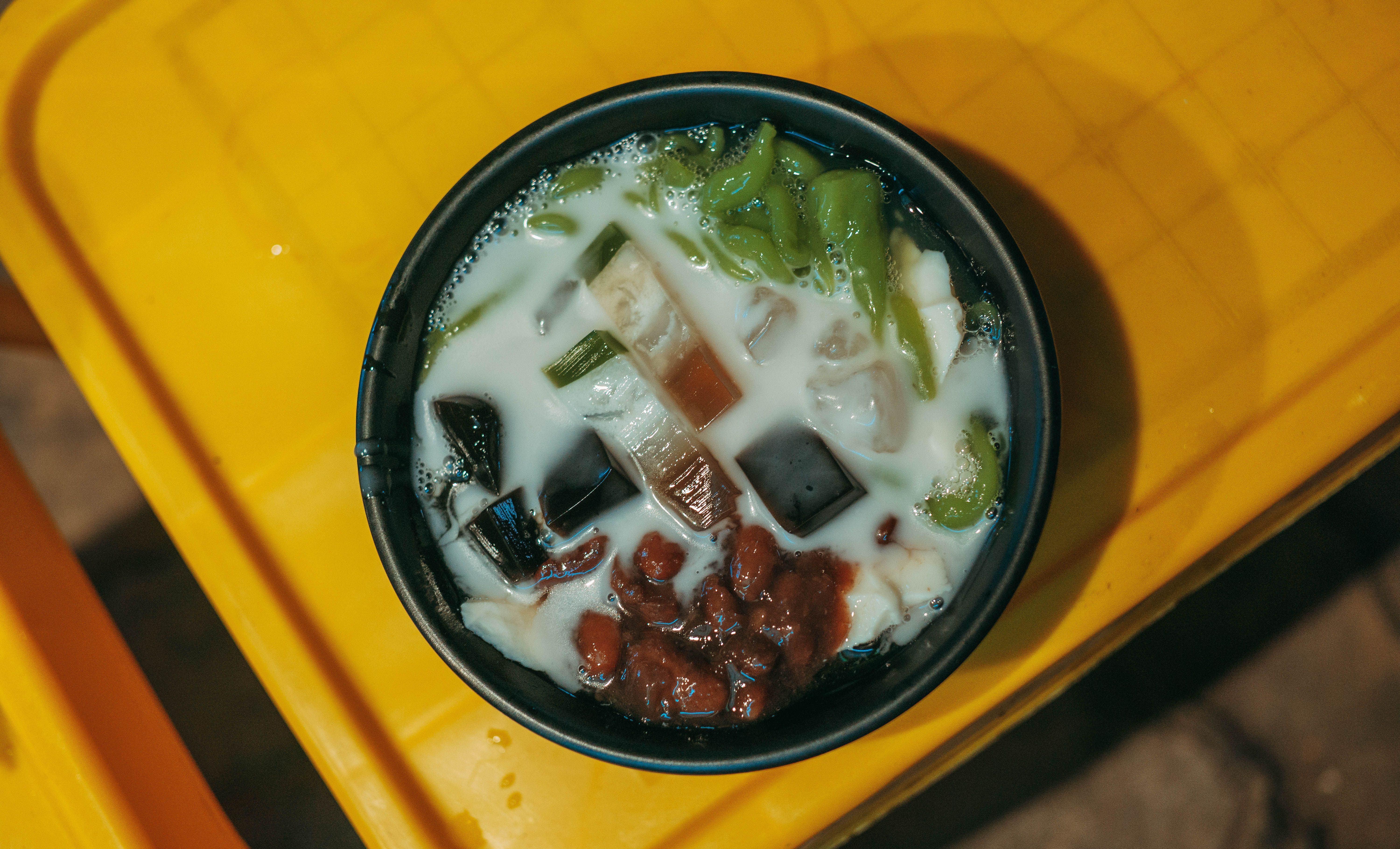
Photo: FOX ^.ᆽ.^= ∫ / Pexels
Vietnamese
Che Ba Mau
The diets react (see scores below)
Common Ingredients
- red beans
- mung beans
- pandan jelly
- coconut milk
- sugar
- shaved ice
- tapioca
Specific recipes may vary.
Incompatible with 9 of 11 diets
Diet Ratings
Che Ba Mau is fundamentally incompatible with a ketogenic diet. This Vietnamese three-color dessert is essentially a sugar bomb with multiple high-carb components stacked together. Red beans and mung beans are legumes with very high net carb content (roughly 20-25g net carbs per 100g cooked). Tapioca is almost pure starch. Added sugar is a direct keto violation. Pandan jelly typically contains sugar and starch-based thickeners. The only marginally keto-friendly ingredient is the coconut milk. Even a small serving would likely exceed an entire day's net carb allowance, making this dish completely incompatible with maintaining ketosis.
Che Ba Mau (Vietnamese three-color dessert) is entirely plant-based as listed. Red beans, mung beans, pandan jelly, tapioca, sugar, and shaved ice are all clearly plant-derived. Coconut milk is a plant-based product made from coconut flesh and water, with no dairy involvement. All ingredients align comfortably with vegan standards. The dish scores an 8 rather than a perfect 10 because it is a sweetened dessert with added sugar and limited nutritional density, though none of its components raise any animal-product concern. The main real-world caveat is that commercial sugar may be processed using bone char, which some strict ethical vegans object to, but this is a production method concern rather than an ingredient concern and is not universally flagged within the vegan community.
Che Ba Mau is fundamentally incompatible with the paleo diet. Nearly every ingredient violates core paleo principles: red beans and mung beans are legumes, which are explicitly excluded due to their lectins and anti-nutrients. Sugar is refined and strictly prohibited. Tapioca, derived from cassava, is a highly processed starch with no nutritional value and is generally excluded. Pandan jelly is a processed, additive-laden product. While coconut milk and shaved ice are technically paleo-acceptable on their own, they cannot redeem a dish built almost entirely on non-paleo foundations. This dessert represents a convergence of multiple avoid-category ingredients with virtually no paleo-compliant substance.
Che Ba Mau is a Vietnamese dessert drink that conflicts significantly with Mediterranean diet principles. Despite containing legumes (red beans, mung beans) which are Mediterranean staples, the dish is built around added sugar, coconut milk (a saturated fat not part of the Mediterranean fat profile), and refined tapioca starch. The primary fat source is coconut milk rather than olive oil, and the dish is essentially a sugar-sweetened dessert with minimal nutritional complexity. Added sugars and sweetened beverages/desserts are minimized in the Mediterranean diet, and coconut milk is not a traditional or encouraged fat source. The legume content provides some redeeming nutritional value but is insufficient to overcome the high sugar load and incompatible fat sources.
Che Ba Mau is a Vietnamese three-color dessert that is entirely plant-based and heavily processed with sugar. Every single ingredient — red beans, mung beans, pandan jelly, coconut milk, sugar, shaved ice, and tapioca — is either plant-derived or a refined carbohydrate. There are zero animal products present. This dish is the polar opposite of carnivore: it is high in sugar, legumes, plant starches, and plant-based fats. There is universal consensus across all carnivore camps that this dish is completely incompatible with the diet.
Che Ba Mau contains multiple excluded ingredients under the Whole30 program. Sugar is explicitly excluded as an added sugar. Red beans and mung beans are legumes, which are a fully excluded food category on Whole30 (with only specific exceptions for green beans, sugar snap peas, and snow peas — neither red beans nor mung beans qualify). These violations alone are sufficient to disqualify the dish entirely.
Che Ba Mau contains multiple high-FODMAP ingredients that make it problematic during the elimination phase. Red beans (kidney beans) and mung beans are both legumes high in GOS (galacto-oligosaccharides), which are a major FODMAP category. Even small servings of these legumes (e.g., more than 1/4 cup canned or any meaningful amount of dried/cooked) push into high-FODMAP territory. Coconut milk can be low-FODMAP at small portions (60ml/1/4 cup) but is commonly served in larger quantities in this dessert, risking sorbitol and fructan overload. Pandan jelly is generally low-FODMAP. Sugar and shaved ice are safe. Tapioca is low-FODMAP. However, the combination of two legume-based ingredients (red beans and mung beans) as primary components makes this dish essentially impossible to consume in a safe portion during the elimination phase — the GOS load from both beans together would be significant even in modest servings of this dessert.
Che Ba Mau (Vietnamese three-color dessert) presents multiple DASH diet concerns. The dish combines several ingredients that individually or collectively conflict with DASH principles. Coconut milk is a tropical oil-based product high in saturated fat, which DASH explicitly limits. Added sugar is a primary ingredient, contributing to significant caloric density with little nutritional benefit — DASH recommends fewer than 5 servings of sweets per week and minimizes added sugars. Tapioca and pandan jelly are refined carbohydrates with minimal fiber or micronutrient value. While red beans and mung beans are genuinely DASH-friendly (rich in fiber, potassium, magnesium, and plant protein), their benefit is substantially offset by the coconut milk and sugar in this preparation. The dish as commonly served is essentially a sweetened dessert beverage with a high glycemic load, placing it in 'avoid' territory despite containing some legumes.
NIH DASH guidelines don't specifically address Che Ba Mau, but clearly limit both coconut milk (saturated fat) and added sugars. Some updated clinical interpretations note that the bean content provides meaningful fiber and minerals, and that occasional consumption of moderate portions may be acceptable within an otherwise strict DASH framework — however, this remains a minority view given the dish's sugar and saturated fat load.
Che Ba Mau is a Vietnamese three-color dessert drink that is fundamentally incompatible with Zone Diet principles. The dish is composed almost entirely of high-glycemic carbohydrates with no meaningful protein and minimal fat of the wrong type. Added sugar is a primary ingredient, driving rapid glycemic spikes. Shaved ice and tapioca are nutritionally empty high-glycemic carb sources. Coconut milk provides saturated fat rather than the monounsaturated fat preferred in the Zone. While red beans and mung beans do offer some fiber and modest protein, in this context they are sweetened and served as a dessert component, not a controlled protein-carb source. There is no lean protein block to anchor the meal, no monounsaturated fat, and the carbohydrate load is overwhelmingly high-glycemic and sugar-driven. The 40/30/30 ratio cannot be approximated without completely dismantling the dish. Even in the Zone's ratio-based framework, which avoids categorical exclusions, this dessert offers no practical pathway to balance — it is essentially a sugar-and-starch delivery vehicle with saturated fat, placing it firmly in the avoid category alongside soda, candy, and other pure sugar sources.
Che Ba Mau (Vietnamese three-color dessert) presents a mixed anti-inflammatory profile. On the positive side, red beans and mung beans are legumes with meaningful fiber, plant protein, and polyphenols — both are recognized as anti-inflammatory foods in Dr. Weil's framework. Pandan has some antioxidant properties. However, the dish is anchored by two significant concerns: added sugar and full-fat coconut milk. Added sugar is a clear pro-inflammatory driver that raises blood glucose and inflammatory markers like CRP, and this dessert typically contains a substantial amount. Coconut milk is high in saturated fat (primarily lauric acid), which is contested — some research suggests lauric acid behaves differently from other saturated fats, but mainstream anti-inflammatory guidance still recommends limiting saturated fat intake. Tapioca is a refined starch with minimal nutritional benefit and a high glycemic load when combined with sugar. Shaved ice is neutral. The dish is not processed in an industrial sense (no trans fats, artificial additives, or HFCS typically), which saves it from an 'avoid' verdict, but the sugar load and glycemic impact are meaningful enough to warrant caution rather than approval.
Some anti-inflammatory practitioners (including those following Dr. Weil's more permissive framework) might view this as an acceptable occasional treat given the legume base and absence of processed ingredients — the beans genuinely contribute fiber and polyphenols. Conversely, stricter anti-inflammatory protocols like AIP or low-glycemic approaches would flag the added sugar and refined tapioca starch as meaningful inflammatory triggers, potentially pushing this closer to 'avoid' for individuals managing blood sugar or autoimmune conditions.
Che Ba Mau is a Vietnamese sweet dessert drink built around sugar, coconut milk, and shaved ice — a profile that conflicts with nearly every GLP-1 dietary priority. The dominant macronutrient is sugar (from added sugar, sweetened coconut milk, and tapioca), with negligible protein and modest fiber from the beans. Coconut milk contributes significant saturated fat. The high sugar load delivers a rapid glycemic spike with little nutritional payoff per calorie, making it a poor use of the reduced appetite and caloric budget GLP-1 patients have. The cold, sweet, high-sugar format is effectively an empty-calorie dessert. While red beans and mung beans do contain fiber and some protein, they appear in small quantities relative to the sweeteners and coconut milk, and their nutritional contribution is insufficient to offset the sugar and fat load. This is a category-clear avoid for GLP-1 patients.
*See how scores were generated at our methodology page.
Nutritional profile
Six traits that cut across every diet.
Fiber & Plants
How much whole-plant food and fiber it delivers.
Healthy Fats
The quality of its fats (unsaturated, omega-3).
Whole / Unprocessed
How close it is to its natural, unprocessed form.
Gut Gentle
How easy it is on digestion (low FODMAP, few irritants).
Low Glycemic
How little it spikes your blood sugar.
Protein Density
How much protein it packs per calorie.
Controversy Index
Higher controversy = more disagreement between diets.
Diet-Specific Tips
 Vegan — 8/10
View tips
- Red beans and mung beans are whole plant foods — fully vegan
- Coconut milk is plant-based, not a dairy product
- Pandan jelly is derived from pandan leaves — plant-based
- Tapioca is starch extracted from cassava root — plant-based
- Shaved ice and sugar are vegan by ingredient; bone char concern in refined sugar is a minor, non-universal ethical debate
- No animal products or animal-derived ingredients present in any component
 Anti-Inflammatory — 4/10
View tips
- Red beans and mung beans provide fiber and polyphenols — anti-inflammatory legumes
- Added sugar is a primary pro-inflammatory concern — raises CRP and blood glucose
- Full-fat coconut milk contributes saturated fat — limited in anti-inflammatory frameworks
- Tapioca is a refined starch with high glycemic index, especially combined with sugar
- No artificial additives, trans fats, or HFCS — mitigates worst-case inflammatory risk
- Pandan offers minor antioxidant benefit
- Overall glycemic load of the dish is high, which is a meaningful inflammatory concern