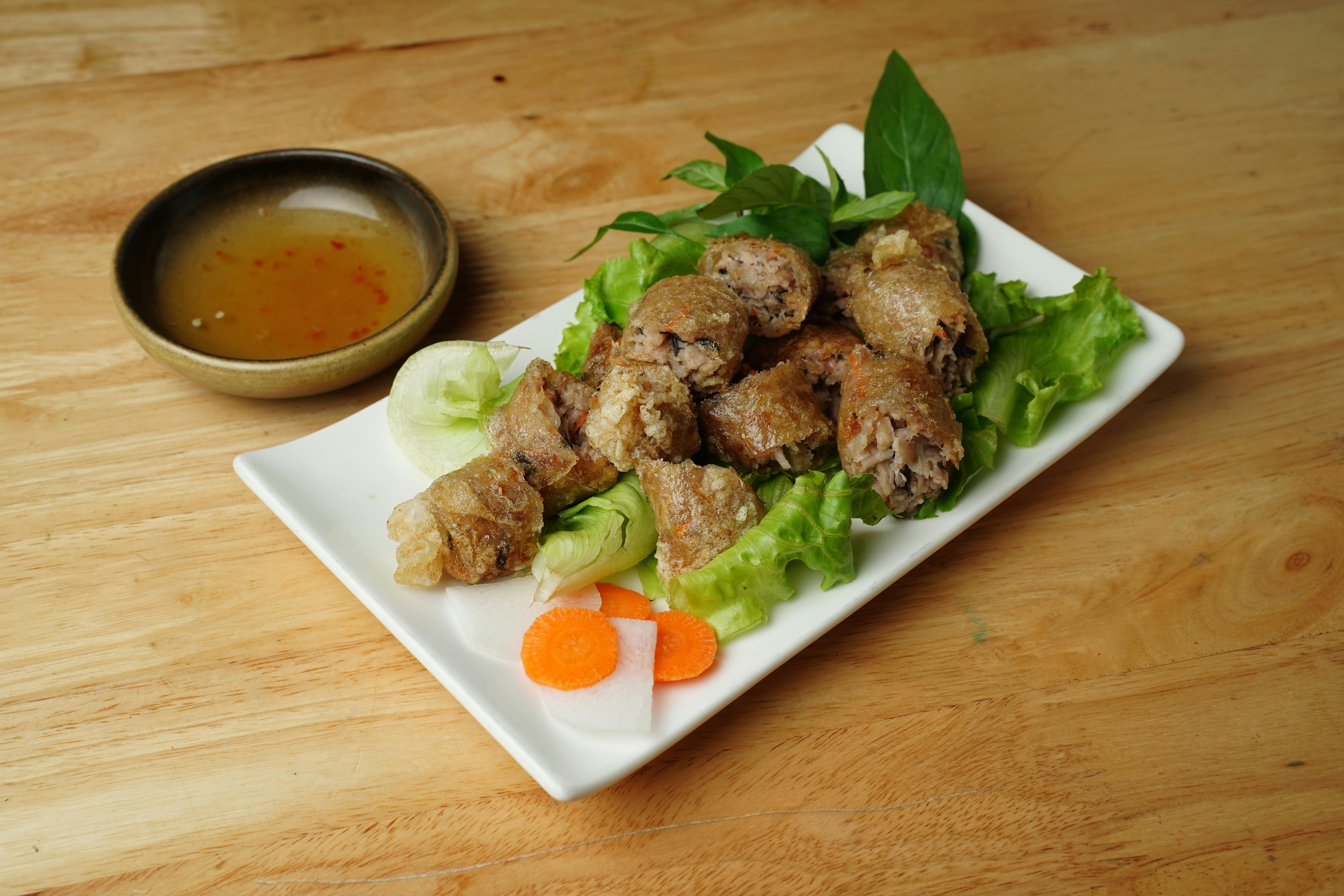
Photo: Kai-Chieh Chan / Pexels
Vietnamese
Nem Nuong
The diets react (see scores below)
Common Ingredients
- ground pork
- garlic
- shallots
- fish sauce
- sugar
- rice paper
- lettuce
- herbs
- peanut sauce
Specific recipes may vary.
Incompatible with 7 of 11 diets
Diet Ratings
Nem Nuong in its traditional form is incompatible with a ketogenic diet due to multiple high-carb components. Rice paper wrappers are made from rice flour and carry approximately 15-20g net carbs per sheet, and dishes typically use multiple sheets. The pork patties themselves contain added sugar (a standard ingredient in the marinade). Peanut sauce dipping accompaniment is typically made with sugar, hoisin sauce, and peanut butter, adding another significant carb load. Collectively, a standard serving easily exceeds the entire daily keto carb allowance of 20-50g. The lettuce and fresh herbs are keto-friendly, and the ground pork base protein is fine, but the structural carb-heavy components make the dish as traditionally prepared clearly incompatible with ketosis.
Nem Nuong contains multiple animal-derived ingredients that make it entirely incompatible with a vegan diet. The primary protein is ground pork, a direct animal product. Fish sauce, a fermented fish-derived condiment, is a second major animal ingredient used as a core flavoring. These two ingredients alone firmly place this dish in the 'avoid' category with no ambiguity. The plant-based components (garlic, shallots, sugar, rice paper, lettuce, herbs, peanut sauce) are irrelevant given the foundational animal ingredients.
Nem Nuong contains multiple non-paleo ingredients that make it incompatible with the diet. Rice paper is a grain-based wrapper (rice is a grain, excluded from paleo). Sugar is refined and explicitly excluded. Peanut sauce is a legume-based condiment, also excluded. Fish sauce typically contains added salt and is processed. While the core components — ground pork, garlic, shallots, lettuce, and fresh herbs — are paleo-friendly, the dish as traditionally prepared relies too heavily on non-paleo staples to be considered even a caution-level food.
Nem Nuong centers on ground pork, a red meat that Mediterranean diet guidelines restrict to a few times per month. The dish also contains added sugar and refined rice paper (a refined grain product), both of which contradict core Mediterranean principles. While several ingredients — garlic, shallots, lettuce, fresh herbs — are genuinely Mediterranean-friendly, and fish sauce adds umami without significant concern, the dominant protein is pork and the overall profile leans processed and sugar-added. The peanut sauce adds some plant-based fat but is typically sweetened. The vegetable and herb wrapping elements are positive but insufficient to elevate the dish given its primary protein source and refined/sweetened components.
Some Mediterranean diet interpreters might rate this as 'caution' rather than 'avoid,' noting that the portion of pork per serving can be modest when wrapped in lettuce and rice paper with abundant herbs, and that the dish's overall vegetable-forward presentation resembles Mediterranean mezze-style eating. The peanut component also provides plant-based protein and healthy fats.
Nem Nuong as a complete dish is fundamentally incompatible with the carnivore diet. While the core pork component is animal-derived, the dish is wrapped in rice paper (grain-based plant food), served with lettuce and fresh herbs (plant foods), and accompanied by peanut sauce (legume-based). The pork itself is also problematic — it contains garlic, shallots (plant aromatics), and sugar as standard ingredients, all of which are excluded on carnivore. Fish sauce is generally acceptable, but sugar added to the meat mixture is a clear violation. The overall dish structure is built around plant wrappers and dipping sauces that make it entirely incompatible.
Nem Nuong contains multiple Whole30-excluded ingredients. Sugar is explicitly excluded as an added sugar. Rice paper is a grain-based wrapper (rice). Peanut sauce contains peanuts, which are legumes and explicitly excluded. Any one of these three violations would be sufficient to disqualify the dish entirely.
Nem Nuong contains multiple high-FODMAP ingredients that make it unsuitable during the elimination phase. Garlic is one of the highest-FODMAP foods (fructans) and is a core flavoring in the pork mixture — even small amounts are problematic. Shallots are also high in fructans and are used as a primary aromatic. The peanut sauce is a significant concern as it typically contains garlic and/or onion, and peanuts themselves are moderate-FODMAP at larger servings (though low at 32g). Rice paper wrappers made from rice starch are low-FODMAP, as are lettuce and most Vietnamese herbs (mint, perilla, cilantro). Fish sauce in typical small quantities is generally considered low-FODMAP. Sugar in small amounts is fine. However, the combination of garlic and shallots embedded directly into the ground pork mixture means there is no way to remove or separate these high-FODMAP ingredients — the fructans are cooked throughout the meat. The peanut sauce compounds the issue. This dish cannot be safely consumed during elimination without a significant recipe reformulation.
Monash University has not specifically tested Nem Nuong as a composite dish, so the exact FODMAP load is estimated from individual ingredients. Some clinical FODMAP practitioners suggest that cooking garlic in oil and discarding it, or using garlic-infused oil instead, could lower the fructan load — but since garlic and shallots are ground into the pork mixture here, this mitigation is not applicable. The peanut sauce formulation varies widely and a homemade low-FODMAP version (without garlic/onion) could reduce risk.
Nem Nuong is a Vietnamese grilled pork sausage dish typically wrapped in rice paper with fresh vegetables and herbs — a mixed profile from a DASH perspective. The fresh components (lettuce, herbs, rice paper) are well-aligned with DASH principles, providing fiber and micronutrients with minimal sodium. However, the ground pork base raises concerns: pork can be fatty depending on the cut used, contributing saturated fat that DASH limits. Fish sauce is a significant sodium contributor — even small amounts (1-2 tbsp) can add 800–1,400mg of sodium, pushing the dish toward the upper limits of DASH sodium targets. The peanut sauce, while containing heart-healthy unsaturated fats and some protein, is often made with added sugar, sodium, and sometimes coconut milk, further compounding sodium and saturated fat concerns. Sugar is explicitly added to the pork mixture as well. The dish is not categorically DASH-incompatible, but the combination of fish sauce, sugared pork, and peanut sauce makes it a moderate-caution item requiring portion control and ideally preparation modifications (e.g., reduced fish sauce, low-sodium soy-based alternatives, lighter peanut sauce).
NIH DASH guidelines flag fish sauce and processed/seasoned meats as high-sodium concerns to limit; however, updated clinical interpretations of DASH note that dishes like Nem Nuong — when portioned appropriately and paired with abundant fresh vegetables and herbs — can fit within a DASH framework, especially if preparation adjusts fish sauce quantity or uses reduced-sodium alternatives. Some DASH-oriented dietitians also credit the fresh herb and vegetable wrapping components as meaningfully offsetting the dish's overall dietary impact.
Nem Nuong is a Vietnamese grilled pork sausage dish typically served wrapped in rice paper with fresh herbs and lettuce, accompanied by peanut sauce. As a snack, it has some Zone-friendly elements but several components require careful management. The fresh herbs, lettuce, and aromatics (garlic, shallots) are excellent low-glycemic Zone carb sources and provide polyphenols. However, the ground pork is not a lean protein — it carries meaningful saturated fat — making it an 'unfavorable' Zone protein compared to skinless chicken or fish. The sugar in the sausage mixture raises the glycemic profile of the protein component unnecessarily. Rice paper is a refined, high-glycemic carbohydrate with little fiber, counting as an 'unfavorable' carb block. The peanut sauce introduces additional sugar and omega-6-heavy peanut oil, though peanuts do have monounsaturated fat. To Zone-balance this snack, you would need to: use leaner pork or substitute with chicken/turkey, minimize sugar in the sausage, limit rice paper to one wrapper, and use a small portion of peanut sauce. The fresh herb and lettuce wrap components are genuinely Zone-favorable. The overall dish is workable but requires significant portion discipline and ideally some ingredient modification to fit cleanly into Zone ratios.
Some Zone practitioners would rate this more favorably, noting that Sears' later anti-inflammatory writings (e.g., The Zone Diet and OmegaRx Zone) acknowledge that pork in moderation is acceptable and that the abundance of fresh herbs, garlic, and vegetables provides meaningful polyphenol benefits. The fish sauce adds umami with minimal caloric impact. If portion-controlled — one small sausage roll with heavy lettuce and herb wrapping and minimal peanut sauce — this could function as a reasonable Zone snack closer to a 6. Conversely, stricter Zone adherents following the original 'Enter the Zone' favorable/unfavorable lists would flag ground pork, rice paper, and peanut sauce simultaneously, potentially pushing the score lower.
Nem Nuong is a Vietnamese grilled pork sausage dish served in rice paper rolls with lettuce and fresh herbs. The profile is genuinely mixed from an anti-inflammatory standpoint. On the positive side: fresh herbs (basil, mint, cilantro) contribute polyphenols and antioxidants; garlic and shallots are anti-inflammatory aromatics with well-documented benefits; lettuce and rice paper wrapping add fiber and keep the dish light; and the fresh-roll format avoids deep frying. Fish sauce, while high in sodium, is used in small quantities and does not meaningfully drive inflammation. However, the primary protein is ground pork, which is red/processed meat territory — anti-inflammatory frameworks recommend limiting red meat and typically flag pork as moderately pro-inflammatory due to saturated fat and arachidonic acid content. The added sugar in the pork mixture is a mild concern. The peanut dipping sauce adds some beneficial monounsaturated fat and polyphenols but also omega-6 fatty acids and often added sugar. Overall, this dish sits in a moderate zone: it's far better than fried or heavily processed Vietnamese options, but the pork base and sugar additions prevent it from being a clear anti-inflammatory choice.
Some anti-inflammatory practitioners, including those following Dr. Weil's broader Mediterranean-style approach, would note that pork in modest portions within a vegetable- and herb-rich dish is acceptable, especially when grilled rather than fried. They might score this higher (6–7) given the herb density and whole-food format. Conversely, stricter AIP and autoimmune-focused protocols would flag pork more harshly and also raise concerns about fish sauce fermentation byproducts and peanuts (a legume with lectin content) for sensitive individuals.
Nem Nuong is a Vietnamese grilled pork sausage typically served as a wrap with rice paper, lettuce, and fresh herbs — a mixed profile for GLP-1 patients. The fresh vegetables, herbs, lettuce, and rice paper contribute fiber, water content, and easy digestibility, which are positives. However, ground pork is a moderate-to-high fat protein source depending on the cut and fat ratio used; traditional nem nuong recipes can contain a meaningful amount of saturated fat and sugar in the meat mixture. Fish sauce adds sodium but is not a major concern in small quantities. The peanut sauce is the most problematic element — it is calorie-dense, high in fat, and easy to over-consume, which can worsen nausea, bloating, and reflux on GLP-1 medications. Protein content per serving is moderate but not high-density relative to the fat load. As a snack category, portion size is critical — a single small roll may be acceptable, but multiple rolls with peanut sauce can quickly become a high-fat, high-calorie snack counterproductive to GLP-1 goals. Sugar in the pork mixture is a minor concern but adds up across multiple rolls.
Some GLP-1-focused dietitians view traditional Vietnamese fresh roll formats favorably because of their vegetable volume, fresh herbs, and relatively light preparation compared to fried alternatives — and would rate nem nuong more positively if peanut sauce is minimized or omitted. Others flag ground pork's variable fat content and the added sugar in the meat mixture as meaningful enough concerns to recommend substituting with shrimp or chicken-based versions for GLP-1 patients.
*See how scores were generated at our methodology page.
Nutritional profile
Six traits that cut across every diet.
Fiber & Plants
How much whole-plant food and fiber it delivers.
Healthy Fats
The quality of its fats (unsaturated, omega-3).
Whole / Unprocessed
How close it is to its natural, unprocessed form.
Gut Gentle
How easy it is on digestion (low FODMAP, few irritants).
Low Glycemic
How little it spikes your blood sugar.
Protein Density
How much protein it packs per calorie.
Controversy Index
Higher controversy = more disagreement between diets.
Diet-Specific Tips
 DASH — 5/10
View tips
- Fish sauce is high in sodium — a key DASH-limiting concern
- Ground pork may contain significant saturated fat depending on fat content
- Peanut sauce adds sodium, sugar, and potential saturated fat (if coconut milk-based)
- Added sugar in the pork mixture conflicts with DASH guidance on limiting sweets
- Fresh lettuce, herbs, and rice paper are DASH-friendly components
- Portion size is critical — as a snack/appetizer, sodium load may remain manageable
- Low-sodium preparation (reduced fish sauce, light peanut sauce) would improve DASH compatibility
 Zone — 5/10
View tips
- Ground pork is higher in saturated fat than preferred Zone proteins (chicken breast, fish, egg whites)
- Rice paper is a refined, low-fiber, high-glycemic carbohydrate — 'unfavorable' in Zone terminology
- Added sugar in the sausage mixture unnecessarily spikes glycemic load
- Peanut sauce contains added sugar and omega-6 fats, though peanuts provide some monounsaturated fat
- Fresh lettuce, herbs, garlic, and shallots are Zone-favorable low-glycemic carb sources with polyphenol benefits
- Fish sauce contributes negligible calories and adds umami without Zone concerns
- As a snack, the dish can be portion-controlled to fit Zone blocks but requires discipline
- Omega-6 heavy peanut oil in peanut sauce is contrary to Zone anti-inflammatory principles
 Anti-Inflammatory — 5/10
View tips
- Pork is the primary protein — red meat category, moderately pro-inflammatory due to saturated fat and arachidonic acid
- Added sugar in the pork mixture is a mild inflammatory concern
- Garlic and shallots are well-established anti-inflammatory aromatics
- Fresh herbs (mint, cilantro, basil) contribute polyphenols and antioxidants
- Rice paper and lettuce wrapping keeps the dish light and avoids fried carbohydrates
- Peanut sauce adds omega-6 fatty acids and often additional sugar
- Grilled preparation is preferable to frying but high-heat charring may generate pro-inflammatory compounds
- Fish sauce contributes sodium but in quantities too small to significantly drive inflammation
 GLP-1 Friendly — 5/10
View tips
- Ground pork has moderate-to-high saturated fat depending on fat ratio — less ideal than lean proteins like chicken breast or shrimp
- Peanut sauce is calorie-dense, high in fat, and a known GLP-1 GI trigger — should be used sparingly or avoided
- Fresh lettuce, herbs, and rice paper add fiber, water content, and digestibility — positive elements
- Added sugar in the pork mixture is a minor but real concern
- Portion-sensitive: one small roll is manageable, multiple rolls with sauce can be problematic
- No fried components in the standard preparation — a meaningful advantage over other pork snack formats
- Protein content per roll is moderate but not high-density enough to anchor a GLP-1 snack on its own