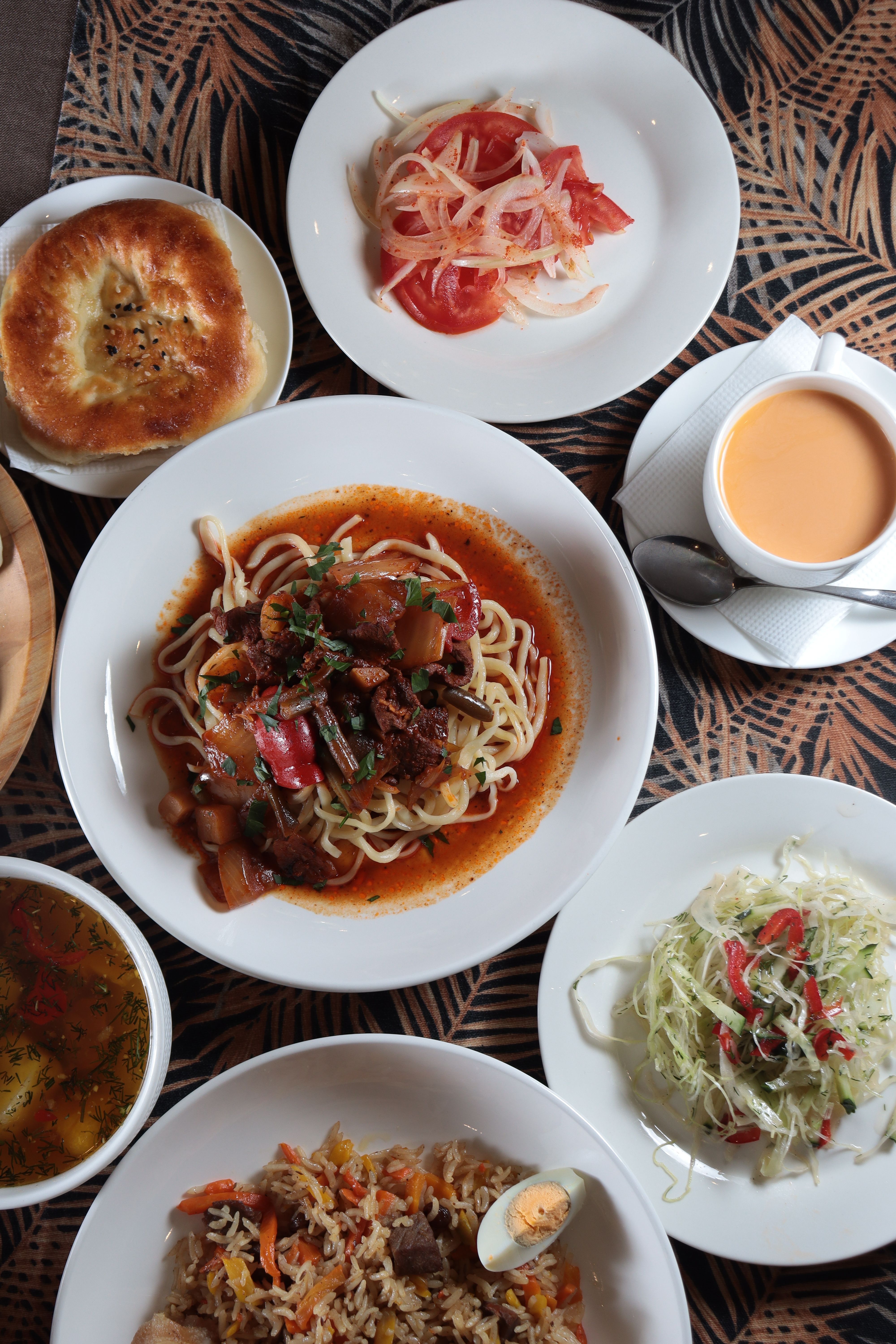
Photo: Merkhat Amangeldinov / Pexels
The diets react (see scores below)
Common Ingredients
- wheat noodles
- lamb
- bell peppers
- tomatoes
- onion
- garlic
- cumin
- chile
Specific recipes may vary.
Incompatible with 7 of 11 diets
Diet Ratings
Laghman is built around wheat noodles, which are a high-carb grain product and the dominant ingredient in this dish. A standard serving of wheat noodles alone delivers 40-60g of net carbs, instantly exceeding or maxing out the entire daily keto carb budget. The lamb, bell peppers, tomatoes, onion, and spices are not inherently problematic, but the foundational noodle base makes this dish entirely incompatible with ketosis. There is no meaningful portion adjustment that would make this dish keto-friendly while retaining its core identity.
Laghman contains lamb, which is a direct animal product (red meat). This is an unambiguous violation of vegan dietary rules. All other ingredients — wheat noodles, bell peppers, tomatoes, onion, garlic, cumin, and chile — are plant-based, but the inclusion of lamb makes this dish entirely incompatible with a vegan diet.
Laghman's defining feature is wheat noodles, which are a grain-based food universally excluded from the paleo diet. Wheat is one of the clearest non-paleo foods due to its gluten content, anti-nutrients (lectins, phytates), and complete absence from the Paleolithic diet. The remaining ingredients — lamb, bell peppers, tomatoes, onion, garlic, cumin, and chile — are all paleo-compliant, but the wheat noodles are a core, non-optional component of this dish that cannot be overlooked. The dish as traditionally prepared is incompatible with paleo principles.
Laghman is a Central Asian/Uyghur noodle dish with several elements that conflict with Mediterranean diet principles. The primary protein is lamb (red meat), which should be limited to only a few times per month. The wheat noodles are typically made from refined white flour, a refined grain that the Mediterranean diet discourages. On the positive side, the dish contains a good array of vegetables (bell peppers, tomatoes, onion, garlic) and flavorful spices (cumin, chile), which are Mediterranean-friendly. However, the combination of red meat as the primary protein with refined grain noodles as the base pushes this dish into 'avoid' territory. If the lamb were replaced with a plant protein or fish, and whole wheat noodles substituted, the dish would score significantly higher.
Some Mediterranean diet interpreters might score this slightly higher, noting that lamb is consumed in traditional Mediterranean cultures (particularly Greek, Turkish, and North African) in moderate portions on occasion, and that the abundant vegetables and spices partially offset the red meat concern. In these regional traditions, a lamb dish with vegetables might be considered an occasional acceptable meal rather than a strict avoid.
Laghman is fundamentally incompatible with the carnivore diet. The dish is built around wheat noodles (a grain), which are entirely plant-derived and strictly excluded. Beyond the noodles, the recipe contains multiple plant-based vegetables (bell peppers, tomatoes, onion, garlic) and plant-derived spices (cumin, chile). While lamb is an excellent ruminant meat and carnivore-approved, it represents only one component of an otherwise fully plant-heavy dish. No amount of modification short of removing every ingredient except the lamb would make this dish carnivore-compliant.
Laghman contains wheat noodles, which are a grain-based pasta explicitly excluded on the Whole30. Grains (including wheat) are one of the core eliminated food groups, and pasta/noodles are also specifically called out in the 'no recreating' rule. All other ingredients — lamb, bell peppers, tomatoes, onion, garlic, cumin, and chile — are fully compliant, but the wheat noodles are a hard disqualifier with no ambiguity.
Laghman contains multiple high-FODMAP ingredients that make it unsuitable during the elimination phase. Wheat noodles are high in fructans — the primary FODMAP concern in wheat — and form the bulk of the dish. Onion and garlic are among the highest-FODMAP foods tested by Monash University, both rich in fructans and problematic even in small quantities. These three ingredients alone are sufficient to classify the dish as high-FODMAP. There is no realistic way to consume a standard serving of Laghman without exceeding FODMAP thresholds for fructans. Bell peppers, tomatoes, lamb, cumin, and chile are generally low-FODMAP at typical serving sizes and do not contribute to the concern.
Laghman is a Central Asian/Uyghur pulled noodle dish that has several DASH-compatible elements alongside some concerns. On the positive side, it features an abundance of vegetables (bell peppers, tomatoes, onion, garlic) rich in potassium, magnesium, and fiber, which are strongly encouraged on DASH. The spices (cumin, chile) are sodium-free flavor enhancers. However, lamb is a red meat with notable saturated fat content, which DASH limits — the NIH DASH plan specifically recommends reducing red meat intake. Wheat noodles are refined carbohydrates rather than whole grains, a missed nutritional opportunity. Sodium content depends heavily on preparation; if soy sauce, fermented black bean paste, or added salt is used (common in some versions), sodium could be a significant concern. As prepared with the listed ingredients only, the dish is moderate in sodium and saturated fat, landing it in the caution range. Substituting lamb with lean poultry or fish and using whole-grain noodles would meaningfully improve DASH compatibility.
NIH DASH guidelines categorically limit red meat due to saturated fat and recommend leaner protein sources. However, some updated clinical interpretations note that lean cuts of lamb (e.g., loin) in modest portions can fit within overall saturated fat targets, and the vegetable-forward nature of this dish may offset some cardiovascular risk — a position increasingly supported by whole-diet pattern research rather than single-nutrient restriction.
Laghman is a Central Asian/Chinese noodle dish with a mixed Zone profile. The vegetable components — bell peppers, tomatoes, onion, and garlic — are excellent low-glycemic Zone-favorable carbs rich in polyphenols and anti-inflammatory compounds. However, the wheat noodles are a high-glycemic, 'unfavorable' carbohydrate in Zone terminology, and they typically dominate the dish's carb load, making macro balancing difficult. Lamb is a functional protein source but is higher in saturated fat than Zone-ideal proteins like skinless chicken or fish, which is a secondary concern. The spice profile (cumin, chile, garlic) is Zone-positive for anti-inflammatory purposes. To fit Zone blocks, a practitioner would need to significantly reduce the noodle portion (treating it as a minor carb block), increase the vegetable ratio, and select leaner lamb cuts (leg rather than shoulder/rib). As traditionally served, the noodle-heavy ratio likely skews carbs too high and fat quality is suboptimal, but the dish is far from a Zone disaster — it has real redeeming ingredients.
Some Zone practitioners and Sears' later writings acknowledge that whole wheat noodles in controlled portions can occupy a legitimate 'unfavorable' carb block, particularly if the dish is vegetable-rich. If lamb is trimmed lean, the saturated fat concern is reduced. A Zone-adapted Laghman with a smaller noodle portion, extra bell peppers and tomatoes, and lean lamb could approach an 'approve' rating. The dish's anti-inflammatory spice base and polyphenol-rich vegetables partially offset the unfavorable carb component.
Laghman is a Central Asian pulled noodle dish with a mixed anti-inflammatory profile. On the positive side, it features several genuinely anti-inflammatory ingredients: garlic and cumin are well-supported anti-inflammatory spices, chile peppers contribute capsaicin (a known anti-inflammatory compound), tomatoes provide lycopene and other antioxidants, bell peppers are rich in vitamin C and carotenoids, and onion contributes quercetin. These colorful vegetables collectively offer meaningful antioxidant and polyphenol content. However, lamb is red meat — a protein source that anti-inflammatory frameworks consistently recommend limiting due to saturated fat content and arachidonic acid, which can promote inflammatory eicosanoid production. Wheat noodles are refined carbohydrates with a moderate-to-high glycemic load, which can contribute to low-grade inflammation, particularly in large portions. The dish is not inherently processed or high in trans fats or added sugars, which keeps it from being an 'avoid.' The overall verdict lands at 'caution': the spice and vegetable profile is genuinely beneficial, but the refined wheat noodles and lamb pull it toward a mixed inflammatory profile rather than a clearly anti-inflammatory one. Smaller portions of noodles, leaner cuts of lamb, and emphasis on the vegetable components would improve the profile.
Some anti-inflammatory practitioners (e.g., those following the Autoimmune Protocol/AIP or Mediterranean-adjacent frameworks) would rate this more negatively, pointing to lamb's saturated fat and the refined wheat noodles as meaningful inflammatory drivers — especially for individuals with autoimmune conditions. Conversely, traditional dietary pattern researchers note that lamb consumed in moderate amounts within a vegetable- and spice-rich context (as in Central Asian cuisine) has not been strongly linked to elevated inflammatory markers in population studies, and some frameworks treat occasional red meat as 'moderate' rather than 'avoid.'
Laghman is a Central Asian pulled noodle dish (common in Uyghur and broader Chinese Muslim cuisine) built around wheat noodles, lamb, and a vegetable-forward sauce of bell peppers, tomatoes, onion, and garlic seasoned with cumin and chile. It has meaningful positives for GLP-1 patients: the tomato-and-pepper sauce contributes fiber, water content, and micronutrients; garlic and onion add prebiotic fiber; and lamb provides complete protein. However, several factors hold it back from an approve rating. Lamb is a moderately fatty red meat — a standard serving contains meaningful saturated fat, which can worsen nausea, bloating, and reflux in GLP-1 patients whose gastric emptying is already slowed. Wheat noodles are a refined carbohydrate with modest fiber and protein density per calorie, meaning a typical laghman portion is carbohydrate-heavy relative to protein. The chile component may irritate the GI tract in patients experiencing nausea or reflux, which are common GLP-1 side effects. The dish is not fried and is broth- or sauce-based, which supports digestibility, and portion control is feasible. Overall, laghman is acceptable in a modified form — smaller noodle portion, leaner lamb or substituted lean protein, and mild chile — but as typically prepared it sits firmly in the caution range.
Some GLP-1-focused dietitians would rate lamb more favorably, noting that its protein density and iron and zinc content are clinically valuable during rapid weight loss where micronutrient depletion is a real concern. Others would flag refined wheat noodles as a more significant drawback than the lamb fat, particularly for patients with concurrent insulin resistance or type 2 diabetes, recommending a whole-grain or legume-based noodle swap as the primary modification.
*See how scores were generated at our methodology page.
Nutritional profile
Six traits that cut across every diet.
Fiber & Plants
How much whole-plant food and fiber it delivers.
Healthy Fats
The quality of its fats (unsaturated, omega-3).
Whole / Unprocessed
How close it is to its natural, unprocessed form.
Gut Gentle
How easy it is on digestion (low FODMAP, few irritants).
Low Glycemic
How little it spikes your blood sugar.
Protein Density
How much protein it packs per calorie.
Controversy Index
Higher controversy = more disagreement between diets.
Diet-Specific Tips
 DASH — 5/10
View tips
- Lamb is red meat with saturated fat, which DASH limits
- High vegetable content (bell peppers, tomatoes, onion, garlic) provides potassium, magnesium, and fiber
- Wheat noodles are refined grains, not whole grains as DASH prefers
- Spices are sodium-free, a positive attribute
- Sodium risk escalates significantly if soy sauce or salted broth is added during preparation
- Portion control of lamb and noodles is important for DASH compliance
- Substituting chicken or fish and using whole-grain noodles would improve the score
 Zone — 5/10
View tips
- Wheat noodles are a high-glycemic 'unfavorable' carbohydrate in Zone terminology, typically dominating the dish
- Bell peppers, tomatoes, onion, and garlic are excellent Zone-favorable, low-glycemic, polyphenol-rich carbs
- Lamb is a functional protein but higher in saturated fat compared to Zone-ideal lean proteins
- Cumin and chile provide anti-inflammatory polyphenol benefits consistent with Sears' anti-inflammatory emphasis
- Dish is heavily carb-skewed as traditionally served, making 40/30/30 macro balance difficult without significant modification
- Lean lamb cuts and reduced noodle portions can make this dish Zone-compatible with effort
 Anti-Inflammatory — 5/10
View tips
- Lamb is red meat — anti-inflammatory frameworks recommend limiting due to saturated fat and arachidonic acid
- Wheat noodles are refined carbohydrates with moderate glycemic load, not ideal for anti-inflammatory eating
- Garlic, cumin, and chile pepper are well-supported anti-inflammatory spices
- Bell peppers and tomatoes contribute carotenoids, lycopene, and vitamin C — strong antioxidant profile
- Onion provides quercetin, a flavonoid with anti-inflammatory properties
- No processed ingredients, trans fats, added sugars, or seed oils — avoids key pro-inflammatory red flags
- Portion size and cut of lamb (leaner cuts reduce saturated fat) significantly affect inflammatory impact
 GLP-1 Friendly — 5/10
View tips
- Lamb is a moderate-fat red meat with saturated fat that can worsen GLP-1 GI side effects
- Wheat noodles are refined carbohydrates with low fiber and protein density per calorie
- Dish is not fried and is sauce-based, supporting easier digestion
- Vegetables (bell peppers, tomatoes, onion, garlic) contribute fiber, water content, and micronutrients
- Chile may exacerbate nausea or reflux in sensitive GLP-1 patients
- Protein content is present but protein-to-calorie ratio is suboptimal compared to lean protein sources
- Portion control is feasible — a smaller noodle portion with more vegetables improves the profile significantly