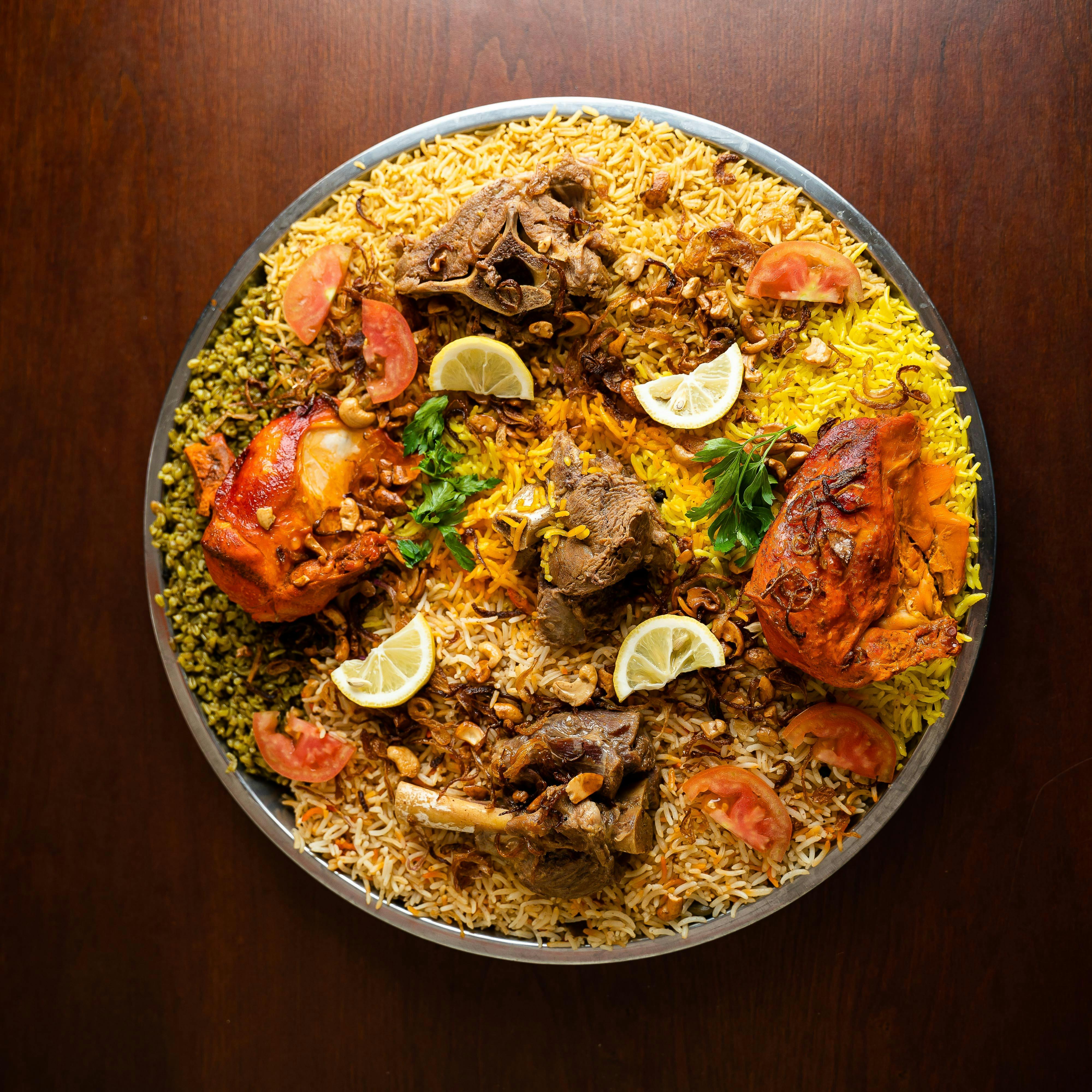
Photo: Murtada Mustafa / Pexels
The diets react (see scores below)
Common Ingredients
- lamb
- basmati rice
- cardamom
- cloves
- cinnamon
- saffron
- onion
- tomatoes
Specific recipes may vary.
Incompatible with 7 of 11 diets
Diet Ratings
Mandi is fundamentally built around basmati rice as a core ingredient, which is a high-glycemic grain with approximately 45g of net carbs per cooked cup. A standard serving of Mandi would easily deliver 60-100g of net carbs from the rice alone, far exceeding the daily keto limit of 20-50g. While the lamb component is excellent for keto — being a fatty, high-quality protein — and the spices (cardamom, cloves, cinnamon, saffron) and aromatics (onion, tomatoes) contribute negligible carbs in typical seasoning quantities, the rice is non-negotiable in this dish and makes it wholly incompatible with ketosis. There is no realistic portion size of traditional Mandi that would keep net carbs within keto limits, as rice is the dish's defining base, not a garnish.
Mandi is a traditional Yemeni slow-cooked meat and rice dish whose defining primary ingredient is lamb, a red meat and clear animal product. There is no ambiguity here: lamb is excluded under every vegan framework without exception. The remaining ingredients — basmati rice, cardamom, cloves, cinnamon, saffron, onion, and tomatoes — are all fully plant-based, but they cannot redeem the dish while lamb remains the central protein. This dish is not vegan in any form of its traditional preparation.
Mandi is a traditional Yemeni slow-cooked lamb and rice dish. While the lamb and all the spices (cardamom, cloves, cinnamon, saffron) are fully paleo-approved, and onion and tomatoes are paleo-friendly vegetables, the dish is built on a foundation of basmati rice — a grain that is excluded from the paleo diet. Grains are among the most clearly prohibited food groups in paleo, as they were not part of the Paleolithic human diet and contain anti-nutrients such as lectins and phytates. Basmati rice is an integral, inseparable component of Mandi; removing it would fundamentally change the dish into something else entirely. The non-rice ingredients are excellent, but the dish as a whole cannot be considered paleo-compatible.
Mandi is a traditional Yemeni slow-cooked lamb and rice dish. The primary protein is lamb, which is red meat — the Mediterranean diet limits red meat to a few times per month. The base is basmati rice, a refined/white grain that modern Mediterranean diet guidelines discourage in favor of whole grains. While the spices (cardamom, cloves, cinnamon, saffron) and vegetables (onion, tomatoes) are entirely compatible and even beneficial, the combination of red meat with refined white rice as the two dominant components places this dish firmly outside regular Mediterranean diet eating. The dish lacks olive oil as a fat source and has no legumes, leafy greens, or whole grains. Occasional consumption is acceptable, but as a regular main it contradicts core principles.
Some Mediterranean diet scholars note that traditional Middle Eastern and Eastern Mediterranean cuisines — including Lebanese, Turkish, and Arabian Peninsula traditions — do incorporate lamb and aromatic rice dishes as celebratory staples. The spice profile and whole-food ingredients (no processing, no added sugars) align with the diet's emphasis on minimally processed cooking, and lamb in traditional culinary contexts was consumed in moderation rather than daily, which some authorities argue is compatible with a broader Mediterranean dietary pattern.
Mandi is fundamentally incompatible with the carnivore diet. While the primary protein — lamb — is an excellent ruminant meat that would score highly on its own, the dish is built around basmati rice as a core component, which is a grain and strictly excluded from carnivore. Additionally, the recipe includes multiple plant-derived ingredients: onion, tomatoes (vegetables/fruits), and a blend of spices (cardamom, cloves, cinnamon, saffron). Even the most lenient carnivore practitioners who allow spices in small amounts would reject this dish outright due to the rice and vegetables forming the bulk of the meal alongside the meat. The lamb itself is the only carnivore-compliant element.
Mandi contains basmati rice, which is a grain and explicitly excluded on the Whole30 program. All grains — including rice — are eliminated for the full 30 days. The lamb and all the spices (cardamom, cloves, cinnamon, saffron) as well as onion and tomatoes are fully compliant, but the rice makes the dish non-compliant as traditionally prepared.
Mandi contains several low-FODMAP ingredients — lamb is a safe protein with no FODMAPs, basmati rice is low-FODMAP, and spices like cardamom, cloves, cinnamon, and saffron are used in small quantities and are generally low-FODMAP at culinary doses. However, two ingredients raise concern: onion is a high-FODMAP ingredient (rich in fructans) and is problematic at any meaningful quantity during the elimination phase. Tomatoes are low-FODMAP at a standard serving (~65g), but can become moderate in FODMAP content at larger portions. In traditional Mandi, onion is typically cooked into the rice and braising liquid as a core flavoring agent, making avoidance or strict portion control difficult. If the onion is removed or substituted with the green tops of spring onions, and tomatoes are kept to a standard serving, the dish could be made low-FODMAP. As traditionally prepared, the onion content makes this a caution-to-avoid dish depending on quantity used.
Monash University rates onion as high-FODMAP even in small cooked quantities due to water-soluble fructans that leach into cooking liquid. Some clinical FODMAP practitioners suggest that onion cooked and then removed from a dish may reduce (but not eliminate) FODMAP content, but this is not endorsed by Monash protocol and is generally discouraged during the strict elimination phase. The practical ambiguity lies in whether the dish is prepared with onion removed post-cooking or with onion blended throughout.
Mandi is a Yemeni slow-cooked dish featuring lamb over basmati rice, spiced with cardamom, cloves, cinnamon, saffron, onion, and tomatoes. The ingredient list itself is largely DASH-friendly — the aromatic spices contribute antioxidants and no sodium, onions and tomatoes are excellent DASH vegetables, and basmati rice is an acceptable grain (though white basmati lacks the fiber of whole grains). The main DASH concern is lamb, which is classified as red meat. DASH guidelines recommend limiting red meat and preferring lean poultry, fish, or plant proteins. Lamb is also higher in saturated fat than chicken or fish, which DASH explicitly limits. However, Mandi is typically prepared by slow-roasting or pit-cooking lamb, which renders out some fat, and the dish is not heavily salted or processed — sodium comes primarily from natural sources rather than added salt or cured ingredients. Portion control is key: a moderate serving of lean lamb cuts (leg, shoulder trimmed of fat) alongside the vegetable-rich spiced rice can fit within DASH limits, but a large portion of fatty lamb cuts would push saturated fat intake higher than DASH recommends. The absence of high-sodium sauces, processed ingredients, or added sugars is a positive factor.
NIH DASH guidelines categorize red meat as a food to limit (no more than a few servings per week), placing lamb-based dishes in the caution category. However, updated clinical interpretations note that lean cuts of lamb prepared without heavy salting or processing can fit within a DASH framework in moderation, particularly when accompanied by DASH-core ingredients like vegetables, tomatoes, and antioxidant-rich spices — some DASH-aligned dietitians treat such dishes as acceptable once or twice weekly.
Mandi is a traditional Yemeni dish combining slow-cooked lamb over basmati rice with aromatic spices. From a Zone perspective, it has significant structural issues. The primary carbohydrate source is basmati rice, which is a high-glycemic, 'unfavorable' Zone carbohydrate — it will spike insulin and disrupt the 40/30/30 ratio without careful portioning. The protein (lamb) is not a lean Zone-ideal protein; it carries moderate-to-high saturated fat depending on the cut, which conflicts with Zone's preference for lean proteins. The dish as traditionally served is also heavily carbohydrate-dominant by volume, making the 40/30/30 ratio very difficult to achieve without dramatically reducing the rice portion. On the positive side, the spices (cardamom, cinnamon, cloves, saffron) are rich in polyphenols and anti-inflammatory compounds, which Sears explicitly endorses. Onions and tomatoes add low-glycemic vegetable carbohydrates. The dish is not impossible to adapt for Zone eating — a small portion of rice (roughly 1/4 cup cooked), a modest serving of lean lamb (trimmed of visible fat), and a side of additional vegetables could approximate Zone blocks — but as traditionally consumed, the rice-to-protein ratio and saturated fat content make this a challenging fit.
Mandi is a Yemeni slow-cooked lamb and rice dish with a genuinely mixed anti-inflammatory profile. On the positive side, the spice blend is a meaningful asset: cardamom, cloves, cinnamon, and saffron all contain documented anti-inflammatory compounds (eugenol in cloves, cinnamaldehyde in cinnamon, safranal/crocin in saffron, terpenes in cardamom). Onion and tomatoes contribute quercetin, lycopene, and other antioxidant polyphenols. Basmati rice is a refined grain but has a lower glycemic index than most white rices, making it less inflammatory than typical refined carbohydrates. The central concern is lamb itself: it is red meat, which anti-inflammatory guidelines consistently place in the 'limit' category due to saturated fat content and its association with elevated inflammatory markers (CRP, IL-6) in epidemiological research. The traditional pit-cooking (tandoor) method used for Mandi is slow and low-temperature, which avoids the high-heat charring (heterocyclic amines, AGEs) that makes grilled red meat more inflammatory — this is a modest mitigating factor. Overall, the dish is not aggressively inflammatory but is pulled down by the lamb and white rice base. It is acceptable occasionally but not an anti-inflammatory staple.
Some anti-inflammatory practitioners, particularly those aligned with Mediterranean or Middle Eastern dietary patterns, argue that lamb consumed in traditional whole-food contexts with abundant spices and vegetables is meaningfully different from processed red meat, and that the spice-to-meat ratio in dishes like Mandi provides net anti-inflammatory benefit. Conversely, stricter anti-inflammatory protocols (e.g., Dr. Weil's guidelines and AIP-adjacent frameworks) emphasize limiting all red meat regardless of preparation, keeping lamb firmly in the moderation zone with no exceptions for spice accompaniments.
Mandi is a slow-cooked lamb and rice dish that offers meaningful protein from lamb and some nutrient value from aromatic spices, but presents notable challenges for GLP-1 patients. Lamb is a fatty red meat — even lean cuts carry more saturated fat than preferred proteins like chicken breast or fish, and traditional Mandi uses bone-in cuts (shoulder or leg) that are higher in fat. The slow-cooking method (pit or oven) renders fat into the meat and rice, increasing the overall fat load per serving. Basmati rice is a refined grain with low fiber and moderate glycemic impact, contributing empty-ish calories in a context where every calorie must count nutritionally. On the positive side, the spice profile (cardamom, cinnamon, cloves, saffron) is GI-neutral to mildly beneficial, and onions and tomatoes add modest fiber and micronutrients. The dish is not fried and is generally easy to digest when portioned carefully. For GLP-1 patients, a small portion of lean lamb meat with limited rice and extra vegetables would make this more acceptable, but the default preparation leans too fatty and carb-heavy to approve outright.
Some GLP-1-focused dietitians accept lean lamb in moderation given its complete protein profile and iron content, arguing that the saturated fat concern is overstated if portion size is controlled — a small serving of lean mandi lamb can deliver 20-25g protein with manageable fat. Others maintain that lamb's saturated fat burden consistently worsens GI side effects in GLP-1 patients and recommend substituting chicken or fish in dishes like this.
*See how scores were generated at our methodology page.
Nutritional profile
Six traits that cut across every diet.
Fiber & Plants
How much whole-plant food and fiber it delivers.
Healthy Fats
The quality of its fats (unsaturated, omega-3).
Whole / Unprocessed
How close it is to its natural, unprocessed form.
Gut Gentle
How easy it is on digestion (low FODMAP, few irritants).
Low Glycemic
How little it spikes your blood sugar.
Protein Density
How much protein it packs per calorie.
Controversy Index
Higher controversy = more disagreement between diets.
Diet-Specific Tips
 DASH — 5/10
View tips
- Lamb is red meat, limited on DASH diet
- Lamb contains saturated fat, which DASH restricts
- No high-sodium sauces or processed ingredients — naturally low sodium
- Basmati rice is white grain; whole grain would score higher
- Tomatoes and onions are excellent DASH vegetables
- Aromatic spices (cardamom, cinnamon, cloves, saffron) are DASH-neutral and antioxidant-rich
- Slow-cooking renders some fat from lamb
- Portion size and cut of lamb critically affect DASH compatibility
 Zone — 4/10
View tips
- Basmati rice is a high-glycemic 'unfavorable' Zone carbohydrate that disrupts the 40/30/30 ratio
- Lamb is not a lean Zone-preferred protein and contributes saturated fat
- Traditional serving proportions are carbohydrate-heavy, making Zone balance difficult without significant portion reduction
- Spices (cinnamon, cardamom, saffron, cloves) are polyphenol-rich and align with Zone anti-inflammatory principles
- Onions and tomatoes contribute favorable low-glycemic carbohydrate blocks
- Dish could be adapted for Zone by reducing rice to 1 block (~1/4 cup cooked) and trimming lamb fat, but requires intentional modification
 Anti-Inflammatory — 5/10
View tips
- Lamb is red meat — placed in the 'limit' category by anti-inflammatory guidelines due to saturated fat and links to elevated CRP/IL-6
- Rich anti-inflammatory spice blend: cardamom, cloves, cinnamon, and saffron all contain documented bioactive anti-inflammatory compounds
- Onions and tomatoes provide quercetin, lycopene, and antioxidant polyphenols
- Basmati rice is a refined carbohydrate but with a lower glycemic index than most white rices — moderate concern
- Slow pit-cooking (tandoor) method avoids high-heat charring, reducing formation of pro-inflammatory AGEs and heterocyclic amines
- No processed ingredients, trans fats, added sugars, or inflammatory seed oils — clean whole-food base
- Portion size and frequency of consumption are key: occasional meal is acceptable, not an everyday anti-inflammatory choice
 GLP-1 Friendly — 4/10
View tips
- Lamb is a fatty red meat with higher saturated fat than preferred GLP-1 proteins
- Slow-cooking renders fat into both meat and rice, increasing per-serving fat load
- Basmati rice is a refined grain — low fiber, moderate glycemic impact, lower nutrient density per calorie
- Spice blend is GI-neutral and well-tolerated; no fried or very spicy components
- Tomatoes and onion add modest fiber and micronutrients but not enough to offset refined grain base
- Portion sensitivity is high — a small lean-meat-focused serving is more acceptable than a standard full plate
- Not inherently avoid-tier, but requires intentional modification to fit GLP-1 dietary priorities