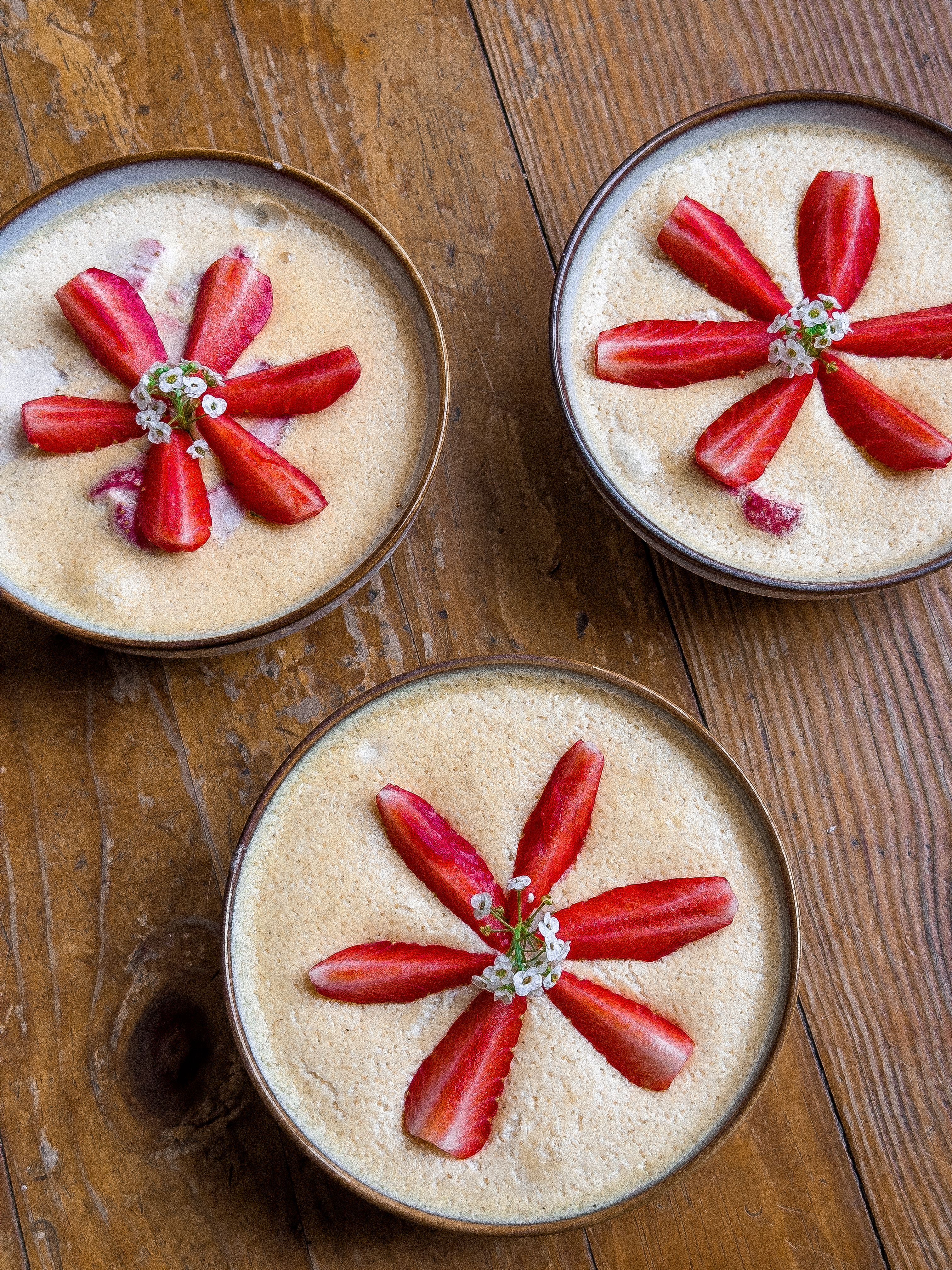
Photo: Laura Decramer / Pexels
The diets react (see scores below)
Common Ingredients
- egg yolks
- sugar
- marsala wine
Specific recipes may vary.
Incompatible with 9 of 11 diets
Diet Ratings
Zabaglione is fundamentally incompatible with ketogenic principles. The dish is built around sugar as a core structural ingredient — typically 1 tablespoon of sugar per egg yolk — contributing significant net carbs per serving. Marsala wine, a fortified wine, adds additional sugar and carbohydrates. A standard serving easily delivers 20-30g of net carbs, which alone can exceed an entire day's keto carb allowance. While egg yolks themselves are keto-friendly and provide healthy fats, the sugar and Marsala wine make the traditional preparation a clear avoid. No meaningful keto substitution can be made without fundamentally changing the dish.
Zabaglione is fundamentally built on egg yolks as its primary and defining ingredient — a classic Italian custard dessert whisked with sugar and Marsala wine. Egg yolks are unambiguously an animal product, making this dish entirely incompatible with a vegan diet. There is no plant-based version of traditional zabaglione; any vegan adaptation would require replacing the egg yolks entirely (e.g., with aquafaba or silken tofu) and would constitute a different dish by name and composition. All three listed ingredients must be assessed: egg yolks are non-vegan, sugar is typically vegan (though some processed white sugars use bone char filtration, this is a secondary concern), and Marsala wine is generally vegan. However, the presence of egg yolks alone is sufficient to render this dish a clear avoid.
Zabaglione is a classic Italian custard made from egg yolks, sugar, and Marsala wine. While egg yolks are fully paleo-approved, the other two ingredients are clear paleo violations. Refined sugar is explicitly excluded from the paleo diet as a processed, modern food with no place in a hunter-gatherer diet. Marsala wine, while alcohol is sometimes debated in paleo circles, is a fortified wine with added brandy spirits and is significantly more processed than simple fermented beverages — making it a poor candidate even for the lenient paleo alcohol debate. The combination of refined sugar and a fortified, processed alcohol in a dessert context makes this dish firmly non-paleo. There is no meaningful version of this dish that can be made paleo-compliant without fundamentally altering its character.
Zabaglione is a traditional Italian dessert made from egg yolks, sugar, and Marsala wine. While eggs are acceptable in moderation on the Mediterranean diet, this dish is problematic primarily due to its significant added sugar content and the fact that it is essentially a sweet dessert served as a snack. Added sugars are explicitly minimized in the Mediterranean diet. The combination of high sugar with egg yolks (high saturated fat) and alcohol, consumed as a standalone snack rather than an occasional dessert, makes this a poor fit. Marsala wine adds some alcohol, which is debated, but the sugar load is the primary concern. As an occasional small dessert at a meal it might score slightly higher, but as a snack it contradicts core Mediterranean principles.
Some traditional Mediterranean diet frameworks acknowledge that small portions of homemade sweets using whole ingredients like eggs and wine are culturally embedded in Italian cuisine and acceptable as rare treats. The PREDIMED study populations from Mediterranean regions did consume traditional sweets occasionally, and zabaglione made at home without excessive sugar could be seen as preferable to ultra-processed alternatives.
Zabaglione is fundamentally incompatible with the carnivore diet. While egg yolks are a carnivore-approved ingredient, the dish requires sugar (a plant-derived sweetener explicitly excluded from all carnivore protocols) and Marsala wine (a plant-derived, fermented grape product). These two non-animal ingredients are not edge cases or community debates — they are categorically excluded from every tier of carnivore eating, including the most lenient 'animal-based' approaches. The egg yolks alone cannot redeem a dish where the majority of ingredients are plant-derived or processed sugars. This is not a carnivore food in any recognized framework.
Zabaglione contains two clearly excluded ingredients: sugar (an added sugar, explicitly banned on Whole30) and Marsala wine (alcohol, explicitly banned on Whole30). Egg yolks alone are compliant, but the other two core ingredients make this dish entirely incompatible with the program. There is no compliant version of traditional zabaglione, as both sugar and alcohol are structural to the recipe.
Zabaglione is made from egg yolks, sugar, and Marsala wine. Egg yolks are low-FODMAP and safe. Plain sugar (sucrose) is low-FODMAP. The key variable is Marsala wine: alcohol itself is not a FODMAP, but Marsala is a fortified wine and may contain residual sugars including fructose. Monash University has tested some wines and notes that most dry wines are low-FODMAP in standard servings (150ml), but sweet or fortified wines like Marsala can contain higher levels of fructose and polyols depending on the sweetness level. A typical zabaglione serving uses a moderate amount of Marsala (roughly 2-4 tablespoons per serving), which is less than a full glass, reducing risk. However, sweet Marsala (dolce) in particular may contribute excess fructose at recipe quantities. The dish overall is relatively low in high-FODMAP ingredients, but the Marsala wine introduces meaningful uncertainty, particularly if a sweet variety is used or portion sizes are generous.
Monash University has not specifically tested Marsala wine; dry Marsala is likely lower in residual sugars and more tolerable, while sweet Marsala could push fructose levels into high-FODMAP territory. Clinical FODMAP practitioners often advise caution with fortified and sweet wines during the strict elimination phase due to unpredictable fructose content.
Zabaglione is made exclusively from egg yolks, sugar, and Marsala wine — none of which are DASH-emphasized foods. Egg yolks are high in cholesterol and saturated fat; DASH guidelines historically limited dietary cholesterol and continue to emphasize lean proteins over yolk-heavy preparations. Sugar is a primary ingredient, contributing added sugars that DASH explicitly limits. Marsala wine adds alcohol and additional sugar. The dish provides no meaningful fiber, potassium, calcium, or magnesium — the key DASH nutrients — and offers no vegetables, whole grains, or low-fat dairy. As a snack, it competes directly with DASH-preferred options like fruits, vegetables, or low-fat dairy. The combination of high added sugar, high cholesterol from multiple egg yolks, and alcohol makes this a poor fit for the DASH dietary pattern.
NIH DASH guidelines do not explicitly address zabaglione, but its components (added sugar, egg yolks, alcohol) each individually conflict with DASH principles. An updated clinical interpretation might allow a very small occasional portion given the 2020-2025 Dietary Guidelines' removal of a strict cholesterol cap, but the high added sugar content remains a clear DASH concern regardless of the evolving egg debate.
Zabaglione is a poor fit for the Zone Diet across multiple dimensions. The dish is made almost entirely of egg yolks, sugar, and Marsala wine — a combination that is high in saturated fat (egg yolks), high-glycemic added sugar, and alcohol-derived calories from the wine. There is virtually no lean protein (egg yolks have fat-to-protein ratios unfavorable for Zone blocks), no low-glycemic carbohydrates, and no monounsaturated fat. The macronutrient ratio is essentially the opposite of Zone targets: heavy on fat (mostly saturated), high in simple sugars and alcohol sugars, and low in quality protein. As a snack, it provides no meaningful Zone balance — it cannot anchor a protein block (egg whites are the Zone-friendly egg component, not yolks in quantity), and its carbohydrates come entirely from added sugar and alcohol, both of which Sears explicitly discourages. There is no realistic portioning strategy that would make zabaglione a Zone-compatible snack without fundamentally altering the recipe.
Zabaglione is a classic Italian dessert made from egg yolks, sugar, and Marsala wine. From an anti-inflammatory perspective, the profile is decidedly mixed. Egg yolks contain some beneficial nutrients (choline, selenium, fat-soluble antioxidants like lutein and zeaxanthin) but also arachidonic acid, which some researchers flag as mildly pro-inflammatory. The added sugar is the clearest inflammatory concern — refined sugar drives spikes in blood glucose and can elevate CRP and other inflammatory markers, especially when consumed regularly. The Marsala wine occupies an ambiguous space: it is a fortified wine (higher alcohol content than table wine) with some polyphenols, but the anti-inflammatory case for alcohol is weakening with newer research, and fortified wines fall outside the moderate red wine allowance in Dr. Weil's pyramid. The dish is not egregiously inflammatory — it contains no trans fats, seed oils, or processed additives — but its combination of added sugar and fortified alcohol in a snack context makes it a 'caution' food that is best treated as an occasional indulgence rather than a regular part of an anti-inflammatory eating pattern.
Some anti-inflammatory nutrition advocates (including those influenced by traditional Mediterranean diet research) might view a small occasional zabaglione more leniently, citing eggs' nutrient density and the polyphenol content of wine; on the other side, stricter anti-inflammatory and autoimmune-focused protocols (AIP, elimination diets) would flag egg yolks' arachidonic acid and any alcohol as pro-inflammatory, potentially rating this dish closer to 'avoid.'
Zabaglione is a poor fit for GLP-1 patients on nearly every relevant criterion. It is made from egg yolks, sugar, and Marsala wine, and the sugar content is high with negligible fiber. While egg yolks do provide some protein, the yolk-only preparation means the dish is high in saturated fat and cholesterol relative to its protein yield, and the protein per serving is modest (roughly 3-5g per typical portion). The sugar adds empty calories in a context where every calorie must count nutritionally. As a snack, it offers no fiber, high sugar, meaningful alcohol, and high saturated fat — hitting multiple 'avoid' triggers simultaneously. Digestibility is also a concern given the richness and fat content, which can worsen nausea and reflux in GLP-1 patients.
*See how scores were generated at our methodology page.
Nutritional profile
Six traits that cut across every diet.
Fiber & Plants
How much whole-plant food and fiber it delivers.
Healthy Fats
The quality of its fats (unsaturated, omega-3).
Whole / Unprocessed
How close it is to its natural, unprocessed form.
Gut Gentle
How easy it is on digestion (low FODMAP, few irritants).
Low Glycemic
How little it spikes your blood sugar.
Protein Density
How much protein it packs per calorie.
Controversy Index
Higher controversy = more disagreement between diets.
Diet-Specific Tips
 Low-FODMAP — 4/10
View tips
- Egg yolks are low-FODMAP and well-tolerated
- Plain sugar (sucrose) is low-FODMAP
- Marsala is a fortified wine — dry varieties are likely safer than sweet (dolce)
- Sweet Marsala may contain excess fructose, a key FODMAP
- Alcohol in moderate amounts is generally tolerated on low-FODMAP, but fortified wines warrant caution
- Monash University has not specifically tested Marsala wine
- Serving size of Marsala per portion is relatively small (2-4 tbsp), reducing overall FODMAP load
 Anti-Inflammatory — 4/10
View tips
- Added refined sugar is a clear pro-inflammatory ingredient elevating CRP and inflammatory markers
- Marsala is a fortified wine with higher alcohol content than table wine, falling outside the moderate red wine allowance
- Egg yolks contain arachidonic acid, which some researchers link to mild inflammatory signaling
- Egg yolks also provide beneficial choline, selenium, and carotenoids (lutein, zeaxanthin), partially offsetting concerns
- No trans fats, seed oils, or artificial additives present
- Occasional consumption as a treat is far less concerning than regular intake